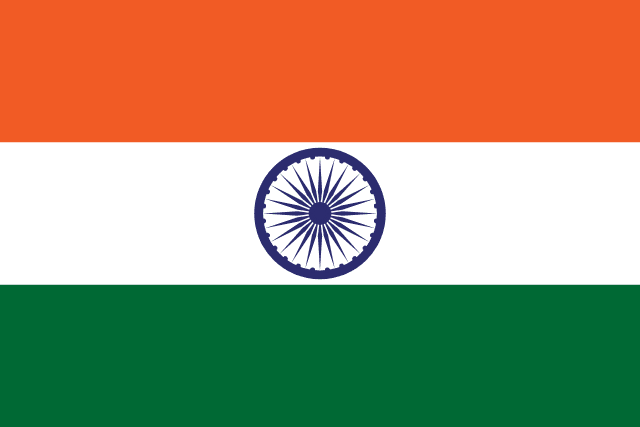
India
Asia

1,440,000,000
16:29 UTC+5:30
+91
Location
Geography
Economy
Main exports
India's leading export commodities and products.
Subscribe to Live Data for live spot prices
Live commodity prices on every nation's exports — $100 AUD/year.
Tap any export to learn more. Spot prices in USD only for Live Data subscribers.
Main imports
India's leading import commodities and products.
Tap any import to learn more.
Military
Historical Timeline
65000 BCE
Arrival of First Inhabitants in India
Genetic and archaeological evidence suggests that the earliest ancestors of modern Indigenous South Asians arrived in the Indian subcontinent around this time. These groups settled across the region, laying the foundations for the diverse population groups present today.
3300 BCE
Indus Valley Civilization
The Indus Valley Civilization emerged as one of the world's earliest major urban societies. Known for its sophisticated city planning, drainage systems, and standardized weights, it flourished across parts of modern-day India and Pakistan.
322 BCE
Founding of the Mauryan Empire
Chandragupta Maurya established the Mauryan Empire, the first empire to unify most of the Indian subcontinent. Under his grandson Ashoka, the empire expanded significantly and promoted the spread of Buddhism across Asia.
320
Establishment of the Gupta Empire
Often regarded as the Golden Age of India, this period saw significant advancements in science, mathematics, literature, and art. Hindu culture and philosophy flourished under the patronage of the Gupta rulers.
1526
Founding of the Mughal Empire
Babur defeated the Sultan of Delhi at the First Battle of Panipat, establishing the Mughal Empire. The empire later expanded to encompass most of South Asia, fostering a unique blend of Persian and Indian cultures.
1857
Indian Rebellion Against British Rule
A widespread uprising against the British East India Company began in 1857, leading to a major transformation in Indian administration. This event triggered the end of company rule and brought India under the direct governance of the British Crown.
1947
Independence and Partition of India
India gained its independence from British colonial rule on August 15, 1947. The event was accompanied by the traumatic Partition of British India into the sovereign nations of India and Pakistan.
1950
Adoption of the Indian Constitution
On January 26, 1950, India formally adopted its constitution, establishing the country as a sovereign, democratic republic. The document established the fundamental rights and institutional framework for the new nation.
1991
Economic Liberalization Reforms
Facing a severe balance-of-payments crisis, India initiated major economic reforms to dismantle the 'License Raj' system. These policies opened the Indian economy to global markets, leading to rapid economic growth and urbanization.
2014
Election of the BJP-led Government
The Bharatiya Janata Party secured a clear majority in the general election, marking a significant shift in Indian political discourse. This victory signaled a transition toward nationalist policies and a focus on centralized development programs.
2023
Chandrayaan-3 Moon Landing
The Indian Space Research Organisation successfully landed the Chandrayaan-3 mission near the lunar south pole. This milestone made India the fourth nation to land on the Moon and the first to reach the lunar south pole region.
2024
General Election for the 18th Lok Sabha
India conducted the world's largest democratic election to form the 18th Lok Sabha. The results saw the return of the incumbent administration to power, reflecting continued political trends in the national landscape.
National Holidays
Commemorates the date on which the Constitution of India came into effect in 1950, replacing the Government of India Act as the governing document.
Celebrates India's independence from the United Kingdom on August 15, 1947, marking the end of British colonial rule.
Marks the birthday of Mahatma Gandhi, the leader of India's non-violent independence movement, and is celebrated as a national day of remembrance.
Language
Counting to 10
1
1
= 10 (n = 0)
World Dictionary
Discover and translate any word into all supported languages.
The multilingual Dictionary is a Nations Pro feature.
Upgrade to Pro