
Russia
Russian Federation
Europe
143,118,856
20:48 UTC+3
+7
.ru
Mount Elbrus
5,642 m · 18,510 ft
Caspian Sea
-28 m · -92 ft
12,938,356
Moscow · 2026
12,938,356
Moscow · 2026
Location
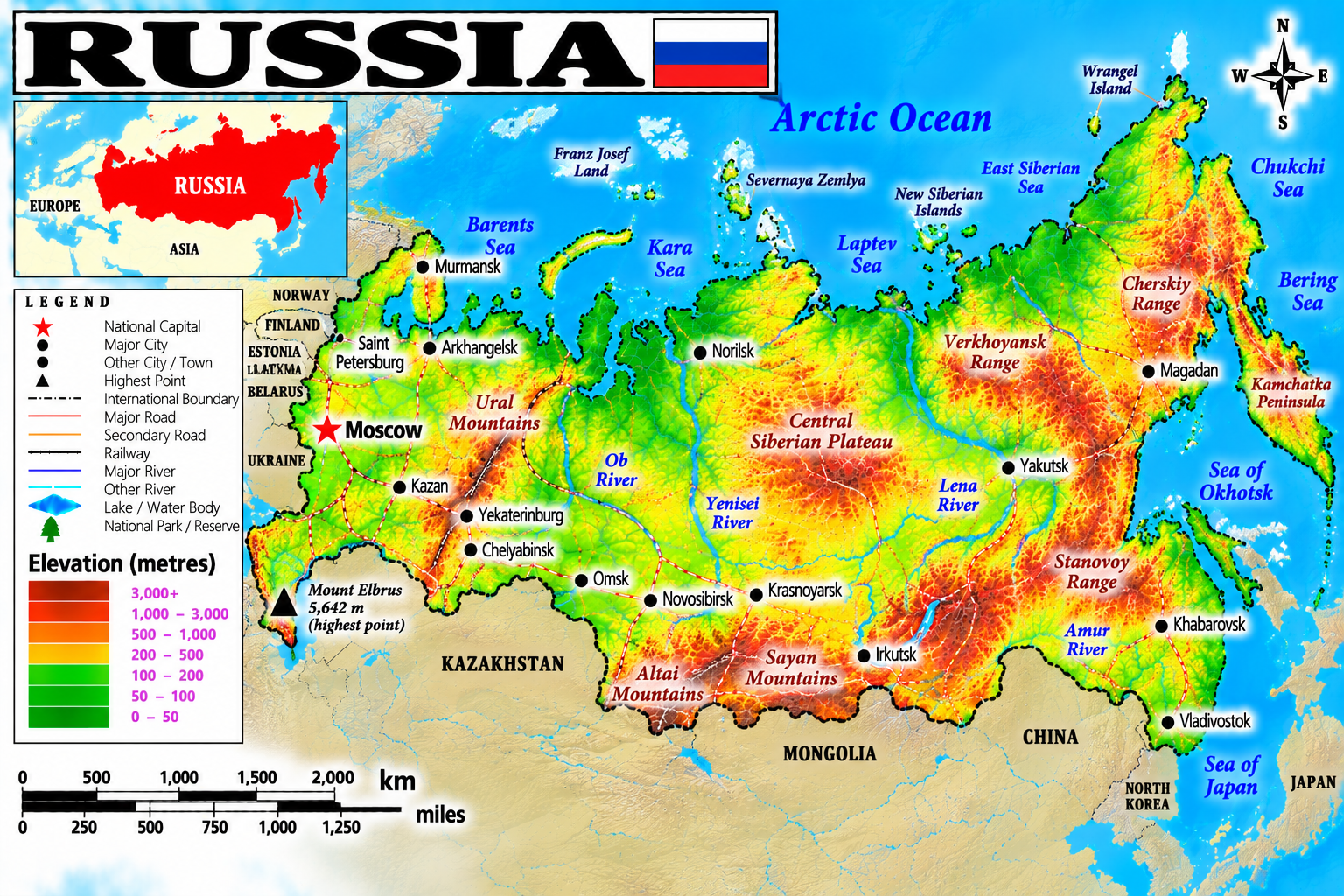
Russia — Detailed Physical Map
The Ural, Altai and Sayan mountains, Mount Elbrus, the Ob, Yenisei and Lena rivers, Siberia, the Arctic coast, major cities and the capital Moscow
Tourist Attractions


As the historic heart of Moscow, this iconic square is surrounded by significant sites including the Kremlin and the colorful domes of St. Basil's Cathedral.
It is the most recognizable symbol of Russia's rich history and architectural grandeur.


Housed within the magnificent Winter Palace, this is one of the world's largest and oldest museums, containing over three million items of art and culture.
The opulent interiors of the former imperial residence are just as breathtaking as the vast art collection.

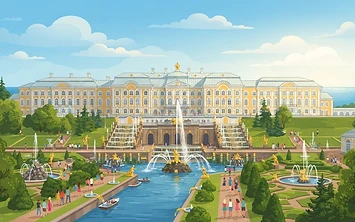
Often referred to as the 'Russian Versailles,' this grand palace-and-park complex was the former summer residence of Peter the Great.
The complex is world-famous for its elaborate system of fountains and meticulously designed gardens.


Recognized as the deepest and oldest freshwater lake in the world, it is a site of immense natural beauty and ecological significance.
The lake's crystal-clear waters and dramatic surrounding landscapes offer a unique experience for nature lovers.

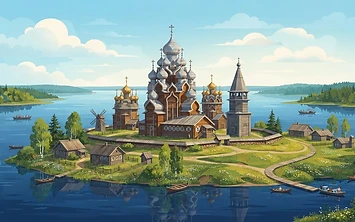
This UNESCO World Heritage site is an open-air museum famous for its stunning collection of 18th-century wooden architecture, including the 22-domed Church of the Transfiguration.
The intricate wooden structures, built without the use of nails, showcase the incredible craftsmanship of early Russian carpenters.


A key city in the 'Golden Ring,' Suzdal is a living museum of medieval Russian history filled with ancient kremlins, monasteries, and traditional wooden houses.
The entire town offers a peaceful, authentic glimpse into Russia's past with its perfectly preserved historic skyline.
Geography
Nature
Mount Elbrus
5,642 m / 18,510 ft
49.8% of land
≈ 8,514,925 km² of forest
FAO / World Bank, forest area (% of land area)
Explore the Nature Atlas4,400 km2,734 mi
Flows entirely within Russian territory to the Arctic Ocean.
3,650 km2,268 mi
Forms the largest estuary in the world at the Ob Gulf.
3,531 km2,194 mi
Recognized as the longest river in Europe.
371,000 km²143,244 sq mi · 1,025 m deep
Recognized as the largest inland body of water globally.
31,722 km²12,248 sq mi · 1,642 m deep
Holds the record for being the deepest lake on Earth.
17,700 km²6,834 sq mi · 230 m deep
Largest lake located entirely within the European continent.
482 m1,581 ft
Situated in the Putorana Plateau and flows only during the summer season.
328 m1,076 ft
Located in the remote Sayan Mountains region of Siberia.
River lengths are whole-river figures, including any section beyond Russia. Researched reference figures. Tap any name for where its name comes from and a Google Maps link.
Major Cities
- 1Capital
Moskva
13,149,8032026
MapServes as the political, economic, and cultural heart of Russia, featuring the iconic Red Square and Kremlin.
- 2
Sankt-Peterburg
5,597,7642026
MapActs as the nation's cultural capital, renowned for the Hermitage Museum and its historic imperial palace architecture.
- 3
Novosibirskaya Oblast’
1,633,5952026
MapFunctions as the major industrial and scientific hub of Siberia, housing the prominent academic center Akademgorodok.
- 4
Sverdlovskaya Oblast’
1,539,3712026
MapStands as a vital metallurgical and engineering center located strategically along the Ural Mountains divide.
- 5
Tatarstan
1,314,6852026
MapBlends Tatar and Russian cultures while featuring the architectural beauty of the historic Kazan Kremlin.
- 6
Krasnoyarskiy Kray
1,196,9132026
MapProvides a massive hub for aluminum production and hydroelectric power within the vast Siberian landscape.
- 7
Nizhegorodskaya Oblast’
1,191,5432026
MapHosts a significant historic kremlin and serves as a major center for Russia's automotive and defense industries.
- 8
Chelyabinskaya Oblast’
1,177,0582026
MapOperates as a massive industrial powerhouse specializing in metallurgy and the production of heavy machinery.
- 9
Bashkortostan
1,163,3052026
MapActs as the capital of Bashkortostan and a major center for Russia's petroleum refining and chemical industries.
- 10
Samarskaya Oblast’
1,158,9782026
MapContributes significantly to the aerospace and defense sectors while sitting along the scenic banks of the Volga River.
- 11
Rostovskaya Oblast’
1,135,9682026
MapFunctions as a crucial agricultural and transportation gateway situated near the Sea of Azov in southern Russia.
- 12
Omskaya Oblast’
1,104,4852026
MapMaintains a vital position in the Siberian transportation network and serves as a key petroleum refining center.
City populations are the latest official, UN or national-statistics estimates (2026–2026) compounded to 2026 at -0.2% a year (the nation's annual population growth rate); figures without a published update come from the open cities database (2020-era estimates) and are projected the same way.
Economy
Main exports
Russia's leading export commodities and products.
Tap any export to learn more. Spot prices in USD only for Live Data subscribers.
Main imports
Russia's leading import commodities and products.
Tap any import to learn more.
Military
Historical Timeline
30000 BCE
Early Upper Paleolithic human settlement
Evidence from sites like Kostenki indicates the presence of early humans in the Russian Plain during the Upper Paleolithic period. These ancient populations laid the foundation for subsequent human occupation in the region.
862
Foundation of Kievan Rus
According to the Primary Chronicle, the Varangian prince Rurik established his rule in Novgorod, marking the traditional beginning of the Russian state. This entity became a powerful political and cultural center in Eastern Europe.
988
Christianization of Kievan Rus
Vladimir the Great adopted Orthodox Christianity as the state religion, aligning the region with Byzantine culture. This decision fundamentally shaped the cultural, religious, and political development of Russia.
1240
Mongol Invasion and the Tatar Yoke
The Siege of Kiev marked the final collapse of Kievan Rus under the Golden Horde, leading to centuries of Mongol dominance. This period shifted the political focus toward the northeast, eventually facilitating the rise of Moscow.
1547
Ivan IV Crowned First Tsar of Russia
Ivan IV, also known as Ivan the Terrible, was crowned the first Tsar of all Russia, centralizing power and expanding the state's territory. His reign significantly strengthened the autocratic nature of the Russian monarchy.
1721
Proclamation of the Russian Empire
Following the victory in the Great Northern War, Peter the Great declared Russia an empire and implemented sweeping reforms. These changes modernized the military, administration, and society along Western European lines.
1861
Emancipation of the Serfs
Tsar Alexander II issued the Emancipation Manifesto, which abolished serfdom throughout the Russian Empire. This major social reform allowed peasants to own property and marry without consent, though it caused long-term economic instability.
1917
The Russian Revolution
The October Revolution led to the collapse of the Russian Provisional Government and the rise of the Bolsheviks. This event initiated the transformation of the country into the world's first socialist state.
1922
Formation of the Soviet Union
The Treaty on the Creation of the USSR was signed, uniting various Soviet republics into a single federal state. The Soviet Union went on to become a global superpower during the 20th century.
1961
Yuri Gagarin First Human in Space
Soviet cosmonaut Yuri Gagarin completed the first crewed spaceflight, orbiting the Earth in Vostok 1. This milestone marked a significant achievement in the Cold War-era Space Race.
1991
Dissolution of the Soviet Union
The Soviet Union officially ceased to exist following political instability and the independence of its constituent republics. The Russian Federation emerged as the legal successor state to the USSR.
2022
Invasion of Ukraine
Russia launched a full-scale invasion of Ukraine, marking a significant escalation in the ongoing Russo-Ukrainian War. The conflict resulted in widespread international sanctions and major shifts in global geopolitical alignments.
2024
Vladimir Putin wins presidential election
Vladimir Putin secured a new six-year term as president in a March 2024 election, receiving approximately 87% of the vote. The election took place without the presence of OSCE observers.
2024
Inauguration of Vladimir Putin
Vladimir Putin was officially inaugurated as President of Russia on May 7, 2024, at a ceremony held in the Kremlin. This event marked the beginning of his new term in office.
2026
World Aquatics lifts restrictions on Russian athletes
In April 2026, World Aquatics removed restrictions on Russian swimmers, divers, and water polo players, allowing them to compete with their national flag and anthem.
National Anthem
Государственный гимн Российской Федерации
Sergey Mikhalkov
Alexander Alexandrov
2000
Россия — священная наша держава, Россия — любимая наша страна. Могучая воля, великая слава — Твоё достоянье на все времена! Славься, Отечество наше свободное, Братских народов союз вековой, Предками данная мудрость народная! Славься, страна! Мы гордимся тобой! От южных морей до полярного края Раскинулись наши леса и поля. Одна ты на свете! Одна ты такая — Хранимая Богом родная земля! Славься, Отечество наше свободное, Братских народов союз вековой, Предками данная мудрость народная! Славься, страна! Мы гордимся тобой!
The music of the Russian anthem was composed by Alexander Alexandrov in 1938 for the 'Hymn of the Bolshevik Party' and was later adopted as the Soviet national anthem in 1944. After the dissolution of the Soviet Union in 1991, Russia used the 'Patriotic Song' by Mikhail Glinka, which lacked official lyrics. In 2000, President Vladimir Putin oversaw the restoration of the Alexandrov melody for the national anthem to provide a sense of continuity. Sergey Mikhalkov, who had co-authored the original 1944 Soviet lyrics, was commissioned to write new words that removed references to Lenin and Stalin. The anthem was officially adopted by federal law in December 2000. It remains a central feature of Russian state ceremonies, diplomatic events, and major national celebrations.
National Holidays
This holiday marks the beginning of the calendar year according to the Gregorian calendar. It is traditionally the most celebrated public holiday in Russia, often followed by a week-long public vacation period.
Originally established to honor the Red Army, this day now serves as a celebration of all men, particularly those who have served or are currently serving in the Russian Armed Forces.
This day commemorates the struggle for women's rights and serves as a cultural celebration of women across the country. It is marked by the tradition of giving flowers and gifts to female friends, colleagues, and family members.
Historically rooted in the international workers' movement, this day is now celebrated as a spring festival in Russia. It is typically marked by public parades and demonstrations organized by labor unions and political parties.
This day commemorates the Soviet Union's victory over Nazi Germany in the Great Patriotic War of 1941–1945. It is marked by military parades, memorial services, and tributes to war veterans.
This holiday marks the adoption of the Declaration of State Sovereignty of the Russian Soviet Federative Socialist Republic in 1990. It is considered the national day of the Russian Federation.
This holiday commemorates the popular uprising that expelled Polish-Lithuanian forces from Moscow in 1612. It symbolizes the historical unity of the Russian people in overcoming periods of national crisis.
Good News Today
Russia and Ukraine agree to large-scale prisoner exchange following US-mediated talks
Following diplomatic negotiations in Abu Dhabi, Russia and Ukraine have reached an agreement for a significant humanitarian release of prisoners of war. This development is being viewed as a positive step toward de-escalation and humanitarian cooperation between the two nations.
Fun Facts
The World's Longest Railway Route
The Trans-Siberian Railway spans a massive 5,772 miles across eight different time zones. It is the longest railway line in the world, connecting Moscow to Vladivostok.
Museums With Resident Cats
The Hermitage Museum in St. Petersburg officially employs dozens of cats to protect its priceless art collection from rodents. These cats have their own press secretary and are celebrated annually.
Birthplace Of Space Exploration
Russia launched Sputnik 1 in 1957, becoming the first nation to successfully place an artificial satellite into orbit. This achievement ignited the global Space Race.
The World's Deepest Freshwater Lake
Lake Baikal contains about 20 percent of the world's unfrozen surface freshwater. It is so deep and clear that you can sometimes see over 130 feet down into its icy depths.
A Nation Of Chess Masters
Russia has produced more world chess champions than any other nation in history. The sport is deeply ingrained in the culture, with many schools offering specialized chess training for children.
The Elaborate Tea Tradition
The samovar is a traditional Russian metal container used to heat water for tea, often serving as the centerpiece of social gatherings. It is frequently accompanied by a variety of jams, honey, and pastries.
Subway Commuting Stray Dogs
Stray dogs in Moscow have learned to navigate the complex subway system to commute from the outskirts to the city center. They use the trains to find food and return home in the evening.
The World's Largest Fortress
The Moscow Kremlin is the largest active fortress in Europe, covering over 68 acres of land. It houses five palaces, four cathedrals, and the famous Tsar Bell.
The Legendary Bolshoi Ballet
The Bolshoi Theatre is one of the world's most prestigious ballet and opera companies, founded in 1776. Its stage has hosted some of the most influential dancers in history.
Honey Is A National Staple
Russia is one of the largest honey-producing countries in the world, with a unique tradition of bee farming in the Bashkortostan region. Local varieties of linden honey are particularly prized for their flavor.
Chuckies Trivia Quiz
Chuckies Trivia Quiz
Fifteen questions on Russia — five easy, five medium, five hard. How far can you get?
Sports & Live Events
Language
Counting to 10
1
1
= 10 (n = 0)
World Dictionary
Discover and translate any word into all supported languages.