
South Korea
Republic of Korea
Asia
51,641,933
22:15 UTC+9
+82
.kr
Hallasan
1,950 m · 6,398 ft
Sea of Japan
0 m · 0 ft
25,297,620
Seoul · 2026
25,297,620
Seoul · 2026
Location
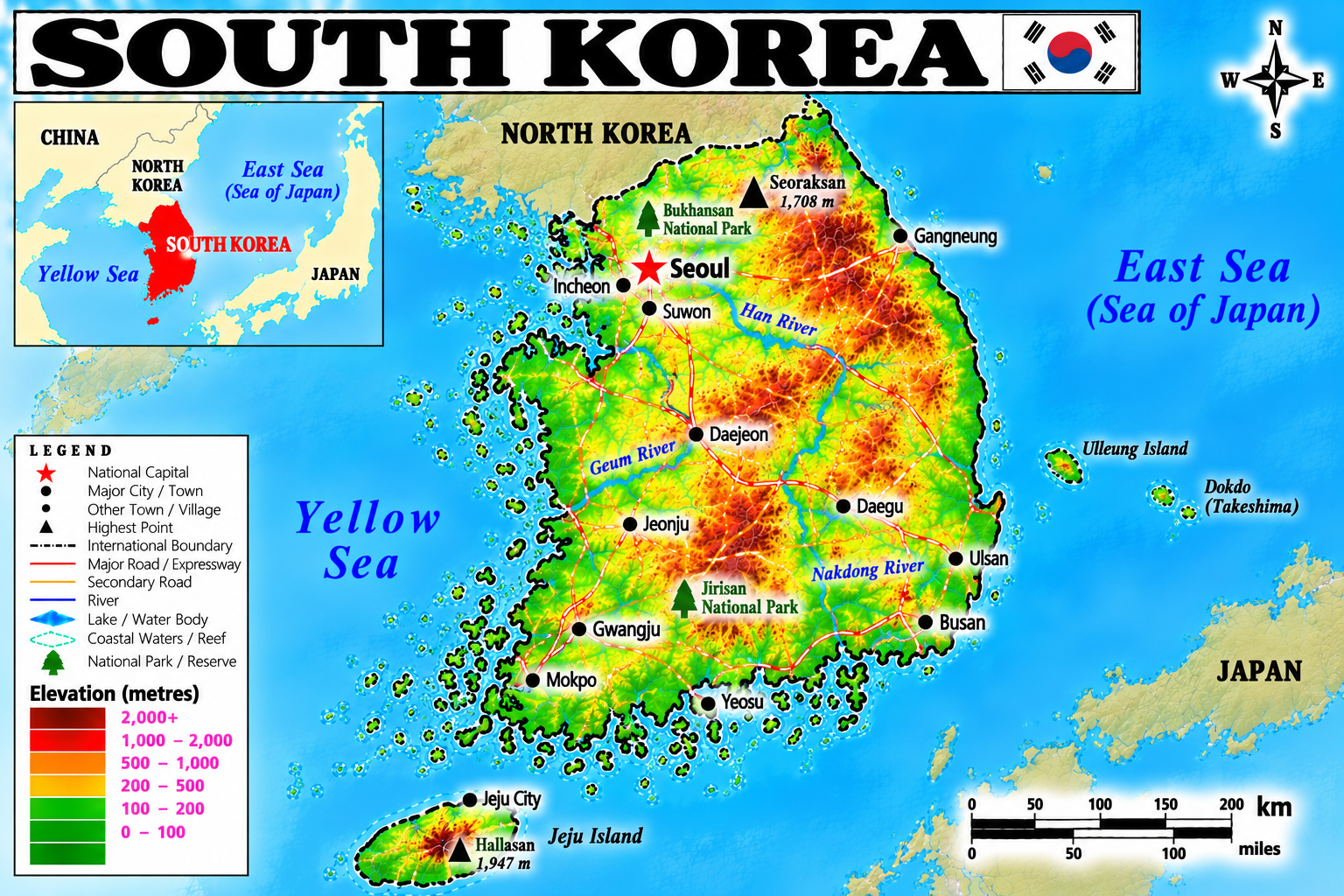
South Korea — Detailed Physical Map
The Taebaek range and Seoraksan, Han and Nakdong rivers, Jeju Island and Hallasan, Ulleung and Dokdo, the Yellow Sea and East Sea coasts, major cities and the capital Seoul
Tourist Attractions
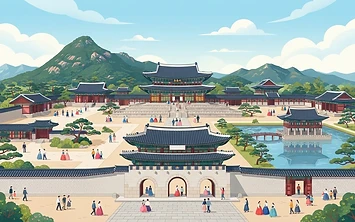
Built in 1395, this is the largest and most iconic of the five grand palaces from the Joseon Dynasty. It serves as a stunning symbol of Korea's royal history and architectural heritage.
Witness the colorful Changing of the Guard ceremony held at the main gate.
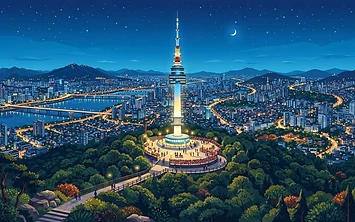
Located on Namsan Mountain, this communication and observation tower offers panoramic views of the entire capital city. It is a beloved landmark that becomes especially magical when illuminated at night.
Take the cable car up the mountain for a breathtaking sunset view of the Seoul skyline.


Often called the Hawaii of South Korea, this volcanic island is a UNESCO World Natural Heritage site known for its dramatic landscapes, lava tubes, and pristine beaches.
Hike the trails of Hallasan, the dormant shield volcano that stands as South Korea's highest peak.

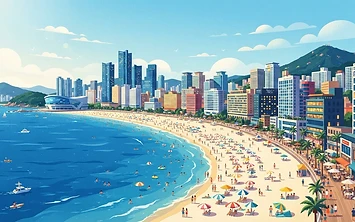
This is South Korea's most famous urban beach, featuring a long crescent of white sand backed by luxury hotels and vibrant seafood restaurants. It is the premier coastal destination for both locals and international travelers.
Enjoy the lively atmosphere and modern skyline views that make this beach a unique urban-coastal experience.

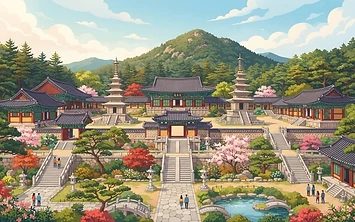
A masterpiece of Buddhist art and architecture, this temple dates back to the Silla Kingdom and is a registered UNESCO World Heritage site. It is surrounded by beautiful gardens and stone structures that reflect ancient Korean craftsmanship.
Visit the nearby Seokguram Grotto to see the famous stone Buddha statue overlooking the sea.

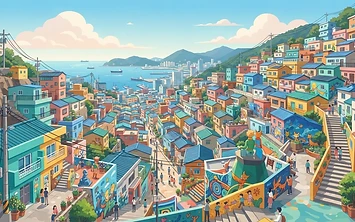
Often referred to as the Santorini of Korea, this hillside village is famous for its maze of narrow alleyways, brightly painted houses, and vibrant street art murals. It was transformed from a former shantytown into a thriving artistic community.
Collect stamps at various art installations throughout the village while exploring the colorful, winding paths.
Geography
Nature
Hallasan
1,950 m / 6,398 ft
63.5% of land
≈ 63,633 km² of forest
FAO / World Bank, forest area (% of land area)
Explore the Nature Atlas506 km314 mi
Flows south through the Yeongnam region into the Korea Strait.
494 km307 mi
Provides the primary water source for the Seoul Metropolitan Area.
397 km247 mi
Rises in the Jangsu area and empties into the Yellow Sea.
70 km²27 sq mi · 120 m deep
Created by the massive Soyang Multi-purpose Dam in Chuncheon.
97 km²37 sq mi · 97 m deep
Formed by the construction of the Chungju Dam on the Namhan River.
51 km²20 sq mi · 124 m deep
Constructed in 1976 as a multi-purpose dam on the Nakdong River.
23 m75 ft
The only waterfall in Asia that falls directly into the ocean.
22 m72 ft
According to legend, seven nymphs descended from heaven to bathe here.
River lengths are whole-river figures, including any section beyond South Korea. Researched reference figures. Tap any name for where its name comes from and a Google Maps link.
Major Cities
- 1Capital
Seoul
9,217,9132026
MapServes as the political, cultural, and economic capital of South Korea and hosts historic palaces like Gyeongbokgung.
- 2
Busan
3,233,1502026
MapFunctions as the nation's largest port city, famous for Haeundae Beach and its bustling international film festival.
- 3
Incheon
3,012,8412026
MapHosts a major international airport and serves as a vital transportation and logistics hub for the country.
- 4
Daegu
2,345,9152026
MapStands as a major center for the textile and fashion industries within the North Gyeongsang province.
- 5
Gwangju
1,438,4572026
MapRepresents a historic symbol of South Korea's democratic movement and serves as the primary hub for the Honam region.
- 6
Daejeon
1,430,6212026
MapActs as the country's center for scientific research and technology, home to the Daedeok Innopolis research cluster.
- 7
Gyeonggi
1,229,4322026
MapFeatures the historic Hwaseong Fortress, a UNESCO World Heritage site and a significant landmark from the Joseon Dynasty.
- 8
Gyeonggi
1,116,1162026
MapHouses the massive KINTEX exhibition center and provides a significant residential base for the greater Seoul metropolitan area.
- 9
Ulsan
1,099,0922026
MapOperates as the industrial powerhouse of South Korea, serving as the home base for major shipbuilding and automotive plants.
- 10
Gyeonggi
1,072,5002026
MapExists as a rural-urban district known for its historical background in the Gimpo area of Gyeonggi-do.
- 11
Gyeongnam
994,6752026
MapServes as a prominent manufacturing hub, specializing in heavy machinery and defense industry production.
- 12
Gyeonggi
890,9392026
MapContains the prominent Bundang new town district and functions as a major satellite city for Seoul.
City populations are the latest official, UN or national-statistics estimates (2026–2026) compounded to 2026 at -0.06% a year (the nation's annual population growth rate); figures without a published update come from the open cities database (2020-era estimates) and are projected the same way.
Economy
Main exports
South Korea's leading export commodities and products.
Tap any export to learn more. Spot prices in USD only for Live Data subscribers.
Main imports
South Korea's leading import commodities and products.
Tap any import to learn more.
Military
Historical Timeline
Creating artwork for each milestone…
8000 BCE
Arrival of the Palaeolithic Inhabitants
Evidence of human occupation on the Korean Peninsula dates back to the Palaeolithic era, with early settlers arriving from the Asian mainland. These groups established the foundations for subsequent cultural and societal development in the region.
2333 BCE
Legendary Founding of Gojoseon
According to tradition, Dangun Wanggeom founded Gojoseon, the first Korean kingdom. This event is considered the cultural and historical starting point of the Korean nation.
668
Unification of the Three Kingdoms
The Silla Kingdom, supported by the Tang dynasty, unified the Three Kingdoms of Korea for the first time. This unification created a centralized state that fostered a distinct and cohesive Korean cultural identity.
1443
Creation of the Hangul Alphabet
King Sejong the Great commissioned the creation of Hangul, a phonetic writing system designed to increase literacy among the common people. It remains a cornerstone of Korean cultural heritage.
1948
Establishment of the Republic of Korea
Following the liberation from Japanese colonial rule and the subsequent division of the peninsula, the Republic of Korea was formally proclaimed. Syngman Rhee was inaugurated as the nation's first president.
1950
Outbreak of the Korean War
North Korean forces invaded South Korea, initiating a brutal three-year conflict involving international powers. The war ended in 1953 with an armistice that maintained the division of the peninsula.
1962
Commencement of the Five-Year Economic Plans
The government implemented a series of ambitious economic plans that shifted the nation from an agrarian society to an industrial powerhouse. This period is often referred to as the Miracle on the Han River.
1987
June Democratic Struggle
Massive public protests forced the ruling regime to accept direct presidential elections and restore democratic rights. This marked the transition toward the modern democratic political system of South Korea.
2017
Impeachment and Election of Moon Jae-in
Following the peaceful removal of President Park Geun-hye through impeachment, Moon Jae-in was elected president. This highlighted the strength of South Korean civil society and democratic institutions.
2022
Election of President Yoon Suk-yeol
Yoon Suk-yeol was elected as the 20th President of South Korea in one of the closest presidential races in the nation's history. His administration prioritized strengthening the military alliance with the United States.
2024
General Election for the National Assembly
The 22nd legislative election resulted in the main opposition party retaining a significant majority. This election reinforced the current political landscape and legislative challenges facing the administration.
2025
Expansion of Global Cultural Influence
South Korea continued to solidify its status as a major global cultural exporter through the sustained international popularity of its music, cinema, and digital technology. This influence has significantly elevated the nation's soft power on the world stage.
National Anthem
애국가
Unknown
Ahn Eak-tai
1948
동해 물과 백두산이 마르고 닳도록 하느님이 보우하사 우리나라 만세 무궁화 삼천리 화려 강산 대한 사람 대한으로 길이 보전하세 남산 위에 저 소나무 철갑을 두른 듯 바람 서리 불변함은 우리 기상일세 무궁화 삼천리 화려 강산 대한 사람 대한으로 길이 보전하세 가을 하늘 공활한데 높고 구름 없이 밝은 달은 우리 가슴 일편단심일세 무궁화 삼천리 화려 강산 대한 사람 대한으로 길이 보전하세 이 기상과 이 맘으로 충성을 다하여 괴로우나 즐거우나 나라 사랑하세 무궁화 삼천리 화려 강산 대한 사람 대한으로 길이 보전하세
The origins of the lyrics of Aegukga are debated, with authorship potentially belonging to various late 19th-century independence activists. Early versions were sung to the tune of the Scottish folk song Auld Lang Syne before Ahn Eak-tai composed the current melody in 1935. It was officially adopted as the national anthem of the Republic of Korea following the establishment of the government in 1948. While the melody was composed by Ahn during the Japanese colonial period, his subsequent collaboration with the colonial government remains a subject of modern historical scrutiny. The anthem serves as a symbol of national identity and resilience, particularly regarding the struggle for sovereignty. It consists of four verses that share a common refrain praising the Korean landscape and the spirit of its people. The song is played at all formal governmental and national sporting events.
National Holidays
Commemorates the March First Movement in 1919, where peaceful protests were held against the Japanese colonial rule of Korea.
A day dedicated to the happiness and dignity of children, emphasizing the importance of their growth and well-being.
Celebrates the liberation of Korea from 35 years of Japanese colonial rule in 1945 and the establishment of the South Korean government in 1948.
A major harvest festival observed on the 15th day of the 8th lunar month, where families gather to share food and honor their ancestors.
Commemorates the legendary founding of Gojoseon, the first Korean kingdom, by Dangun Wanggeom in 2333 BCE.
Celebrates the invention and proclamation of the Korean alphabet, Hangeul, by King Sejong the Great to increase literacy among his people.
Good News Today
Stranger Anonymously Pays $420 Lunch Tab for 27 Disabled Residents and Caregivers
An anonymous diner paid for a $420 barbecue lunch for a group of 27 disabled residents and caregivers from a community welfare center in Incheon. The generous individual left the restaurant without revealing their identity, leaving the group deeply moved by the random act of kindness.
Fun Facts
World's Highest Spirit Consumption
South Korea consumes more distilled spirits per capita than any other nation in the world, largely driven by the popularity of the rice-based liquor known as soju.
World's Busiest Flight Route
The air route between Seoul Gimpo International Airport and Jeju International Airport is consistently ranked as the busiest passenger air route on the planet.
Men Embrace Skincare Routines
South Korean men spend more money on skincare products per capita than men in any other country, with a massive market dedicated to male grooming.
Unique Age Calculation Tradition
Traditionally, South Koreans were considered one year old at birth and everyone turned a year older on New Year's Day, though the country is currently transitioning to international standards.
Fastest Average Internet Speeds
South Korea consistently maintains some of the fastest average internet connection speeds in the world, supported by a highly dense fiber-optic infrastructure.
Incredibly High Education Enrollment
South Korea boasts one of the highest tertiary education attainment rates in the world, with over 70% of young adults completing university-level education.
Extensive Robot Adoption Rates
South Korea has the highest density of industrial robots in the world, employing more robots per human manufacturing worker than any other nation.
Fermented Kimchi Museum Exists
The country takes its national dish so seriously that there is a dedicated Kimchi Museum in Seoul that traces the history and scientific fermentation process of the side dish.
Unique Valentine's Day Traditions
In South Korea, Valentine's Day involves women giving chocolates to men, while White Day in March involves men returning the favor with gifts.
Global Leader in Shipbuilding
South Korea is home to several of the world's largest shipyards and consistently competes for the top spot in global ship production tonnage.
Chuckies Trivia Quiz
Chuckies Trivia Quiz
Fifteen questions on South Korea — five easy, five medium, five hard. How far can you get?
Sports & Live Events
Language
Counting to 10
1
1
= 10 (n = 0)
World Dictionary
Discover and translate any word into all supported languages.