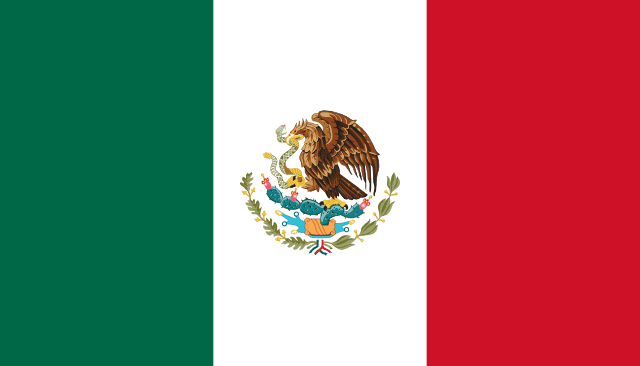
Mexico
North America

129,000,000
07:27 UTC-6
+52
Location
Geography
Economy
Main exports
Mexico's leading export commodities and products.
Subscribe to Live Data for live spot prices
Live commodity prices on every nation's exports — $100 AUD/year.
Tap any export to learn more. Spot prices in USD only for Live Data subscribers.
Main imports
Mexico's leading import commodities and products.
Tap any import to learn more.
Military
Historical Timeline
12000 BCE
Early Paleo-Indian Settlement
Evidence of human habitation in Mexico dates back to at least 12,000 BCE, represented by early hunter-gatherer groups. These Paleo-Indian populations laid the foundation for the diverse civilizations that would eventually emerge across Mesoamerica.
1200 BCE
Rise of the Olmec Civilization
Often considered the mother culture of Mesoamerica, the Olmec civilization emerged along the Gulf Coast of Mexico. They established early urban centers, complex social hierarchies, and religious traditions that influenced later cultures.
1325
Founding of Tenochtitlan
The Mexica people founded their capital city, Tenochtitlan, on an island in Lake Texcoco. This city would grow into the center of the powerful Aztec Empire.
1521
Fall of the Aztec Empire
Spanish conquistadors led by Hernán Cortés, aided by indigenous allies, conquered Tenochtitlan. This event initiated three centuries of Spanish colonial rule in Mexico.
1810
Grito de Dolores and Independence Start
Miguel Hidalgo y Costilla issued the Grito de Dolores, calling for an end to Spanish colonial rule. This act marked the beginning of the Mexican War of Independence.
1821
Recognition of Mexican Independence
The Treaty of Córdoba was signed, officially recognizing Mexico as an independent nation following eleven years of conflict. The First Mexican Empire was subsequently established.
1848
Treaty of Guadalupe Hidalgo
Following the Mexican-American War, Mexico signed the Treaty of Guadalupe Hidalgo. This agreement forced Mexico to cede more than half of its territory to the United States.
1910
Beginning of the Mexican Revolution
The armed struggle led by figures like Francisco I. Madero, Emiliano Zapata, and Pancho Villa began against the long-standing dictatorship of Porfirio Díaz. This conflict led to radical political and social transformations.
1917
Promulgation of the Mexican Constitution
The Constitution of 1917 was enacted, establishing a framework for a secular, democratic republic with strong protections for labor and land reform. It remains the foundation of Mexico's modern legal system.
1994
NAFTA Comes into Effect
The North American Free Trade Agreement went into force, integrating the Mexican economy more closely with Canada and the United States. This move marked a significant shift toward neoliberal economic policies.
2000
End of PRI Hegemony
Vicente Fox of the National Action Party was elected president, ending 71 years of continuous rule by the Institutional Revolutionary Party. This transition represented a major milestone in Mexican democratic development.
2024
Election of Claudia Sheinbaum
Claudia Sheinbaum was elected as the first female president in the history of Mexico. This event marked a significant turning point in national politics and gender representation.
National Holidays
A public holiday marking the first day of the year according to the Gregorian calendar.
Commemorates the promulgation of the 1917 Constitution of Mexico following the Mexican Revolution.
Celebrates the birth of the 19th-century president who was a key figure in modernizing Mexico and defending its sovereignty.
An international day recognized in Mexico to honor the contributions and struggles of the labor movement.
Marks the 'Grito de Dolores' in 1810, the call to arms that initiated the Mexican War of Independence from Spain.
A national holiday commemorating the birth of Jesus Christ, widely observed across the country.
Language
Counting to 10
1
1
= 10 (n = 0)
World Dictionary
Discover and translate any word into all supported languages.
The multilingual Dictionary is a Nations Pro feature.
Upgrade to Pro