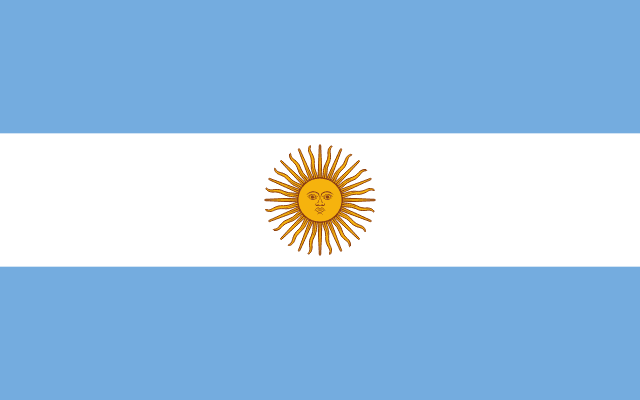
Argentina
South America

45,696,159
15:44 UTC-3
+54
Location
Geography
Economy
Main exports
Argentina's leading export commodities and products.
Subscribe to Live Data for live spot prices
Live commodity prices on every nation's exports — $100 AUD/year.
Tap any export to learn more. Spot prices in USD only for Live Data subscribers.
Main imports
Argentina's leading import commodities and products.
Tap any import to learn more.
Military
Historical Timeline
11000 BCE
Arrival of the first inhabitants
Archaeological evidence suggests that the first Paleo-Indian hunter-gatherer groups arrived in the region of the Southern Cone during the late Pleistocene epoch. These early populations established settlements across diverse ecosystems, from the Pampas to the Patagonian region.
1536
First foundation of Buenos Aires
The Spanish conquistador Pedro de Mendoza established the first settlement of Buenos Aires on the banks of the Río de la Plata. The site was abandoned in 1541 due to hostile interactions with local tribes and severe food shortages.
1776
Creation of the Viceroyalty of the Río de la Plata
The Spanish Crown established the Viceroyalty of the Río de la Plata to improve colonial administration and defend the territory against Portuguese influence. This administrative move centralized political and economic power in the city of Buenos Aires.
1810
May Revolution
The May Revolution marked the beginning of the independence process for Argentina, leading to the formation of the first national government known as the Primera Junta. This movement successfully deposed the Spanish viceroy in Buenos Aires.
1816
Declaration of Argentine Independence
On July 9, the Congress of Tucumán formally declared the independence of the United Provinces of the Río de la Plata from Spain. This consolidated the political sovereignty of the region following years of revolutionary conflict.
1853
Promulgation of the National Constitution
After the fall of dictator Juan Manuel de Rosas, the National Constitution was adopted to create a federal republic. It established the institutional framework that continues to govern the Argentine state to the present day.
1912
Sáenz Peña Law
This landmark electoral reform law established universal, secret, and mandatory male suffrage. It paved the way for democratic transitions and the eventual rise of the Radical Civic Union party to national power.
1946
First Presidency of Juan Domingo Perón
Juan Domingo Perón was elected president, initiating the political movement known as Peronism, which profoundly reshaped social and labor policies in Argentina. His administration emphasized state intervention in the economy and the expansion of workers' rights.
1976
Military Coup d'État
A military junta seized power in March, initiating a period of systemic state terrorism known as the National Reorganization Process. The regime was characterized by the widespread disappearance and torture of political dissidents.
1983
Restoration of Democracy
Raúl Alfonsín was elected president, marking the official end of military rule and the return to constitutional democratic governance. His administration focused on investigating the human rights abuses committed by the former military junta.
2001
Economic and Political Crisis
Argentina experienced a catastrophic economic collapse and social unrest, leading to the resignation of President Fernando de la Rúa. The crisis forced the country to default on its international debt and triggered a major currency devaluation.
2023
Election of Javier Milei
Javier Milei was elected president, signaling a shift toward radical libertarian economic reforms to address historic inflation and fiscal deficits. His presidency represents a significant departure from traditional political alliances in Argentina.
National Holidays
Language
Counting to 10
1
1
= 10 (n = 0)
World Dictionary
Discover and translate any word into all supported languages.
The multilingual Dictionary is a Nations Pro feature.
Upgrade to Pro