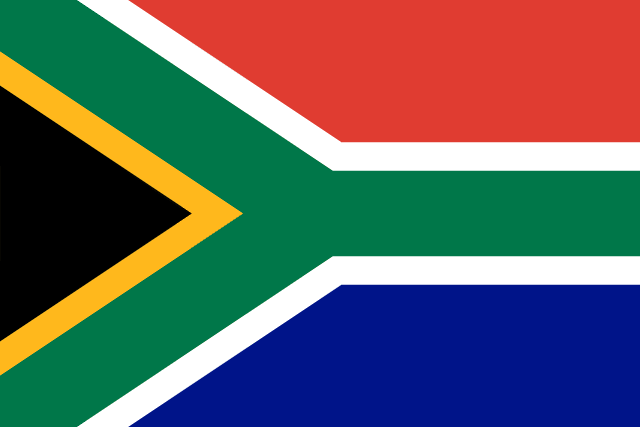

South Africa
Republic of South Africa
Africa
65,602,815
05:47 UTC+2
+27
.za
Mafadi
3,450 m · 11,319 ft
Prince Edward Islands
0 m · 0 ft
771,708
Pretoria · 2026
6,217,529
Johannesburg · 2026
Location
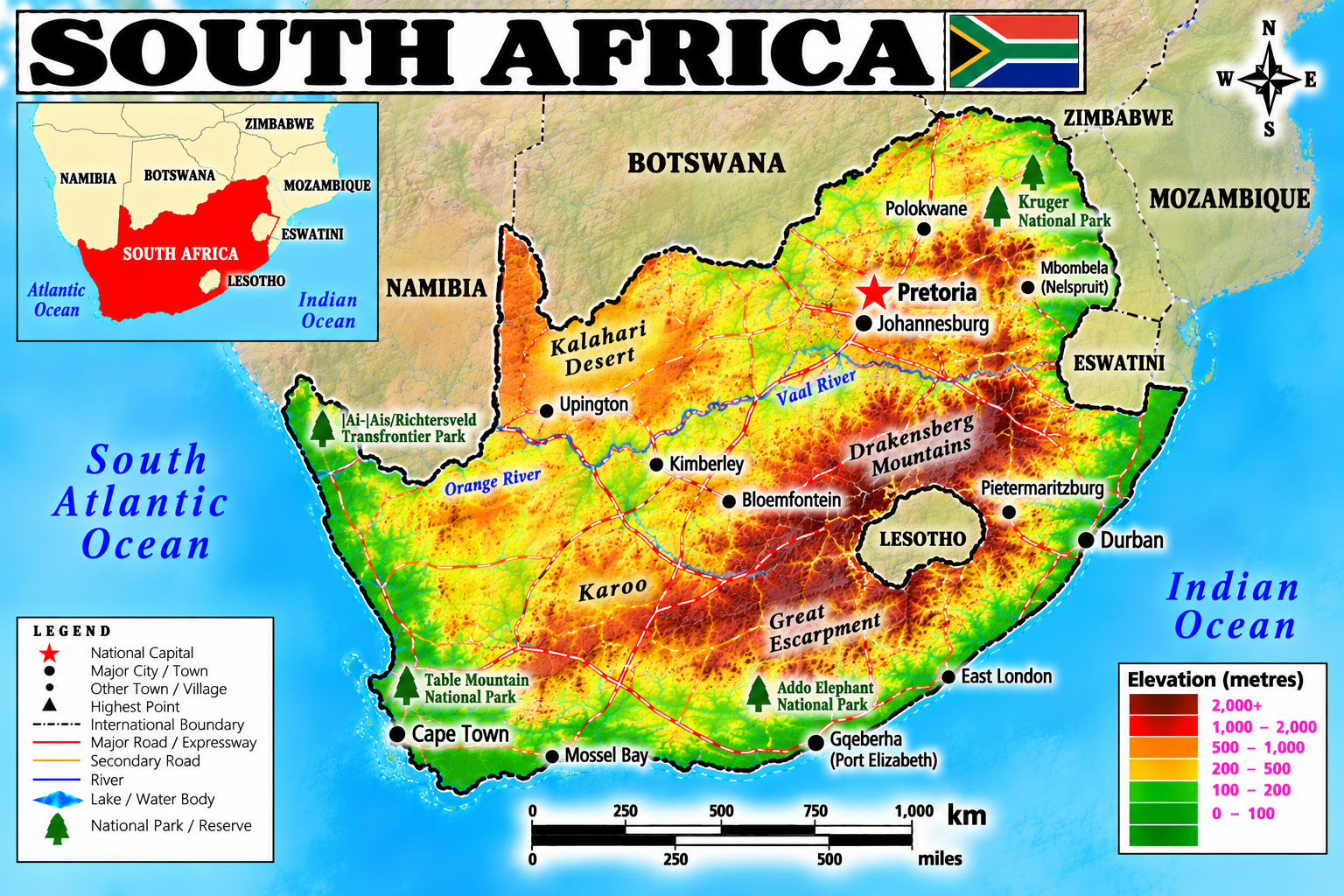
South Africa — Detailed Physical Map
The Drakensberg and Great Escarpment, Kalahari and Karoo, Orange and Vaal rivers, Kruger and Table Mountain parks, the Lesotho enclave, major cities and the capitals Pretoria, Cape Town and Bloemfontein
Tourist Attractions

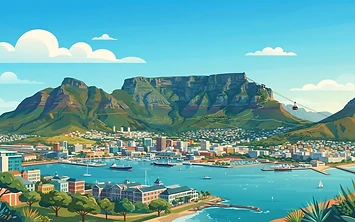
This iconic flat-topped mountain dominates the Cape Town skyline and is recognized as one of the New 7 Wonders of Nature. Visitors can reach the summit via a rotating cable car or by hiking various scenic trails.
The panoramic sunset views of the city and coastline from the summit are unparalleled.

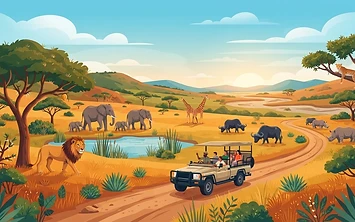
As one of the largest and most famous game reserves in Africa, this park offers an unparalleled safari experience. It is home to the Big Five and a vast array of diverse wildlife in their natural habitat.
It provides the best opportunity in the country to spot lions, leopards, elephants, rhinos, and buffalo in the wild.

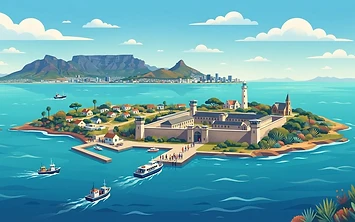
This UNESCO World Heritage Site served as a political prison during the apartheid era, most notably holding Nelson Mandela for 18 of his 27 years of incarceration. Today, it operates as a museum offering guided tours led by former political prisoners.
A visit offers a deeply moving and essential perspective on South Africa's journey toward democracy.

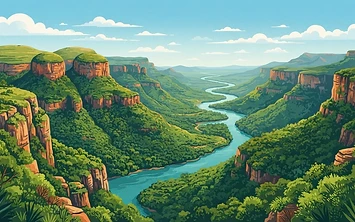
Known as one of the largest green canyons in the world, this natural wonder is a highlight of the scenic Panorama Route. It features dramatic cliffs, lush vegetation, and spectacular viewpoints like the Three Rondavels.
The breathtaking vistas from God's Window provide one of the most famous views in the country.


This world-renowned stretch of coastline runs from Mossel Bay to Storms River, characterized by lush forests, dramatic cliffs, and charming coastal towns. It is a premier destination for road-trippers, hikers, and outdoor enthusiasts.
The route offers a perfect blend of pristine beaches, indigenous forests, and diverse coastal scenery.

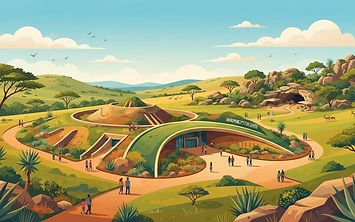
This UNESCO World Heritage Site is a paleoanthropological treasure trove where significant early hominid fossils have been discovered. The site includes the Maropeng Visitor Centre and the Sterkfontein Caves, which provide insight into human evolution.
It is home to some of the oldest and most important fossil discoveries in human history.
Geography
Nature
Mafadi
3,450 m / 11,319 ft
14.1% of land
≈ 172,166 km² of forest
FAO / World Bank, forest area (% of land area)
Explore the Nature Atlas2,200 km1,367 mi
Rises in the Drakensberg mountains and forms part of the border with Namibia.
1,750 km1,087 mi
Serves as the northern border between South Africa and Botswana and Zimbabwe.
1,120 km696 mi
Primary source of water for the industrial heartland of the Gauteng province.
77 km²30 sq mi · 12 m deep
Largest freshwater lake in South Africa located in the KwaZulu-Natal province.
1 km²0 sq mi
Sacred lake formed by a massive landslide in the Soutpansberg mountains.
948 m3,110 ft
Often considered the second tallest waterfall in the world.
56 m184 ft
Located on the Orange River and means place of great noise in Khoikhoi.
River lengths are whole-river figures, including any section beyond South Africa. Researched reference figures. Tap any name for where its name comes from and a Google Maps link.
Major Cities
- 1
Gauteng
12,043,1752026
MapKnown as the City of Gold, it serves as the primary financial and industrial hub of South Africa.
- 2Capital
Western Cape
4,974,3272026
MapHome to the iconic Table Mountain, it is the legislative capital and a major international tourist destination.
- 3
KwaZulu-Natal
3,303,0462026
MapHosts the busiest shipping terminal in Africa and remains a premier coastal holiday destination.
- 4Capital
Gauteng
3,296,9212026
MapServes as the administrative capital of South Africa and is famous for its vibrant purple jacaranda trees.
- 5
Gauteng
1,695,0472026
MapRecognized for its pivotal role in the struggle against apartheid and the 1976 student uprising.
- 6
North West
660,2942026
MapFunctions as a global center for platinum mining operations located at the foothills of the Magaliesberg.
- 7
KwaZulu-Natal
584,7022026
MapFamous as the capital of KwaZulu-Natal, it is renowned for its well-preserved Victorian architecture and gardens.
- 8
Gauteng
515,4832026
MapEstablished as a major industrial center along the Vaal River following the discovery of coal deposits.
- 9
Gauteng
496,6752026
MapDeveloped as a significant residential township in the East Rand serving the workforce of the industrial sector.
- 10
Free State
431,9442026
MapPlanned as a model town to support the booming gold mining industry in the Free State.
- 11
Western Cape
415,8492026
MapRanked among the largest townships in South Africa, it represents a major urban development in Western Cape.
- 12
Northern Cape
301,6472026
MapGained international fame as the site of the world's largest diamond rush and the Big Hole.
City populations are the latest official, UN or national-statistics estimates (2026–2026) compounded to 2026 at 1% a year (the nation's annual population growth rate); figures without a published update come from the open cities database (2020-era estimates) and are projected the same way.
Economy
Main exports
South Africa's leading export commodities and products.
Tap any export to learn more. Spot prices in USD only for Live Data subscribers.
Main imports
South Africa's leading import commodities and products.
Tap any import to learn more.
Military
Historical Timeline
100000 BCE
San and Khoekhoe Presence
Archaeological evidence confirms that the San and Khoekhoe peoples, the indigenous inhabitants of Southern Africa, occupied the region for tens of thousands of years. These hunter-gatherer and pastoralist societies developed distinct languages and cultures long before European contact.
1652
Establishment of the Dutch Cape Colony
The Dutch East India Company established a supply station at the Cape of Good Hope under Jan van Riebeeck. This event marked the beginning of permanent European settlement in South Africa.
1814
British Control of the Cape
Following the Napoleonic Wars, the Cape Colony was formally ceded to the British Empire. This led to significant cultural and political shifts, prompting the Great Trek of Afrikaners into the interior.
1867
Discovery of Diamonds in Kimberley
The discovery of diamonds transformed South Africa's economy from agrarian to industrial. This event accelerated colonial expansion and intensified competition between British and Boer interests.
1899
The Second Boer War
Conflict erupted between the British Empire and the Boer Republics of the Transvaal and the Orange Free State. The war resulted in a British victory and the eventual formation of the Union of South Africa.
1910
Union of South Africa Formed
The British colonies and the Boer republics were unified into the Union of South Africa. This dominion status consolidated white minority rule while systematically excluding the black majority from political participation.
1948
Implementation of Apartheid
The National Party won the general election and introduced the formal system of apartheid. This institutionalized racial segregation, discrimination, and the disenfranchisement of non-white citizens.
1994
End of Apartheid and First Democratic Election
South Africa held its first multiracial democratic election, resulting in the victory of the African National Congress. Nelson Mandela was inaugurated as the country's first black president, marking the end of minority rule.
2010
Hosting the FIFA World Cup
South Africa became the first African nation to host the FIFA World Cup. The event showcased the country's modern infrastructure and fostered a brief period of national unity.
2018
Cyril Ramaphosa Becomes President
Cyril Ramaphosa assumed the presidency following the resignation of Jacob Zuma. His leadership marked a transition in the governing party's focus toward economic reform and anti-corruption efforts.
2023
South Africa Hosts BRICS Summit
Johannesburg hosted the 15th BRICS summit, where member nations discussed expansion and geopolitical influence. This emphasized South Africa's role as a key representative of the Global South.
2024
Formation of the Government of National Unity
Following the 2024 general election where no party gained an absolute majority, the African National Congress formed a Government of National Unity. This coalition government represented a significant change in South African democratic governance.
National Anthem
Enoch Sontonga and C.J. Langenhoven
Enoch Sontonga and M.L. de Villiers
1997
Nkosi sikelel' iAfrika Maluphakanyiswe uphondo lwayo, Yizwa imithandazo yethu, Nkosi sikelela, thina lusapho lwayo. Morena boloka setjhaba sa heso, O fedise dintwa le matshwenyeho, O se boloke, O se boloke setjhaba sa heso, Setjhaba sa South Afrika - South Afrika. Uit die blou van onse hemel, Uit die diepte van ons see, Oor ons ewige gebergtes, Waar die kranse antwoord gee. Sounds the call to come together, And united we shall stand, Let us live and strive for freedom, In South Africa our land.
The current South African anthem is a hybrid song combining two distinct musical pieces that were previously used as rival anthems. The first part originates from the hymn 'Nkosi Sikelel' iAfrika', composed in 1897 by Enoch Sontonga, which became a symbol of the liberation struggle. The second part is derived from 'Die Stem van Suid-Afrika', a poem written by C.J. Langenhoven in 1918 and set to music by M.L. de Villiers in 1921. Following the end of apartheid, the government sought a unified symbol to represent the country's diverse demographics. In 1994, both songs were used as co-anthems before being officially merged into a single composition in 1997. This unique arrangement integrates five of the country's eleven official languages, reflecting a commitment to reconciliation and inclusivity. Today, it serves as a central symbol of South African national identity and post-apartheid unity.
National Holidays
Commemorates the Sharpeville Massacre of 1960, where 69 people were killed while protesting against pass laws. It serves as a reminder of the fight for human rights and equality in South Africa.
Marks the anniversary of the first democratic, non-racial elections held in 1994. It celebrates the end of apartheid and the birth of a new constitutional democracy.
Recognized globally as International Workers' Day, this holiday acknowledges the contributions and struggles of workers in the economy and the fight for labor rights.
Commemorates the 1976 Soweto Uprising, where students protested against the mandatory use of Afrikaans as the medium of instruction in schools. It honors the role of youth in the struggle against apartheid.
Encourages South Africans to celebrate their cultural heritage and the diversity of their beliefs and traditions in the wider context of a nation belonging to all its people.
Established in 1994 to foster reconciliation and national unity among all South Africans. It replaced separate historical holidays that were previously observed by different groups.
Good News Today
Hikers raise money for women’s shelter
Cape Town residents participated in the annual 'Blocktober' campaign, raising funds to support survivors of gender-based violence at the Saartjie Baartman Centre. The initiative combines physical activity with community solidarity to provide essential resources and employment support for women in need.
Fun Facts
Oldest Wine Industry Outside Europe
South Africa has been producing wine since 1659, with the first harvest recorded at the Cape by Jan van Riebeeck.
World's Most Diverse Floral Kingdom
The Cape Floral Kingdom is the smallest yet richest of the world's six floral kingdoms, containing over 9,000 plant species.
Home To Massive Diamond Finds
The Cullinan Diamond, the largest gem-quality rough diamond ever found, was discovered in 1905 at the Premier No. 2 mine.
Penguins On The Beach
Boulders Beach in Simon's Town is famous for its colony of endangered African penguins, which thrive in the warm coastal climate.
Three Distinct Capital Cities
South Africa is unique for having three capitals: Pretoria for administration, Cape Town for legislation, and Bloemfontein for the judiciary.
Cradle Of Humankind Heritage Site
The Sterkfontein Caves have provided some of the most significant hominid fossils in the world, tracing human ancestry back millions of years.
The National Tradition Of Braai
South Africans celebrate 'Braai Day' annually on September 24th to honor the deep cultural significance of cooking meat over an open flame.
World Class Astronomy Hub
The Southern African Large Telescope (SALT), located in Sutherland, is the largest single optical telescope in the Southern Hemisphere.
Hosts Largest Timed Cycle Race
The Cape Town Cycle Tour is the world's largest individually timed cycle race, drawing over 35,000 riders annually.
Longest Wine Route Globally
Route 62 is famously marketed as the longest wine route in the world, stretching through the scenic Western and Eastern Cape provinces.
Chuckies Trivia Quiz
Chuckies Trivia Quiz
Fifteen questions on South Africa — five easy, five medium, five hard. How far can you get?
Sports & Live Events
Language
Counting to 10
1
1
= 10 (n = 0)
World Dictionary
Discover and translate any word into all supported languages.