

Pakistan
Islamic Republic of Pakistan
Asia
262,223,540
08:53 UTC+5
+92
.pk
K2
8,611 m · 28,251 ft
Arabian Sea
0 m · 0 ft
1,395,242
Islamabad · 2026
18,034,335
Karachi · 2026
Location
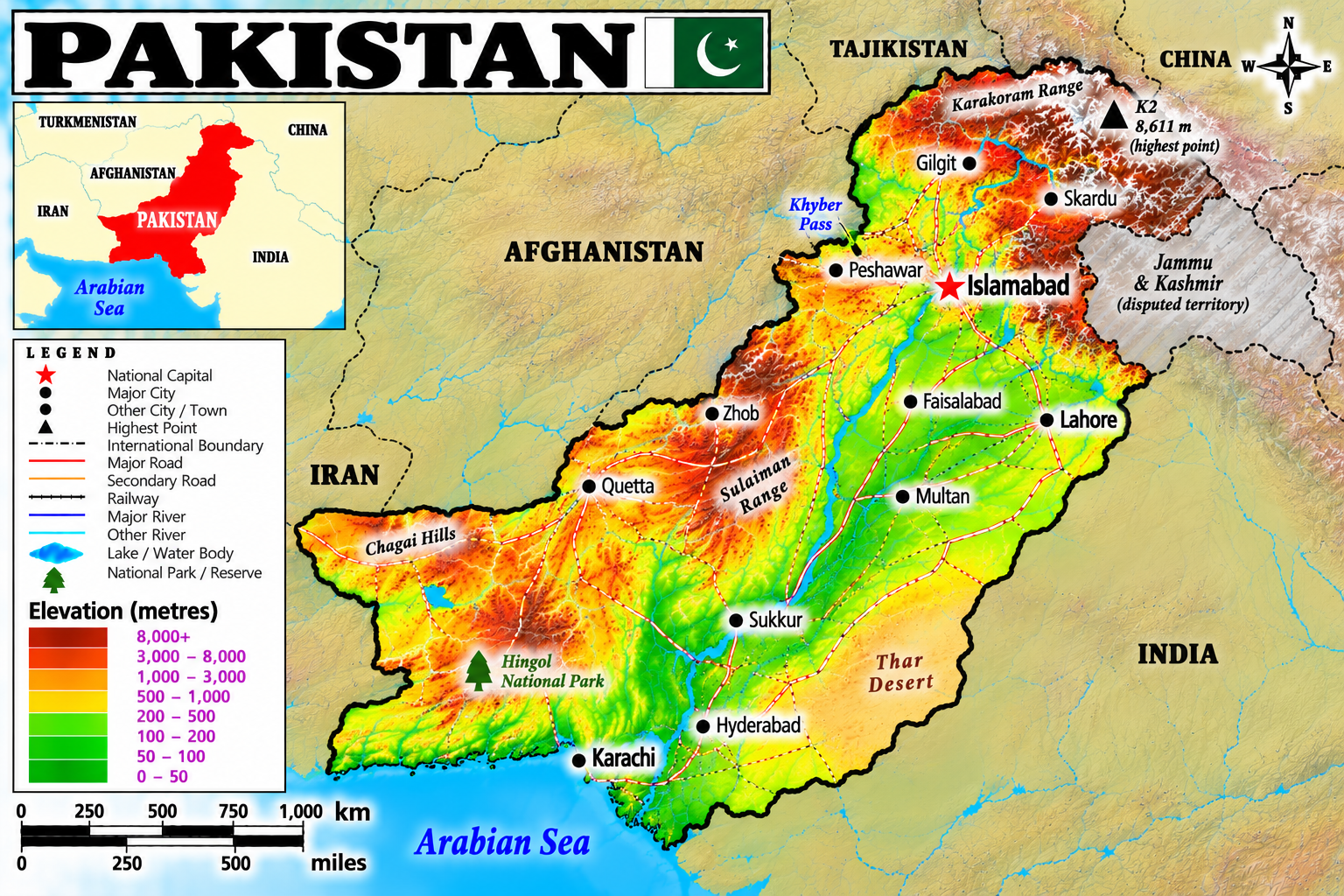
Pakistan — Detailed Physical Map
K2 and the Karakoram Range, the Indus River, Thar Desert, Khyber Pass, Sulaiman Range, major cities and the capital Islamabad
Tourist Attractions

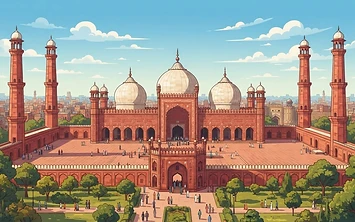
Commissioned by Emperor Aurangzeb in 1673, this majestic mosque is one of the largest in the world and a masterpiece of Mughal architecture. Its red sandstone walls and white marble domes dominate the skyline of the Walled City of Lahore.
The sheer scale and intricate marble inlay work make it an architectural marvel.

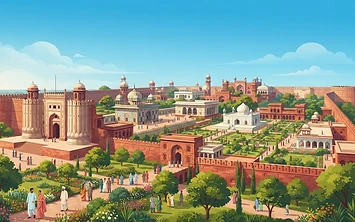
A sprawling UNESCO World Heritage site, this fort complex features palaces, halls, and mosques built by successive Mughal emperors. It serves as a living record of the grandeur of the Mughal Empire in South Asia.
The stunning Shish Mahal, or Palace of Mirrors, is a breathtaking display of craftsmanship.

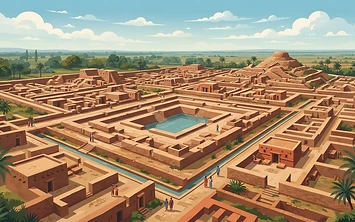
Dating back to 2,500 BC, this is one of the world's oldest and best-preserved cities of the ancient Indus Valley Civilisation. The site reveals a sophisticated urban layout with advanced drainage systems and public structures.
Walking through the ruins of one of humanity's earliest urban centers is a profound historical experience.

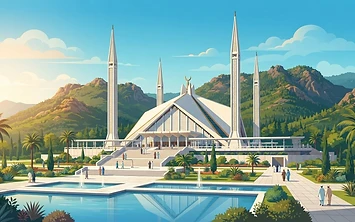
Designed by Turkish architect Vedat Dalokay, this contemporary mosque is shaped like a desert Bedouin tent and serves as the national mosque of Pakistan. It is nestled at the foot of the Margalla Hills, offering a striking contrast between modern design and natural beauty.
Its unique, non-traditional design makes it one of the most iconic religious structures in the world.

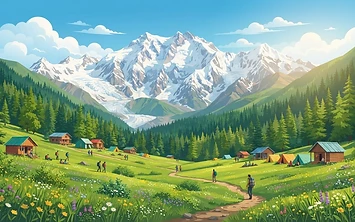
Located at the base of Nanga Parbat, the ninth-highest mountain in the world, this alpine grassland offers unparalleled views of snow-capped peaks and lush forests. It is a premier destination for trekkers and nature lovers seeking tranquility.
The dramatic, unobstructed view of the towering Nanga Parbat is truly unforgettable.

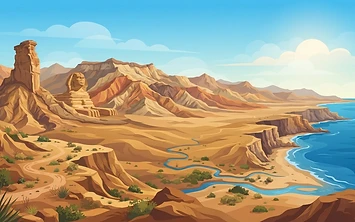
As the largest national park in Pakistan, it features a diverse landscape of rugged mountains, vast deserts, and coastal cliffs along the Arabian Sea. It is home to unique geological formations like the Princess of Hope and the Sphinx.
The surreal, wind-sculpted rock formations set against the backdrop of the sea are unlike anywhere else in the country.
Geography
Nature
K2
8,611 m / 28,251 ft
4.8% of land
≈ 42,332 km² of forest
FAO / World Bank, forest area (% of land area)
Explore the Nature Atlas3,180 km1,976 mi
Rises in Tibet and flows through Pakistan to the Arabian Sea.
725 km450 mi
A primary tributary of the Chenab River that flows through the Kashmir region.
1,450 km901 mi
Longest of the five rivers that flow through the historic Punjab region.
260 km²100 sq mi · 4 m deep
One of the largest freshwater lakes in Pakistan located in Dadu District.
3 km²1 sq mi · 34 m deep
Alpine glacial lake situated in the Kaghan Valley near Naran.
14 km²5 sq mi · 109 m deep
Formed by a massive landslide in the Hunza Valley during 2010.
—
Located in the Bolan Valley of Balochistan near the city of Quetta.
55 m180 ft
Situated in the Skardu Valley known for its surrounding lush green meadows.
River lengths are whole-river figures, including any section beyond Pakistan. Researched reference figures. Tap any name for where its name comes from and a Google Maps link.
Major Cities
- 1
Sindh
21,243,3902026
MapFinancial hub and largest port city, serving as the primary economic engine of the nation.
- 2
Punjab
14,062,7452026
MapHistorical and cultural heart known for its Mughal-era architecture, including the Badshahi Mosque and Lahore Fort.
- 3
Punjab
3,959,3982026
MapMajor industrial center famously known as the Manchester of Pakistan due to its extensive textile manufacturing sector.
- 4
Punjab
3,900,9892026
MapVital military headquarters and garrison city situated adjacent to the national capital.
- 5
Punjab
2,793,9692026
MapIndustrial city globally recognized for its significant production of high-quality kitchenware and electric appliances.
- 6
Punjab
2,409,6022026
MapHistoric city of saints renowned for its ancient shrines, intricate pottery, and delicious production of mangoes.
- 7
Khyber Pakhtunkhwa
2,070,4852026
MapAdministrative center of Swat Valley known for its proximity to archaeological Buddhist sites and scenic mountainous landscapes.
- 8
Sindh
2,022,5862026
MapSignificant commercial center historically famous for its production of glass bangles and handicrafts in Sindh.
- 9
Khyber Pakhtunkhwa
1,874,8312026
MapAncient frontier gateway serving as a historic trading hub connecting the subcontinent with Central Asia.
- 10
Balochistan
1,818,9052026
MapProvincial capital of Balochistan acting as a strategic trade gateway near the borders of Afghanistan and Iran.
- 11Capital
Islamabad
1,162,4542026
MapModern capital city planned for its lush greenery, wide boulevards, and the iconic Faisal Mosque.
- 12
Punjab
983,8002026
MapFormer princely state known for the majestic Noor Mahal palace and proximity to the vast Cholistan Desert.
City populations are the latest official, UN or national-statistics estimates (2026–2026) compounded to 2026 at 1.8% a year (the nation's annual population growth rate); figures without a published update come from the open cities database (2020-era estimates) and are projected the same way.
Economy
Main exports
Pakistan's leading export commodities and products.
Tap any export to learn more. Spot prices in USD only for Live Data subscribers.
Main imports
Pakistan's leading import commodities and products.
Tap any import to learn more.
Military
Historical Timeline
7000 BCE
Mehrgarh Neolithic Settlement
The Mehrgarh site represents one of the earliest known farming settlements in South Asia, marking the foundation of agricultural life in the Indus Valley region.
2500 BCE
Indus Valley Civilization Peak
The Indus Valley Civilization reached its zenith, characterized by sophisticated urban planning, advanced drainage systems, and standardized weights and measures.
711
Umayyad Conquest of Sindh
Muhammad bin Qasim led an Umayyad expedition into Sindh, marking the beginning of significant Islamic cultural and political influence in the region.
1947
Independence of Pakistan
Pakistan achieved independence from British colonial rule on August 14, 1947, following the partition of British India.
1956
Adoption of the First Constitution
Pakistan transitioned from a Dominion to an Islamic Republic with the adoption of its first constitution, officially establishing its sovereign state structure.
1971
Separation of East Pakistan
Following a civil war and military conflict with India, East Pakistan seceded to become the independent nation of Bangladesh.
1973
Promulgation of the 1973 Constitution
A new parliamentary constitution was enacted, which remains the foundational legal framework of the country today.
1998
Chagai-I Nuclear Tests
Pakistan conducted a series of successful underground nuclear tests in the Chagai District, officially declaring itself a nuclear-armed state.
2013
First Democratic Transition of Power
For the first time in its history, a democratically elected government completed its full term and peacefully transferred power to another elected administration.
2022
Vote of No Confidence
Imran Khan became the first Prime Minister in Pakistan's history to be removed from office through a parliamentary vote of no confidence.
2024
General Elections and Coalition Formation
Following the 2024 general elections, a new coalition government was formed, reflecting significant shifts in the national political landscape.
2025
Supreme Court Judicial Appointments
The Pakistani judicial system implemented significant procedural updates to its appointment process to address administrative challenges and ensure constitutional adherence.
National Anthem
قومی ترانہ
Hafeez Jullundhri
Ahmed G. Chagla
1954
پاک سرزمین شاد باد کشورِ حسین شاد باد تُو نشانِ عزمِ عالی شان ارضِ پاکستان! مرکزِ یقین شاد باد پاک سرزمین کا نظام قوتِ اخوتِ عوام قوم، ملک، سلطنت پائندہ تابندہ باد! شاد باد منزلِ مراد پرچمِ ستارہ و ہلال رہبرِ ترقی و کمال ترجمانِ ماضی، شانِ حال جانِ استقبال! سایۂ خدائے ذوالجلال
Following the independence of Pakistan in 1947, the country lacked an official national anthem. In 1949, the government formed the National Anthem Committee to compose a melody and lyrics. Ahmed G. Chagla composed the music in 1950, which was approved by the government and used during the visit of the Shah of Iran. Hafeez Jullundhri wrote the Persian-influenced Urdu lyrics, which were officially adopted in 1954. The anthem is unique for its heavy use of Persian vocabulary, making it understandable to speakers of many regional languages in Pakistan. It is played at official events and ceremonies to represent the unity and sovereignty of the nation. No changes have been made to the lyrics since its official adoption.
National Holidays
This day commemorates the Lahore Resolution of 1940, which called for the establishment of a separate homeland for the Muslims of British India.
Also known as International Workers' Day, it is observed to recognize the contributions and rights of the labour force in Pakistan.
This marks the date in 1947 when Pakistan gained independence from the United Kingdom and became a sovereign state.
This day honors the sacrifices made by soldiers in the 1965 war between Pakistan and India to defend the nation's borders.
This holiday commemorates the birthday of Allama Muhammad Iqbal, the national poet and philosopher who envisioned the creation of Pakistan.
This day celebrates the birthday of Muhammad Ali Jinnah, the founder of Pakistan, who is honored for his role in the country's creation.
Good News Today
Pakistan's new pollution squad races to douse stubble fires to combat smog
Pakistan has launched a 750-member rapid-response force across major rice-growing districts to extinguish illegal field fires that contribute to hazardous air quality. The initiative includes providing farmers with subsidized machinery to clear fields without burning, aiming to improve public health and environmental conditions.
Fun Facts
Home to K2 Peak
Pakistan hosts K2, the second-highest mountain in the world, which is often considered a much more difficult climb than Mount Everest.
Cricket Passion and Legacy
Cricket is the most popular sport in Pakistan, and the country famously won the 1992 Cricket World Cup.
Indus Valley Civilization Roots
Mohenjo-daro is one of the world's oldest and most advanced urban centers, dating back to the 25th century BCE.
World Cup Football Producers
The city of Sialkot is the global epicenter for football manufacturing, producing the majority of official FIFA World Cup match balls.
Highest Paved International Road
The Karakoram Highway is the highest paved international road in the world, connecting Pakistan to China through high-altitude mountain passes.
Intricate Truck Art Tradition
Truck art is a vibrant, uniquely Pakistani folk tradition where heavy vehicles are elaborately painted with intricate floral patterns and poetry.
Lassi Culture and Yogurt
Pakistan is one of the world's largest milk-producing countries, and lassi is a ubiquitous yogurt-based drink served throughout the nation.
Junction of Three Ranges
Northern Pakistan is where three of the world's most famous mountain ranges meet: the Himalayas, the Karakoram, and the Hindu Kush.
Khewra Salt Mine Wonders
The Khewra Salt Mine is the second largest salt mine in the world and includes a mosque built entirely out of pink salt bricks.
Biryani as National Staple
Biryani, a fragrant, spiced rice dish, is the most celebrated meal in Pakistan, with countless regional variations found across its provinces.
Chuckies Trivia Quiz
Chuckies Trivia Quiz
Fifteen questions on Pakistan — five easy, five medium, five hard. How far can you get?
Sports & Live Events
Language
Counting to 10
1
1
= 10 (n = 0)
World Dictionary
Discover and translate any word into all supported languages.