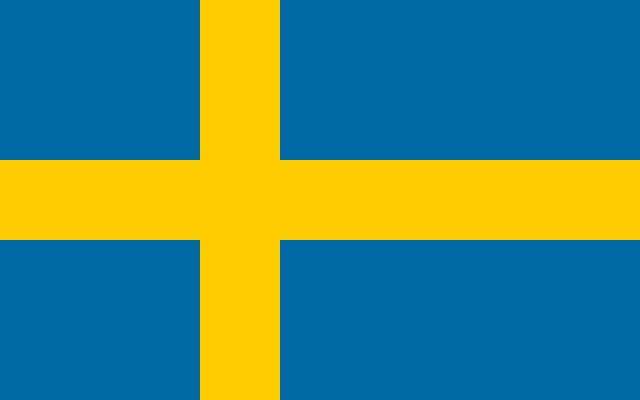
Sweden
Europe
10,500,000
15:28 UTC+2
+46
Location
Geography
Economy
Main exports
Sweden's leading export commodities and products.
Subscribe to Live Data for live spot prices
Live commodity prices on every nation's exports — $100 AUD/year.
Tap any export to learn more. Spot prices in USD only for Live Data subscribers.
Main imports
Sweden's leading import commodities and products.
Tap any import to learn more.
Military
Historical Timeline
10000 BCE
First human settlement in Sweden
Following the retreat of the Weichsel glaciation, the first hunter-gatherer groups arrived in the southern parts of modern-day Sweden. These early inhabitants laid the foundation for the region's continuous human occupation.
1250
Establishment of the Folkung Dynasty
The ascension of Valdemar Birgersson marked a consolidation of royal power and the beginning of a more unified Swedish state. This era saw the introduction of national laws and the strengthening of the monarchy.
1397
Formation of the Kalmar Union
Denmark, Norway, and Sweden were united under a single monarch to counter the rising influence of the Hanseatic League. The union periodically collapsed and reformed, heavily influencing Scandinavian geopolitics for over a century.
1523
Gustav Vasa leads Swedish independence
Following the Stockholm Bloodbath, Gustav Vasa led a rebellion against the Kalmar Union and was elected king. This event marked the final dissolution of the union and the birth of a sovereign, independent Swedish state.
1527
The Swedish Reformation
The Riksdag of Västerås established the Protestant Reformation in Sweden, leading to the confiscation of Church property. This transition significantly bolstered royal authority and redirected national resources toward the state.
1630
Sweden enters the Thirty Years' War
Under King Gustavus Adolphus, Sweden intervened in the European conflict, rising to the status of a major continental power. The war cemented Sweden's military dominance in the Baltic region for the remainder of the century.
1721
End of the Swedish Empire
The Treaty of Nystad concluded the Great Northern War, forcing Sweden to cede vast territories and ending its era as a Great Power. This period initiated the Age of Liberty, which saw increased parliamentary influence.
1809
Adoption of the Instrument of Government
A new constitution was enacted following the loss of Finland to Russia, introducing a separation of powers. It remained a fundamental part of the Swedish legal framework for over 160 years.
1919
Introduction of universal suffrage
Sweden granted full voting rights to both men and women, marking a transformative milestone for democratic participation. This reform was followed by the rapid expansion of the Swedish welfare state.
1995
Accession to the European Union
Following a national referendum, Sweden officially joined the European Union. This integration deeply influenced the nation's economic policy and international political cooperation.
2023
Application for NATO membership
In response to the shifting security landscape in Europe, Sweden officially pursued accession to the North Atlantic Treaty Organization. This move represented a significant departure from its long-standing policy of military non-alignment.
2024
Sweden joins NATO
Sweden formally became the 32nd member of NATO on March 7, 2024. This action finalized a historic shift in the country's national defense strategy.
National Holidays
This holiday marks the beginning of the new calendar year according to the Gregorian calendar.
This day follows Easter Sunday and is a traditional public holiday in Sweden celebrating the resurrection of Jesus.
This day commemorates the election of Gustav Vasa as King of Sweden in 1523 and the adoption of the 1809 Instrument of Government.
This cultural celebration marks the summer solstice and the longest day of the year, involving traditional dancing and feasts.
This holiday celebrates the birth of Jesus Christ and is the primary day of Christmas observance in Sweden.
Language
Counting to 10
1
1
= 10 (n = 0)
World Dictionary
Discover and translate any word into all supported languages.
The multilingual Dictionary is a Nations Pro feature.
Upgrade to Pro