
Switzerland
Swiss Confederation
Europe
9,181,200
03:23 UTC+1
+41
.ch
Dufourspitze
4,634 m · 15,203 ft
Lake Maggiore
193 m · 633 ft
141,007
Bern · 2026
1,416,802
Zurich · 2026
Location
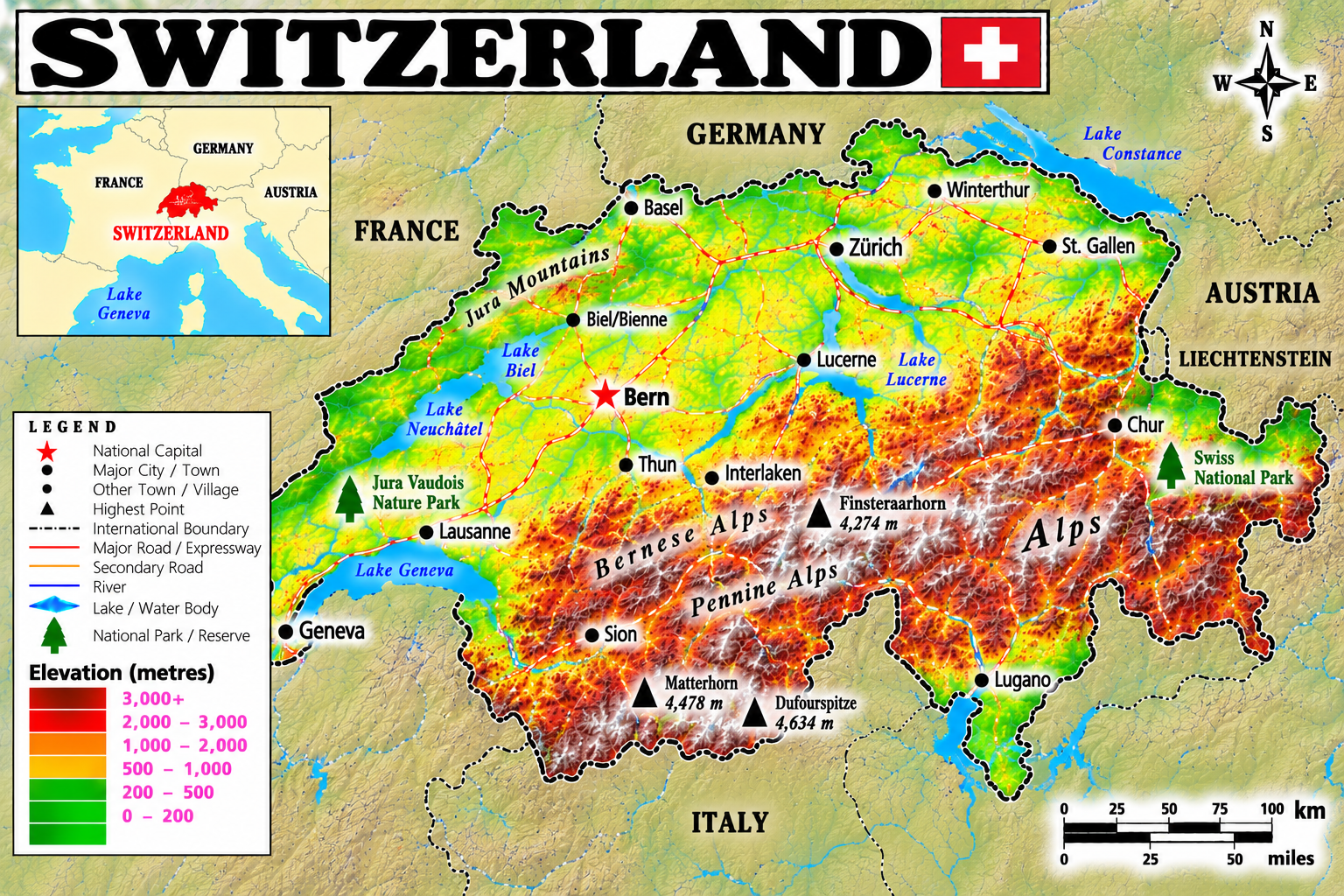
Switzerland — Detailed Physical Map
The Bernese and Pennine Alps, Matterhorn and Finsteraarhorn, Jura Mountains, Lake Geneva and Constance, Swiss National Park, major cities and the capital Bern
Tourist Attractions

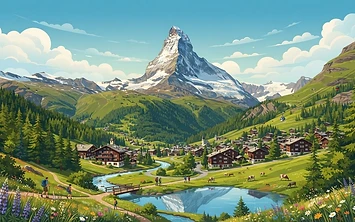
The Matterhorn is one of the world's most iconic mountain peaks, famous for its distinct pyramid shape and its role as a symbol of the Swiss Alps.
The breathtaking views of this majestic peak are a must-see for every visitor to Switzerland.

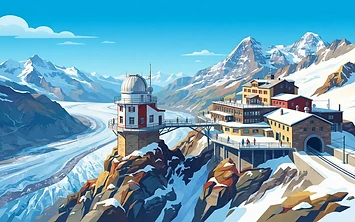
Known as the Top of Europe, this high-altitude destination features an observation deck and the Sphinx Observatory overlooking the Aletsch Glacier.
Experience the spectacular panoramic views of the surrounding snow-capped peaks and the massive glacier.

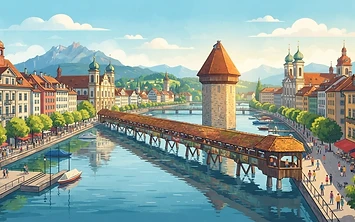
This 14th-century wooden covered bridge is one of the oldest of its kind in Europe and serves as a defining landmark of Lucerne.
Admire the historic paintings that decorate the interior of this beautifully preserved medieval structure.

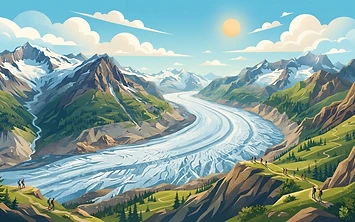
As the largest glacier in the Alps, this massive river of ice snakes through the mountains, offering a dramatic display of natural power.
Witness the sheer scale of this vast, winding ice formation from the surrounding mountain trails.

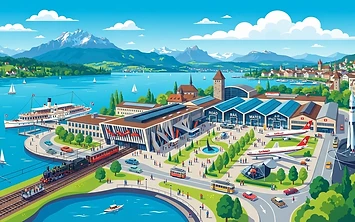
This comprehensive museum showcases the history of Swiss transportation, including road, rail, water, air, and space travel exhibits.
Explore the interactive displays and the IMAX theatre that make this one of the most popular museums in the country.

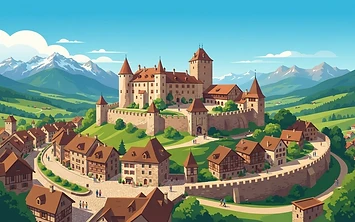
Perched in a charming medieval town, this 13th-century castle is a site of national significance that offers a glimpse into Swiss history.
Walk through the well-preserved medieval architecture and enjoy the stunning views of the surrounding Fribourg countryside.
Geography
Nature
Dufourspitze
4,634 m / 15,203 ft
32.3% of land
≈ 13,335 km² of forest
FAO / World Bank, forest area (% of land area)
Explore the Nature Atlas1,230 km764 mi
Rises in the Swiss Alps and flows into the North Sea.
295 km183 mi
The longest river that flows entirely within Swiss territory.
813 km505 mi
Emerges from the Rhone Glacier in the Valais Alps.
580 km²224 sq mi · 310 m deep
Divided between Switzerland and France and contains the Jet dEau.
536 km²207 sq mi · 252 m deep
Bordered by Switzerland, Germany, and Austria.
218 km²84 sq mi · 152 m deep
Largest lake lying entirely within the borders of Switzerland.
23 m75 ft
The largest waterfall in Europe by volume of water.
297 m974 ft
Located in the Lauterbrunnen Valley and is one of the highest free-falling waterfalls.
River lengths are whole-river figures, including any section beyond Switzerland. Researched reference figures. Tap any name for where its name comes from and a Google Maps link.
Major Cities
- 1
Zürich
443,5542026
MapGlobal financial center renowned for its banking sector and the vibrant shopping destination of Bahnhofstrasse.
- 2
Genève
212,6302026
MapDiplomatic hub hosting the United Nations headquarters and numerous international organizations on the shores of Lake Geneva.
- 3
Basel-Stadt
181,3362026
MapCultural capital home to Art Basel and a leading center for the global pharmaceutical and chemical industries.
- 4
Vaud
146,5402026
MapOlympic capital serving as the permanent seat of the International Olympic Committee and a center for higher education.
- 5Capital
Bern
139,4582026
MapCapital city featuring a UNESCO-listed medieval old town and the iconic Zytglogge clock tower.
- 6
Zürich
121,5602026
MapIndustrial powerhouse evolved into a prominent center for engineering, technology, and renowned fine art museums.
- 7
Luzern
87,2942026
MapScenic tourist gateway famous for its preserved medieval Chapel Bridge and stunning views of the Alps.
- 8
Sankt Gallen
80,0182026
MapMedieval abbey town recognized for its historic monastery library and long tradition of textile manufacturing.
- 9
Ticino
64,1342026
MapSun-drenched financial center in the Italian-speaking canton of Ticino known for its Mediterranean flair and lakefront.
- 10
Bern
57,8362026
MapHistoric watchmaking capital serving as the global headquarters for major luxury timepiece brands.
- 11
Ticino
44,5802026
MapStrategic fortress town celebrated for its three iconic UNESCO World Heritage medieval castles.
- 12
Bern
43,9762026
MapPicturesque gateway to the Bernese Oberland characterized by its medieval castle overlooking the Aare River.
City populations are the latest official, UN or national-statistics estimates (2025–2025) compounded to 2026 at 0.7% a year (the nation's annual population growth rate); figures without a published update come from the open cities database (2020-era estimates) and are projected the same way.
Economy
Main exports
Switzerland's leading export commodities and products.
Tap any export to learn more. Spot prices in USD only for Live Data subscribers.
Main imports
Switzerland's leading import commodities and products.
Tap any import to learn more.
Military
Historical Timeline
5000 BCE
Neolithic Settlement at Cortaillod
The earliest established Neolithic farming communities in the Swiss plateau were formed by the Cortaillod culture. These groups were among the first to build lake-dwelling settlements in the region.
1291
Federal Charter of 1291
The cantons of Uri, Schwyz, and Unterwalden signed a pact to provide mutual defense against external threats. This document is traditionally viewed as the foundational moment of the Swiss Confederation.
1499
Swabian War and de facto Independence
Following the Swiss victory over the Swabian League, the Treaty of Basel granted the Confederation effective independence from the Holy Roman Empire. This solidified Switzerland's sovereign status in Europe.
1515
Battle of Marignano and Policy of Neutrality
After a decisive defeat in the Italian Wars, Switzerland began to transition toward a policy of armed neutrality. This strategic shift defined the nation's foreign policy for subsequent centuries.
1648
Peace of Westphalia
The Treaty of Westphalia formally and internationally recognized the Swiss Confederation as a state independent from the Holy Roman Empire. This confirmed the legal sovereignty established after the Swabian War.
1815
Congress of Vienna
The Great Powers of Europe guaranteed Swiss independence and perpetual neutrality at the Congress of Vienna. This agreement established the current external borders of Switzerland.
1848
Creation of the Federal Constitution
Switzerland transitioned from a loose confederation of states into a federal state with a centralized government. This established the modern democratic structure and national parliamentary system.
1971
Women's Suffrage Granted
Following a national referendum, Swiss women were granted the right to vote and stand for election at the federal level. This marked a major milestone for political inclusivity in the country.
2002
Accession to the United Nations
After a national referendum, Switzerland officially became a full member state of the United Nations. This move ended decades of avoiding formal membership in major international organizations.
2010
First Female Majority in Federal Council
The election of Simonetta Sommaruga to the Federal Council created a historical first where women held a majority of the seats in the national executive branch.
2023
Switzerland Joins UN Security Council
Switzerland began its first term as a non-permanent member of the United Nations Security Council. This marked an increased role for the neutral state in international diplomacy.
2025
Viola Amherd as President of the Confederation
Viola Amherd served as the President of the Swiss Confederation for the year 2025, presiding over the Federal Council. This position continues the annual rotation of the head of government among the seven councillors.
National Anthem
Schweizerpsalm
Leonhard Widmer
Alberich Zwyssig
1981
Trittst im Morgenrot daher, Seh’ ich dich im Strahlenmeer, Dich, du Hocherhabener, Herrlicher! Wenn der Alpenfirn sich rötet, Betet, freie Schweizer, betet! Eure fromme Seele ahnt, Eure fromme Seele ahnt, Gott im hehren Vaterland, Gott, den Herrn, im hehren Vaterland.
The Swiss Psalm was composed in 1841 by Cistercian monk Alberich Zwyssig after he received a text written by Zurich author Leonhard Widmer. The melody was originally intended for a different poem but was adapted for the psalm, which gained popularity throughout the 19th century. Although it served as the de facto anthem for many years, it officially replaced the previous anthem, 'Rufst du, mein Vaterland', only in 1981. This transition followed a referendum process and a period of testing which started in the 1960s to find a more modern alternative. The anthem is traditionally sung in all four official languages of Switzerland, with specific versions for German, French, Italian, and Romansh. It holds significant cultural importance as a unifying symbol of the Swiss Confederation's diverse linguistic and cantonal identity.
National Holidays
This date marks the beginning of the civil calendar year.
This Christian holiday commemorates the ascension of Jesus Christ into heaven, occurring 40 days after Easter.
This day commemorates the Federal Charter of 1291, which is considered the founding document of the Swiss Confederation.
This holiday commemorates the birth of Jesus Christ, marking the principal day of the Christmas season.
Good News Today
Zurich University Hospital performs brain surgery using a hologram
Zurich University Hospital successfully performed brain surgery using a hologram projected above the patient's head. Surgeons utilized special glasses to view the brain's structure in three dimensions during the procedure.
Fun Facts
World Leaders in Chocolate Consumption
Swiss residents consume more chocolate per capita than any other nation, averaging roughly 10 kilograms per person annually.
Nuclear Fallout Shelter Capacity
Switzerland is unique in having enough nuclear fallout shelter space to accommodate 100 percent of its entire population in case of emergency.
More Peaks Than You Imagine
The country features 48 mountain peaks that reach an altitude of over 4,000 meters above sea level.
Direct Democracy at Work
Swiss citizens can challenge any law passed by parliament by collecting 50,000 signatures within 100 days, triggering a nationwide referendum.
Guinea Pigs Need Company
It is illegal to own just one guinea pig in Switzerland because they are social animals and are considered to suffer from loneliness, making it a form of animal abuse.
The Square Flag Design
The Swiss flag is one of only two sovereign state flags in the world that is perfectly square; the other is the Vatican City flag.
World Class Rail Punctuality
Swiss trains are world-famous for precision, with the entire national transport system operating on highly synchronized schedules that connect seamlessly across the country.
No Standing Army Required
Switzerland maintains a mandatory conscription system for men, resulting in a unique citizen-soldier model where soldiers keep their rifles and equipment at home.
The Global Hub of Horology
Switzerland produces more than half of the world's total supply of luxury watches, solidifying its reputation as the epicenter of horological craftsmanship.
Vast Variety of Local Cheeses
There are over 450 distinct varieties of Swiss cheese produced, with many regional traditions dating back hundreds of years.
Chuckies Trivia Quiz
Chuckies Trivia Quiz
Fifteen questions on Switzerland — five easy, five medium, five hard. How far can you get?
Sports & Live Events
Language
Counting to 10
1
1
= 10 (n = 0)
World Dictionary
Discover and translate any word into all supported languages.