
Israel
State of Israel
Asia
10,283,117
06:13 UTC+2
+972
.il
Mount Meron
1,208 m · 3,963 ft
Dead Sea
-430 m · -1,411 ft
1,015,530
Jerusalem · 2026
4,174,385
Jerusalem · 2026
Location
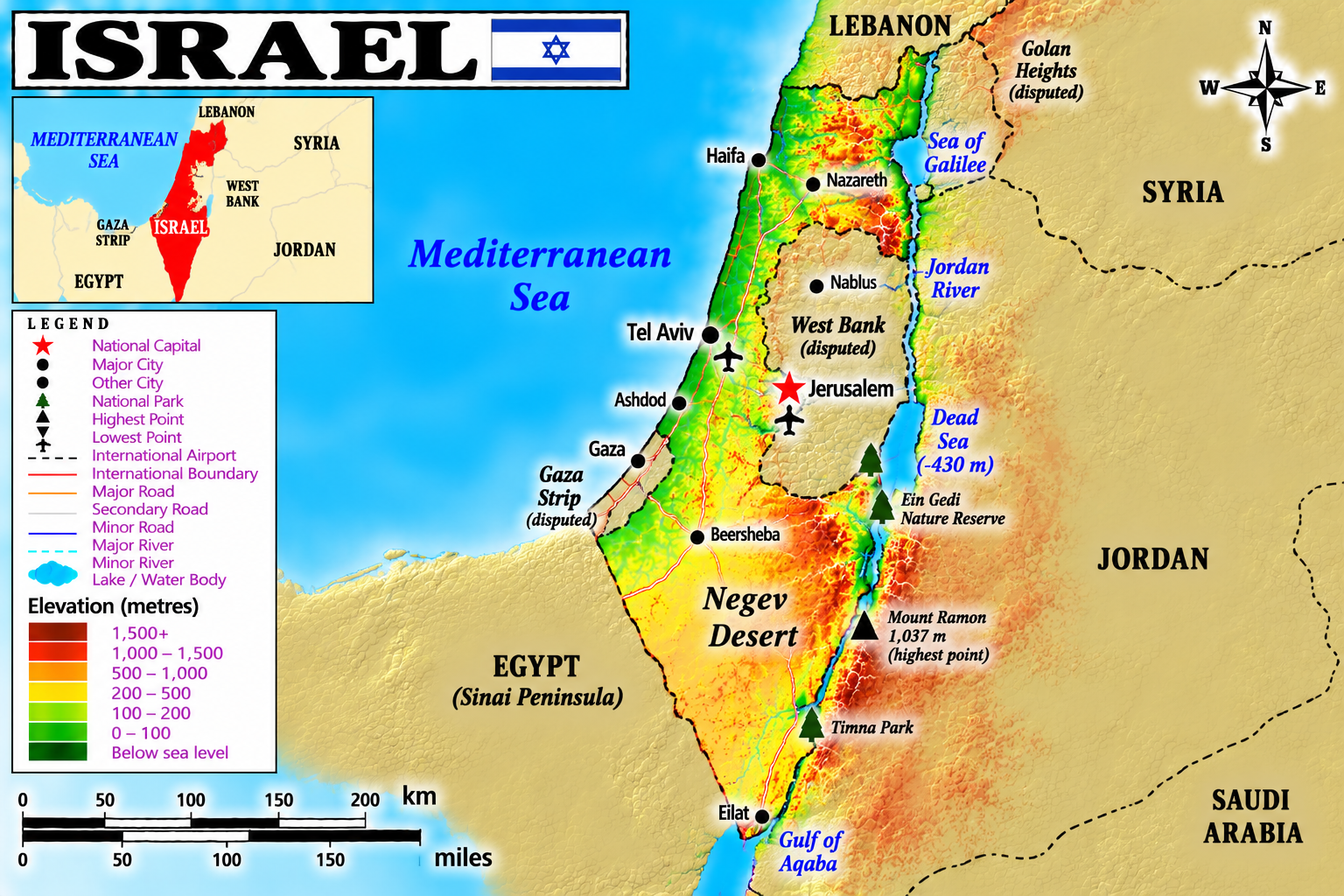
Israel — Detailed Physical Map
The Jordan River, Sea of Galilee and Dead Sea, the Negev Desert, Mount Ramon, major cities and the capital Jerusalem
Tourist Attractions
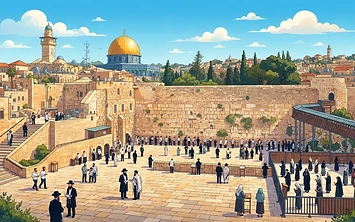
The Western Wall is one of the most significant and sacred religious sites for the Jewish people, serving as a remnant of the ancient retaining wall of the Second Temple.
Experience the profound atmosphere of prayer and reflection at this iconic site.
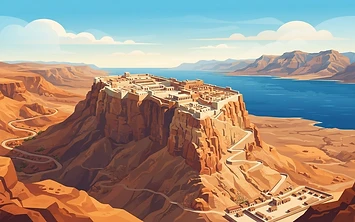
This ancient desert fortress, built by King Herod, sits atop a dramatic plateau overlooking the Dead Sea and is famous for its historical significance and archaeological remains.
Ascend the mountain at sunrise for breathtaking views and a powerful connection to history.


As one of the world's leading art and archaeology museums, it houses an extensive collection ranging from prehistoric artifacts to contemporary Israeli art.
View the Shrine of the Book, which houses the famous Dead Sea Scrolls.

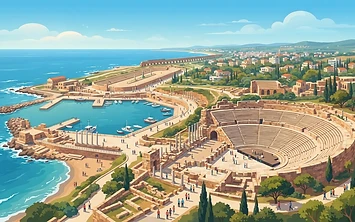
This site features the remarkably preserved ruins of an ancient Roman port city built by King Herod, including a theater, hippodrome, and harbor.
Explore the ancient Roman theater that is still used for modern-day performances.

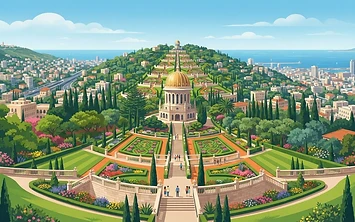
These stunning terraced gardens extend up the northern slope of Mount Carmel, surrounding the golden-domed Shrine of the Báb.
Enjoy the meticulously manicured landscape and panoramic views of the Haifa Bay.

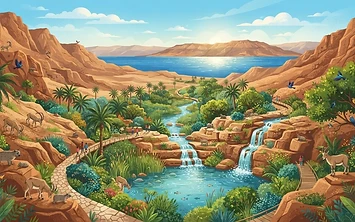
A lush desert oasis featuring freshwater springs, waterfalls, and diverse wildlife, providing a stark and beautiful contrast to the surrounding arid landscape.
Hike the scenic trails to discover hidden waterfalls and natural pools in the desert.
Geography
Nature
Mount Meron
1,208 m / 3,963 ft
6.5% of land
≈ 1,435 km² of forest
FAO / World Bank, forest area (% of land area)
Explore the Nature Atlas251 km156 mi
Flows south from Mount Hermon to the Dead Sea.
28 km17 mi
Flows through Tel Aviv into the Mediterranean Sea.
13 km8 mi
Drains the Jezreel Valley and enters the Mediterranean at Haifa Bay.
605 km²234 sq mi · 304 m deep
Lowest point on Earth's land surface.
166 km²64 sq mi · 43 m deep
Lowest freshwater lake in the world.
20 m66 ft
Located on the Golan Heights and flows strongest during winter rains.
30 m98 ft
Found in the Ayun Nature Reserve in the Upper Galilee.
River lengths are whole-river figures, including any section beyond Israel. Researched reference figures. Tap any name for where its name comes from and a Google Maps link.
Major Cities
- 1Capital
Jerusalem
1,181,7592026
MapHouses sacred sites for Judaism, Christianity, and Islam, including the Western Wall and the Dome of the Rock.
- 2
Tel Aviv
601,9952026
MapServes as the country's primary financial, cultural, and technological hub located along the Mediterranean coastline.
- 3
Haifa
317,8202026
MapFeatures the Bahá'í Gardens and serves as the country's largest maritime port on the Mediterranean Sea.
- 4
Central
316,9092026
MapFounded in 1878 as the first modern Jewish agricultural settlement in the country.
- 5
Southern
244,8332026
MapActs as the administrative and academic capital of the Negev desert region.
- 6
Tel Aviv
235,7272026
MapServes as a major center for Haredi Jewish culture and scholarship.
- 7
Southern
235,5842026
MapFunctions as a vital economic center hosting one of the country's two main deep-water ports.
- 8
Central
234,4022026
MapEstablished by early Zionist pioneers in 1882 and historically significant for its founding of the modern Israeli wine industry.
- 9
Central
223,3372026
MapKnown as the Israeli Riviera, this coastal city attracts many tourists for its extensive sandy beaches and cliffside parks.
- 10
Tel Aviv
174,5622026
MapDistinguishes itself through numerous public art installations and a dedicated children's museum.
- 11
Southern
165,9162026
MapContains a national park featuring ancient ruins from the Philistine, Roman, and Crusader periods.
- 12
Tel Aviv
148,1392026
MapHosts one of the world's largest diamond exchanges and a renowned safari park.
City populations are the latest official, UN or national-statistics estimates (2026–2026) compounded to 2026 at 1.6% a year (the nation's annual population growth rate); figures without a published update come from the open cities database (2020-era estimates) and are projected the same way.
Economy
Main exports
Israel's leading export commodities and products.
Tap any export to learn more. Spot prices in USD only for Live Data subscribers.
Main imports
Israel's leading import commodities and products.
Tap any import to learn more.
Military
Historical Timeline
10000 BCE
Early Settlement by Natufian Culture
The Natufian culture established some of the earliest sedentary settlements in the Levant, marking a transition to agricultural practices. Archaeological evidence confirms their presence as one of the foundational societies in the region.
1000 BCE
Establishment of the United Monarchy
The biblical United Monarchy of Israel and Judah emerged under kings such as David and Solomon. This era established Jerusalem as a central political and religious capital.
1948
Declaration of Independence and Statehood
Israel declared its independence on May 14, 1948, following the end of the British Mandate. This led to the 1948 Arab-Israeli War and established the country as a sovereign nation.
1967
The Six-Day War
Israel engaged in a brief conflict with neighboring Arab states, resulting in the capture of the West Bank, Gaza Strip, Golan Heights, and East Jerusalem. The outcome significantly altered the geopolitical landscape of the region.
1979
Egypt-Israel Peace Treaty
Israel and Egypt signed a historic peace treaty, the first between Israel and an Arab nation. The agreement followed the Camp David Accords and led to the return of the Sinai Peninsula to Egypt.
1993
Oslo Accords Signed
The Oslo Accords established a framework for a peace process between Israel and the Palestine Liberation Organization. The agreement created the Palestinian Authority to govern parts of the West Bank and Gaza.
2005
Unilateral Disengagement from Gaza
Israel withdrew all military forces and civilian settlements from the Gaza Strip in August 2005. The move marked a significant shift in Israeli policy regarding territory occupied since 1967.
2020
Normalization via the Abraham Accords
Israel normalized diplomatic relations with the United Arab Emirates, Bahrain, Sudan, and Morocco through the Abraham Accords. These agreements expanded Israel's diplomatic integration in the Middle East.
2021
Formation of the 36th Government
A diverse governing coalition took office, notably including the United Arab List as the first independent Arab party to join an Israeli government. This signaled a unique shift in domestic political representation.
2023
Outbreak of the Israel-Hamas War
Following large-scale attacks by Hamas on October 7, Israel launched a major military campaign in Gaza. This event triggered a profound security and humanitarian crisis.
2025
Escalation of Regional Conflict
The conflict expanded significantly in 2025, involving increased military engagement on Israel's northern border and indirect fire exchanges with regional proxies. These developments strained national infrastructure and security resources.
2026
Continued Governance and Political Shifts
Israel continues to navigate the complexities of ongoing regional security challenges and domestic political debates throughout 2026. The government remains focused on managing the military and socioeconomic impacts of the long-term conflict.
National Anthem
הַתִּקְוָה
Naftali Herz Imber
Samuel Cohen
2004
כָּל עוֹד בַּלֵּבָב פְּנִימָה נֶפֶשׁ יְהוּדִי הוֹמִיָּה וּלְפַאֲתֵי מִזְרָח קָדִימָה עַיִן לְצִיּוֹן צוֹפִיָּה עוֹד לֹא אָבְדָה תִּקְוָתֵנוּ הַתִּקְוָה בַּת שְׁנוֹת אַלְפַּיִם לִהְיוֹת עַם חָפְשִׁי בְּאַרְצֵנוּ אֶרֶץ צִיּוֹן וִירוּשָׁלַיִם
The poem 'Hatikvah' was written in 1878 by the Galician poet Naftali Herz Imber, who expressed the yearning of the Jewish people for their ancestral homeland. The melody was adapted by Samuel Cohen in 1888, based on a Romanian folk song known as 'Cucuruz cu frunza-n sus'. It became a de facto anthem during the early years of the Zionist movement and was widely sung by delegates at Zionist Congresses. Although it served as the unofficial anthem from the inception of the State of Israel in 1948, it was not legally codified until an amendment to the Flag and Emblem Law was passed by the Knesset in 2004. Over time, the lyrics were simplified from the original nine-stanza poem to the single stanza and refrain that are performed today. It remains a powerful cultural symbol representing the resilience, historical connection, and aspirations of the Jewish people.
National Holidays
Commemorates the deliverance of the Jewish people in the ancient Persian Empire from Haman's plot to annihilate them, as recorded in the Book of Esther.
Commemorates the biblical story of the Exodus, in which the Israelites were freed from slavery in ancient Egypt.
Marks the anniversary of the establishment of the State of Israel in 1948, following the Declaration of Independence.
Celebrates the biblical event of God giving the Torah to Moses on Mount Sinai and marks the summer wheat harvest.
Serves as the Jewish New Year, marking the beginning of the High Holy Days and a period of introspection and prayer.
Known as the Day of Atonement, it is the holiest day of the year in Judaism, dedicated to fasting, prayer, and repentance.
Good News Today
New AI-powered home therapy for stroke patients
Israeli researchers have developed a new AI-powered therapeutic treatment that allows stroke patients to receive rehabilitation care at home. This innovation aims to improve recovery outcomes by making specialized therapy more accessible and convenient for patients.
Fun Facts
Global Leader In Water Recycling
Israel recycles nearly 90 percent of its wastewater for agricultural use, the highest percentage of any country in the world.
The Famous Cherry Tomato
While tomatoes are ancient, the modern sweet cherry tomato was commercially developed and refined by scientists in Israel during the 1970s.
Only Country With More Trees
Israel is one of the only countries in the world to end the 20th century with more trees than it began with, due to massive reforestation.
Highest Density Of Startups
Israel has the highest density of tech startups per capita in the world, earning it the nickname the Startup Nation.
Advanced Aviation Innovation
Israel was the first country to develop a system for commercial aircraft to defend against shoulder-launched missiles.
Dead Sea Scroll Treasures
The Dead Sea Scrolls, containing some of the oldest biblical manuscripts, were discovered in the Qumran Caves between 1947 and 1956.
Lowest Point On Earth
The Dead Sea shore is the lowest land-based point on the planet, sitting more than 400 meters below sea level.
Pill Camera Technology
The ingestible camera pill, which allows doctors to view the digestive tract without invasive surgery, was invented in Israel.
Agricultural Bee Conservation
Israel is a global leader in bee-friendly agricultural technology, helping to combat declining bee populations through innovative hive monitoring.
High Tertiary Education Rate
Israel has one of the highest percentages of university-educated citizens in the world, with over 50 percent of the population holding a degree.
Chuckies Trivia Quiz
Chuckies Trivia Quiz
Fifteen questions on Israel — five easy, five medium, five hard. How far can you get?
Sports & Live Events
Language
Counting to 10
1
1
= 10 (n = 0)
World Dictionary
Discover and translate any word into all supported languages.