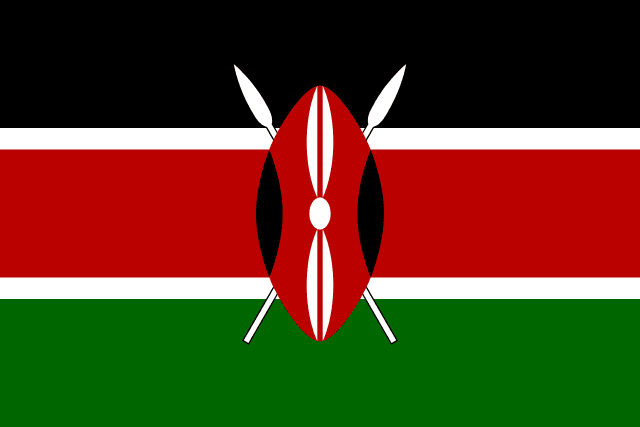

Kenya
Republic of Kenya
Africa
59,279,812
09:25 UTC+3
+254
.ke
Mount Kenya
5,199 m · 17,057 ft
Indian Ocean
0 m · 0 ft
5,425,261
Nairobi · 2026
5,425,261
Nairobi · 2026
Location
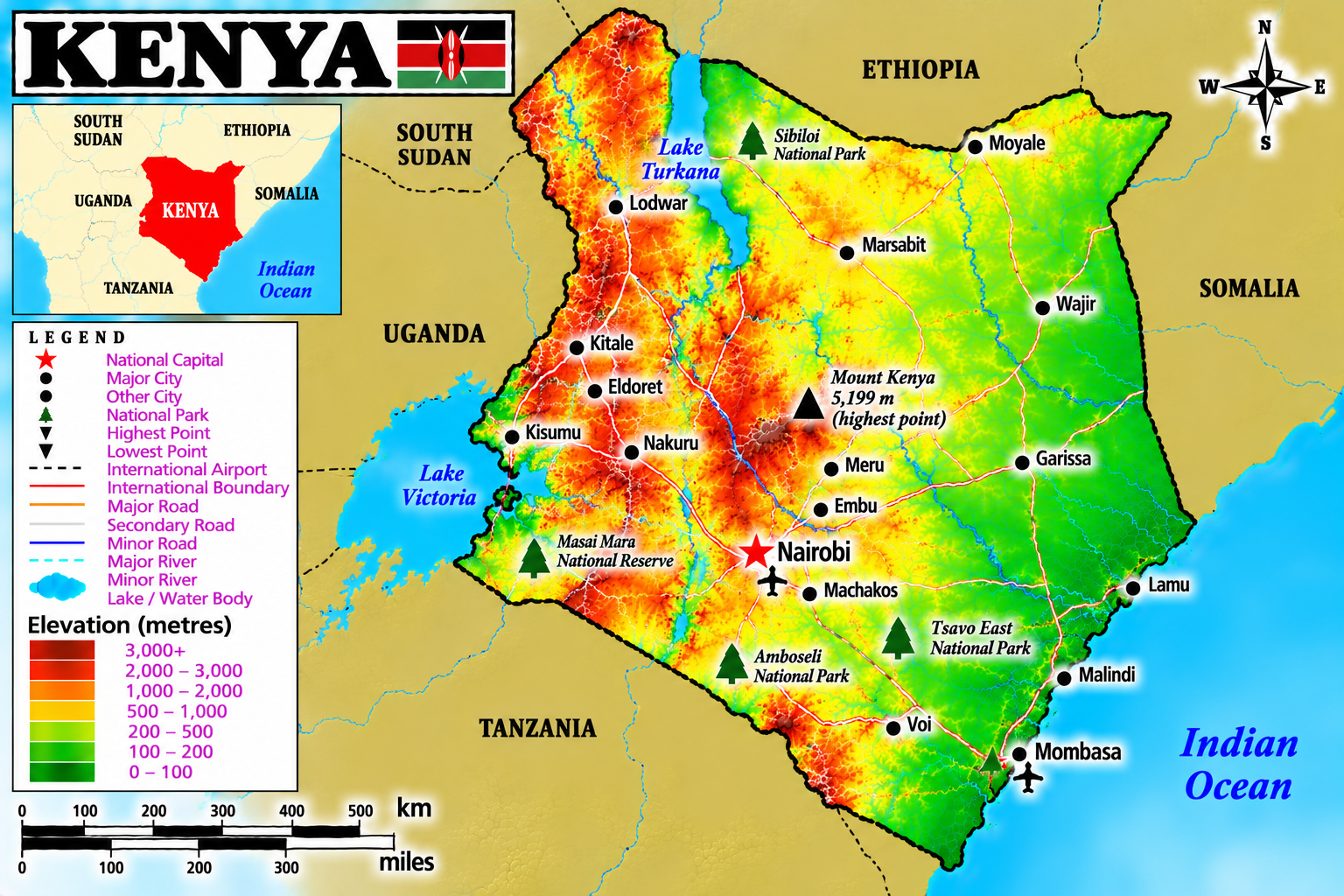
Kenya — Detailed Physical Map
Mount Kenya, the Rift Valley and Lake Turkana, Maasai Mara and Tsavo parks, the Indian Ocean coast, major cities and the capital Nairobi
Tourist Attractions

This world-renowned reserve is famous for its exceptional population of lions, leopards, and cheetahs, and the annual Great Migration of wildebeest and zebras.
Witnessing the dramatic Great Migration across the vast savannah plains is a once-in-a-lifetime experience.
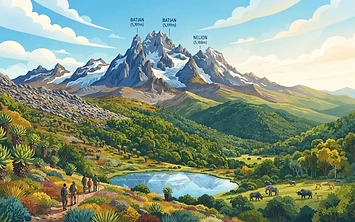
Surrounding Africa's second-highest peak, this UNESCO World Heritage site features diverse ecosystems ranging from alpine meadows to glaciers.
The park offers breathtaking trekking opportunities through stunning mountain scenery and unique high-altitude flora.

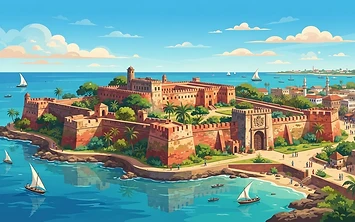
Constructed by the Portuguese in 1593, this formidable fort is a UNESCO World Heritage site that serves as a powerful symbol of colonial and maritime history.
Explore the extensive collection of artifacts and impressive architecture that reveal centuries of Indian Ocean trade history.

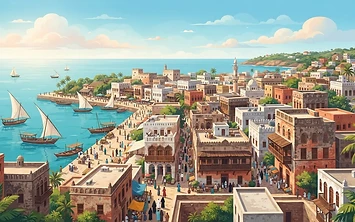
As the oldest and best-preserved Swahili settlement in East Africa, this town is built from coral stone and mangrove timber.
Wander through the narrow, car-free streets to experience the unique blend of Swahili, Arabic, and European architectural influences.


This unique protected area is one of the only national parks in the world located within a capital city's boundaries, allowing wildlife to roam against a backdrop of skyscrapers.
You can spot lions, rhinos, and giraffes with the iconic Nairobi city skyline visible in the distance.


Located at the foot of the Ngong Hills, this museum is the former home of the Danish author who wrote the famous memoir 'Out of Africa'.
Visitors can tour the original farmhouse and learn about the colonial-era history and literary legacy of the estate.
Geography
Nature
Mount Kenya
5,199 m / 17,057 ft
6.3% of land
≈ 36,563 km² of forest
FAO / World Bank, forest area (% of land area)
Explore the Nature Atlas1,000 km621 mi
Rises in the Aberdare Mountains and empties into the Indian Ocean.
620 km385 mi
Flows through Tsavo East National Park before reaching the Indian Ocean.
257 km160 mi
Originates from the Cherangani Hills and flows into Lake Victoria.
6,405 km²2,473 sq mi · 109 m deep
Largest permanent desert lake and the largest alkaline lake in the world.
68,800 km²26,564 sq mi · 80 m deep
World's largest tropical lake and a major reservoir for the Nile River.
45 km²17 sq mi · 3 m deep
Famous for its massive flocks of flamingos that feed on algae.
273 m896 ft
Tallest waterfall in Kenya, located within the Aberdare National Park.
74 m243 ft
Located on the Ewaso Nyiro River near the town of Nyahururu.
River lengths are whole-river figures, including any section beyond Kenya. Researched reference figures. Tap any name for where its name comes from and a Google Maps link.
Major Cities
- 1Capital
Nairobi City
5,603,5022026
MapKenya's capital city serves as a major commercial hub and features the unique Nairobi National Park within its borders.
- 2
Meru
2,088,6602026
MapAgriculture thrives in this region, which is famous for its productive tea and coffee plantations near Mount Kenya.
- 3
Mombasa
1,478,6072026
MapHistorical coastal trade center hosting the Kilindini Harbour and the iconic seventeenth-century Fort Jesus fortress.
- 4
Nakuru
809,8252026
MapUrban center situated near Lake Nakuru, globally celebrated for its vast populations of flamingos and abundant wildlife diversity.
- 5
Uasin Gishu
675,0732026
MapProminent highland city recognized internationally as a training base for world-class long-distance runners and elite athletes.
- 6
Kisumu
544,9022026
MapVital port city located on the shores of Lake Victoria serving as a primary center for fishing and trade.
- 7
Kiambu
453,4202026
MapHistorical administrative site known for its significant role in the establishment of early colonial mission stations and educational institutions.
- 8
Wajir
198,4222026
MapKey transit point in northern Kenya serving as a vital trading post for pastoralist communities in Wajir County.
- 9
Kajiado
196,6392026
MapRapidly expanding residential suburb located south of Nairobi that caters to a growing middle-class population.
- 10
Nakuru
178,5922026
MapCool highland town historically associated with large-scale agricultural production, particularly pyrethrum and dairy farming.
- 11
Kajiado
175,9762026
MapThriving commercial town on the outskirts of Nairobi known for its fast-paced real estate development and manufacturing sectors.
- 12
Kiambu
168,4942026
MapHeartland of coffee production near the capital, reflecting a deep historical connection to the country's agricultural export economy.
City populations are the latest official, UN or national-statistics estimates (2026–2026) compounded to 2026 at 2.2% a year (the nation's annual population growth rate); figures without a published update come from the open cities database (2020-era estimates) and are projected the same way.
Economy
Main exports
Kenya's leading export commodities and products.
Tap any export to learn more. Spot prices in USD only for Live Data subscribers.
Main imports
Kenya's leading import commodities and products.
Tap any import to learn more.
Military
Historical Timeline
2000000 BCE
Early Hominid Presence at Lake Turkana
Archaeological findings at Lake Turkana reveal the earliest evidence of hominids in the region, establishing Kenya as a cradle of human evolution. These discoveries include remains of Homo habilis and Homo erectus.
2000 BCE
Arrival of Cushitic Speaking Peoples
Pastoralist groups speaking Cushitic languages migrated into the region from the north, introducing livestock farming to the area. This marked a significant shift in the subsistence patterns of early inhabitants.
1000
Development of Swahili City-States
The growth of coastal towns like Mombasa and Lamu fostered intense trade links across the Indian Ocean with Arabia, Persia, and India. This period saw the emergence of the unique Swahili culture and language.
1895
Establishment of the East Africa Protectorate
The British government established the East Africa Protectorate to secure the source of the Nile and facilitate trade. This formal act initiated formal British colonial administration over the territory.
1902
Construction of the Uganda Railway
The completion of the railway from Mombasa to Lake Victoria significantly altered the regional economy and demographics. It encouraged the settlement of European farmers in the fertile highlands.
1952
Declaration of the Mau Mau Uprising
The Mau Mau rebellion began as a militant anti-colonial movement led by the Kikuyu people against British rule. The conflict led to a state of emergency and accelerated the path toward national liberation.
1963
Kenya Gains Independence
Kenya achieved independence from Great Britain on December 12, with Jomo Kenyatta serving as the first Prime Minister. This event transitioned the nation into a sovereign state under the Kenya African National Union.
1964
Establishment of the Republic of Kenya
Kenya became a republic, with Jomo Kenyatta inaugurated as the country's first President. This constitutional change solidified the governance structure of the newly independent nation.
2002
Democratic Transition of Power
Mwai Kibaki won the presidential election, marking the first peaceful transfer of power to an opposition party in Kenya's history. This signaled a major shift toward a multi-party democratic political system.
2010
Promulgation of the New Constitution
A new constitution was overwhelmingly approved by voters, introducing significant reforms such as devolution of power to 47 counties. This framework sought to address historical grievances and improve governmental transparency.
2013
Implementation of the Devolved Government System
Following the 2013 general election, the county-based governance system officially commenced operation. This restructuring aimed to decentralize resources and political authority throughout the nation.
2022
Election of William Ruto
William Ruto was declared the winner of the presidential election, following a competitive process that went through the Supreme Court. The transition marked the fifth administration since the nation's independence.
2024
U.S.-Kenya State Visit
President Joe Biden hosted President William Ruto for a state visit in May 2024, marking the 60th anniversary of diplomatic relations between the two nations.
2024
Anti-Finance Bill Protests and Parliament Invasion
Widespread public protests against the Finance Bill 2024 culminated in demonstrators storming the Parliament buildings in Nairobi on June 25, 2024.
2024
IASP World Conference on Science Parks
Konza Technopolis hosted the 41st IASP World Conference on Science Parks and Areas of Innovation in September 2024, highlighting Kenya's role in technology and research.
2025
June 2025 civil unrest
The death of a blogger in police custody triggered public protests and increased scrutiny of Kenyan security forces. These events occurred alongside broader anti-government demonstrations regarding the national finance bill.
2026
Establishment of the National Infrastructure Fund
In March 2026, Kenya implemented a new financing strategy for national development through the creation of the National Infrastructure Fund. This initiative aims to build long-term national assets.
National Anthem
Ee Mungu Nguvu Yetu
Graham Hyslop, Thomas Kalume, Peter Kibukosya, John Seii and George Senoga-Zake
Graham Hyslop, Thomas Kalume, Peter Kibukosya, John Seii and George Senoga-Zake
1963
Ee Mungu nguvu yetu Ilete baraka kwetu. Haki iwe ngao na mlinzi Natukae na undugu Amani na uhuru Raha tupate na ustawi. Amkeni ndugu zetu Tufanye sote bidii Nasi tujitoe kwa nguvu Nchi yetu ya Kenya Tunayoipenda Tuwe tayari kuilinda. Natujenge taifa letu Ee, ndio wajibu wetu Kenya istahili heshima Tuungane mikono Pamoja kazini Kila siku tuwe na shukrani.
The Kenyan national anthem was commissioned by a government steering committee following the country's independence from Britain. It was composed by a five-member music commission led by Graham Hyslop, which drew inspiration from a traditional Pokomo folk melody used by mothers to lull their children to sleep. The anthem was officially adopted in 1963 as a symbol of national unity and sovereignty. It was originally written in both Swahili and English, and the versions have remained largely unchanged since its adoption. The lyrics emphasize themes of justice, unity, peace, and service to the nation. Today, it serves as a central component of national ceremonies and is deeply respected as a unifying emblem of the Kenyan identity.
National Holidays
Commemorates the day in 1963 when Kenya attained internal self-rule from British colonial rule. It serves as a reminder of the country's journey toward full independence.
A day set aside to celebrate the diverse cultural heritage and traditions of the various communities in Kenya.
Also known as Heroes' Day, it honors all Kenyans who contributed toward the struggle for the country's independence and those who have made significant contributions to the nation.
Marks the date Kenya became a republic in 1964, one year after gaining independence from Great Britain. It is the country's most significant national holiday.
Good News Today
Kenya Beehive Project Boosts Biodiversity and Farmer Incomes
A sustainable beekeeping initiative in Kenya has successfully increased regional bee populations and improved crop pollination across 5,000 hectares. The project provides rural families with training and equipment, resulting in a measurable increase in household income through the sale of honey and wax.
Fun Facts
Global Hub for Long-Distance
The high-altitude region of Iten is globally famous as the 'Home of Champions' for producing the world's most elite long-distance runners.
The Great Migration Spectacle
The annual Wildebeest Migration across the Masai Mara is often described as one of the Seven Natural Wonders of the World.
Renowned Kenyan Coffee Beans
Kenya is world-famous for its high-quality coffee beans, which are noted for their intense flavor and unique acidic profile due to high-altitude volcanic soil.
The Cradle of Mankind
The Turkana Basin in northern Kenya has provided some of the most significant fossil evidence regarding the early evolution of the human species.
Lake Nakuru's Pink Shores
Lake Nakuru is famous for attracting thousands of lesser and greater flamingos, turning the shorelines into a shimmering blanket of pink.
Diani Beach Coastal Beauty
Diani Beach is consistently voted one of the top beach destinations in Africa, known for its pristine white sands and turquoise coral reefs.
Tea Production Powerhouse
Kenya is one of the world's leading exporters of black tea, with tea plantations covering vast, picturesque rolling hills in the highlands.
Elephant Sanctuary Success
The Sheldrick Wildlife Trust in Nairobi is a world-renowned rehabilitation center for orphaned baby elephants and rhinos.
The Lunatic Express Railway
The historic Uganda Railway, built in the late 19th century, was nicknamed the 'Lunatic Express' due to the immense engineering challenges of its construction.
Mount Kenya's Second Summit
Mount Kenya is the second-highest peak in Africa and is an ancient dormant volcano that offers unique equatorial glaciated peaks.
Chuckies Trivia Quiz
Chuckies Trivia Quiz
Fifteen questions on Kenya — five easy, five medium, five hard. How far can you get?
Sports & Live Events
Language
Counting to 10
1
1
= 10 (n = 0)
World Dictionary
Discover and translate any word into all supported languages.