
Chile
Republic of Chile
South America
19,996,571
03:28 UTC-3
+56
.cl
Ojos del Salado
6,893 m · 22,615 ft
Pacific Ocean
0 m · 0 ft
7,320,165
Santiago · 2026
7,320,165
Santiago · 2026
Location
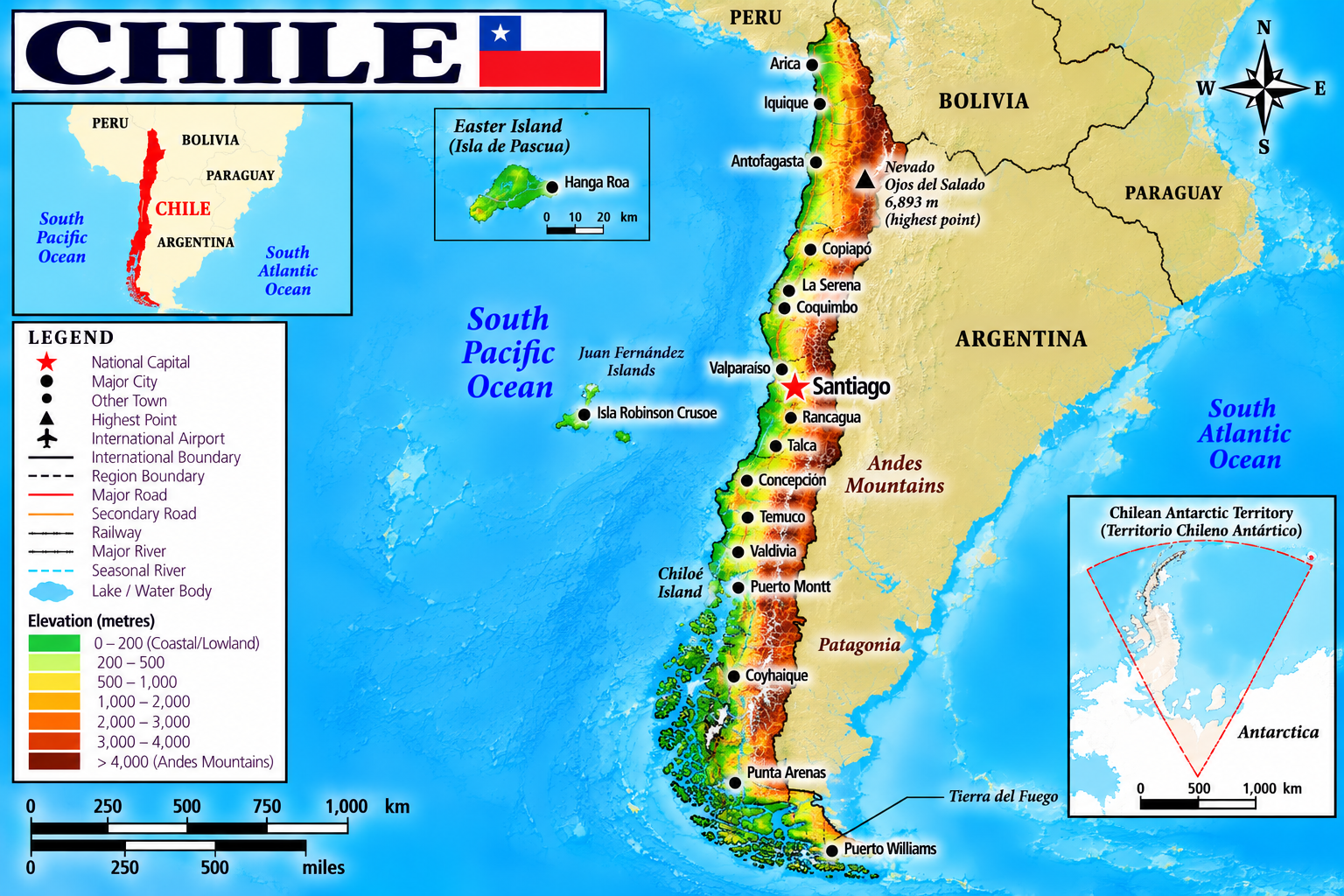
Chile — Detailed Physical Map
Andes Mountains, Atacama Desert, Patagonia, Easter Island, regions, major cities and the capital Santiago
Tourist Attractions

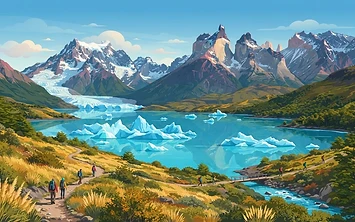
A world-renowned wilderness area featuring towering granite peaks, bright blue icebergs, and golden pampas. It is a premier destination for hikers and nature enthusiasts seeking dramatic landscapes.
The iconic granite towers provide one of the most spectacular mountain vistas on the planet.

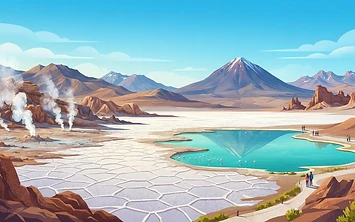
Known as the driest non-polar desert in the world, this region offers otherworldly landscapes including salt flats, geysers, and high-altitude lagoons. It is also one of the best places on Earth for stargazing.
The Valle de la Luna offers a surreal, moon-like landscape that is breathtaking at sunset.

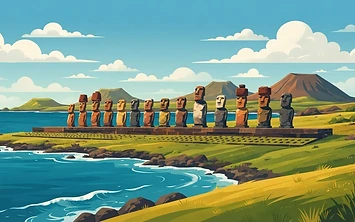
A remote volcanic island famous for its nearly 900 monumental statues called moai, created by the early Rapa Nui people. It is a place of profound archaeological mystery and cultural significance.
Seeing the massive moai statues standing against the backdrop of the Pacific Ocean is a once-in-a-lifetime experience.


These stunning geological formations were sculpted by water erosion over thousands of years, creating intricate swirls of blue and white marble. The caves are accessible only by boat or kayak from the turquoise waters of the lake.
The vibrant, shifting reflections of the turquoise water against the marble walls create a unique visual spectacle.

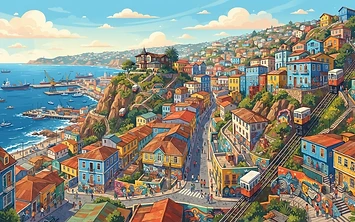
A colorful, bohemian port city built on steep hills, famous for its labyrinthine streets, vibrant street art, and historic funicular elevators. It is a UNESCO World Heritage site that served as the home of poet Pablo Neruda.
Riding the historic funiculars offers both a charming local experience and panoramic views of the bay.

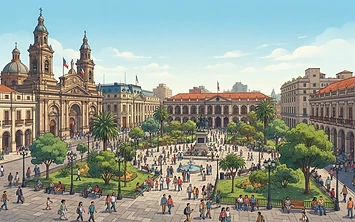
The historic heart of Chile's capital, this square serves as the city's 'kilometer zero' and is surrounded by significant colonial-era architecture, including the Metropolitan Cathedral. It is a bustling hub that reflects the foundational history of the nation.
The plaza is the perfect starting point to explore the city's most important civic and religious landmarks.
Geography
Nature
Ojos del Salado
6,893 m / 22,615 ft
25.0% of land
≈ 189,026 km² of forest
FAO / World Bank, forest area (% of land area)
Explore the Nature Atlas440 km273 mi
The longest river in Chile flowing through the Atacama Desert.
380 km236 mi
Historically considered the border between the Spanish Empire and the Mapuche people.
240 km149 mi
Originates in the high Andes and provides significant irrigation for central agriculture.
1,850 km²714 sq mi · 590 m deep
Known for the Marble Caves carved by water over thousands of years.
860 km²332 sq mi · 317 m deep
The second largest lake in the country located in the Lake District.
80 km²31 sq mi · 90 m deep
An artificial reservoir created by the damming of the Rapel River.
35 m115 ft
Consists of four distinct waterfalls located on the Laja River.
10 m33 ft
Features rapids flowing over volcanic rock formations near Osorno Volcano.
River lengths are whole-river figures, including any section beyond Chile. Researched reference figures. Tap any name for where its name comes from and a Google Maps link.
Major Cities
- 1
Región Metropolitana
573,6942026
MapHouses the largest population of any municipality in the nation and serves as a major suburban district.
- 2
Región Metropolitana
525,2132026
MapCommemorates a decisive 1818 battle that secured national independence with the Votive Temple of Maipu landmark.
- 3Capital
Región Metropolitana
443,2562026
MapServes as the political, cultural, and financial center of Chile located in a large valley surrounded by mountains.
- 4
Antofagasta
436,3312026
MapHosts a major mining center driven by the extraction of copper and nitrates from the surrounding Atacama Desert.
- 5
Región Metropolitana
369,6692026
MapFunctions as a primarily residential area in the southeastern sector of the capital city with strong commercial activity.
- 6
Valparaíso
348,4592026
MapKnown as the Garden City, it attracts tourists to its coastal beaches and the famous annual music festival.
- 7
Región Metropolitana
337,3482026
MapOperates as a significant industrial and railway hub located to the south of the metropolitan capital area.
- 8
Región Metropolitana
293,9172026
MapContains the Sanhattan financial district characterized by its high-rise skyscrapers and upscale commercial shopping centers.
- 9
Valparaíso
287,7952026
MapFeatures colorful hillside neighborhoods and a historic port designated as a UNESCO World Heritage site.
- 10
Araucanía
284,8272026
MapFunctions as the central gateway to the Araucania region and a hub for the local Mapuche cultural heritage.
- 11
Libertador General Bernardo O’Higgins
260,5862026
MapHosts the historical site of a pivotal 1814 battle and serves as a key hub for copper mining.
- 12
Biobío
237,3562026
MapActs as the industrial and educational hub of the Biobio region with a history of significant seismic activity.
City populations are the latest official, UN or national-statistics estimates (2024–2024) compounded to 2026 at 0.5% a year (the nation's annual population growth rate); figures without a published update come from the open cities database (2020-era estimates) and are projected the same way.
Economy
Main exports
Chile's leading export commodities and products.
Tap any export to learn more. Spot prices in USD only for Live Data subscribers.
Main imports
Chile's leading import commodities and products.
Tap any import to learn more.
Military
Historical Timeline
12500 BCE
Arrival of Monte Verde Inhabitants
Archaeological evidence at the Monte Verde site confirms the presence of early human hunter-gatherer societies in Chile. These findings indicate some of the earliest human settlements in the Americas.
1541
Founding of Santiago
Spanish conquistador Pedro de Valdivia founded the city of Santiago de Nueva Extremadura. This established a permanent Spanish base of operations in the region.
1818
Chilean Independence Declaration
After a protracted struggle against Spanish royalist forces, Chile officially declared its independence. Bernardo O'Higgins became the country's first Supreme Director.
1879
War of the Pacific
Chile engaged in a major conflict against Bolivia and Peru over mineral-rich territories in the Atacama Desert. The war resulted in significant territorial expansion for Chile.
1925
Constitution of 1925
A new constitution was enacted to modernize the Chilean state and separate church and state. It shifted power from the legislative branch to the presidency.
1970
Election of Salvador Allende
Salvador Allende became the first Marxist president to be elected to office in a liberal democracy in Latin America. His presidency initiated radical economic and social reforms.
1973
Military Coup D'état
A violent military coup led by General Augusto Pinochet overthrew the democratically elected government of Salvador Allende. This began a period of authoritarian rule lasting until 1990.
1990
Return to Democracy
Following a national plebiscite, Patricio Aylwin was inaugurated as president, ending the military dictatorship. This marked the transition to a democratic political system.
2006
Election of Michelle Bachelet
Michelle Bachelet became the first woman to be elected as the President of Chile. Her victory marked a significant milestone for gender representation in Chilean politics.
2019
Estallido Social Protest Movement
Massive nationwide protests erupted, driven by demands for greater social equality and constitutional reform. These protests fundamentally changed the national political agenda.
2022
Inauguration of Gabriel Boric
Gabriel Boric was inaugurated as the youngest president in the history of Chile. His election represented a shift in the country's political leadership toward a younger generation.
2023
Second Constitutional Referendum
Chilean voters rejected a second proposed draft of a new constitution in a national plebiscite. The failure to approve the new document maintained the existing 1980 constitution framework.
National Anthem
Himno Nacional de Chile
Eusebio Lillo
Ramón Carnicer
1847
Puro, Chile, es tu cielo azulado, puras brisas te cruzan también, y tu campo de flores bordado es la copia feliz del Edén. Majestuosa es la blanca montaña que te dio por baluarte el Señor, y ese mar que tranquilo te baña te promete futuro esplendor. Dulce Patria, recibe los votos con que Chile en tus aras juró: que o la tumba serás de los libres o el asilo contra la opresión.
The current Chilean national anthem resulted from a long process of development beginning with a composition by Manuel Robles in 1820. In 1828, the Spanish composer Ramón Carnicer was commissioned to create a new musical score while living in exile in London. The lyrics were subsequently rewritten by the Chilean poet Eusebio Lillo in 1847 to replace earlier, more inflammatory verses written by Bernardo de Vera y Pintado. The anthem was officially adopted in 1847 and has remained in use ever since. The text centers on the natural beauty of the country and the commitment of its people to liberty and sovereignty. It is performed at official state ceremonies, sporting events, and cultural occasions as a symbol of national identity. While there have been minor adjustments to the lyrics over the decades, the version by Lillo and Carnicer remains the definitive national song.
National Holidays
A public holiday dedicated to celebrating the achievements of workers and the labor movement. It is marked by demonstrations and public gatherings across the country.
Commemorates the Battle of Iquique, which took place in 1879 during the War of the Pacific. It honors the naval heroism of Arturo Prat and the crew of the Esmeralda.
Established to honor the cultural heritage and traditions of Chile's indigenous communities. The date coincides with the winter solstice, a significant time for many native groups.
Celebrates the proclamation of the First Government Junta of 1810, which marked the beginning of Chile's independence process from Spanish colonial rule.
Also known as the Day of the Glories of the Army, this holiday honors the Chilean military. It is traditionally observed with a large military parade in Santiago.
Good News Today
Chile's driest desert blooms with 200 plant species
Record rainfall from a recent weather event has triggered the Atacama Desert's most vivid flowering in 30 years. This phenomenon has awakened seeds that had remained dormant in the arid landscape since before the year 2000.
Fun Facts
Global Astronomy Capital Hub
Because of its clear, dry skies in the Atacama Desert, Chile hosts more than half of the world's astronomical observation infrastructure.
The Birthplace of Potatoes
Genetic research suggests that the common potato originated in the southern regions of Chile and nearby Andean areas.
Carménère Wine Rediscovery Tale
Thought to be extinct in Europe due to pests, the Carménère grape was rediscovered in Chile in 1994, where it thrives today.
Extremely Long Pacific Coastline
Chile is over 4,200 kilometers long, yet it averages only 177 kilometers in width, creating a unique climate strip.
World's Most Active Volcanoes
Chile contains one of the largest chains of volcanoes in the world, with over 2,000 volcanic centers dotting the Andes.
Magellanic Penguins in North
While associated with the cold south, colonies of Humboldt and Magellanic penguins can be found along the rocky Chilean coastline.
Houses Built on Stilts
In the archipelago of Chiloé, traditional wooden houses called palafitos are built on stilts over the water to accommodate tide changes.
Atacama's Flowering Desert Phenomenon
When rainfall occurs in the extremely arid Atacama Desert, millions of flowers bloom suddenly in a phenomenon known as the Desierto Florido.
Poetry Nobel Prize Winners
Chile is famously known as the country of poets, having produced two Nobel Prize winners in Literature: Gabriela Mistral and Pablo Neruda.
Summer Skiing World Class
Because of its location in the Southern Hemisphere, visitors can enjoy world-class skiing in the Andes during the Northern Hemisphere summer.
Chuckies Trivia Quiz
Chuckies Trivia Quiz
Fifteen questions on Chile — five easy, five medium, five hard. How far can you get?
Sports & Live Events
Language
Counting to 10
1
1
= 10 (n = 0)
World Dictionary
Discover and translate any word into all supported languages.