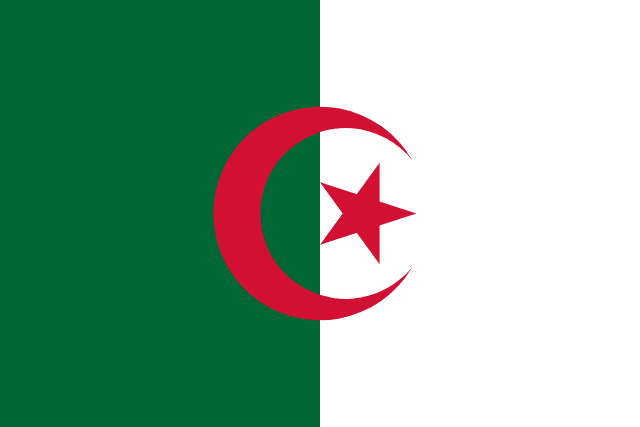

Algeria
People's Democratic Republic of Algeria
Africa
48,069,727
03:14 UTC+1
+213
.dz
Mount Tahat
2,908 m · 9,541 ft
Chott Melrhir
-40 m · -131 ft
2,432,423
Algiers · 2026
4,663,147
Algiers · 2026
Location
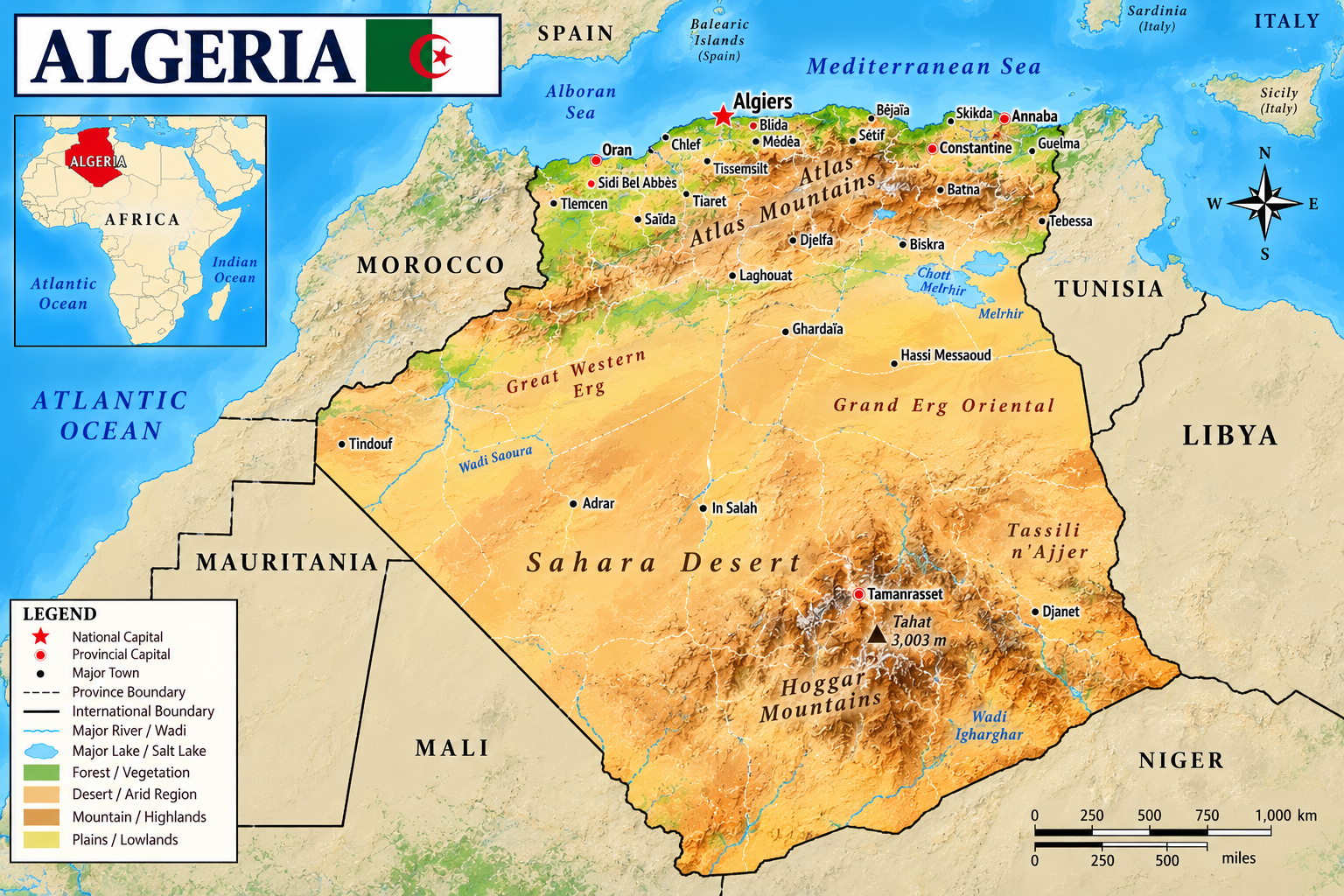
Algeria — Detailed Physical Map
Terrain, Atlas and Hoggar mountains, Sahara ergs, wadis, provincial capitals and major towns
Tourist Attractions

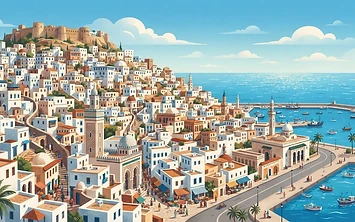
A UNESCO World Heritage site, this historic medina is a dense maze of narrow alleys, Ottoman-era palaces, and traditional houses overlooking the Mediterranean. It serves as the cultural heart of the capital and a testament to Algeria's complex history.
The stunning blend of Ottoman and Moorish architecture found within its ancient, winding streets.

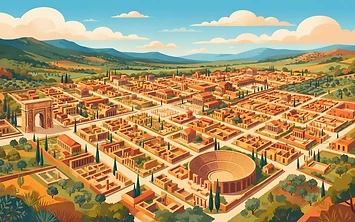
Often called the 'Pompeii of Africa,' this remarkably preserved Roman city was founded by Emperor Trajan in 100 AD. Its grid-like urban planning remains so precise that it is still clearly visible from the air today.
The perfectly preserved Roman triumphal arch and the massive library that once held thousands of scrolls.

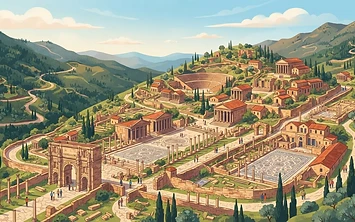
Formerly known as Cuicul, this UNESCO-listed Roman city is uniquely adapted to the rugged, mountainous terrain of the Kabylie region. It features exceptionally well-preserved temples, basilicas, and intricate floor mosaics.
The dramatic mountain backdrop that makes this Roman site visually distinct from any other in the world.

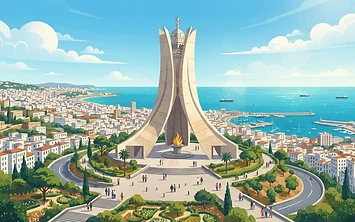
This iconic concrete monument, shaped like three stylized palm leaves, commemorates the Algerian War of Independence. It stands as a prominent symbol of the nation's sovereignty and offers panoramic views of the city and the sea.
The observation deck at the top provides a breathtaking bird's-eye view of the Bay of Algiers.

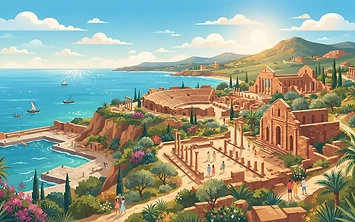
Located along the Mediterranean coast, this ancient site features a unique fusion of Phoenician, Roman, and Byzantine ruins. It is a UNESCO World Heritage site that offers a serene atmosphere where ancient history meets the sea.
The picturesque ruins set directly against the backdrop of the sparkling Mediterranean coastline.

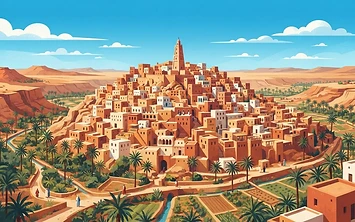
This UNESCO-listed region consists of five ancient fortified cities, or 'ksour,' built in the northern Sahara. The architecture is famous for its unique, minimalist design and traditional way of life that has been preserved for centuries.
The striking, uniform whitewashed architecture of the fortified desert settlements.
Geography
Nature
Mount Tahat
2,908 m / 9,541 ft
0.8% of land
≈ 19,054 km² of forest
FAO / World Bank, forest area (% of land area)
Explore the Nature Atlas725 km450 mi
Originates in the Saharan Atlas mountains and flows into the Mediterranean Sea.
6,700 km²2,587 sq mi
Largest lake in Algeria acting as a seasonal endorheic salt lake.
300 km²116 sq mi
Endorheic salt lake located in the northwest near the city of Oran.
—
Located within the Tlemcen National Park surrounded by lush forest vegetation.
River lengths are whole-river figures, including any section beyond Algeria. Researched reference figures. Tap any name for where its name comes from and a Google Maps link.
Major Cities
- 1Capital
Alger
2,961,3242026
MapServing as the capital, this coastal metropolis features the historic Casbah, a UNESCO World Heritage site overlooking the Mediterranean Sea.
- 2
Oran
942,3402026
MapActing as a major Mediterranean port and economic hub, this vibrant city is famously associated with the birth of Raï music.
- 3
Annaba
842,9132026
MapHosting the historic Basilica of St. Augustine, this coastal city is a key center for the Algerian steel industry.
- 4
Djelfa
653,8442026
MapFunctioning as a vital crossroads between the northern Tell and the Sahara, this city is a hub for pastoral sheep farming.
- 5
Blida
553,9662026
MapFamous for its lush orange groves and proximity to the Chréa National Park, this region serves as a major agricultural center.
- 6
Constantine
397,0562026
MapKnown as the City of Bridges, this ancient settlement is dramatically perched above the deep Rhumel River gorge.
- 7
Batna
385,8432026
MapLocated in the Aures Mountains, this city serves as the gateway to the ancient Roman ruins of Timgad.
- 8
Sétif
336,2942026
MapHousing the famous Ain El Fouara fountain, this high-plateau city is a significant industrial and commercial hub in eastern Algeria.
- 9
Tébessa
294,7772026
MapContaining some of the best-preserved Byzantine fortifications in North Africa, this border city reflects a rich history of Roman influence.
- 10
Sidi Bel Abbès
267,1042026
MapRenowned for its former role as the headquarters of the French Foreign Legion, this city now serves as a regional agricultural market.
- 11
Biskra
265,6322026
MapRecognized as the gateway to the Sahara, this oasis city is celebrated for its production of high-quality Deglet Nour dates.
- 12
Tiaret
249,1512026
MapSituated on the high plateaus, this city is historically significant for its world-renowned stud farms and Arabian horse breeding.
City populations are the latest official, UN or national-statistics estimates (2026–2026) compounded to 2026 at 1.6% a year (the nation's annual population growth rate); figures without a published update come from the open cities database (2020-era estimates) and are projected the same way.
Economy
Main exports
Algeria's leading export commodities and products.
Tap any export to learn more. Spot prices in USD only for Live Data subscribers.
Main imports
Algeria's leading import commodities and products.
Tap any import to learn more.
Military
Historical Timeline
10000 BCE
Arrival of the Amazigh peoples
Archaeological evidence suggests that the ancestors of the Amazigh people, known as the Berbers, first inhabited the North African territory of modern-day Algeria. They established distinct cultures and languages that have defined the region for millennia.
202 BCE
Unification of the Numidian Kingdom
King Masinissa unified the nomadic tribes of the region into the powerful Kingdom of Numidia. This marked the formation of the first major centralized state in the territory of Algeria.
647
The Arab Islamic Conquest
Beginning in the mid-7th century, the Rashidun Caliphate launched campaigns that brought Islam and the Arabic language to the region. This transformed the socio-cultural landscape of the indigenous population over the following centuries.
1516
Establishment of the Regency of Algiers
The Oruç Reis brothers established the Regency of Algiers under the influence of the Ottoman Empire. This period solidified Algiers as a major Mediterranean power for three centuries.
1830
Beginning of French Colonial Rule
French forces invaded Algiers, initiating a colonial period that would last for over 130 years. This event led to profound structural changes in the administrative and social organization of the country.
1954
Outbreak of the Algerian War
The National Liberation Front initiated a nationwide armed revolution against French colonial rule. The conflict resulted in widespread casualties and eventually forced negotiations for Algerian independence.
1962
Algerian Independence
Following the Evian Accords, Algeria officially gained independence from France after a brutal eight-year war. Ahmed Ben Bella became the first president of the newly sovereign Algerian state.
1991
Beginning of the Algerian Civil War
The cancellation of legislative elections, in which the Islamic Salvation Front was poised to win, triggered a decade-long conflict. This period was marked by significant violence and instability across the country.
2019
Hirak Protests and Political Change
Mass nationwide protests known as the Hirak movement forced the resignation of long-time President Abdelaziz Bouteflika. These protests sought major political reforms and an end to government corruption.
2021
Legislative Elections under New Constitution
Following constitutional reforms, Algeria held legislative elections aimed at renewing the political class. The process was part of an effort to address the demands of the Hirak movement.
2024
Presidential Election and Incumbent Re-election
President Abdelmadjid Tebboune was re-elected for a second term in a national presidential poll. The election focused on economic diversification and strengthening the state's role in the region.
2025
Implementation of New Economic Reforms
The Algerian government launched a series of legislative and fiscal initiatives aimed at reducing the country's dependence on hydrocarbons. These measures sought to stimulate private investment and improve the national manufacturing sector.
National Anthem
Qassaman
Moufdi Zakaria
Mohamed Fawzi
1963
Qassaman bin-nazilat-il-mahiqat, Wad-dima' az-zakiyat-it-tahirat, Wal-bunud-il-lami'at-il-khafiqat, Fi-jibal-ina-sh-shamikhat-ish-shahiqat, Nahnu thurna fahayat-un au mamat, Wa-qad 'aqadna al-'azma an tahya al-Jaza'ir, Fash-hadu, fash-hadu, fash-hadu!
Qassaman was written by the Algerian poet Moufdi Zakaria in 1955 while he was imprisoned by French colonial authorities. The poem was written on the walls of his prison cell using his own blood to serve as a rallying cry during the Algerian War of Independence. Egyptian composer Mohamed Fawzi provided the music for the anthem in 1956. Upon independence from France in 1962, the anthem was officially adopted in 1963 by the new Algerian state. The lyrics explicitly reference the revolutionary struggle and the sacrifices made for national sovereignty. It remains a powerful symbol of Algerian national identity and is performed during all major state ceremonies.
National Holidays
This holiday marks the beginning of the Gregorian calendar year.
This day celebrates the social and economic achievements of workers and the international labor movement.
This day commemorates Algeria's independence from France in 1962.
This holiday marks the anniversary of the beginning of the Algerian War of Independence in 1954.
Good News Today
Algeria Hosts Kansas Residents to Repay World Cup Kindness
Algeria welcomed a delegation of residents and officials from Lawrence, Kansas, for a trip of a lifetime to repay the hospitality shown to the Algerian national football team during the 2026 World Cup. The guests were treated to tours of historical sites and cultural landmarks as a gesture of international friendship.
Fun Facts
Largest Country in Africa
Algeria is the largest country on the African continent, with over 80 percent of its land mass comprised of the vast, mesmerizing Sahara Desert.
Casbah of Algiers
The Casbah, a UNESCO World Heritage site, is a maze-like ancient citadel that features narrow, winding streets designed to confuse invaders.
Tassili n'Ajjer Rock Art
The Tassili n'Ajjer national park contains one of the most important groupings of prehistoric cave art in the world, with over 15,000 drawings depicting ancient fauna.
Sahara Cheetah Habitat
The critically endangered Northwest African cheetah is found in small populations in the remote Saharan regions of the Ahaggar Mountains.
Couscous as National Pride
Couscous is the quintessential staple of the Algerian diet, often prepared with intricate variations of vegetables, lamb, and spicy merguez sausages.
The Ghardaia Water Architecture
The M'zab Valley in Ghardaia features unique 'pentapolis' architecture built in a defensive, communal style that has influenced modern urban planning.
A Legacy of Roman Grain
During the Roman Empire, the fertile coastal plains of Algeria were considered the 'breadbasket' of Rome, supplying the capital with vast quantities of wheat.
The Queen of the South
The oasis city of Timimoun is known for its distinct red-ochre buildings and a unique mix of Berber, Arab, and Sudanese cultural influences.
Stargazing in the Desert
Due to the extremely low light pollution in the Sahara, southern Algeria offers some of the most breathtaking and clear night skies for professional astronomy.
Biodiversity in the Tell
Despite the desert interior, the northern coastal strip, known as the Tell, is lush and mountainous, supporting forests of Mediterranean cedar and cork oak.
Chuckies Trivia Quiz
Chuckies Trivia Quiz
Fifteen questions on Algeria — five easy, five medium, five hard. How far can you get?
Sports & Live Events
Language
Counting to 10
1
1
= 10 (n = 0)
World Dictionary
Discover and translate any word into all supported languages.