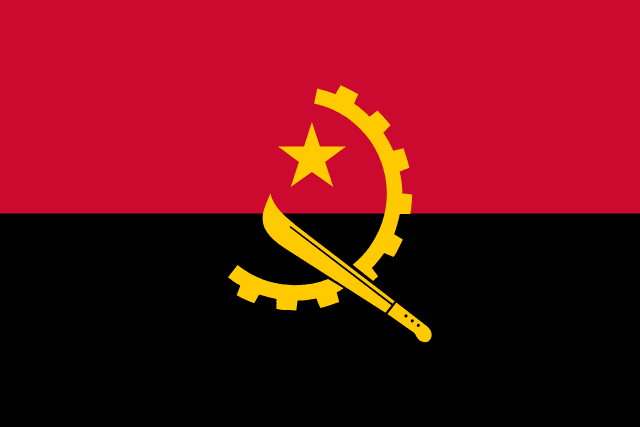
Angola
Africa

37,513,168
12:01 UTC+1
+244
Location
Geography
Economy
Main exports
Angola's leading export commodities and products.
Subscribe to Live Data for live spot prices
Live commodity prices on every nation's exports — $100 AUD/year.
Tap any export to learn more. Spot prices in USD only for Live Data subscribers.
Main imports
Angola's leading import commodities and products.
Tap any import to learn more.
Military
Historical Timeline
50000 BCE
Early human habitation by Khoisan peoples
Archaeological evidence suggests that hunter-gatherer groups, ancestors of the Khoisan, inhabited the region now known as Angola tens of thousands of years ago. These groups established the earliest cultural foundations in the territory before later Bantu migrations.
500
Bantu migration and state formation
Bantu-speaking peoples migrated into the region, introducing advanced iron-working technology and settled agriculture. This transformation facilitated the development of complex social structures and the eventual rise of centralized kingdoms.
1482
Arrival of Portuguese explorers
Diogo Cão became the first European to reach the mouth of the Congo River, marking the beginning of sustained contact between Portugal and the Kingdom of Kongo. This encounter initiated long-term diplomatic and eventually colonial ties.
1575
Founding of Luanda
Paulo Dias de Novais established the settlement of Luanda, which served as a strategic Portuguese military and commercial outpost. The city later became the focal point for the Atlantic slave trade.
1961
Outbreak of the Angolan War of Independence
Anticolonial insurgencies led by the MPLA and UPA triggered a protracted armed struggle against Portuguese colonial rule. The conflict lasted for over a decade and significantly weakened Portugal's administrative control.
1975
Independence from Portugal
Following the Carnation Revolution in Lisbon, Angola gained formal independence on November 11. Control of the new state was immediately contested by rival factions, leading to a long-standing civil war.
1976
MPLA consolidates one-party rule
The Popular Movement for the Liberation of Angola emerged as the dominant political force, establishing a socialist one-party state. This move solidified the country's alignment with the Soviet bloc during the Cold War.
1992
Introduction of multiparty democracy
Angola held its first multiparty general elections as part of a peace effort to end the civil war. The transition to democracy proved fragile, as fighting resumed shortly after the election results.
2002
End of the Angolan Civil War
The death of rebel leader Jonas Savimbi led to a ceasefire and the signing of the Luena Memorandum. This brought a definitive end to nearly three decades of internal military conflict.
2010
Adoption of a new constitution
The government approved a new constitution that abolished direct presidential elections and consolidated power within the executive branch. The document reshaped the political landscape and the role of the National Assembly.
2017
João Lourenço becomes President
João Lourenço succeeded long-serving president José Eduardo dos Santos, marking the first peaceful transition of executive power in the post-independence era. His administration initiated significant anti-corruption and economic reform efforts.
2022
General elections and political continuity
The MPLA secured a victory in the general elections, allowing President João Lourenço to serve a second term. The results were contested by the opposition but maintained the current trajectory of national governance.
National Holidays
Commemorates the 1961 uprising against Portuguese colonial rule, marking the beginning of the armed struggle for independence.
Celebrates the signing of the peace agreement in 2002 which ended the country's long-standing civil war.
A public holiday dedicated to honoring workers and celebrating the labor movement.
Marks the date in 1975 when Angola officially gained its independence from Portugal.
A national holiday observing the birth of Jesus Christ, widely celebrated across the country.
Language
Counting to 10
1
1
= 10 (n = 0)
World Dictionary
Discover and translate any word into all supported languages.
The multilingual Dictionary is a Nations Pro feature.
Upgrade to Pro