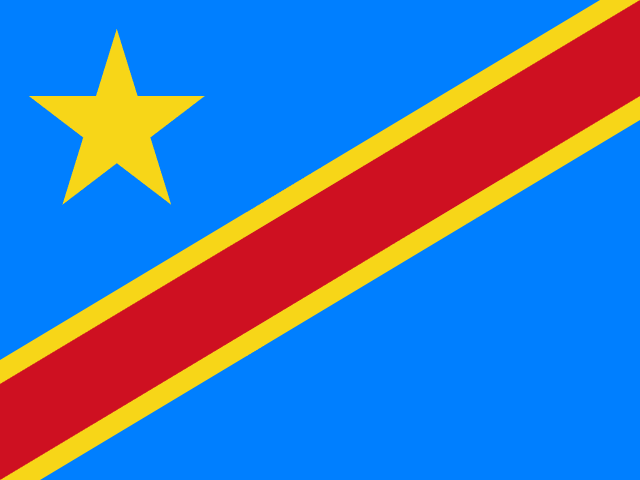

Democratic Republic of the Congo
Africa
117,858,316
03:13 UTC+1
+243
.cd
Mount Stanley
5,109 m · 16,762 ft
Atlantic Ocean
0 m · 0 ft
18,887,504
Kinshasa · 2026
18,887,504
Kinshasa · 2026
Location
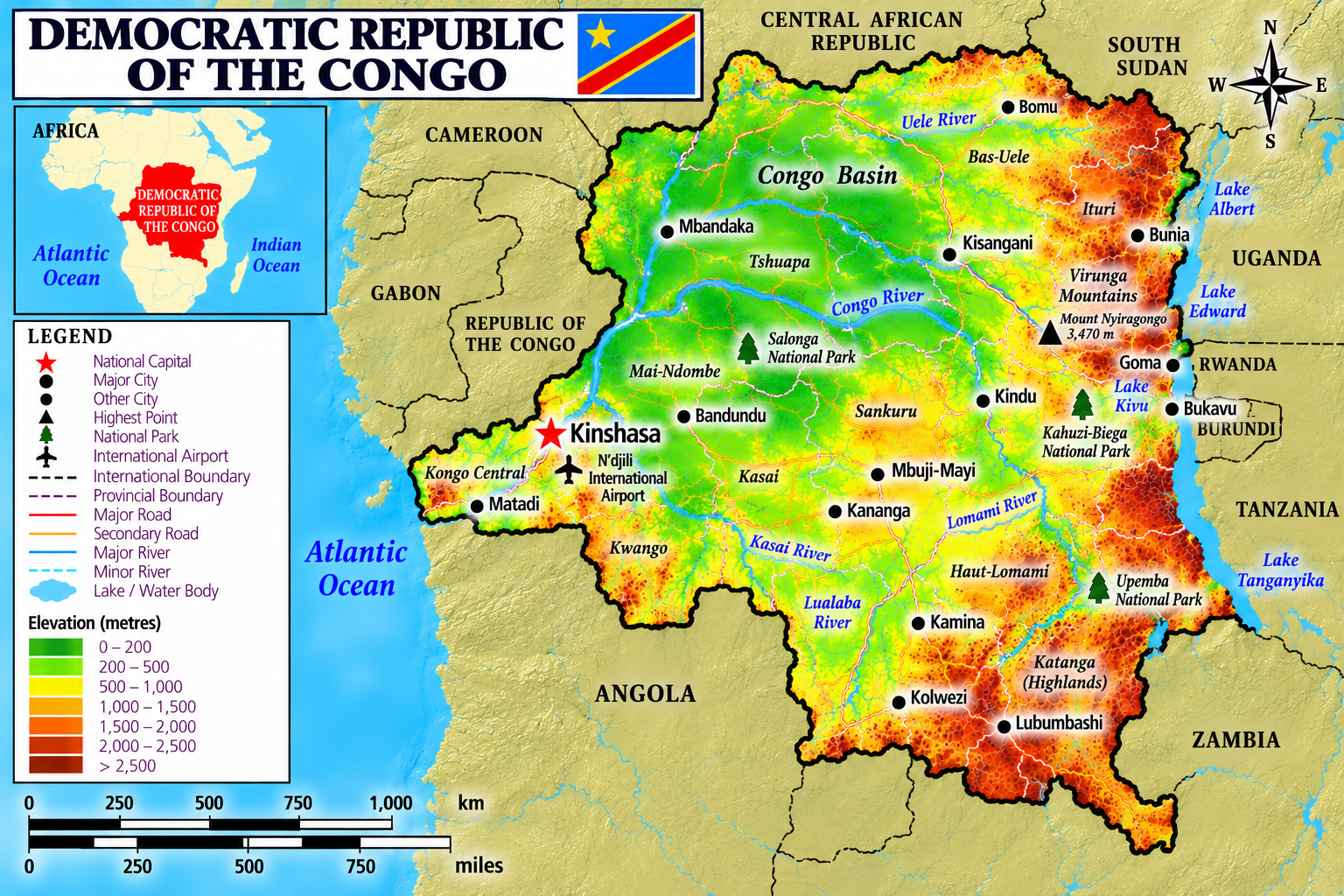
Democratic Republic of the Congo — Detailed Physical Map
Congo Basin, Congo and Lualaba rivers, Virunga Mountains, Katanga highlands, major cities and the capital Kinshasa
Tourist Attractions

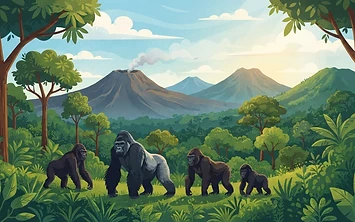
A UNESCO World Heritage site that protects a vast array of wildlife, including approximately 25% of the world's endangered mountain gorillas.
It is the premier destination for tracking mountain gorillas in their natural habitat.

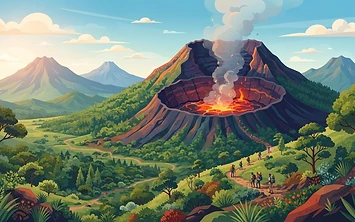
One of the world's most active volcanoes, featuring a massive crater that contains the largest active lava lake on the planet.
The otherworldly glow of the lava lake at night provides an unforgettable trekking experience.

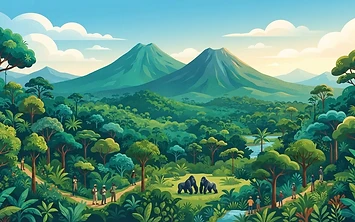
A sprawling UNESCO World Heritage site known for its rich biodiversity, encompassing both mountainous terrain and tropical forests.
It serves as a vital sanctuary for the eastern lowland gorillas.


Located in the heart of the Ituri Forest, this reserve protects the elusive okapi, a unique forest giraffe endemic to the region.
It offers rare anthropological insights into the indigenous Mbuti people who live within the forest.

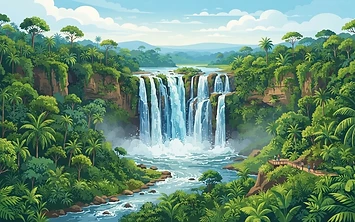
A spectacular and powerful waterfall located in the vicinity of the capital city, surrounded by lush tropical vegetation.
The falls offer a refreshing and scenic natural escape just a short distance from the bustling city of Kinshasa.

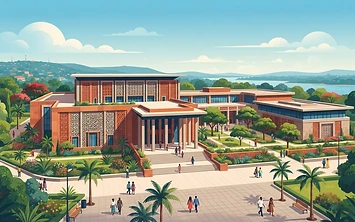
A modern cultural institution dedicated to preserving and showcasing the diverse historical and artistic heritage of the Congolese people.
The museum houses an impressive collection of traditional artifacts, masks, and contemporary art.
Geography
Nature
Mount Stanley
5,109 m / 16,762 ft
55.6% of land
≈ 1,303,741 km² of forest
FAO / World Bank, forest area (% of land area)
Explore the Nature Atlas4,700 km2,920 mi
Second longest river in Africa and deepest in the world.
2,153 km1,338 mi
Major tributary of the Congo River flowing through central Africa.
1,800 km1,118 mi
Main headstream of the Congo River located entirely within the nation.
32,900 km²12,703 sq mi · 1,470 m deep
Second deepest and second oldest freshwater lake in the world.
2,700 km²1,042 sq mi · 480 m deep
Contains large quantities of dissolved methane and carbon dioxide in its deep waters.
2,325 km²898 sq mi · 112 m deep
Located within the Albertine Rift near the border with Uganda.
61 m200 ft
Series of seven cataracts making up the largest waterfall by volume.
270 m886 ft
Collection of massive rapids on the lower Congo River.
River lengths are whole-river figures, including any section beyond Democratic Republic of the Congo. Researched reference figures. Tap any name for where its name comes from and a Google Maps link.
Major Cities
- 1Capital
Kinshasa
21,852,1442026
MapServes as the nation's capital and largest urban center, located along the Congo River across from Brazzaville.
- 2
Kasaï Oriental
3,319,8772026
MapFunctions as a major industrial hub for the extraction and processing of diamonds within the Kasai region.
- 3
Haut-Katanga
3,165,4542026
MapStands as the country's mining capital and the central city of the copper-rich Katanga region.
- 4
Kasaï Central
1,897,1782026
MapActs as the administrative capital of the Kasai-Central province and a significant commercial transit point for the region.
- 5
Tshopo
1,583,8252026
MapMarks the final navigable point on the Congo River before the Boyoma Falls interrupt transit upstream.
- 6
Sud-Kivu
1,417,3322026
MapBordered by Lake Kivu, this scenic city is known for its rolling hills and role as a regional trade hub.
- 7
Kasaï
1,101,0362026
MapGained international prominence as a center for artisanal diamond mining located near the Angolan border.
- 8
Lualaba
1,015,1292026
MapProcesses vast quantities of copper and cobalt, driving the economic activity of the Lualaba province.
- 9
Ituri
768,0002026
MapProvides a central trading post for the gold-rich Ituri province and serves as a major regional market.
- 10
Sud-Kivu
706,3882026
MapLies along the northern shores of Lake Tanganyika, serving as a key gateway for trade with neighboring East Africa.
- 11
Haut-Katanga
605,0002026
MapDeveloped as a significant center for the mining and metallurgy industries within the heart of the Katanga copper belt.
- 12
Équateur
476,0002026
MapOperates as a vital river port on the Congo River, serving as the capital of the Equateur province.
City populations are the latest official, UN or national-statistics estimates (2026–2026) compounded to 2026 at 3.2% a year (the nation's annual population growth rate); figures without a published update come from the open cities database (2020-era estimates) and are projected the same way.
Economy
Main exports
Democratic Republic of the Congo's leading export commodities and products.
Tap any export to learn more. Spot prices in USD only for Live Data subscribers.
Main imports
Democratic Republic of the Congo's leading import commodities and products.
Tap any import to learn more.
Military
Historical Timeline
8000 BCE
Arrival of the Bantu Peoples
Bantu-speaking agriculturalists began migrating into the Congo Basin, establishing early settlements and introducing iron-working techniques to the region.
1400
Formation of the Kingdom of Kongo
The Kingdom of Kongo was established as a highly centralized state in the western region, becoming a major regional power before European contact.
1885
Establishment of the Congo Free State
King Leopold II of Belgium secured personal control over the territory at the Berlin Conference, initiating a period of brutal colonial exploitation.
1908
Belgian Congo Established
The Belgian government took formal control of the colony from King Leopold II following international outcry over human rights abuses.
1960
Independence from Belgium
The Republic of the Congo gained independence from Belgium on June 30, with Patrice Lumumba serving as the first Prime Minister.
1965
Rise of Mobutu Sese Seko
Mobutu Sese Seko seized power in a coup, eventually establishing a long-term authoritarian regime and renaming the country Zaire in 1971.
1997
End of the Mobutu Regime
Laurent-Désiré Kabila led a rebellion that toppled the Mobutu government, renaming the country the Democratic Republic of the Congo.
1998
The Second Congo War
A devastating regional conflict involving multiple African nations began, leading to significant loss of life and prolonged instability.
2006
First Multi-party Elections
The nation held its first multi-party democratic elections in decades, resulting in the victory of Joseph Kabila as president.
2019
First Peaceful Transfer of Power
Felix Tshisekedi was sworn in as president following the country's first peaceful transition of power since its independence.
2024
Inauguration of Felix Tshisekedi for Second Term
President Felix Tshisekedi was sworn in for a second five-year term following his victory in the December 2023 general elections.
2025
Ongoing Security and Development Efforts
The Congolese government continues to grapple with persistent security challenges in the eastern provinces while pursuing national economic development initiatives.
National Anthem
Joseph Lutumba
Simon-Pierre Boka
1960
Debout Congolais, unis par le sort, Unis dans l'effort pour l'indépendance, Dressons nos fronts, longtemps courbés Et pour de bon prenons le plus bel élan, Dans la paix. O peuple ardent, par le labeur, nous bâtirons un pays plus beau qu'avant, dans la paix. Citoyens, entonnez l'hymne sacré de votre solidarité, Fièrement, saluez l'emblème d'or de votre souveraineté, Congo.
Debout Congolais was adopted as the national anthem of the Democratic Republic of the Congo upon its independence from Belgium on June 30, 1960. The anthem was created through a national competition to find a song that represented the new nation's identity. The lyrics were written by Joseph Lutumba, while the music was composed by Simon-Pierre Boka. Following the transition to the Republic of Zaire in 1971, the song was replaced by the anthem La Zaïroise, but it was reinstated after the fall of the Mobutu regime in 1997. The lyrics emphasize national unity, the importance of labor, and the achievement of sovereignty. It remains a central symbol of national pride and is performed at all major state and ceremonial events across the country.
National Holidays
This day honors the memory of the martyrs who died during the 1959 riots in Leopoldville, which were a key turning point in the struggle for independence from Belgian colonial rule.
This holiday commemorates the anniversary of the assassination of Patrice Lumumba, the country's first democratically elected Prime Minister and a central figure in the independence movement.
Observed globally, this day is a public holiday in the Democratic Republic of the Congo to celebrate the social and economic achievements of workers.
This day marks the anniversary of the country's independence from Belgium in 1960.
Good News Today
US advances investment push in DR Congo, eyes critical minerals, transport infrastructure
The United States and the Democratic Republic of the Congo are strengthening their strategic partnership to boost economic development and infrastructure. The initiative aims to create jobs and skills development opportunities for Congolese citizens through investments in energy and transport.
Fun Facts
Second Largest African Nation
The Democratic Republic of the Congo is the second largest country in Africa by area, roughly the size of Western Europe combined.
Home To Bonobos
The Congo is the only place in the world where you can find bonobos in the wild, our closest living genetic relatives alongside chimpanzees.
Enormous Congo River Basin
The Congo River is the deepest river in the world, reaching depths of over 700 feet, and is second only to the Amazon in discharge volume.
Active Volcanic Peaks
Mount Nyiragongo features one of the world's largest persistent lava lakes, creating a spectacular and rare geological phenomenon.
Global Influence Of Congolese Rumba
Congolese Rumba is a world-renowned musical genre that has heavily influenced the development of contemporary African pop music.
Vast Mineral Wealth
The nation sits on some of the world's most significant deposits of cobalt, copper, and diamonds, which are essential for modern global electronics.
Second Largest Rainforest
The Congo Basin contains the second-largest tropical rainforest on Earth, often referred to as the second 'lung' of the planet.
Equatorial Geographic Position
The Equator runs directly through the northern part of the country, resulting in a consistent tropical climate and high biodiversity year-round.
Okapi Wildlife Sanctuary
The Okapi Wildlife Sanctuary is home to the okapi, a unique giraffe-related mammal that was only scientifically discovered by Westerners in 1901.
Kinshasa's Massive Population
Kinshasa is one of the largest and fastest-growing cities in Africa, serving as a vibrant hub for art, fashion, and culture.
Chuckies Trivia Quiz
Chuckies Trivia Quiz
Fifteen questions on Democratic Republic of the Congo — five easy, five medium, five hard. How far can you get?
Sports & Live Events
Language
Counting to 10
1
1
= 10 (n = 0)
World Dictionary
Discover and translate any word into all supported languages.