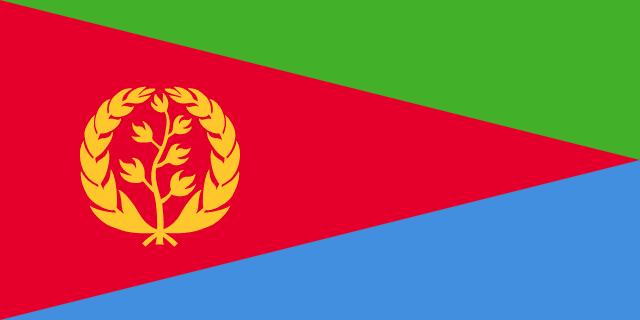
Eritrea
Africa

3,800,000
14:01 UTC+3
+291
Location
Geography
Economy
Main exports
Eritrea's leading export commodities and products.
Subscribe to Live Data for live spot prices
Live commodity prices on every nation's exports — $100 AUD/year.
Tap any export to learn more. Spot prices in USD only for Live Data subscribers.
Main imports
Eritrea's leading import commodities and products.
Tap any import to learn more.
Military
Historical Timeline
8000 BCE
Early human presence in Eritrea
Archaeological evidence suggests that hunter-gatherer societies occupied the region along the Red Sea coast and the highlands by at least 8000 BCE. These early inhabitants are considered the ancestors of the diverse ethnic groups that populate modern Eritrea.
800 BCE
Rise of the D'mt Kingdom
The D'mt kingdom emerged in the region during the 8th century BCE, establishing trade links across the Red Sea. It is one of the earliest documented states to influence the development of complex social structures in the Horn of Africa.
100
Expansion of the Aksumite Empire
The Aksumite Empire expanded its influence over the Eritrean highlands and coast, serving as a pivotal hub for maritime trade between the Roman Empire and India. During this era, the region saw significant cultural and religious shifts, including the adoption of Christianity in the 4th century.
1557
Ottoman conquest of Massawa
The Ottoman Empire captured the strategic port city of Massawa, incorporating parts of the Eritrean coast into the Habesh Eyalet. This event marked the beginning of centuries of external struggle for control over the Red Sea coastline.
1890
Establishment of Italian Eritrea
The Kingdom of Italy formally declared Eritrea as its colony following the treaty of Wuchale. This period initiated decades of centralized colonial administration and significant infrastructural development.
1941
British Military Administration
British forces captured Eritrea from Italy during the East African Campaign of World War II. Eritrea remained under British military administration until 1952, a period characterized by political uncertainty regarding the region's future status.
1952
Federation with Ethiopia
The United Nations resolved to establish a federation between Eritrea and Ethiopia, granting Eritrea internal autonomy. However, the federal arrangement was progressively undermined by Ethiopian political encroachment.
1961
Beginning of the Eritrean War of Independence
The Eritrean Liberation Front launched an armed struggle against Ethiopian rule following the forced annexation of Eritrea by Ethiopia in 1962. This initiated a 30-year conflict that defined the modern Eritrean national identity.
1991
Eritrean People's Liberation Front victory
Eritrean forces captured Asmara, effectively ending Ethiopian military presence in the country. This victory served as the de facto attainment of sovereignty for the Eritrean people.
1993
Formal independence after national referendum
Eritrea gained official international recognition as an independent state following a landslide vote in a UN-supervised national referendum. Isaias Afwerki became the first president of the newly independent nation.
1998
Eritrean-Ethiopian Border War
A major conflict erupted between Eritrea and Ethiopia over the disputed border town of Badme, leading to a massive loss of life and displacement. The war ended in 2000 with the Algiers Agreement and the establishment of the UN Mission in Ethiopia and Eritrea.
2018
Eritrea-Ethiopia Peace Agreement
A landmark peace agreement was signed in Asmara, formally ending two decades of hostility and military stalemate between Eritrea and Ethiopia. This milestone led to the reopening of borders and restored diplomatic relations between the two neighbors.
National Holidays
This holiday marks the beginning of the Gregorian calendar year and is celebrated as a public holiday nationwide.
This day commemorates the anniversary of the Operation Fenkil during the Eritrean War of Independence, which led to the liberation of the port city of Massawa in 1990.
This day honors the economic, political, and social achievements of women and recognizes the significant role women played in the Eritrean struggle for independence.
This is Eritrea's national day, commemorating the country's formal declaration of independence from Ethiopia in 1993 following a long liberation war.
This is a solemn day of remembrance dedicated to honoring the men and women who sacrificed their lives for the sovereignty and independence of Eritrea.
This day marks the anniversary of the start of the Eritrean War of Independence in 1961, when Hamid Idris Awate fired the first shots at Mount Adal.
Language
Counting to 10
1
1
= 10 (n = 0)
World Dictionary
Discover and translate any word into all supported languages.
The multilingual Dictionary is a Nations Pro feature.
Upgrade to Pro