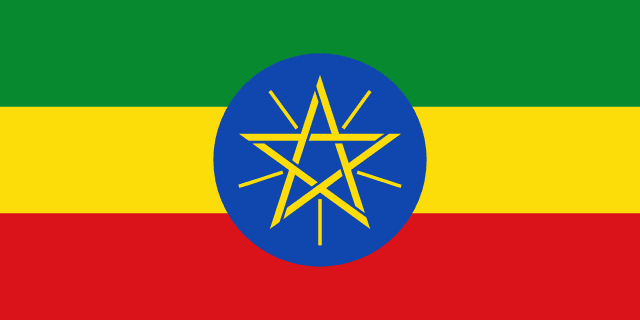

Ethiopia
Federal Democratic Republic of Ethiopia
Africa
140,240,666
03:47 UTC+3
+251
.et
Ras Dashen
4,550 m · 14,928 ft
Danakil Depression
-125 m · -410 ft
5,491,782
Addis Ababa · 2026
5,491,782
Addis Ababa · 2026
Location
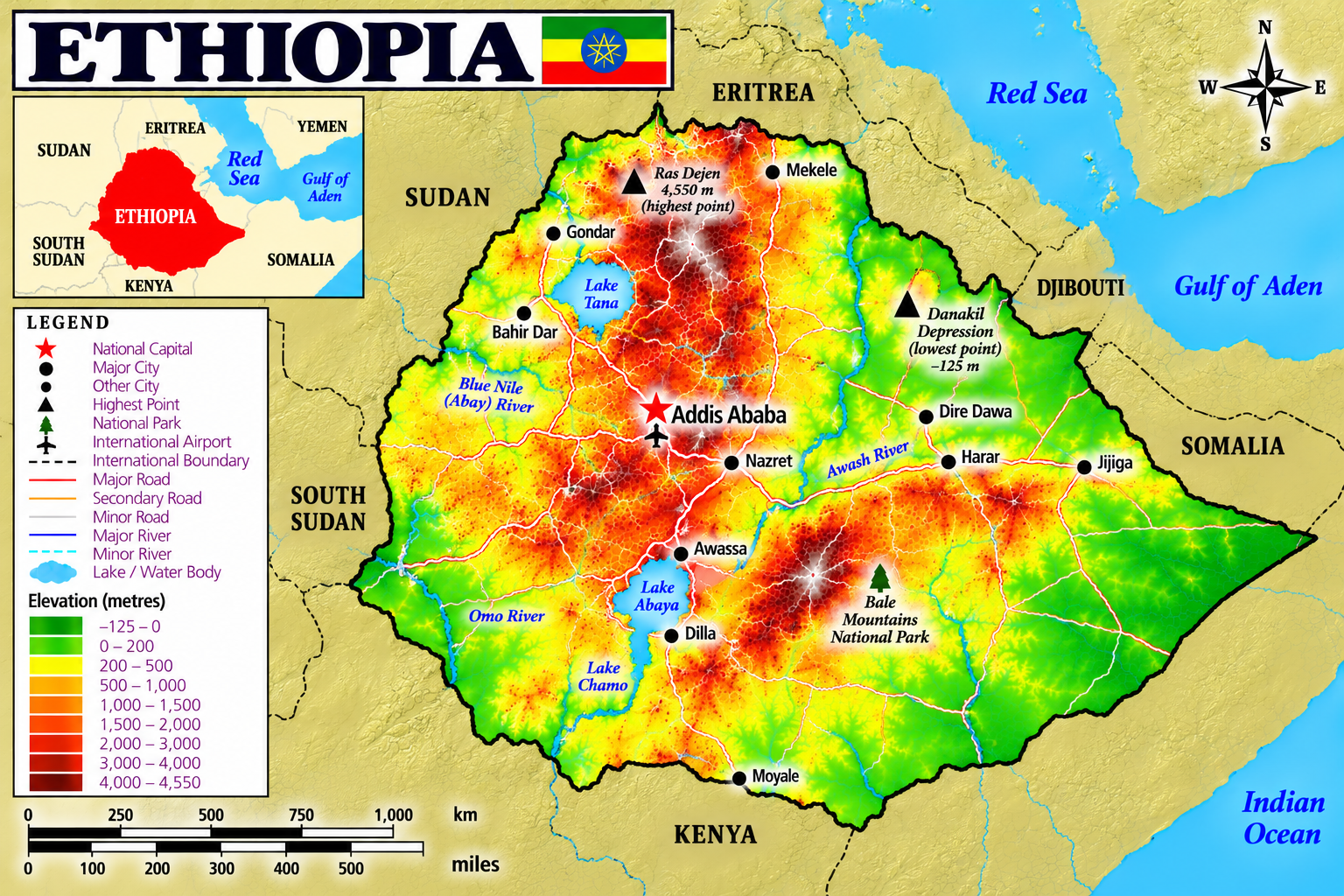
Ethiopia — Detailed Physical Map
Ras Dejen, the Danakil Depression, Lake Tana and the Blue Nile, the Bale Mountains, major cities and the capital Addis Ababa
Tourist Attractions
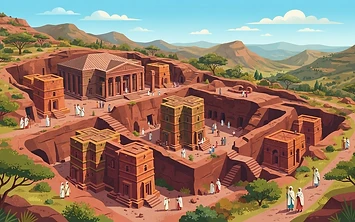
A UNESCO World Heritage site featuring 11 monolithic churches carved directly into volcanic rock during the 12th century. These active places of worship are considered the 'New Jerusalem' of Ethiopian Christianity.
The Church of St. George is a stunning architectural marvel carved in the shape of a perfect cross.

A dramatic landscape of jagged peaks, deep precipices, and high-altitude plateaus. It is home to unique endemic wildlife, including the gelada baboon and the Walia ibex.
The park offers some of the most spectacular trekking and mountain scenery in all of Africa.

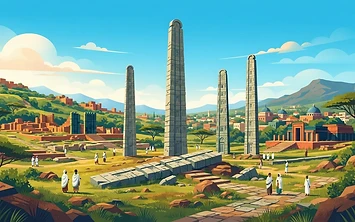
The ancient capital of the Kingdom of Aksum, known for its towering granite obelisks and archaeological ruins. It is a site of immense historical significance, linked to the Queen of Sheba and the Ark of the Covenant.
The massive, intricately carved 4th-century stelae are iconic symbols of Ethiopia's ancient power.


A fortress-city that served as the residence of the Ethiopian emperor Fasilides and his successors in the 17th century. The site features a unique blend of Portuguese, Indian, and local architectural styles.
The well-preserved stone castles and palaces offer a fascinating glimpse into the royal history of the Gondarine period.


A premier cultural institution that houses a vast collection of Ethiopian art, traditional crafts, and archaeological artifacts. It provides essential context for the country's deep history and human evolution.
The museum is home to the famous 3.2-million-year-old fossil remains of 'Lucy' (Australopithecus afarensis).

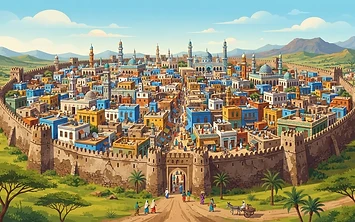
A fortified historic town known as the fourth holiest city of Islam, featuring a maze of limestone alleys and 82 mosques. It is a living heritage site where African and Islamic traditions have fused over centuries.
The city is famous for its intact medieval walls and the unique tradition of feeding wild hyenas at night.
Geography
Nature
Ras Dashen
4,550 m / 14,928 ft
12.2% of land
≈ 134,725 km² of forest
FAO / World Bank, forest area (% of land area)
Explore the Nature Atlas1,450 km901 mi
Rises in the Ethiopian Highlands and provides most of the main Nile water.
1,200 km746 mi
Flows entirely within Ethiopia and ends in a chain of saline lakes.
760 km472 mi
Important for the lower Omo Valley, a UNESCO World Heritage site.
3,600 km²1,390 sq mi · 15 m deep
Serves as the primary source of the Blue Nile.
1,162 km²449 sq mi · 13 m deep
Contains many islands and is known for its reddish water.
440 km²170 sq mi · 4 m deep
Freshwater lake in the Main Ethiopian Rift.
45 m148 ft
Known locally as Tis Abay, meaning smoking water.
150 m492 ft
Located on the Finchaa River in the Horo Gudru Welega Zone.
River lengths are whole-river figures, including any section beyond Ethiopia. Researched reference figures. Tap any name for where its name comes from and a Google Maps link.
Major Cities
- 1Capital
Ādīs Ābeba
4,229,5692026
MapServes as the capital city and the headquarters of the African Union.
- 2
Sumalē
1,137,4062026
MapActs as a major commercial center in the Somali region located along the Shebelle River.
- 3
Sumalē
752,6412026
MapFunctions as an important agricultural market hub in the eastern lowland regions of Ethiopia.
- 4
Āmara
578,5472026
MapContains the historic seventeenth-century castle complex known as Fasil Ghebbi.
- 5
Tigray
559,5442026
MapProvides a crucial commercial and educational center for the northern region of Tigray.
- 6
Oromīya
555,0722026
MapOperates as a significant industrial center and a major transport hub connecting the central highlands.
- 7
YeDebub Bihēroch Bihēreseboch na Hizboch
549,5162026
MapHosts the prominent regional administration of the Sidama people and sits beside a major lake.
- 8
Āmara
434,5882026
MapStands as a picturesque tourist destination located on the southern shores of Lake Tana.
- 9
Dirē Dawa
380,1602026
MapGrew as a planned industrial city following the construction of the Ethio-Djibouti Railway.
- 10
YeDebub Bihēroch Bihēreseboch na Hizboch
265,5672026
MapFunctions as the capital of the Wolayita Zone and a central market town for the region.
- 11
YeDebub Bihēroch Bihēreseboch na Hizboch
261,5482026
MapServes as the gateway to the Nech Sar National Park and features numerous natural freshwater springs.
- 12
Oromīya
253,1702026
MapServes as an important transit junction linking southern, eastern, and central Ethiopian trade routes.
City populations are the latest official, UN or national-statistics estimates (2026–2026) compounded to 2026 at 2.5% a year (the nation's annual population growth rate); figures without a published update come from the open cities database (2020-era estimates) and are projected the same way.
Economy
Main exports
Ethiopia's leading export commodities and products.
Tap any export to learn more. Spot prices in USD only for Live Data subscribers.
Main imports
Ethiopia's leading import commodities and products.
Tap any import to learn more.
Military
Historical Timeline
100000 BCE
Early Human Settlement in the Horn of Africa
Archaeological evidence, including the discovery of fossils like Omo remains, confirms that modern humans have inhabited the Ethiopian highlands for over 100,000 years.
980 BCE
Founding of the Kingdom of Dʿmt
The Kingdom of Dʿmt established early statehood in northern Ethiopia and Eritrea, forming the cultural foundation for the later Axumite civilization.
100
Rise of the Kingdom of Aksum
Aksum became a major global power and trade hub, controlling commerce between the Roman Empire and India while dominating the Red Sea region.
330
Adoption of Christianity
King Ezana converted to Christianity, making the Kingdom of Aksum one of the first states in the world to adopt the religion as its official faith.
1270
Establishment of the Solomonic Dynasty
Yekuno Amlak overthrew the Zagwe dynasty and claimed descent from King Solomon, establishing a ruling lineage that lasted until 1974.
1896
Victory at the Battle of Adwa
Ethiopian forces led by Menelik II defeated the Italian army, successfully preserving the nation's sovereignty during the Scramble for Africa.
1974
Fall of the Monarchy
A military junta known as the Derg deposed Emperor Haile Selassie, ending the centuries-old imperial system and beginning a period of socialist rule.
1991
End of the Derg Regime
The Ethiopian People's Revolutionary Democratic Front captured Addis Ababa, ending 17 years of military rule and initiating a transitional government.
2018
Election of Abiy Ahmed as Prime Minister
Abiy Ahmed became the first Oromo leader of Ethiopia, initiating significant political reforms and a peace treaty with neighboring Eritrea.
2020
Outbreak of the Tigray War
Tensions between the federal government and the Tigray People's Liberation Front escalated into a major internal armed conflict with widespread humanitarian consequences.
2022
Signing of the Pretoria Peace Agreement
The Ethiopian government and the Tigray People's Liberation Front signed a cessation of hostilities agreement, formally ending the two-year war in Northern Ethiopia.
2025
Launch of the Grand Ethiopian Renaissance Dam
Ethiopia officially reached full operational capacity for electricity generation at the Grand Ethiopian Renaissance Dam, marking a significant milestone in national energy infrastructure.
National Anthem
Wodefit Gesgeshi, Wudd Enate Ityopya
Dereje Melaku Mengesha
Solomon Lulu Mitiku
1992
የዜግነት ክብር በኢትዮጵያችን፣ ፀንቶ ይኖራል አገራችን። ከጠላት በኩል አርነት የወጣን፣ ባንድነት ለክብር የቆምን። መሰረት ፅኑ ሰላም ፍቅርን፣ ለህዝቦች ኑሮ የሆንን እርስ በርስ። የመድብለ ባህል ቃል ኪዳን፣ የዜግነት ክብር በኢትዮጵያችን፣ ፀንቶ ይኖራል አገራችን።
The current national anthem of Ethiopia, 'Wodefit Gesgeshi, Wudd Enate Ityopya,' was adopted in 1992 following the fall of the Derg regime. The lyrics were written by Dereje Melaku Mengesha, while the music was composed by Solomon Lulu Mitiku. It replaced the previous anthem, 'Ethiopia, Ethiopia, Ethiopia be first,' which had been associated with the imperial and socialist eras. The new anthem was selected through a national competition to better reflect the country's ethnic diversity and political shift toward a federal system. It emphasizes national unity, peace, and the multicultural identity of the Ethiopian people. The anthem is performed at all official government functions and major national events as a symbol of the modern Ethiopian state.
National Holidays
This day commemorates the birth of Jesus Christ according to the Julian calendar, which is followed by the Ethiopian Orthodox Tewahedo Church.
This holiday celebrates the decisive victory of Ethiopian forces over the Italian army in 1896, which successfully maintained the country's sovereignty.
This date marks the end of the Italian occupation in 1941, commemorating the liberation of Ethiopia during the East African campaign of World War II.
This holiday marks the anniversary of the 1991 fall of the Derg regime, leading to the end of the Ethiopian Civil War.
This day marks the beginning of the Ethiopian calendar year and traditionally signifies the end of the main rainy season.
This religious and national holiday commemorates the finding of the True Cross by Queen Helena in the fourth century.
Good News Today
Ethiopia launches US$90 million partnership to strengthen maternal and newborn care
The Ethiopian Ministry of Health and the Beginnings Fund have launched a five-year, US$90 million partnership to improve maternal and newborn health services. The initiative aims to prevent approximately 86,000 deaths by 2031 through better infrastructure, training, and emergency care.
Fun Facts
Birthplace of Coffee Culture
Legend says that coffee was discovered in the Ethiopian highlands after a goat herder noticed his goats became energetic after eating berries.
Thirteen Months of Sunshine
Ethiopia follows its own unique calendar which consists of thirteen months, putting the country several years behind the Gregorian calendar.
Rock-Hewn Churches of Lalibela
Lalibela is home to eleven monolithic churches carved directly out of solid volcanic rock in the 12th century.
Ancient Uncolonized Sovereignty
Ethiopia is one of the only African nations to have maintained its sovereignty throughout the colonial era.
Injera Culinary Tradition
Injera, a sour fermented flatbread made from teff flour, is the primary staple food and also serves as a dining utensil.
Humanity's Ancient Roots
The famous fossil remains of 'Lucy' were discovered in Ethiopia, providing crucial insights into early human evolution.
Unique Ancient Alphabet
Ge'ez is one of the oldest living writing systems in the world and is still used today in religious contexts.
Global Long Distance Domination
Ethiopian athletes consistently dominate international long-distance running events, having won numerous Olympic gold medals.
The Roof of Africa
The Simien Mountains are known as the 'Roof of Africa' due to their jagged peaks and dramatic deep valleys.
Sunrise Based Timekeeping
Many Ethiopians follow a 12-hour clock system that starts at dawn, effectively shifting the traditional workday by six hours.
Chuckies Trivia Quiz
Chuckies Trivia Quiz
Fifteen questions on Ethiopia — five easy, five medium, five hard. How far can you get?
Sports & Live Events
Language
Counting to 10
1
1
= 10 (n = 0)
World Dictionary
Discover and translate any word into all supported languages.