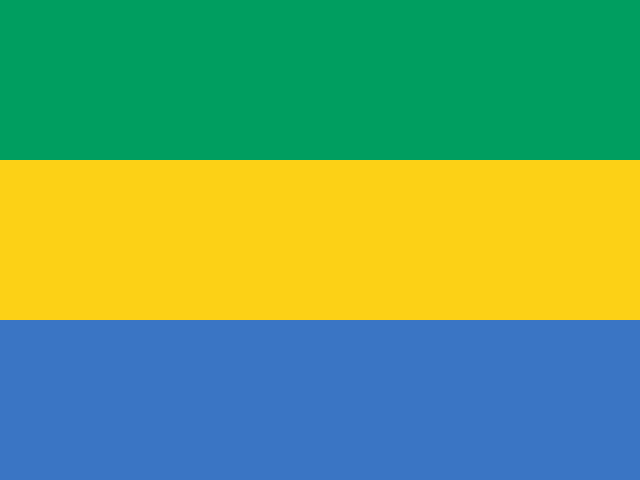

Gabon
Gabonese Republic
Africa
2,528,236
06:47 UTC+1
+241
.ga
Mont Bengoue
1,070 m · 3,510 ft
Atlantic Ocean
0 m · 0 ft
848,675
Libreville · 2026
848,675
Libreville · 2026
Location
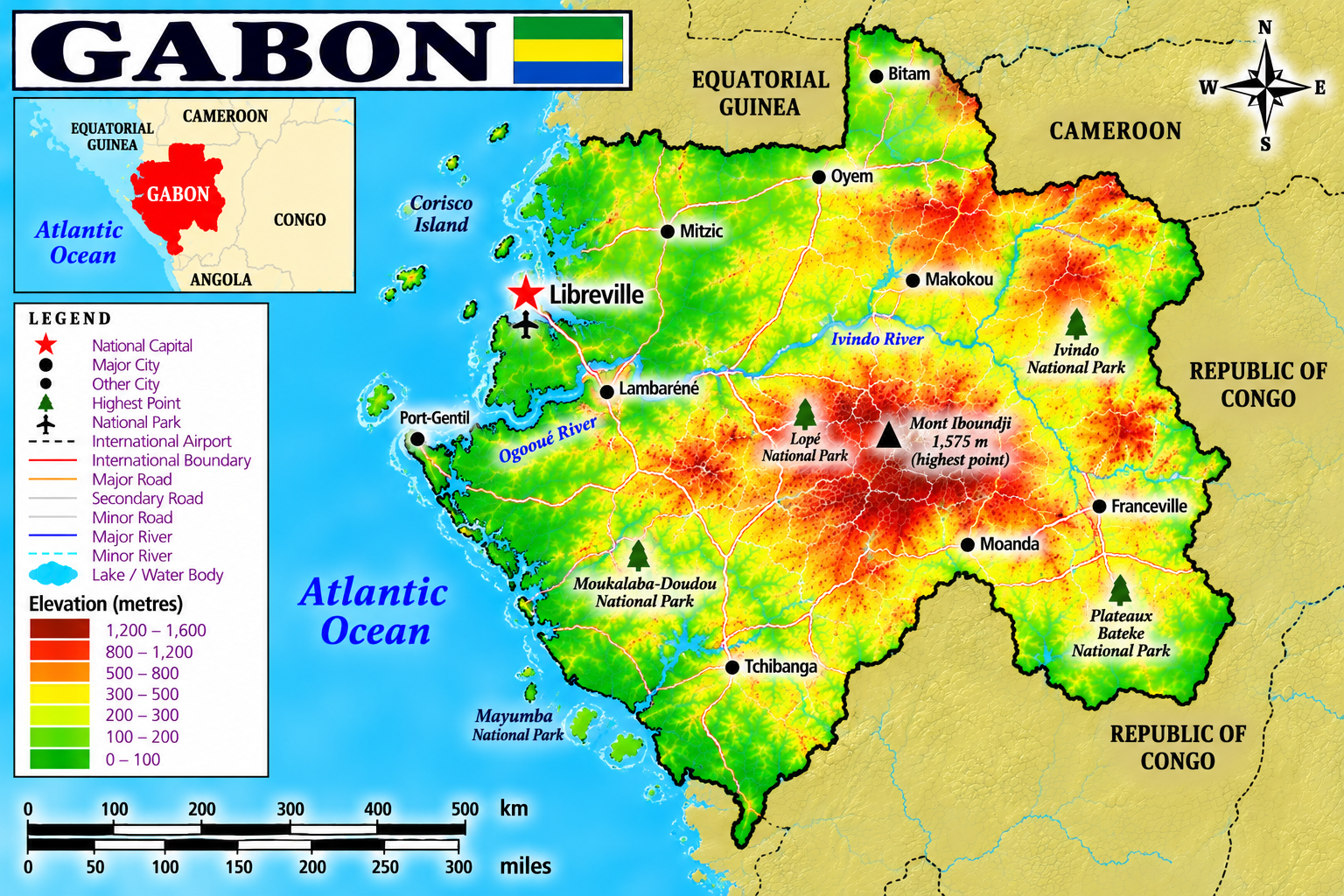
Gabon — Detailed Physical Map
Ivindo and Lope national parks, Mont Iboundji, the Ogooue River, Port-Gentil and the Atlantic coast, and the capital Libreville
Tourist Attractions

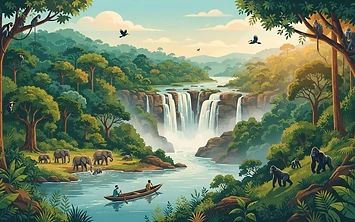
A UNESCO World Heritage site known for its dense rainforests and the spectacular Kongou and Mingouli waterfalls. It is a premier destination for observing diverse wildlife, including primates and forest elephants.
The Kongou Falls are widely considered the most impressive waterfalls in Gabon.

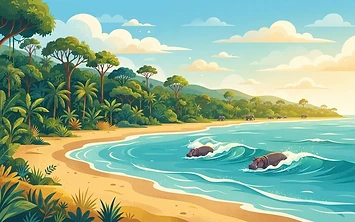
This unique coastal park is famous for its diverse ecosystems where rainforests meet the Atlantic Ocean. It is globally renowned for the rare sight of hippos surfing in the ocean waves.
It is one of the few places on Earth where you can see forest wildlife like elephants and hippos on the beach.

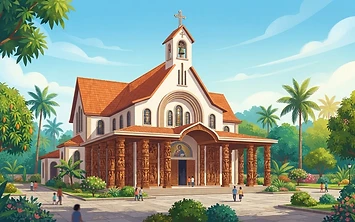
A striking architectural landmark in the capital city, famous for its 31 hand-carved wooden columns. The intricate carvings were created by a local blind craftsman and depict various biblical scenes.
The ornate, hand-carved wooden columns are a masterpiece of Gabonese religious art.

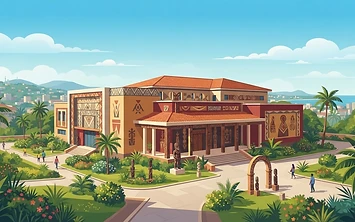
This museum is dedicated to preserving the rich cultural heritage of Gabon's various ethnic groups. It houses an extensive collection of traditional masks, ritual objects, and historical artifacts.
The collection of traditional Fang masks offers a profound insight into Gabonese cultural history.

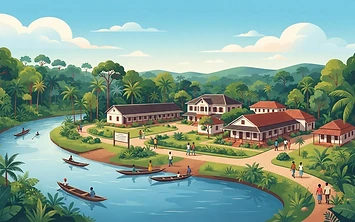
Founded in 1913 by the Nobel Peace Prize-winning physician Albert Schweitzer, this site remains a significant historical landmark. The museum commemorates his life, medical work, and humanitarian legacy in the rainforest.
Visitors can tour the original hospital buildings and learn about the history of medical humanitarianism in Africa.

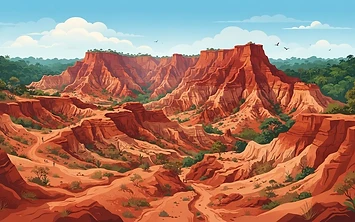
A dramatic geological formation in southeastern Gabon, characterized by deep red canyons and loose sand. This striking landscape offers a stark contrast to the country's lush rainforests.
The vibrant red rock formations create a unique and otherworldly landscape perfect for adventurous travelers.
Geography
Nature
Mont Bengoue
1,070 m / 3,510 ft
91.3% of land
≈ 244,381 km² of forest
FAO / World Bank, forest area (% of land area)
Explore the Nature Atlas1,200 km746 mi
Flows entirely through Gabon before emptying into the Atlantic Ocean.
600 km373 mi
Originates in the Republic of the Congo and crosses into southern Gabon.
500 km311 mi
Major tributary of the Ogooue river known for its diverse tropical ecosystem.
40 km²15 sq mi
Shallow lake system located within the Ogooue River basin near Lambarene.
100 km²39 sq mi
Connected to the Ogooue River and supports significant local fishing communities.
150 km²58 sq mi
Part of a network of flooded lakes in the Ogooue Delta region.
56 m184 ft
Located on the Ivindo River and considered among the most impressive in Africa.
30 m98 ft
Situated deep within Ivindo National Park along the Ivindo River.
River lengths are whole-river figures, including any section beyond Gabon. Researched reference figures. Tap any name for where its name comes from and a Google Maps link.
Major Cities
- 1Capital
Estuaire
997,9532026
MapServes as the capital and largest city of Gabon, acting as the country's main administrative and commercial hub.
- 2
Ogooué-Maritime
190,1802026
MapFunctions as the center of the Gabonese petroleum industry and the country's primary seaport.
- 3
Estuaire
138,4242026
MapHosts the primary port facilities for Gabon and serves as the gateway for timber exports.
- 4
Haut-Ogooué
119,9702026
MapStands as a major educational center and the final terminus of the Trans-Gabon Railway.
- 5
Woleu-Ntem
116,2452026
MapActs as the agricultural hub for northern Gabon, particularly known for extensive cocoa and coffee production.
- 6
Estuaire
99,5202026
MapProvides a vital industrial and agricultural supply point located strategically near the national capital.
- 7
Haut-Ogooué
90,3572026
MapContains one of the largest manganese mines in the world, driving a significant portion of the national economy.
- 8
Ngounié
69,0762026
MapActs as a primary regional trade center located along the banks of the Ngounie River.
- 9
Moyen-Ogooué
69,0222026
MapGained worldwide fame for hosting the hospital established by Nobel Peace Prize laureate Albert Schweitzer.
- 10
Nyanga
53,7472026
MapServes as the provincial capital and an important transit point for travelers moving through southern Gabon.
- 11
Woleu-Ntem
53,4882026
MapSits at a key tri-border junction, facilitating robust trade between Gabon, Cameroon, and Equatorial Guinea.
- 12
Ogooué-Ivindo
29,9732026
MapProvides access to the spectacular Ivindo National Park and its famous Kongou Falls.
City populations are the latest official, UN or national-statistics estimates (2026–2026) compounded to 2026 at 2.2% a year (the nation's annual population growth rate); figures without a published update come from the open cities database (2020-era estimates) and are projected the same way.
Economy
Main exports
Gabon's leading export commodities and products.
Tap any export to learn more. Spot prices in USD only for Live Data subscribers.
Main imports
Gabon's leading import commodities and products.
Tap any import to learn more.
Military
Historical Timeline
10000 BCE
Initial Settlement by Pygmy Groups
The earliest known inhabitants of the region, including ancestors of the Baka and other Pygmy groups, settled in the dense rainforests of present-day Gabon. These hunter-gatherer societies established the region's initial human presence.
1000
Bantu Migrations
Bantu-speaking peoples began migrating into the region, bringing with them advanced agricultural techniques and iron-working skills. This demographic shift significantly altered the social and political structure of the territory.
1472
Arrival of Portuguese Explorers
Portuguese navigator Lopo Gonçalves reached the Gabonese coast, marking the first recorded European contact with the area. The region was later named 'Gabão' after the Portuguese word for the coat-like shape of the Komo River estuary.
1839
Establishment of French Protectorate
France established its first formal presence in the region by signing treaties with local coastal chiefs. This led to the creation of the settlement of Libreville, which served as a hub for anti-slavery efforts and colonial administration.
1910
Integration into French Equatorial Africa
Gabon became one of the four territories of French Equatorial Africa, a federal entity managed by the French colonial government. This administrative centralization consolidated colonial control over resources and trade.
1960
Independence from France
Gabon gained full independence from France on August 17, with Léon M'ba serving as the country's first president. This milestone marked the formal transition to sovereign statehood within the international community.
1967
Accession of Omar Bongo
Following the death of Léon M'ba, Omar Bongo Ondimba assumed the presidency. His long tenure established a stable, oil-reliant political order that defined Gabonese politics for over four decades.
1990
Return to Multiparty Democracy
Following widespread civil unrest and demands for political reform, the government legalized opposition parties. This ended the decades-long one-party rule of the Gabonese Democratic Party.
2009
Ali Bongo Ondimba Elected President
After the death of his father Omar Bongo, Ali Bongo Ondimba won the presidential election. This transition signaled the continuation of the Bongo family's influence over the Gabonese state.
2021
Gabon Joins the Commonwealth
Gabon officially became a member of the Commonwealth of Nations. This move marked a significant shift in the country's diplomatic outreach and international alignment.
2023
Military Coup d'État
Members of the Gabonese military led by General Brice Oligui Nguema seized power, deposing Ali Bongo Ondimba shortly after he was declared the winner of a contested election. This event ended over 50 years of Bongo family rule.
2025
National Dialogue and Transition Progress
The transitional government continued its roadmap toward the restoration of civilian rule through the implementation of constitutional reforms. These efforts aimed to stabilize the political landscape ahead of scheduled future elections.
National Anthem
Georges Aleka Damas
Georges Aleka Damas
1960
Uni dans la Concorde et la fraternité Éveille-toi, Gabon, une aube se lève Encourage l'ardeur qui vibre et nous soulève C'est enfin notre essor vers la félicité. C'est enfin notre essor vers la félicité. Salut à toi où que tu sois Joue pour toujours la grande loi Demain, Gabao, tu seras Le pays de nos droits et de nos joies. Éveille-toi, Gabon, une aube se lève Encourage l'ardeur qui vibre et nous soulève C'est enfin notre essor vers la félicité Uni dans la Concorde et la fraternité.
La Concorde was composed and written by Georges Aleka Damas in 1960 to commemorate the independence of Gabon from France. The anthem was officially adopted following the nation's declaration of sovereignty on August 17, 1960. Damas, a prominent Gabonese composer and diplomat, created the melody and lyrics to reflect themes of unity, peace, and national progress. While the original version contained three verses, the modern performance practice typically focuses on the first verse, the refrain, and a repeat of the opening section. The anthem has remained unchanged since its adoption, serving as a symbol of national identity and pride. It continues to be played during all significant state ceremonies and public events throughout the country.
National Holidays
A public holiday marking the beginning of the civil calendar year.
A day designated to celebrate the social, economic, cultural, and political achievements of women.
A day observed globally to recognize the contributions and rights of workers.
A Christian holiday commemorating the belief in the bodily ascension of the Virgin Mary into heaven.
Celebrates Gabon's independence from France, which was officially declared on this date in 1960.
A public holiday commemorating the birth of Jesus Christ.
Good News Today
Gabon restores access to social media platforms
The High Communication Authority of Gabon announced the lifting of an eight-month ban on major social media platforms. This move restores access to digital services for the country's 2.5 million people, benefiting both local businesses and social connectivity.
Fun Facts
Home of the Western Lowland Gorilla
Over 80 percent of Gabon is covered in dense rainforest, providing a critical sanctuary for the world's largest population of western lowland gorillas.
Surfing Hippos of the Coast
Gabon is home to the world's only known surfing hippos, which have been documented riding waves in the Atlantic Ocean at Loango National Park.
Thirteen National Parks Established
In 2002, the government created a massive network of 13 protected national parks, safeguarding over 11 percent of the nation's total land area.
The Sacred Okoume Tree
The Okoume tree is the nation's primary timber export and is so vital to the local economy that it is featured prominently on the country's coat of arms.
Humpback Whale Migration Hub
Gabon's coastline serves as a vital breeding and calving ground for southern humpback whales, which arrive in the warm waters between July and September.
Elusive Forest Elephants
The country hosts the largest population of forest elephants in Africa, a distinct species smaller and darker than their famous savanna cousins.
Popular Palm Wine Culture
Traditional palm wine, known locally as malamba, is a cultural staple tapped from raffia palm trees and consumed at village social gatherings.
The Bwiti Secret Society
The Bwiti religion, indigenous to the Fang people, involves intricate initiation rites and ceremonies that are central to the spiritual life of many Gabonese.
Low Population Density Leader
Despite its abundant resources, Gabon remains one of the least densely populated countries in Africa, helping preserve its vast wilderness.
Prehistoric Stone Tool Sites
Archaeologists have discovered ancient stone tools along the Ogooue River, indicating that the region has been inhabited by human ancestors for thousands of years.
Chuckies Trivia Quiz
Chuckies Trivia Quiz
Fifteen questions on Gabon — five easy, five medium, five hard. How far can you get?
Sports & Live Events
Language
Counting to 10
1
1
= 10 (n = 0)
World Dictionary
Discover and translate any word into all supported languages.