
Ghana
Republic of Ghana
Africa
36,080,614
09:14 UTC+0
+233
.gh
Mount Afadja
885 m · 2,904 ft
Atlantic Ocean
0 m · 0 ft
4,826,950
Accra · 2026
4,826,950
Accra · 2026
Location
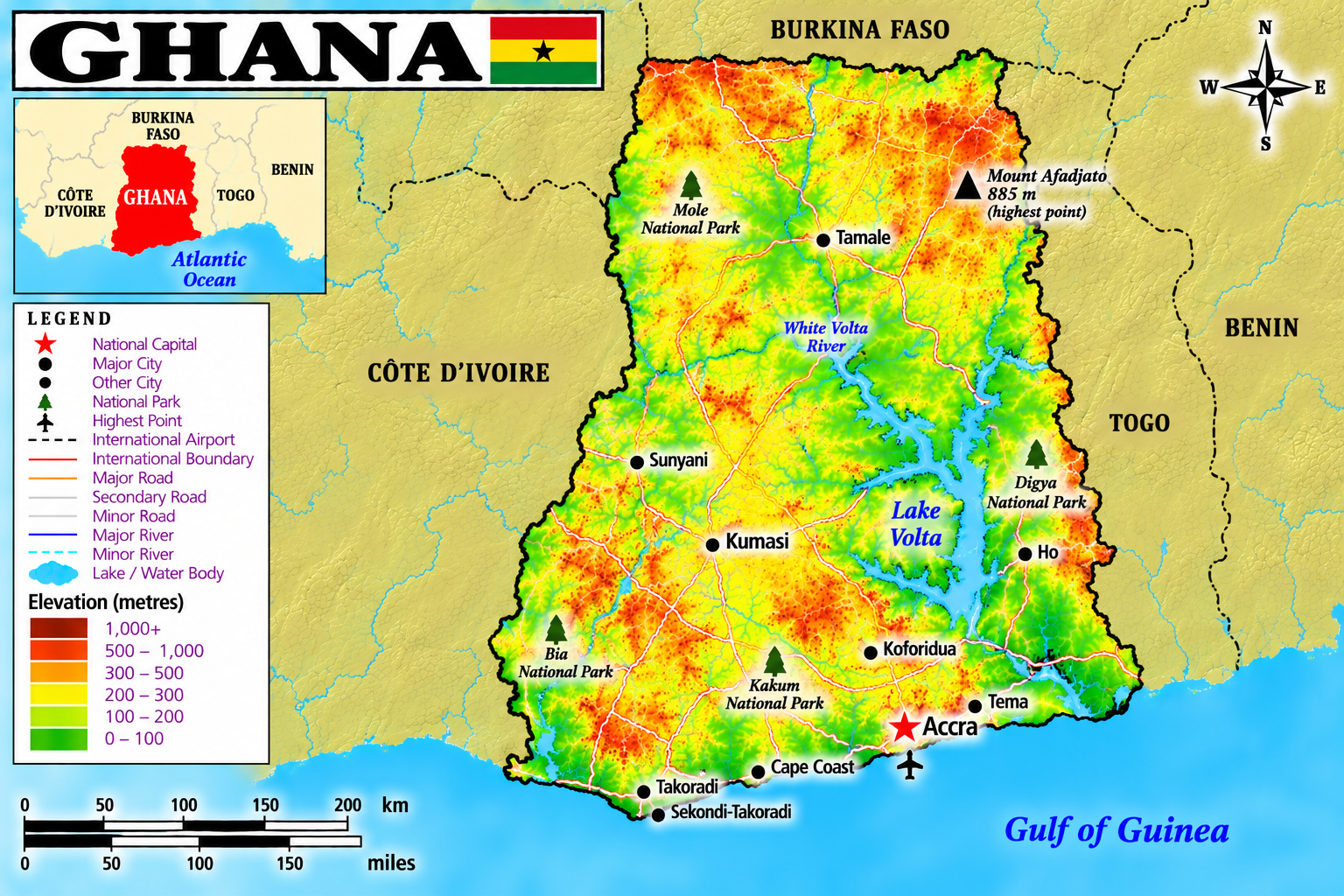
Ghana — Detailed Physical Map
Lake Volta and the Volta rivers, Mole and Kakum national parks, Mount Afadjato, the Gold Coast and the capital Accra
Tourist Attractions

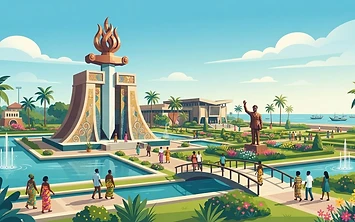
This park serves as the final resting place of Ghana's first president, Dr. Kwame Nkrumah, and features a mausoleum and a museum dedicated to his life and legacy.
It is a deeply significant site for understanding Ghana's journey to independence.

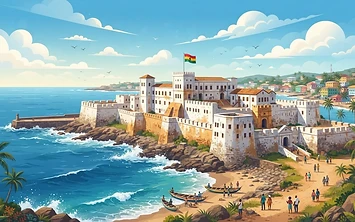
A UNESCO World Heritage Site, this historic fortress played a central role in the trans-Atlantic slave trade and now serves as a museum and memorial.
The preserved dungeons offer a poignant and essential look into a difficult chapter of global history.

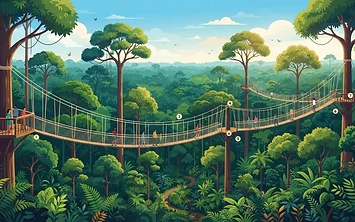
This tropical rainforest reserve is famous for its 333-meter long canopy walkway, which is suspended high above the forest floor.
Walking among the treetops provides a unique and thrilling perspective of the lush rainforest canopy.

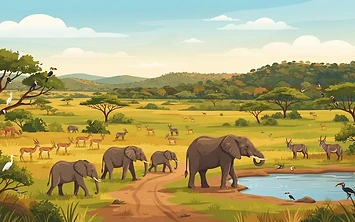
As Ghana's largest wildlife refuge, this park is home to diverse species including elephants, antelopes, and various birdlife within a vast savanna landscape.
It is the premier destination in the country for authentic safari experiences and wildlife viewing.

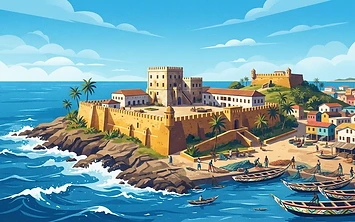
Built by the Portuguese in 1482, this is one of the oldest and most significant European structures in sub-Saharan Africa.
The striking white architecture against the backdrop of the Atlantic Ocean creates a powerful and memorable visual.

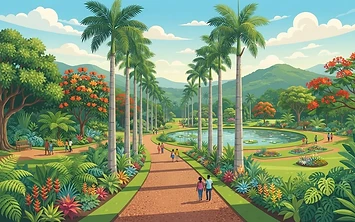
Located in the cool highlands, these gardens feature a diverse collection of tropical plants, towering trees, and peaceful walking paths.
It offers a serene and refreshing escape from the bustling city life of nearby Accra.
Geography
Nature
Mount Afadja
885 m / 2,904 ft
35.1% of land
≈ 83,725 km² of forest
FAO / World Bank, forest area (% of land area)
Explore the Nature Atlas1,500 km932 mi
Flows southwards into the Atlantic Ocean through the Gulf of Guinea.
240 km149 mi
Serves as a major drainage basin in the southern part of the country.
190 km118 mi
Flows entirely within Ghana, originating north of Wiawso.
8,502 km²3,283 sq mi · 75 m deep
Largest reservoir by surface area in the world by water storage capacity.
80 m262 ft
Tallest waterfall in West Africa, located near the border with Togo.
25 m82 ft
Located on the Pumpum River and features three distinct main drops.
River lengths are whole-river figures, including any section beyond Ghana. Researched reference figures. Tap any name for where its name comes from and a Google Maps link.
Major Cities
- 1
Ashanti
4,529,1182026
MapActs as the historic seat of the Ashanti Empire and a major commercial hub for the central forest region.
- 2
Ashanti
3,792,6252026
MapServes as a pivotal inland port and logistics hub connecting Ghana's northern regions to international trade routes.
- 3Capital
Greater Accra
2,951,5322026
MapFunctions as the vibrant capital city, serving as the nation's primary economic, political, and administrative center.
- 4
Bono
1,132,8032026
MapFunctions as a prominent center for cocoa production and traditional leadership within the Bono Region.
- 5
Northern
826,4572026
MapOperates as the rapid-growing capital of the Northern Region and a critical gateway to the country's northern landscapes.
- 6
Western
508,1842026
MapHosts a major deep-water harbor that has historically served as a critical node for Ghana's maritime industry.
- 7
Central
378,1062026
MapPreserves colonial history through its infamous castle, which remains a poignant global symbol of the transatlantic slave trade.
- 8
Greater Accra
280,1112026
MapMaintains a dense and bustling metropolitan character as one of the most significant residential and trade hubs near Tema.
- 9
Bono
197,6482026
MapStands as a key agricultural and forestry hub known for its clean environment and rapid urban development.
- 10
Ashanti
179,6042026
MapHouses one of the world's largest and most famous gold mining operations, dominating the local landscape and economy.
- 11
Greater Accra
155,7822026
MapContains Ghana's largest seaport, acting as the primary industrial gateway for import and export activities.
- 12
Greater Accra
101,2072026
MapServes as a prominent and densely populated residential suburb situated within the expanding Accra metropolitan area.
City populations are the latest official, UN or national-statistics estimates (2025–2026) compounded to 2026 at 2.1% a year (the nation's annual population growth rate); figures without a published update come from the open cities database (2020-era estimates) and are projected the same way.
Economy
Main exports
Ghana's leading export commodities and products.
Tap any export to learn more. Spot prices in USD only for Live Data subscribers.
Main imports
Ghana's leading import commodities and products.
Tap any import to learn more.
Military
Historical Timeline
1500 BCE
Early Migration of Kintampo Culture
Archaeological evidence suggests the Kintampo culture inhabited parts of modern-day Ghana, representing some of the earliest sedentary societies in the region. They were early adopters of agriculture and animal husbandry.
1200
Rise of the Bono State
The Bono state was established by the Akan people, marking the beginning of organized centralized political structures in the forest zone. It became a significant center for gold trade and regional commerce.
1670
Formation of the Asante Empire
Osei Tutu I unified several Akan states to establish the powerful Asante Empire, which became a dominant regional force. The empire was renowned for its wealth in gold and sophisticated military organization.
1844
Signing of the Bond of 1844
Fante chiefs signed an agreement with the British, effectively establishing colonial jurisdiction over coastal areas. This marked the beginning of formal British colonial expansion in the region.
1902
Annexation of the Asante Empire
Following the War of the Golden Stool, the British formally annexed the Asante Empire. This consolidated British control over the interior and the coast as the Gold Coast colony.
1957
Ghana Gains Independence
Led by Kwame Nkrumah, the Gold Coast became the first sub-Saharan African colony to achieve independence from European colonial rule. The nation was renamed Ghana in honor of the ancient Ghana Empire.
1960
Establishment of the Republic
Ghana transitioned from a constitutional monarchy to a republic, with Kwame Nkrumah serving as its first president. This marked a significant shift toward centralized presidential governance.
1992
Return to Multi-Party Democracy
A new constitution was approved via referendum, ending years of military rule and ushering in the Fourth Republic. Jerry Rawlings was subsequently elected as the first president of the new democratic era.
2009
Inauguration of President John Atta Mills
Following the 2008 general election, John Atta Mills was sworn in, marking a peaceful transfer of power between the two major political parties. This consolidated Ghana's reputation for democratic stability in West Africa.
2017
Nana Akufo-Addo Assumes Presidency
Nana Akufo-Addo was inaugurated after winning the 2016 general election, marking another successful democratic transition. His administration prioritized economic reforms and industrialization initiatives like 'One District, One Factory'.
2021
Launch of the African Continental Free Trade Area
The secretariat for the African Continental Free Trade Area (AfCFTA) was officially opened in Accra. Ghana played a key diplomatic role in hosting the headquarters to foster intra-African trade.
2025
2024 General Election Outcome
Ghana held its ninth general election of the Fourth Republic in late 2024 to determine the presidency and parliamentary composition. The election outcome shaped the national leadership trajectory heading into 2025 and 2026.
National Anthem
Michael Kwame Gbordzoe
Philip Gbeho
1957
God bless our homeland Ghana And make our nation great and strong Bold to defend forever The cause of freedom and of right Fill our hearts with true humility Make us cherish fearless honesty And help us to resist oppressors' rule With all our will and might for evermore Hail to thy name, O Ghana To thee we make our solemn vow Steadfast to build together A nation strong in unity With our gifts of mind and strength of arm Whether night or day, in the midst of storm In every need, whate'er the call may be To serve thee, Ghana, now and evermore Raise high the flag of Ghana And one with Africa advance Black star of hope and honor To all who thirst for liberty Where the banner of Ghana freely flies May the way to freedom truly lie Arise, arise, O sons of Ghana land And under God march on for evermore
The national anthem of Ghana was composed by Philip Gbeho, a renowned Ghanaian musician and teacher. It was adopted in 1957 when Ghana achieved its independence from British colonial rule. A competition was held to choose the anthem, and Gbeho's composition was selected as the winner. The original lyrics were written by a committee; however, they were later revised by Michael Kwame Gbordzoe in the 1960s to better reflect the nation's values. The anthem emphasizes themes of freedom, unity, and resilience against oppression. It serves as a symbol of national pride and is performed at all official government and state events. Today, the anthem remains a central element of Ghanaian identity and patriotism.
National Holidays
Commemorates the coming into effect of the 1992 Constitution of Ghana, marking the beginning of the Fourth Republic.
Celebrates Ghana's formal declaration of independence from British colonial rule in 1957.
A national holiday observed to honor and celebrate the contributions and achievements of workers across the country.
Commemorates the contributions of all those who led the struggle for Ghana's independence, specifically marking the formation of the Aborigines' Rights Protection Society and the United Gold Coast Convention.
Honors the birth anniversary of Dr. Kwame Nkrumah, Ghana's first president and a key leader in the pan-African movement.
Good News Today
Ghana Leads African Push for Climate Finance Justice at COP31
Ghana is spearheading efforts at the COP31 climate conference to ensure developed nations fulfill their financial commitments to support Africa's climate adaptation. The country is advocating for grant-based funding and the development of bankable projects to foster sustainable economic growth.
Fun Facts
World's Leading Cocoa Producer
Ghana is the second-largest producer of cocoa in the world, with its high-quality beans serving as a primary ingredient for global chocolate manufacturing.
Artistic Fantasy Coffins
In Ghana, the Ga people create elaborate 'fantasy coffins' shaped like objects significant to the deceased, such as airplanes, fish, or Coca-Cola bottles.
Home To Largest Reservoir
Lake Volta, located in Ghana, is the largest man-made lake in the world by surface area, covering nearly 3.6 percent of the nation's total landmass.
Birthplace Of Kente Cloth
Kente, a famous silk and cotton fabric made of interwoven cloth strips, originated from the Akan people and was historically reserved for royalty.
Mastery Of Talking Drums
The hourglass-shaped talking drum, or 'donno,' is used in traditional music to mimic the pitch and prosody of human speech to communicate messages.
Mole National Park Wildlife
Ghana's Mole National Park is a haven for African elephants, and it is one of the few places in West Africa where visitors can go on walking safaris.
Ancestral Mud Mosque Architecture
The Larabanga Mosque is the oldest mosque in Ghana, built in the Sudano-Sahelian architectural style using only mud and stick beams.
Gold Coast Historical Naming
Before independence, Ghana was known as the Gold Coast because the region possessed such vast quantities of the precious metal along its shores.
The Spicy Jollof Tradition
Ghanaian Jollof rice is a beloved national dish made with long-grain rice, tomatoes, onions, and spices, sparking friendly culinary rivalries across West Africa.
Center Of The Earth
Tema, a city in Ghana, is geographically located very close to the intersection of the Greenwich Meridian and the Equator, effectively the 'center' of the world.
Chuckies Trivia Quiz
Chuckies Trivia Quiz
Fifteen questions on Ghana — five easy, five medium, five hard. How far can you get?
Sports & Live Events
Language
Counting to 10
1
1
= 10 (n = 0)
World Dictionary
Discover and translate any word into all supported languages.