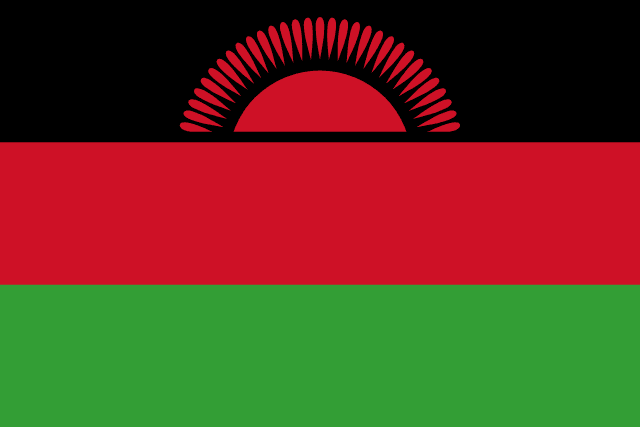

Malawi
Republic of Malawi
Africa
22,381,824
06:22 UTC+2
+265
.mw
Mount Mulanje
3,002 m · 9,849 ft
Shire River
37 m · 121 ft
375,642
Lilongwe · 2026
1,085,768
Lilongwe · 2026
Location
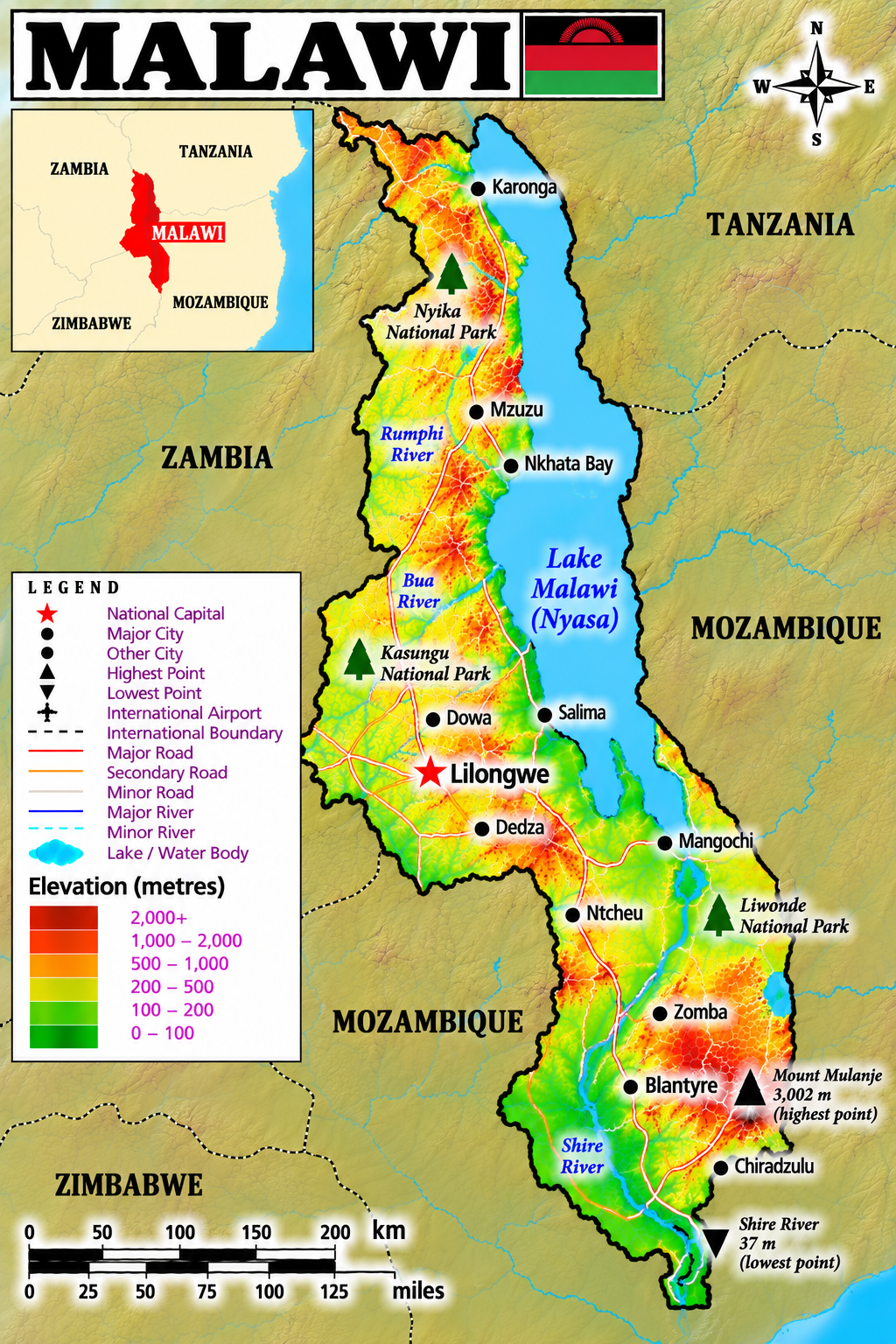
Malawi — Detailed Physical Map
Lake Malawi, Mount Mulanje, the Shire and Rumphi rivers, Nyika and Liwonde parks, major cities and the capital Lilongwe
Tourist Attractions

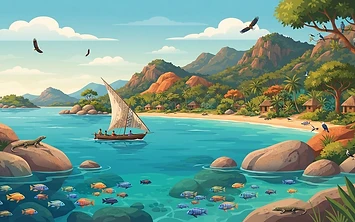
This UNESCO World Heritage Site is the world's first freshwater national park, renowned for its crystal-clear waters and incredible biodiversity. It protects a vast array of endemic cichlid fish species and diverse terrestrial wildlife.
Experience world-class snorkeling in a vibrant, natural freshwater aquarium.

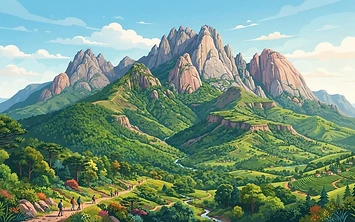
A massive granite massif that dominates the landscape, offering dramatic peaks and lush subtropical forests. It is a premier destination for hikers and trekkers looking to explore its unique cedar forests and high-altitude plateaus.
Trek to the mountain's peaks for breathtaking panoramic views of the surrounding plains.

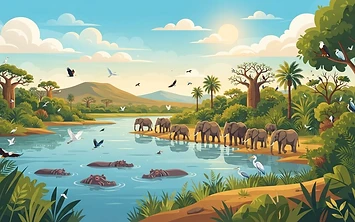
Regarded as Malawi's premier game park, this reserve offers excellent opportunities to spot elephants, hippos, and a wide variety of birdlife. The park is defined by the Shire River, which provides a stunning backdrop for wildlife viewing.
Take a boat safari on the Shire River to see elephants and hippos at close range.

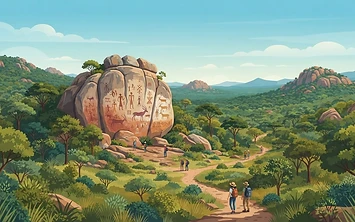
This UNESCO World Heritage Site features the highest concentration of rock art in Central Africa. The paintings were created by BaTwa hunter-gatherers and Chewa agriculturists, dating back to the late Stone Age.
Explore ancient rock paintings that offer a fascinating glimpse into early human history.

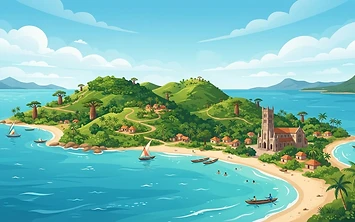
Located in the northern part of Lake Malawi, this island is famous for its pristine, unspoiled coastline and crystal-clear waters. It provides a tranquil escape for travelers seeking a relaxed beach experience.
Relax on the island's secluded, sandy beaches surrounded by the clear waters of the lake.

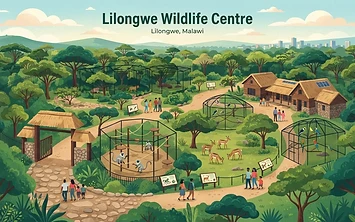
A sanctuary situated within a dense woodland area in the capital city, dedicated to the rescue and rehabilitation of injured or orphaned wildlife. It serves as a vital green space and educational hub for visitors.
See rescued animals like baboons and servals in a protected, natural forest environment.
Geography
Nature
Mount Mulanje
3,002 m / 9,849 ft
22.0% of land
≈ 26,066 km² of forest
FAO / World Bank, forest area (% of land area)
Explore the Nature Atlas402 km250 mi
Flows from Lake Malawi to the Zambezi River in Mozambique.
250 km155 mi
Provides vital irrigation for agricultural production in central Malawi.
300 km186 mi
Flows through the northern region of Malawi into Lake Malawi.
29,600 km²11,429 sq mi · 706 m deep
Contains more species of fish than any other lake in the world.
2,400 km²927 sq mi · 4 m deep
Closed drainage lake that experiences significant seasonal fluctuations in size.
450 km²174 sq mi · 7 m deep
Located south of Lake Malawi along the course of the Shire River.
—
Located on the Shire River and used for hydroelectric power generation.
—
Situated near the historic mission town of Livingstonia in northern Malawi.
River lengths are whole-river figures, including any section beyond Malawi. Researched reference figures. Tap any name for where its name comes from and a Google Maps link.
Major Cities
- 1
- 2
Blantyre
932,2322026
MapServes as the country's main commercial and industrial hub established by Scottish missionaries.
- 3
Mzimba
330,0992026
MapActs as the major administrative and educational headquarters of the northern region.
- 4
Zomba
120,6182026
MapServed as the former colonial capital and hosts the historic University of Malawi.
- 5
Karonga
86,4612026
MapFeatures a significant cultural museum housing unique dinosaur fossils found in the region.
- 6
Kasungu
80,2442026
MapProduces substantial amounts of tobacco and lies near a prominent national park.
- 7
Mangochi
68,0882026
MapProvides a primary gateway for tourism along the southern shores of Lake Malawi.
- 8
Balaka
52,7412026
MapHosts the country's most popular national park famous for elephant and bird populations.
- 9
Salima
45,9632026
MapConnects the interior to Lake Malawi through its vital railway terminal and market.
- 10
Dedza
43,4152026
MapShowcases ancient rock art paintings designated as a UNESCO World Heritage site.
- 11
Mchinji
40,1122026
MapFunctions as a crucial border crossing point on the trade route to Zambia.
- 12
Nkhotakota
31,6282026
MapContains a vast wildlife reserve and a historic site of the nineteenth century slave trade.
City populations are the latest official, UN or national-statistics estimates (2026–2026) compounded to 2026 at 2.7% a year (the nation's annual population growth rate); figures without a published update come from the open cities database (2020-era estimates) and are projected the same way.
Economy
Main exports
Malawi's leading export commodities and products.
Tap any export to learn more. Spot prices in USD only for Live Data subscribers.
Main imports
Malawi's leading import commodities and products.
Tap any import to learn more.
Military
Historical Timeline
8000 BCE
Early Hunter-Gatherer Settlement
Archaeological evidence indicates that early Stone Age hunter-gatherers inhabited the region surrounding Lake Malawi thousands of years ago. These groups established the initial human presence in the territory.
1480
Establishment of the Maravi Empire
The Chewa people migrated into the region and established the Maravi Empire, a powerful kingdom that dominated trade in the area for several centuries. This entity laid the foundation for the modern nation-state's identity.
1859
David Livingstone Explores Lake Malawi
British explorer David Livingstone reached Lake Malawi, marking the beginning of increased European interest in the region. This expedition facilitated the arrival of missionaries and subsequent colonial influence.
1891
British Central Africa Protectorate Declared
The United Kingdom officially declared the region the British Central Africa Protectorate to secure colonial interests. The territory was later renamed Nyasaland in 1907.
1953
Formation of the Federation of Rhodesia and Nyasaland
The British government combined Northern Rhodesia, Southern Rhodesia, and Nyasaland into a single federation. This union faced strong opposition from the indigenous population who feared permanent white minority rule.
1964
Independence from British Rule
Malawi gained its full independence from the United Kingdom on July 6, 1964. Hastings Kamuzu Banda became the country's first Prime Minister and later declared it a republic.
1966
Declaration of a One-Party State
Malawi became a republic with Hastings Kamuzu Banda as president, eventually formalizing a one-party state under the Malawi Congress Party. This regime maintained control over the country for three decades.
1994
Transition to Multiparty Democracy
Following international pressure and domestic protest, Malawi held its first multiparty elections, which were won by Bakili Muluzi. This marked the end of the one-party rule established in the 1960s.
2012
Joyce Banda Becomes First Female President
Following the death of President Bingu wa Mutharika, Vice President Joyce Banda ascended to the presidency. She became the first female head of state in Malawi's history.
2020
Historic Presidential Election Rerun
After the 2019 election was annulled due to irregularities, Lazarus Chakwera won a historic court-ordered rerun election. This event was widely seen as a strengthening of Malawi's democratic institutions.
2024
Implementation of National Economic Reforms
The government launched intensive structural adjustment programs to combat severe inflation and economic instability. These measures focused on debt restructuring and expanding agricultural exports to stabilize the economy.
2025
General Elections and Political Transition
Malawi successfully held its scheduled general elections in 2025, continuing its commitment to constitutional governance. The process marked a critical milestone for the nation's ongoing political evolution.
National Anthem
Michael-Fred Paul Sauka
Michael-Fred Paul Sauka
1964
O God bless our land of Malawi, Keep it a land of peace. Each and everyone of us, To join as one heart. Our own land of Malawi, Land of beauty, land of woods, Offering freedom to all, And a smile to all.
The national anthem of Malawi was written and composed by Michael-Fred Paul Sauka in 1964. It was selected through a national competition organized by the government to mark the country's independence from British colonial rule. Upon independence on July 6, 1964, the composition was officially adopted as the anthem of the new republic. The anthem is highly regarded for its focus on national unity, peace, and the natural beauty of the country. Despite some internal political changes in the nation over the decades, the lyrics and melody have remained unchanged since their adoption. It is performed regularly during national ceremonies, state events, and daily at the beginning of broadcasts on public radio stations.
National Holidays
This day commemorates the life and legacy of Reverend John Chilembwe, a prominent figure in the struggle against colonial rule in Malawi.
This day honors the people who lost their lives in the 1959 struggle for independence from British colonial rule.
This date marks Malawi's formal declaration of independence from the United Kingdom in 1964.
This holiday celebrates the anniversary of Malawi becoming a republic within the Commonwealth in 1966.
Good News Today
Malawi Receives 11.7 Tonnes of Essential Supplies from UNICEF
Malawi has received 11.7 tonnes of humanitarian supplies, including health and education kits, to support children and families. The shipment was delivered through a partnership between UNICEF and Norwegian Air Shuttle to help the country prepare for potential El Niño conditions.
Fun Facts
Lake Malawi Cichlid Diversity
Lake Malawi contains more species of fish than any other lake on the planet, most of which are colorful cichlids.
The Warm Heart Africa
Malawi is affectionately known as 'The Warm Heart of Africa' due to the legendary friendliness and hospitality of its people.
Mount Mulanje Granite Peak
Mount Mulanje is a massive granite massif that rises abruptly from the surrounding plains and is the highest point in the country.
Thriving Tea Growing Industry
Malawi is one of the oldest and largest tea producers in Africa, with estates dating back to the late 1800s.
Livingstone Exploration History
David Livingstone, the famous explorer, spent years exploring Lake Malawi, which he called the 'Lake of Stars'.
Nsima Staple Diet
Nsima, a thick porridge made from ground maize, is the cultural cornerstone of almost every meal served in the country.
Liwonde Wildlife Restoration
Liwonde National Park has become a major conservation success story, featuring thriving populations of elephants, rhinos, and lions.
Ancient Rock Art Sites
The Chongoni Rock Art Area features the densest cluster of rock art in Central Africa, dating back to the Stone Age.
Deep Lake Clarity
The waters of Lake Malawi are so clear that you can often see fish swimming several meters beneath the surface.
Vibrant Cultural Festivals
The Lake of Stars festival is a world-renowned music event that attracts artists from across the globe to the shores of the lake.
Chuckies Trivia Quiz
Chuckies Trivia Quiz
Fifteen questions on Malawi — five easy, five medium, five hard. How far can you get?
Sports & Live Events
Language
Counting to 10
1
1
= 10 (n = 0)
World Dictionary
Discover and translate any word into all supported languages.