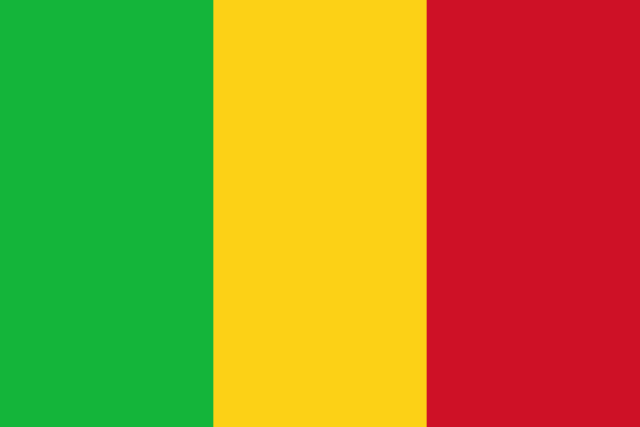

Mali
Republic of Mali
Africa
25,758,320
04:22 UTC+0
+223
.ml
Hombori Tondo
1,155 m · 3,789 ft
Senegal River
239 m · 784 ft
2,745,891
Bamako · 2026
2,745,891
Bamako · 2026
Location
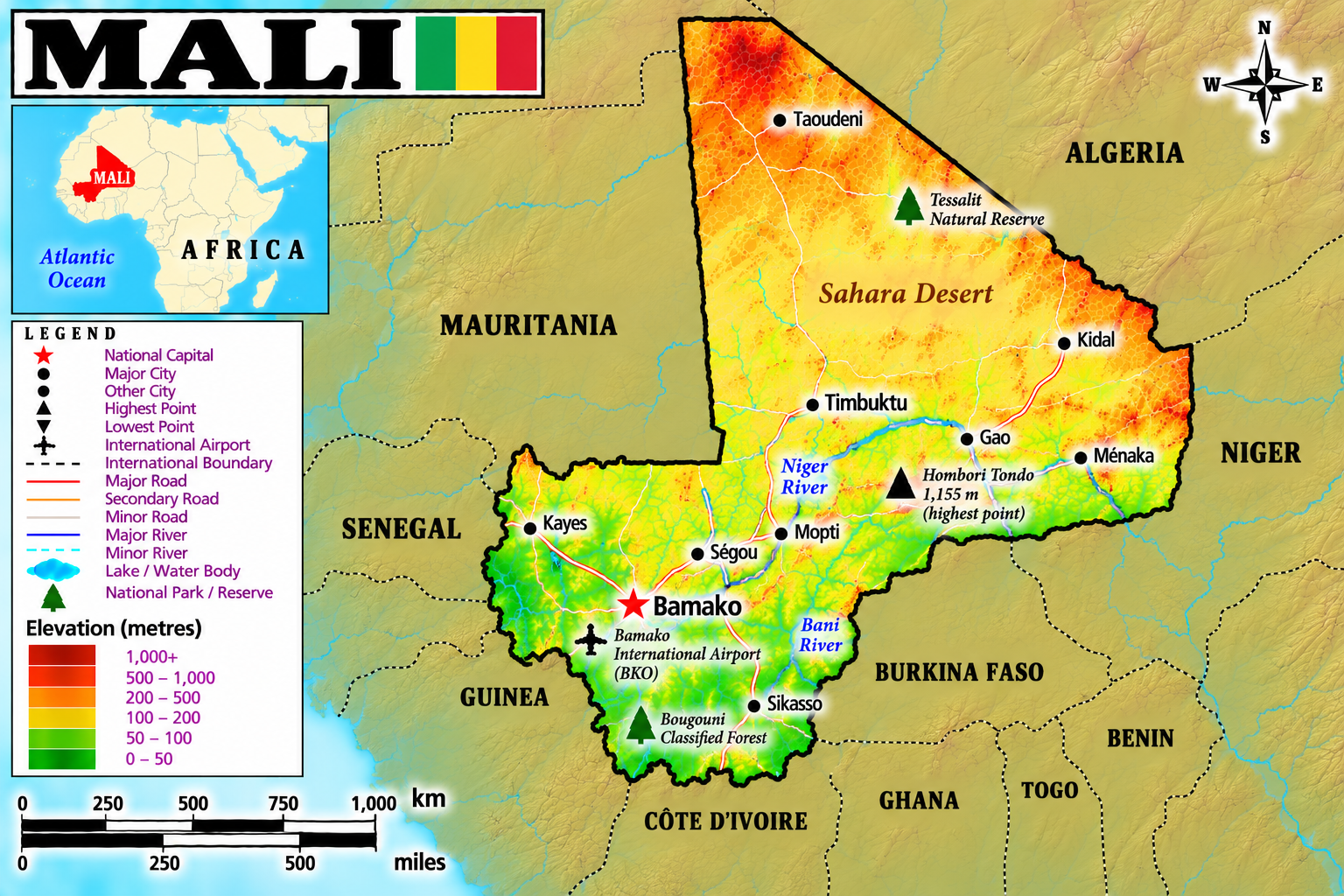
Mali — Detailed Physical Map
The Sahara, Timbuktu and the Niger River, Hombori Tondo, Bougouni forest, major cities and the capital Bamako
Tourist Attractions

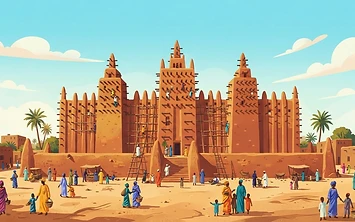
This massive structure is the largest mud-brick building in the world and a masterpiece of Sudano-Sahelian architecture. It is meticulously maintained by the local community through an annual restoration festival.
Witnessing the unique, towering mud-brick facade that defines the skyline of this ancient city.

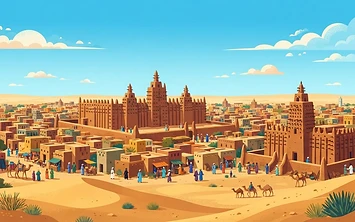
A legendary city at the edge of the Sahara, Timbuktu was a historic center of Islamic learning and a vital hub for the trans-Saharan gold and salt trade. It is home to iconic earthen mosques like Djinguereber and Sankore.
Exploring the historic mosques and the rich intellectual legacy of this fabled desert gateway.

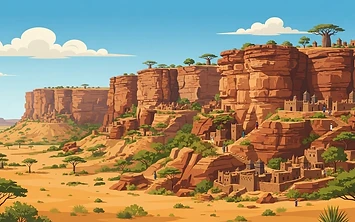
This dramatic sandstone cliff range is the ancestral home of the Dogon people, known for their unique cliff-side villages and ancient cultural traditions. The area offers breathtaking landscapes and a deep look into traditional Malian life.
Hiking the cliffs to see the traditional architecture and villages built directly into the rock face.

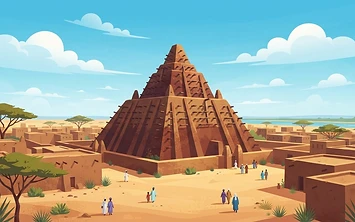
Built in 1495 by the Emperor of the Songhai Empire, this pyramid-shaped structure is a significant example of the region's earthen architectural heritage. It remains a spiritual and historical landmark of great importance.
Viewing the unique pyramid design that has stood as a symbol of the Songhai Empire for centuries.

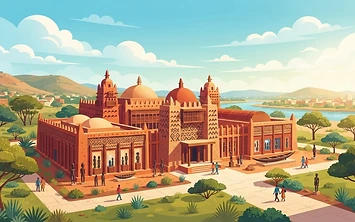
Located in the capital, this museum houses an extensive collection of archaeological artifacts, traditional textiles, and ethnographic objects from Mali's diverse ethnic groups. It serves as a premier institution for preserving the nation's cultural history.
Seeing the impressive collection of ceremonial masks and traditional musical instruments.

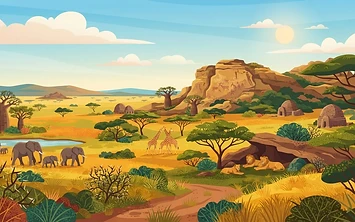
This expansive national park is a sanctuary for Sahelian wildlife, including giraffes, lions, and elephants. It is also home to significant prehistoric rock art and ancient tombs scattered throughout its savannah landscape.
Discovering ancient rock art sites while observing diverse wildlife in their natural habitat.
Geography
Nature
Hombori Tondo
1,155 m / 3,789 ft
3.3% of land
≈ 40,926 km² of forest
FAO / World Bank, forest area (% of land area)
Explore the Nature Atlas4,180 km2,597 mi
The principal river of West Africa, rising in the Guinea Highlands.
1,086 km675 mi
Forms part of the border between Mali and Mauritania.
160 km²62 sq mi · 5 m deep
An inland delta lake located in the Mopti region.
590 km²228 sq mi
A large lake system that fluctuates significantly based on flood levels.
16 m52 ft
Located on the Senegal River, it spans 500 meters in width.
15 m49 ft
Situated near Kayes on the Senegal River.
River lengths are whole-river figures, including any section beyond Mali. Researched reference figures. Tap any name for where its name comes from and a Google Maps link.
Major Cities
- 1Capital
Bamako
5,163,5642026
MapServes as the capital city and the primary administrative, cultural, and economic hub of the nation.
- 2
Kayes
1,906,7612026
MapFunctions primarily as a small agricultural settlement within the Koulikoro Region.
- 3
Sikasso
505,9222026
MapActs as the country's main agricultural center, renowned for high fruit production and the historic Tata fortifications.
- 4
Sikasso
330,9292026
MapRecognized as the primary center for cotton production, often earning the title of the white gold capital.
- 5
Kayes
295,5422026
MapKnown historically as one of the hottest inhabited places in Africa and a major transit trade hub.
- 6
Mopti
226,2502026
MapOperates as a vital river port located at the confluence of the Niger and Bani rivers.
- 7
Ségou
192,6002026
MapStands as a historic center of the Bamana Empire located along the banks of the Niger River.
- 8
Gao
188,0002026
MapHistorically served as the capital of the Songhai Empire and remains a key commercial center in the north.
- 9
Koulikoro
175,2002026
MapHosts a significant military base and functions as a major rail hub near the capital city.
- 10
Sikasso
92,2772026
MapServes as an important regional center for agricultural trade and cotton farming in southern Mali.
- 11
Kayes
86,8652026
MapSituated near famous sacred mountains and known for its long history of gold mining activities.
- 12
Ségou
64,1662026
MapFamous for the massive Markala Dam, which manages water flow for extensive irrigation schemes.
City populations are the latest official, UN or national-statistics estimates (2025–2026) compounded to 2026 at 3% a year (the nation's annual population growth rate); figures without a published update come from the open cities database (2020-era estimates) and are projected the same way.
Economy
Main exports
Mali's leading export commodities and products.
Tap any export to learn more. Spot prices in USD only for Live Data subscribers.
Main imports
Mali's leading import commodities and products.
Tap any import to learn more.
Military
Historical Timeline
10000 BCE
Early Human Settlement in Mali
Archeological evidence suggests that early hunter-gatherer societies occupied the Sahara and Sahel regions of present-day Mali as early as 10,000 BCE. These early populations established some of the earliest complex societies in West Africa near the inland Niger Delta.
1076
Fall of Ghana Empire
The Almoravids captured the capital of the Ghana Empire, marking the decline of the region's first major centralized state. This shift facilitated the eventual rise of the Mali Empire in the following centuries.
1235
Foundation of the Mali Empire
Sundiata Keita defeated the Sosso king Sumanguru Kante at the Battle of Kirina, establishing the Mali Empire. The empire became a major regional power through control of trans-Saharan trade routes.
1324
Mansa Musa's Pilgrimage
Mansa Musa began his famous pilgrimage to Mecca, during which his immense display of wealth brought Mali to the attention of the Mediterranean world. His journey stimulated trade and scholarly exchange between Mali and North Africa.
1591
Moroccan Invasion of Songhai
A Moroccan army equipped with firearms defeated the Songhai Empire at the Battle of Tondibi, ending the era of the great medieval Sahelian empires. This victory led to the fragmentation of the region into smaller competing states.
1893
French Colonization of French Sudan
French colonial forces completed the conquest of the region, formally incorporating it into French West Africa as French Sudan. This period saw the reorganization of local administration under French colonial rule.
1960
Independence from France
Mali achieved full independence from France on September 22, 1960, with Modibo Keita serving as the country's first president. This marked the end of colonial rule and the establishment of the Republic of Mali.
1992
Establishment of Multi-party Democracy
Following the 1991 revolution, Alpha Oumar Konare was elected president in the country's first democratic multi-party elections. This transition ended decades of military rule and established a new constitution.
2012
Tuareg Rebellion and Military Coup
A Tuareg-led rebellion in the north triggered a military coup in the capital, leading to the collapse of state authority in the northern regions. The crisis necessitated international intervention and the deployment of peacekeeping missions.
2020
Military Coup d'Etat
Following mass protests against the government, members of the Malian military seized power in a coup, deposing President Ibrahim Boubacar Keita. The event led to the establishment of a transitional military-led government.
2024
Dissolution of the Algiers Agreement
The transitional government officially terminated the 2015 peace agreement with northern rebel groups. This decision marked a significant shift in the state's internal security policy and approach to regional conflicts.
2025
Constitutional Referendum and Political Reform
The Malian state continued the implementation of constitutional reforms aimed at consolidating executive power and reorganizing national administration. These institutional changes represent the current direction of the transitional government as it moves toward potential future elections.
National Anthem
Pour le Mali, pour toi, Mali
Seydou Badian Kouyaté
Banzumana Sissoko
1962
Pour le Mali, pour toi, Mali Notre drapeau, emblème de notre foi. Pour le Mali et pour toi, Mali Notre peuple, notre force à nous tous. Pour le Mali, pour toi, Mali Notre terre, notre honneur à nous tous. Pour le Mali et pour toi, Mali Notre cœur, notre âme à nous tous. Pour le Mali, pour toi, Mali Notre vie, notre avenir à nous tous.
The Malian national anthem was written by the Malian writer and politician Seydou Badian Kouyaté. The music was composed by Banzumana Sissoko, a renowned Malian musician and storyteller known as the 'old lion' of Malian music. The anthem was officially adopted in 1962, shortly after Mali gained independence from France in 1960. It was created to foster a sense of national unity and pride among the diverse ethnic groups within the newly independent nation. The song replaced the previous anthem used during the period of the Mali Federation. It remains a central feature of Malian state ceremonies and is deeply respected as a symbol of the country's sovereignty and resilience.
National Holidays
Commemorates the proclamation of independence of the Republic of Mali from France in 1960.
A Christian holiday celebrated nationally in Mali to commemorate the birth of Jesus Christ.
Good News Today
Vegetable Growers in Mali Find Strength in Collaboration
Twenty vegetable cooperatives in southern Mali have successfully piloted collective sales contracts to increase their bargaining power and market influence. By planning and selling together, these small-scale farmers are significantly improving their economic stability.
Fun Facts
Gold And Salt Empire
During the 14th century, the Mali Empire was the world's largest producer of gold, fundamentally changing global trade markets.
Largest Mud Building
The Great Mosque of Djenne is the largest mud-brick building in the world and is a designated UNESCO World Heritage site.
Ancient Manuscript Archives
Timbuktu was once a major center of learning, housing thousands of ancient manuscripts covering everything from astronomy to Islamic law.
Birthplace Of Desert Blues
Mali is internationally renowned for its unique musical tradition, often cited as the root inspiration for American blues music.
The Mighty Niger River
The Niger River serves as the lifeblood of the nation, flowing through the arid landscape and supporting vast agricultural communities.
Dogon Mask Traditions
The Dogon people are famous for their complex astronomical knowledge and intricate mask dances performed during sacred ceremonies.
One Of The Hottest
Mali consistently ranks among the hottest countries in the world, with large portions of its land situated within the Sahara Desert.
Bizarre Rock Formations
The Bandiagara Escarpment features dramatic sandstone cliffs that have been inhabited by the Dogon people for centuries.
Traditional Three Tea Ritual
Social life often revolves around the 'three teas' ceremony, where guests are served tea that grows increasingly sweet with each pour.
Desert Dwelling Elephants
The Gourma elephant herd is one of the only groups of elephants in the world that migrates across a harsh desert landscape.
Chuckies Trivia Quiz
Chuckies Trivia Quiz
Fifteen questions on Mali — five easy, five medium, five hard. How far can you get?
Sports & Live Events
Language
Counting to 10
1
1
= 10 (n = 0)
World Dictionary
Discover and translate any word into all supported languages.