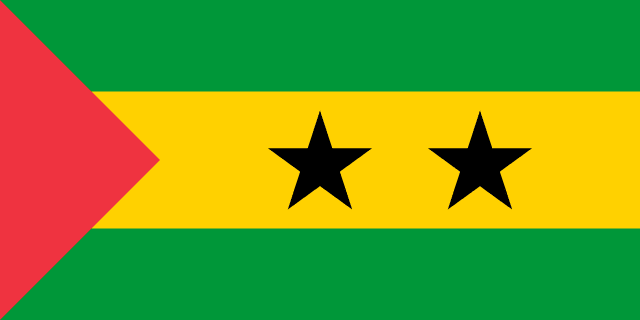

Sao Tome and Principe
Democratic Republic of São Tomé and Príncipe
Africa
241,157
+239
.st
Pico de Sao Tome
2,024 m · 6,640 ft
Atlantic Ocean
0 m · 0 ft
72,538
Sao Tome · 2026
72,538
Sao Tome · 2026
Location
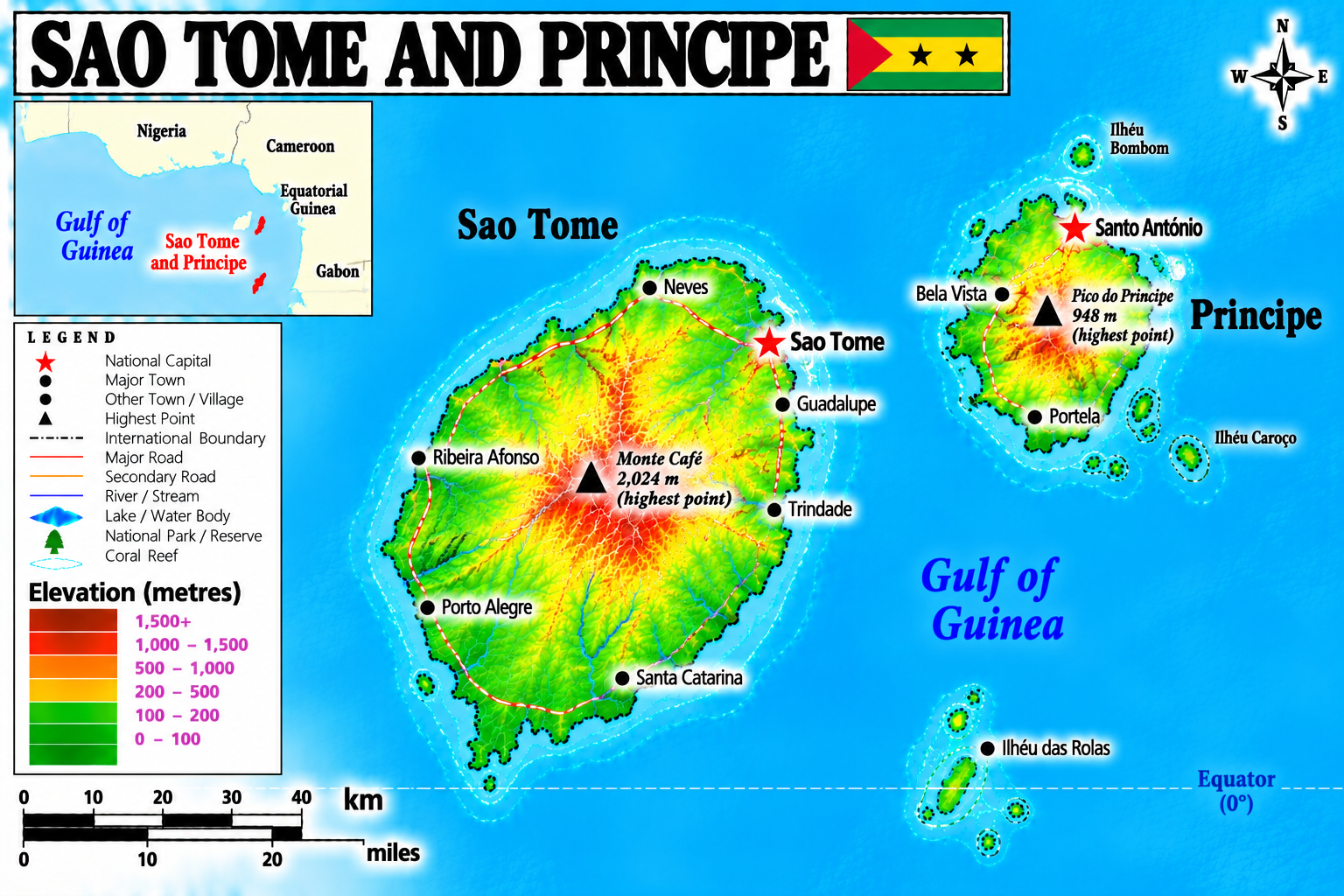
Sao Tome and Principe — Detailed Physical Map
Sao Tome and Principe islands, Pico do Principe, Monte Cafe, the equator line, coastal towns and the capital Sao Tome
Tourist Attractions

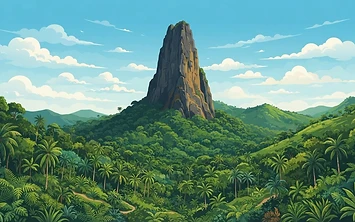
A dramatic, sheer volcanic plug rising nearly 300 meters out of the dense tropical forest. It is one of the most recognizable and iconic natural landmarks in the country.
The viewpoint at the base offers a breathtaking, otherworldly perspective of this massive rock spire.

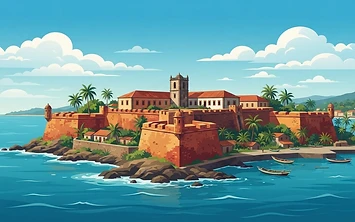
Built in 1575, this historic Portuguese fort now houses the National Museum of São Tomé and Príncipe. It contains a significant collection of colonial artifacts and religious art.
The museum rooftop provides an iconic, panoramic view of the ocean and nearby palm-fringed beaches.

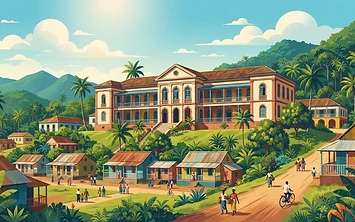
Once the largest cocoa plantation on the island, this site now functions as a living museum and residential community. It features striking neoclassical architecture, including a grand hospital building.
Visitors can walk through active drying sheds to see how cocoa beans are still processed by hand.

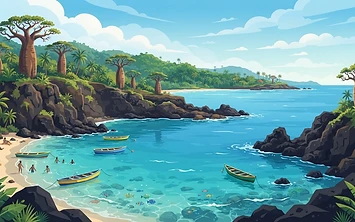
A stunning volcanic bay known for its crystal-clear waters and surrounding ancient baobab trees. It is a popular spot for swimming and photography due to its unique coastal scenery.
The contrast between the deep blue water and the massive, historic baobab trees creates a perfect photo opportunity.

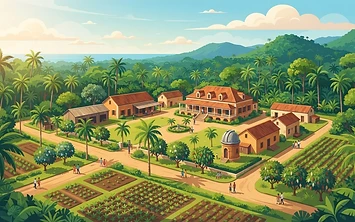
A historic plantation that gained international fame in 1919 when Arthur Eddington proved Einstein's Theory of Relativity here during a solar eclipse. It is part of the UNESCO-listed colonial agricultural system.
It is a site of immense scientific importance where a major breakthrough in modern physics was confirmed.

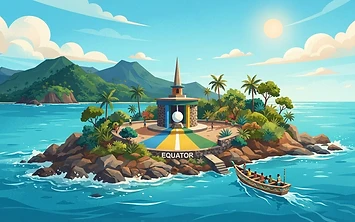
A small monument located on the tiny islet of Rolas that marks the exact line of the equator. It is a popular destination for travelers taking short boat trips from the main island.
You can stand with one foot in the northern hemisphere and the other in the southern hemisphere.
Geography
Nature
Pico de Sao Tome
2,024 m / 6,640 ft
43.0% of land
≈ 430 km² of forest
FAO / World Bank, forest area (% of land area)
Explore the Nature Atlas—
Originates in the mountainous regions of Sao Tome island.
—
Flows through the southeastern part of Sao Tome island.
—
Located in the northwestern district of the island of Sao Tome.
—
Located near the botanical garden in the interior of Sao Tome.
—
Features a picturesque coastal drop on the island of Sao Tome.
River lengths are whole-river figures, including any section beyond Sao Tome and Principe. Researched reference figures. Tap any name for where its name comes from and a Google Maps link.
Major Cities
- 1Capital
Água Grande
83,9052026
MapServes as the nation's capital and largest city, hosting the main harbor and historical colonial architecture.
- 2
Lembá
11,0722026
MapOperates as a major industrial hub, featuring the country's primary brewery and significant port facilities.
- 3
Cantagalo
9,8242026
MapFunctions as a prominent coastal town known for its vibrant local fishing industry and proximity to scenic beaches.
- 4
Mé-Zóchi
8,8212026
MapStands as the largest inland town in the country, serving as a vital commercial junction for mountain trade.
- 5
Lobata
4,3892026
MapActs as the administrative center of the Lobata District, characterized by its surrounding agricultural landscapes and cocoa plantations.
- 6
Príncipe
3,3992026
MapFunctions as the principal town and administrative headquarters of the autonomous island province of Principe.
- 7
Caué
2,9682026
MapRepresented by its historic site of a major slave rebellion and its role as a key agricultural community.
City populations are the latest official, UN or national-statistics estimates (2012–2024) compounded to 2026 at 2% a year (the nation's annual population growth rate); figures without a published update come from the open cities database (2020-era estimates) and are projected the same way.
Economy
Main exports
Sao Tome and Principe's leading export commodities and products.
Tap any export to learn more. Spot prices in USD only for Live Data subscribers.
Main imports
Sao Tome and Principe's leading import commodities and products.
Tap any import to learn more.
Military
Historical Timeline
1470
Portuguese discovery of the islands
Portuguese explorers João de Santarém and Pêro Escobar discovered the uninhabited islands of São Tomé and Príncipe. The islands were subsequently colonized and became vital hubs for the Atlantic slave trade.
1530
Establishment of the sugar industry
The islands became the world's largest sugar exporter for a brief period using enslaved labor on plantations. This economic shift shaped the islands' social and demographic structure.
1595
Revolt of Rei Amador
Rei Amador led a major slave rebellion that briefly controlled much of the island of São Tomé. He remains a national symbol of resistance against colonial oppression.
1822
Introduction of coffee and cocoa
The introduction of coffee and cocoa crops transformed the islands into the world's largest cocoa producers by the early 20th century. These plantations, known as roças, relied on a system of indentured labor.
1953
Batepá Massacre
Portuguese colonial forces killed hundreds of local laborers who were protesting against forced labor practices. The event galvanized the nationalist movement seeking independence from Portugal.
1975
Independence from Portugal
São Tomé and Príncipe gained formal independence on July 12, 1975. Manuel Pinto da Costa became the nation's first president, leading a one-party state.
1991
Transition to multi-party democracy
The government held the first free, multi-party presidential and legislative elections, ending the era of single-party rule. Miguel Trovoada was elected president, marking a significant democratic milestone.
2003
Military coup d'état
A military junta led by Major Fernando Pereira seized power while the president was abroad. The coup was peacefully resolved within a week through negotiations involving international mediators.
2016
Evaristo Carvalho elected president
Evaristo Carvalho won the presidential election, following a period of political uncertainty and boycotts. This event underscored the ongoing consolidation of the country's democratic processes.
2021
Carlos Vila Nova becomes president
Carlos Vila Nova was elected as the president in a competitive national poll. He succeeded Evaristo Carvalho, representing a peaceful transfer of power.
2022
Patrice Trovoada returns as prime minister
Following legislative elections, Patrice Trovoada was appointed prime minister of the nation. This marked a major change in government leadership during a period of economic reform.
2025
Continued economic and political development
The nation focused on strengthening its tourism and agriculture sectors while maintaining its commitment to parliamentary democracy. Ongoing efforts addressed long-standing challenges regarding infrastructure and sustainable resource management.
National Anthem
Independência total
Alda do Espírito Santo
Manuel dos Santos Barreto de Sousa e Almeida
1975
Independência total, gloriosa aliança, São Tomé e Príncipe, terra abençoada. Filhos do solo da ilha de São Tomé, Cantamos a glória do teu povo, Onde a luta é o nosso ideal. Independência total, gloriosa aliança, São Tomé e Príncipe, terra abençoada.
The national anthem of São Tomé and Príncipe, 'Independência total', was adopted in 1975 upon the country's independence from Portugal. The lyrics were written by the renowned poet and independence activist Alda do Espírito Santo. The music was composed by Manuel dos Santos Barreto de Sousa e Almeida. It serves as a symbol of the nation's liberation and the identity of its people. The anthem is performed at all major state and cultural ceremonies. The lyrics highlight the historical struggle for sovereignty and the pride associated with the archipelago's freedom. There have been no significant changes to the anthem since its initial adoption.
National Holidays
This day commemorates the Batepa Massacre of 1953, a tragic event that served as a catalyst for the country's struggle for independence from Portuguese colonial rule.
This holiday marks the anniversary of Sao Tome and Principe's declaration of independence from Portugal, which was achieved in 1975.
This day celebrates the establishment and service of the national armed forces of Sao Tome and Principe.
This holiday commemorates the signing of the agreement in Algiers in 1974, which set the roadmap for the transition to national independence.
Good News Today
New Marine Protected Areas Established to Safeguard Biodiversity
The nation has successfully established eight marine protected areas and implemented a new fisheries surveillance plan to combat illegal fishing. This initiative protects critical habitats for endangered hawksbill turtles and supports the long-term sustainability of local fish stocks.
Fun Facts
Centered on the World Map
The country is uniquely positioned almost exactly at the intersection of the Equator and the Prime Meridian in the Gulf of Guinea.
Historically Known as Chocolate Islands
During the early 20th century, these islands were the world's largest cocoa producers, earning them the nickname The Chocolate Islands.
Spectacular Volcanic Rock Formation
The Pico Cão Grande is a massive, iconic volcanic plug that rises like a sharp needle 370 meters above the surrounding tropical forest.
Global Sea Turtle Nesting Haven
The archipelago serves as a critical nesting ground for several species of sea turtles, including the critically endangered hawksbill turtle.
A Paradise for Bird Watchers
The islands are home to an exceptionally high number of endemic bird species that cannot be found anywhere else on Earth.
World Renowned Arabica Coffee
Some of the oldest plantations in the world still produce high-quality, shade-grown Arabica coffee beans cherished by connoisseurs globally.
Hidden Tropical Beach Gems
The islands boast pristine, secluded beaches with golden sand and volcanic rock backdrops that are rarely visited by large tourist crowds.
Unique Tchiloli Theater Tradition
The Tchiloli is a traditional performance art that blends Portuguese Renaissance drama with local music, costumes, and African rhythmic dance.
Rare Botanical Giant Trees
The Obô Natural Park protects vast, ancient forests that contain some of the most diverse and rare flora in Western Africa.
Thriving Sustainable Fishing Culture
Local fishing communities use traditional wooden boats called kanuas to maintain a sustainable, low-impact lifestyle deeply tied to the surrounding Atlantic waters.
Chuckies Trivia Quiz
Chuckies Trivia Quiz
Fifteen questions on Sao Tome and Principe — five easy, five medium, five hard. How far can you get?
Sports & Live Events
World Dictionary
Discover and translate any word into all supported languages.