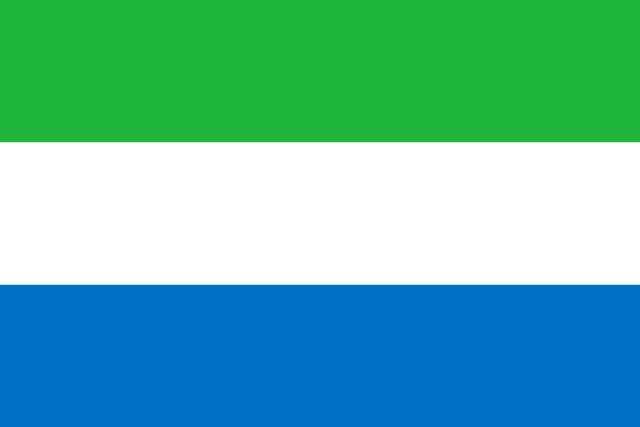
Sierra Leone
Africa

9,000,000
15:01 UTC+0
+232
Location
Geography
Economy
Main exports
Sierra Leone's leading export commodities and products.
Subscribe to Live Data for live spot prices
Live commodity prices on every nation's exports — $100 AUD/year.
Tap any export to learn more. Spot prices in USD only for Live Data subscribers.
Main imports
Sierra Leone's leading import commodities and products.
Tap any import to learn more.
Military
Historical Timeline
2500 BCE
Early Human Settlement by Indigenous Peoples
Archaeological evidence suggests that the coastal regions of Sierra Leone were inhabited by groups using stone tools as early as 2500 BCE. These early populations eventually transitioned into agricultural societies across the region.
1462
Arrival of Portuguese Explorer Pedro da Cintra
Portuguese navigator Pedro da Cintra mapped the coastline and gave the area the name Serra Lyoa, meaning Lion Mountains. This event marked the beginning of sustained maritime contact with European powers.
1787
Establishment of the Province of Freedom
The settlement was founded by abolitionists and the British government as a home for freed slaves from London, North America, and the Caribbean. It was the precursor to the modern capital of Freetown.
1808
Sierra Leone Becomes a British Crown Colony
The British government took formal control of the Freetown peninsula to serve as a base for suppressing the Atlantic slave trade. This marked the beginning of formal colonial administration.
1898
The Hut Tax War
Bai Bureh led a significant uprising against British colonial taxation and administrative policies in the interior. The conflict served as a major expression of resistance against British imperial rule.
1961
Sierra Leone Gains Independence
Sierra Leone formally achieved independence from the United Kingdom on April 27, 1961. Sir Milton Margai became the nation's first Prime Minister.
1971
Transition to a Republican Government
Sierra Leone abandoned its monarchical system and transitioned to a republic, with Siaka Stevens becoming the nation's first executive President.
1991
Beginning of the Sierra Leone Civil War
The Revolutionary United Front launched an insurgency against the government, triggering a decade-long conflict. The war was characterized by brutal violence and international concerns over blood diamonds.
2002
Official End of the Civil War
The government and rebel forces declared the official end of the civil war following the successful disarmament of combatants. A United Nations peacekeeping mission helped oversee the transition to stability.
2014
West African Ebola Virus Epidemic
Sierra Leone faced a devastating outbreak of the Ebola virus that caused thousands of deaths and crippled the nation's healthcare system. The crisis required a massive international humanitarian response.
2018
Successful Democratic Transition of Power
Julius Maada Bio was elected president, marking a peaceful democratic transfer of power between opposing political parties. This consolidated the nation's post-war democratic progress.
2023
Re-election of President Julius Maada Bio
Julius Maada Bio was re-elected for a second term in the June 2023 presidential election. The outcome faced scrutiny regarding transparency, though the process remained the central focus of national politics.
National Holidays
A public holiday marking the first day of the Gregorian calendar.
Commemorates Sierra Leone's independence from the United Kingdom on this day in 1961.
Marks the end of Ramadan, the Islamic holy month of fasting.
Honors the willingness of Ibrahim to sacrifice his son as an act of obedience to God's command.
A Christian holiday celebrating the birth of Jesus Christ.
A public holiday traditionally observed the day after Christmas.
Language
Counting to 10
1
1
= 10 (n = 0)
World Dictionary
Discover and translate any word into all supported languages.
The multilingual Dictionary is a Nations Pro feature.
Upgrade to Pro