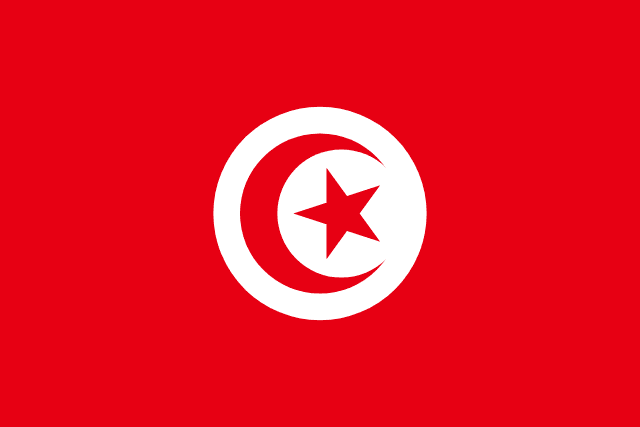

Tunisia
Republic of Tunisia
Africa
12,740,531
10:10 UTC+1
+216
.tn
Jebel ech Chambi
1,544 m · 5,066 ft
Shatt al Gharsah
-17 m · -56 ft
716,860
Tunis · 2026
2,590,637
Tunis · 2026
Location
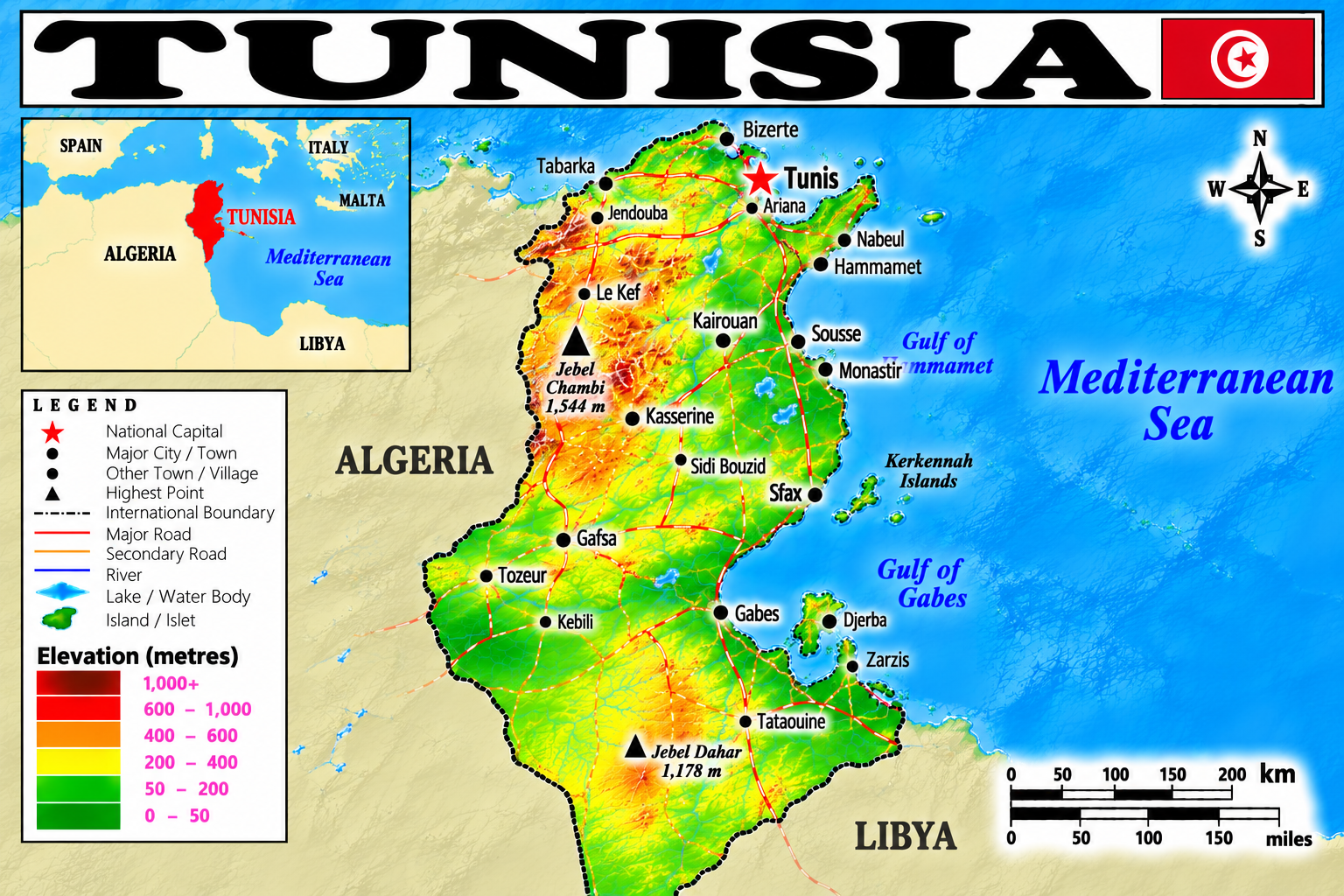
Tunisia — Detailed Physical Map
Jebel Chambi and Jebel Dahar, the Cap Bon Peninsula, Djerba and the Kerkennah Islands, major cities and the capital Tunis
Tourist Attractions
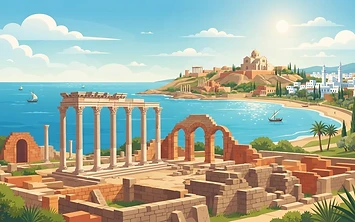
Once a powerful Phoenician city-state and a major rival to Rome, these coastal ruins offer a profound look into ancient Mediterranean history.
The site features stunning archaeological remains overlooking the Mediterranean Sea.
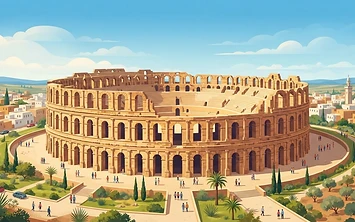
This massive Roman amphitheatre is the third-largest in the world and remains remarkably well-preserved, reflecting the grandeur of the ancient city of Thysdrus.
Visitors can explore the underground hypogeum and climb the tiers for an intimate view of this architectural marvel.

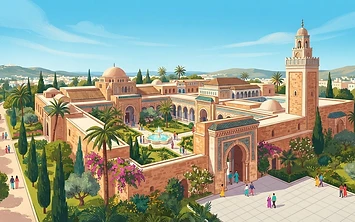
Housed in a beautiful 13th-century palace, this museum holds one of the world's most significant collections of Roman mosaics.
It provides an unparalleled look at the artistic and cultural history of Tunisia through its vast collection of ancient artifacts.

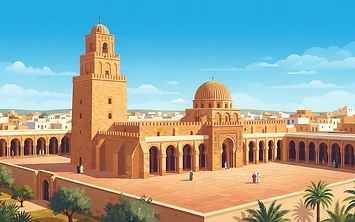
Dating back to 670 AD, this is one of the oldest and most significant mosques in the Islamic world, known for its impressive architecture and spiritual importance.
The mosque is a masterpiece of Islamic design and a central pillar of Tunisia's religious heritage.

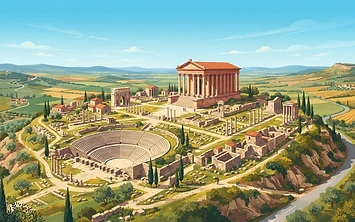
Widely considered the best-preserved Roman small town in North Africa, this UNESCO World Heritage site sits on a hill overlooking fertile plains.
The site offers an immersive experience of Roman urban planning with its intact temples, theatre, and baths.

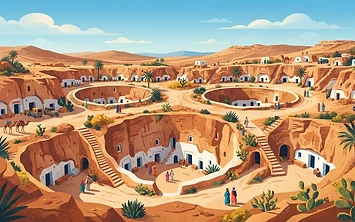
Famous for its unique troglodyte architecture, this village features traditional homes carved deep into the rock to escape the desert heat.
The subterranean dwellings offer a fascinating glimpse into traditional Berber life and have gained fame as a filming location.
Geography
Nature
Jebel ech Chambi
1,544 m / 5,066 ft
6.7% of land
≈ 10,962 km² of forest
FAO / World Bank, forest area (% of land area)
Explore the Nature Atlas484 km301 mi
Flows from northeastern Algeria through Tunisia into the Gulf of Tunis.
5,000 km²1,931 sq mi
Largest salt lake in Tunisia located in the southern part of the country.
120 km²46 sq mi · 2 m deep
UNESCO World Heritage site providing a crucial habitat for migratory birds.
—
Hidden desert oasis waterfall located in the mountain ranges of western Tunisia.
River lengths are whole-river figures, including any section beyond Tunisia. Researched reference figures. Tap any name for where its name comes from and a Google Maps link.
Major Cities
- 1Capital
Tunis
2,687,1232026
MapServes as the nation's capital and political center, housing the historic Medina and the landmark Zitouna Mosque.
- 2
Bizerte
413,5082026
MapLocated on the northernmost point of Africa, it is famous for its strategic port and historic maritime architecture.
- 3
L’Ariana
412,6032026
MapKnown as a vibrant residential extension of the capital, housing major government buildings and diverse public gardens.
- 4
Sfax
309,4542026
MapFunctions as a major industrial hub and the primary port for phosphate exports in Tunisia.
- 5
Sousse
244,1822026
MapAttracts millions of tourists annually due to its expansive Mediterranean resorts and ancient coastal fortifications.
- 6
Gabès
178,3252026
MapFeatures vast palm groves and traditional irrigation methods characteristic of the southern Tunisian oasis landscape.
- 7
Kairouan
164,8872026
MapStands as the spiritual capital of Tunisia and a UNESCO World Heritage site known for its Great Mosque.
- 8
L’Ariana
157,0162026
MapProvides a significant residential and commercial suburb located near the international airport serving the capital region.
- 9
Sidi Bouzid
127,4882026
MapGained international historical significance as the starting point of the 2010 Tunisian Revolution.
- 10
Sfax
119,3482026
MapServes as a prominent industrial and residential district situated just north of the major coastal city Sfax.
- 11
Gabès
111,5692026
MapUnique for being one of the only coastal oases in the world, renowned for its diverse agricultural produce.
- 12
Kébili
42,6722026
MapActs as a gateway to the Sahara Desert and remains one of the oldest human settlements in the region.
City populations are the latest official, UN or national-statistics estimates (2023–2024) compounded to 2026 at 0.8% a year (the nation's annual population growth rate); figures without a published update come from the open cities database (2020-era estimates) and are projected the same way.
Economy
Main exports
Tunisia's leading export commodities and products.
Tap any export to learn more. Spot prices in USD only for Live Data subscribers.
Main imports
Tunisia's leading import commodities and products.
Tap any import to learn more.
Military
Historical Timeline
10000 BCE
Arrival of the Amazigh people
The indigenous Amazigh populations, also known as Berbers, settled in the region during the prehistoric period. They established the cultural and linguistic foundation of North Africa.
814 BCE
Foundation of Carthage
Phoenician settlers from Tyre founded the city-state of Carthage. It grew to become a dominant maritime power in the Mediterranean.
146 BCE
Roman Annexation of Carthage
Following the defeat of Carthage in the Punic Wars, the territory was annexed by the Roman Republic. It became a prosperous province known as the granary of Rome.
670
Founding of Kairouan
Uqba ibn Nafi founded the city of Kairouan, marking the beginning of Islamic influence in the region. It became an important center for Islamic scholarship and culture.
1881
Establishment of the French Protectorate
Tunisia became a French protectorate following the signing of the Treaty of Bardo. This period introduced significant political and economic administrative reforms.
1956
Independence from France
Tunisia gained full independence from France on March 20, 1956. Habib Bourguiba became the country's first prime minister and later its first president.
1957
Proclamation of the Republic
The monarchy was abolished on July 25, 1957, and Tunisia was declared a republic. This shift consolidated executive power under a secular presidency.
2011
The Tunisian Revolution
The Jasmine Revolution led to the ousting of President Zine El Abidine Ben Ali. This event served as the primary catalyst for the broader Arab Spring.
2014
Adoption of the 2014 Constitution
A new constitution was ratified, guaranteeing civil rights and establishing a democratic framework. It was praised for its progressive approach to gender equality and religious freedom.
2021
President Kais Saied's Exceptional Measures
President Kais Saied suspended the parliament and assumed executive authority in July 2021. This action marked a significant shift in the country's political structure.
2022
Ratification of a New Constitution
A constitutional referendum was held, resulting in the adoption of a new constitution that increased the powers of the presidency. The move sparked significant debate over the state of democratic institutions.
2024
Presidential Election
Kais Saied was re-elected for a second term as President of Tunisia. The election took place under the legal framework established by the 2022 constitution.
National Anthem
Humat al-Hima
Mustafa Sadiq al-Rafii and Abul-Qasim al-Shabbi
Mohammed Abdel Wahab
1987
Humat al-hima ya humat al-hima Halumma li-majdi lizamani Amam al-ula ha nahnu ghurra Nasudu bil-ghissi anna al-mihani Wa nahnu barqund yadhawu fi-ssama Wa nahnu ra'dun idha ma sara'na Shuyukhu 'uliyyun wa shabbu hamim La yadh'ufu fi-l-hawli qattu 'azamuna Humat al-hima ya humat al-hima Halumma li-majdi lizamani
Humat al-Hima replaced 'Ala Khallat al-Mada as the national anthem of Tunisia in 1987. The lyrics incorporate verses written by the Egyptian poet Mustafa Sadiq al-Rafii and the prominent Tunisian poet Abul-Qasim al-Shabbi. The music was composed by the renowned Egyptian musician Mohammed Abdel Wahab. It was adopted following the assumption of power by Zine El Abidine Ben Ali to signal a new political era. The anthem is performed regularly at official state functions, sporting events, and in schools to instill a sense of national unity. It serves as a powerful symbol of Tunisian identity, emphasizing the historical resilience and bravery of the people.
National Holidays
Commemorates the start of the 2010-2011 Tunisian Revolution.
Marks the anniversary of Tunisia's independence from France in 1956.
Honors the Tunisians who died during the 1938 nationalist demonstrations against French colonial rule.
A national holiday celebrating the social and economic achievements of workers.
Commemorates the abolition of the monarchy in 1957 and the proclamation of the Republic of Tunisia.
Celebrates the promulgation of the Code of Personal Status in 1956 which granted women significant legal rights.
Good News Today
Dutch grant funds coastal protection works across Tunisia
Tunisia and the Netherlands signed a €60.92 million grant agreement on November 10, 2026, to fund critical coastal protection projects. The initiative will support infrastructure works in Bizerte, Sousse, Monastir, and Djerba to combat coastal erosion.
Fun Facts
Star Wars filming location
Many scenes for the original Star Wars trilogy were filmed in the Tunisian desert, and the famous 'Luke Skywalker' house remains standing in Matmata.
Ancient Carthage archaeological ruins
Tunisia was the site of the powerful ancient civilization of Carthage, whose historical remains, including massive Roman baths, overlook the Mediterranean Sea.
Chott el Djerid salt lake
The massive salt lake of Chott el Djerid covers over 7,000 square kilometers and frequently transforms into a mirage-like landscape of crystal salt flats.
Bardo Museum mosaic mastery
The Bardo National Museum houses one of the world's most extensive and finest collections of Roman mosaics, preserved in stunningly intricate detail.
Harissa as spicy heritage
Harissa, the iconic hot chili pepper paste, is a central element of Tunisian cuisine and was recently added to the UNESCO Intangible Cultural Heritage list.
Sidi Bou Said blue aesthetics
The town of Sidi Bou Said is famous for its strict architectural code, where all buildings must be painted in a specific shade of blue and white.
Douz gateway to Sahara
The town of Douz is widely known as the 'Gateway to the Sahara,' serving as the starting point for desert treks across the vast sand dunes.
Kairouan spiritual capital city
Kairouan is considered one of the holiest cities in the Islamic world and is renowned for the Great Mosque, which dates back to the 7th century.
Chechia traditional wool hat
The Chechia is a traditional brimless felt cap that has been the symbol of Tunisian national identity and craftsmanship for many centuries.
Troglodyte houses of Matmata
Residents of Matmata have traditionally lived in underground 'cave' dwellings to escape the extreme heat of the desert climate.
Chuckies Trivia Quiz
Chuckies Trivia Quiz
Fifteen questions on Tunisia — five easy, five medium, five hard. How far can you get?
Sports & Live Events
Language
Counting to 10
1
1
= 10 (n = 0)
World Dictionary
Discover and translate any word into all supported languages.