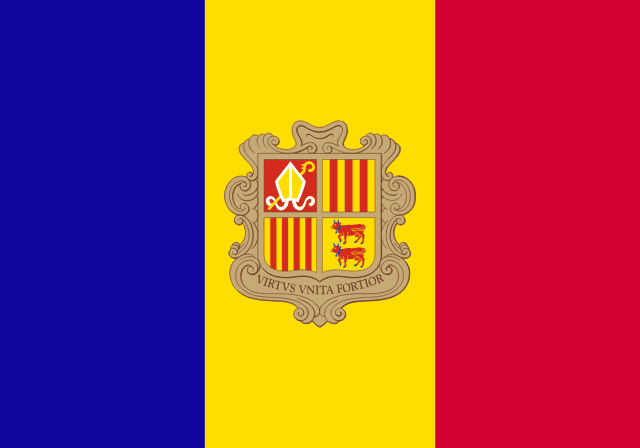
Andorra
Europe

85,000
17:04 UTC+2
+376
Location
Geography
Economy
Main exports
Andorra's leading export commodities and products.
Subscribe to Live Data for live spot prices
Live commodity prices on every nation's exports — $100 AUD/year.
Tap any export to learn more. Spot prices in USD only for Live Data subscribers.
Main imports
Andorra's leading import commodities and products.
Tap any import to learn more.
Military
Historical Timeline
6000 BCE
Earliest Neolithic Settlement
Archaeological evidence suggests that humans first occupied the valleys of Andorra during the Neolithic period. These early settlers relied on agriculture and pastoralism in the high Pyrenean environment.
805
Charlemagne Grants Charter
According to tradition, Charlemagne granted the Andorran people a charter in exchange for their assistance in fighting the Moors. This event established the early political status of the valleys.
1278
Signing of the First Pareatges
The First Pareatges established a feudal co-principality between the Bishop of Urgell and the Count of Foix. This agreement defined the dual-sovereignty structure that remains the foundation of Andorra's political identity.
1419
Creation of the Consell de la Terra
The Consell de la Terra was established as an early form of parliament to represent the interests of the parishes. It provided a framework for local self-governance within the co-principality.
1748
The Manual Digest
Antoni Fiter i Rossell compiled the Manual Digest, a comprehensive text documenting the history, laws, and customs of Andorra. It served as a critical guide for the governance of the valleys for centuries.
1866
The New Reform
The New Reform introduced significant political changes, including the granting of voting rights to heads of households. This marked a shift toward a more modern and representative governance system.
1933
Andorran Crisis and Democracy
A period of social and political unrest led to the temporary occupation of Andorra by French gendarmerie. The crisis resulted in increased demands for suffrage and modernized political structures.
1981
Establishment of the Executive Council
The creation of the Executive Council separated legislative and executive powers for the first time in Andorran history. This step transitioned the country toward a parliamentary model.
1993
Adoption of the Constitution
Andorra adopted a modern democratic constitution that formally defined the country as a parliamentary co-principality. This change solidified the nation's sovereignty and legal independence.
1994
Admission to the United Nations
Andorra became a full member of the United Nations, gaining formal recognition on the international stage. This solidified the state's status as a sovereign entity in global affairs.
2011
Introduction of Personal Income Tax
Andorra implemented a personal income tax to align with international transparency standards. This marked a major economic shift away from its reputation as a tax haven.
2023
Xavier Espot Re-elected as Head of Government
Xavier Espot Zamora secured a second term as Head of Government following parliamentary elections. His administration continued focusing on international integration and economic diversification.
National Holidays
A public holiday marking the first day of the year in the Gregorian calendar.
Commemorates the 1993 referendum that established Andorra as a sovereign parliamentary democracy.
An international holiday dedicated to celebrating the achievements and contributions of workers.
A religious observance commemorating the belief in the Virgin Mary's bodily ascent into heaven.
The National Day of Andorra, honoring the patron saint of the country with pilgrimages to the Meritxell sanctuary.
A religious holiday dedicated to honoring all Christian saints and often used to remember deceased loved ones.
A religious holiday celebrating the belief that the Virgin Mary was conceived without original sin.
A national holiday commemorating the birth of Jesus Christ.
Language
Counting to 10
1
1
= 10 (n = 0)
World Dictionary
Discover and translate any word into all supported languages.
The multilingual Dictionary is a Nations Pro feature.
Upgrade to Pro