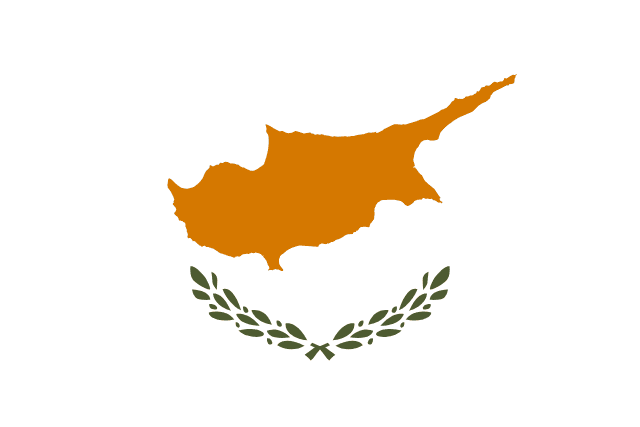

Cyprus
Republic of Cyprus
Europe
1,393,712
05:49 UTC+2
+357
.cy
Mount Olympus
1,952 m · 6,404 ft
Mediterranean Sea
0 m · 0 ft
338,749
Nicosia · 2026
463,025
Nicosia · 2026
Location
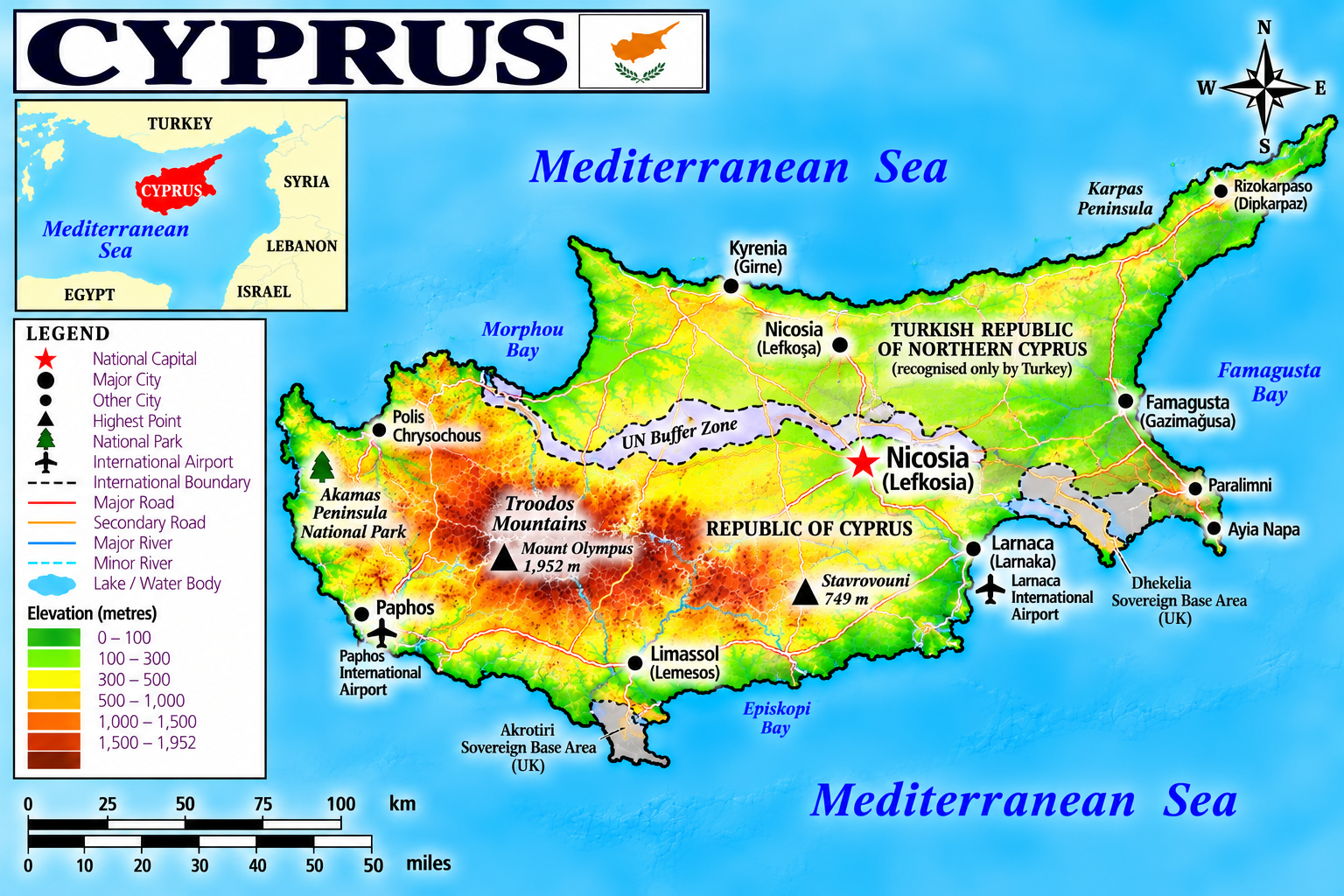
Cyprus — Detailed Physical Map
Troodos Mountains, Mount Olympus, the Karpas Peninsula, major cities and the capital Nicosia
Tourist Attractions

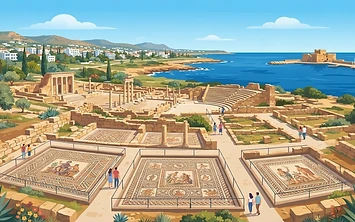
A UNESCO World Heritage site containing significant ruins from the Roman period, including famous, well-preserved floor mosaics.
The intricate Roman mosaics are considered some of the finest in the Eastern Mediterranean.

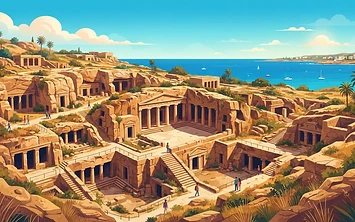
A monumental necropolis carved into solid rock, dating back to the Hellenistic and Roman periods.
The impressive underground chambers and Doric-style pillars offer a unique glimpse into ancient burial customs.


The island's largest and oldest archaeological museum, housing an extensive collection of Cypriot antiquities from the Neolithic to the Byzantine period.
It features the iconic statue of Aphrodite of Soloi and a vast array of ancient terracotta figurines.

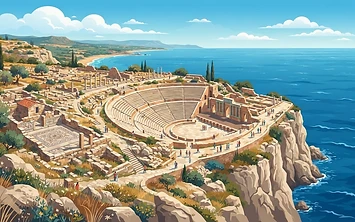
An ancient city-state perched on a cliff overlooking the sea, featuring a spectacular Greco-Roman amphitheatre.
The view from the ancient theatre across the Mediterranean coastline is breathtaking.

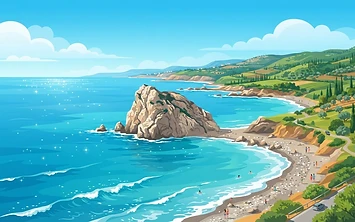
A stunning sea stack located off the coast, famously known in mythology as the birthplace of the goddess Aphrodite.
It is a legendary and highly photogenic natural landmark perfect for coastal walks.

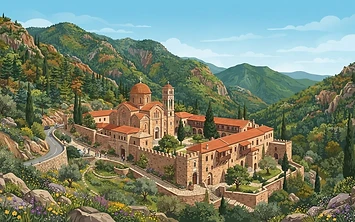
A historic Royal and Stavropegic monastery nestled in the mountains, known for housing a miraculous icon of the Virgin Mary.
The serene mountain setting and the monastery's rich religious history make it a peaceful cultural retreat.
Geography
Nature
Mount Olympus
1,952 m / 6,404 ft
18.7% of land
≈ 1,730 km² of forest
FAO / World Bank, forest area (% of land area)
Explore the Nature Atlas100 km62 mi
Rises in the Troodos Mountains and flows through the capital city Nicosia.
105 km65 mi
Second longest river on the island flowing eastward into the Famagusta Bay.
38 km24 mi
Feeds the Kouris Dam which is the largest water reservoir in Cyprus.
2 km²1 sq mi · 1 m deep
Complex network of four interconnected salt lakes attracting large flocks of flamingos.
17 km²7 sq mi · 1 m deep
Located within the British Overseas Territory of Akrotiri on the southern coast.
15 m49 ft
Located near Platres village and accessible via a scenic nature trail.
13 m43 ft
Situated in the Troodos region and surrounded by dense pine forest.
River lengths are whole-river figures, including any section beyond Cyprus. Researched reference figures. Tap any name for where its name comes from and a Google Maps link.
Major Cities
- 1Capital
Lefkosía
276,4162026
MapFunctions as the capital and largest city, serving as the primary administrative and financial center of Cyprus.
- 2
Lemesós
216,8112026
MapHosts the busiest port in the country and serves as a major hub for international tourism and business.
- 3
Lárnaka
98,1132026
MapFeatures the primary international airport of Cyprus and is famous for the historic Church of Saint Lazarus.
- 4
Páfos
79,1662026
MapBoasts significant archaeological ruins and remains protected as a UNESCO World Heritage site for its ancient mosaics.
- 5
Ammóchostos
42,5262026
MapPreserves the historic walled old city and the famous Othello Castle within its medieval fortifications.
- 6
Kerýneia
26,7012026
MapRenowned for its scenic harbor and a historic castle overlooking the Mediterranean Sea on the northern coast.
- 7
Lemesós
23,2312026
MapOperates as a large suburban municipality located in the Limassol District.
- 8
Lárnaka
22,9342026
MapServes as an important residential and industrial municipality adjacent to Larnaca.
- 9
Lefkosía
17,8052026
MapForms a significant residential suburb situated in the southern outskirts of Nicosia.
- 10
Ammóchostos
15,8832026
MapActs as the administrative center for the popular coastal tourism region in the eastern part of Cyprus.
- 11
Lemesós
15,3382026
MapFunctions as a densely populated residential and commercial district within the greater Limassol urban area.
- 12
Lemesós
15,2562026
MapIncludes many modern business offices and residential developments overlooking the city of Limassol.
City populations are the latest official, UN or national-statistics estimates (2021–2026) compounded to 2026 at 1.2% a year (the nation's annual population growth rate); figures without a published update come from the open cities database (2020-era estimates) and are projected the same way.
Economy
Main exports
Cyprus's leading export commodities and products.
Tap any export to learn more. Spot prices in USD only for Live Data subscribers.
Main imports
Cyprus's leading import commodities and products.
Tap any import to learn more.
Military
Historical Timeline
8500 BCE
Earliest Neolithic Settlers in Cyprus
Archaeological evidence at sites like Khirokitia indicates that the earliest known human settlers arrived on the island during the Aceramic Neolithic period. These early inhabitants established organized agricultural communities and introduced domesticated animals to the island.
1191
Richard the Lionheart Conquers Cyprus
During the Third Crusade, King Richard I of England conquered Cyprus from the Byzantine ruler Isaac Komnenos. This event ended centuries of Byzantine rule and set the stage for the establishment of the Lusignan Kingdom.
1489
Venetian Rule Established
Queen Catherine Cornaro formally ceded the Kingdom of Cyprus to the Republic of Venice. The Venetians fortified the island, specifically Nicosia and Famagusta, to defend against Ottoman expansion.
1571
Ottoman Conquest of Cyprus
Following the Siege of Famagusta, Ottoman forces completed their conquest of the island, ending Venetian rule. Cyprus became a province of the Ottoman Empire for the next three centuries.
1878
British Administration Begins
Under the Cyprus Convention, the Ottoman Empire granted the United Kingdom the right to administer the island in exchange for protection against Russia. While technically remaining Ottoman territory, British rule fundamentally changed the island's political trajectory.
1960
Independence from Britain
Cyprus gained formal independence from the United Kingdom and became a republic under the London-Zurich Agreements. Archbishop Makarios III was elected as the first President of the new nation.
1974
The Turkish Military Intervention
Following a Greek-backed coup d'état, Turkey launched a military invasion of Cyprus, resulting in the de facto partition of the island. This conflict led to the creation of a buffer zone and the displacement of thousands of inhabitants.
2004
Cyprus Joins the European Union
The Republic of Cyprus officially joined the European Union, marking a major economic and geopolitical milestone. The acquis communautaire was suspended in the northern part of the island due to the ongoing division.
2013
Banking Crisis and Bailout
The Republic of Cyprus faced a severe financial crisis, resulting in a controversial Eurogroup bailout agreement that included a 'haircut' on bank deposits. This event prompted significant structural economic reforms.
2023
Nikos Christodoulides Elected President
Nikos Christodoulides won the presidential election, marking a transition to a new administration. He succeeded Nicos Anastasiades, following a campaign focused on economic stability and national security.
2024
Amalthea Initiative Humanitarian Corridor
Cyprus launched the Amalthea initiative, a maritime corridor designed to facilitate the delivery of humanitarian aid to Gaza. This operation highlighted the country's strategic role in regional stability and crisis management.
2025
Expansion of Natural Gas Exploration
The government intensified efforts to develop its offshore energy resources in the Eastern Mediterranean. This project remains a focal point for the nation's economic strategy and regional energy cooperation.
National Anthem
Ύμνος εις την Ελευθερίαν
Dionysios Solomos
Nikolaos Mantzaros
1966
Σε γνωρίζω από την κόψη του σπαθιού την τρομερή, σε γνωρίζω από την όψη που με βιά μετράει τη γη. Απ' τα κόκκαλα βγαλμένη των Ελλήνων τα ιερά, και σαν πρώτα ανδρειωμένη, χαίρε, ω χαίρε, Ελευθεριά!
The anthem, known as the Hymn to Liberty, was originally a 158-stanza poem written by Dionysios Solomos in 1823 during the Greek War of Independence. The music was composed by Nikolaos Mantzaros in 1828 to accompany the verses. Cyprus adopted the first two stanzas of the poem as its national anthem in 1966, following a decision by the Council of Ministers. The adoption serves as a symbol of the shared cultural and historical identity between Cyprus and Greece. Although the original poem is extremely long, only the first two stanzas are used for formal state occasions. The melody remains identical to the Greek national anthem, reflecting the strong political and cultural ties between the two nations. It has remained the official anthem of Cyprus since its adoption without any significant changes to the lyrics.
National Holidays
Commemorates the start of the Greek War of Independence against the Ottoman Empire in 1821.
Marks the beginning of the EOKA struggle against British colonial rule in 1955.
An international holiday dedicated to celebrating the achievements and rights of workers.
A major religious holiday celebrating the Dormition of the Virgin Mary.
Celebrates the anniversary of Cyprus gaining independence from the United Kingdom in 1960.
Commemorates the Greek rejection of the ultimatum given by fascist Italy in 1940, marking Greece's entry into World War II.
Good News Today
Diwali at Parklane gathers together 600 from Cyprus' diverse communities
Approximately 600 people from various cultural backgrounds gathered in Limassol to celebrate the festival of lights, promoting social harmony and inclusion. The event followed a historic celebration at the Presidential Palace, highlighting the growing multicultural spirit of the nation.
Fun Facts
The Original Halloumi Producers
Cyprus is the exclusive home of Halloumi cheese, which has a high melting point allowing it to be grilled or fried. This traditional cheese has been a staple of the island's diet since the Byzantine period.
World's Oldest Named Wine
Commandaria, a sweet dessert wine produced in the foothills of the Troodos Mountains, is officially the world's oldest named wine still in production. It was famously named by the Knights Templar in the 12th century.
Entire City is a UNESCO Site
The entire town of Paphos is included on the UNESCO World Heritage list due to its exceptional collection of ancient ruins and mosaics. The site includes the spectacular Tombs of the Kings, carved directly into solid rock.
Crucial Mediterranean Sea Turtle Sanctuary
Lara Bay is a strictly protected nature reserve that serves as one of the most important nesting grounds for green and loggerhead turtles. Visitors are prohibited from using umbrellas or chairs in certain areas to keep the sand undisturbed for hatchlings.
An Island Divided by Borders
Nicosia is the only capital city in the world that remains divided by a border between two different geopolitical entities. The United Nations buffer zone splits the heart of the city in two.
Wild Donkeys of Karpas Peninsula
A population of wild donkeys lives freely on the remote Karpas Peninsula, descendants of animals left behind by farmers decades ago. They have become a beloved symbol of the island's untamed natural beauty.
Located at Three-Continent Intersection
Cyprus is geologically situated at the intersection of Europe, Asia, and Africa. Its unique location has made it a crossroads of civilizations for thousands of years.
Home to the Troodos Pine
The Troodos Mountains are home to rare endemic plants, including the Troodos Pine which is found nowhere else on earth. The high altitude allows for a surprising microclimate that even features snow during the winter months.
Major Global Ship Registry
Cyprus maintains one of the largest ship registries in the entire world. Due to its strategic maritime position, the country has become a massive hub for international shipping companies and merchant fleets.
Legendary Birthplace of Aphrodite
According to Greek mythology, the goddess Aphrodite rose from the sea foam at a site called Petra tou Romiou. Today, this iconic offshore rock formation remains a major landmark for visitors.
Chuckies Trivia Quiz
Chuckies Trivia Quiz
Fifteen questions on Cyprus — five easy, five medium, five hard. How far can you get?
Sports & Live Events
Language
Counting to 10
1
1
= 10 (n = 0)
World Dictionary
Discover and translate any word into all supported languages.