
Liechtenstein
Principality of Liechtenstein
Europe
40,682
05:22 UTC+1
+423
.li
Grauspitz
2,599 m · 8,527 ft
Rhine River
430 m · 1,411 ft
6,029
Vaduz · 2026
6,029
Schaan · 2026
Location
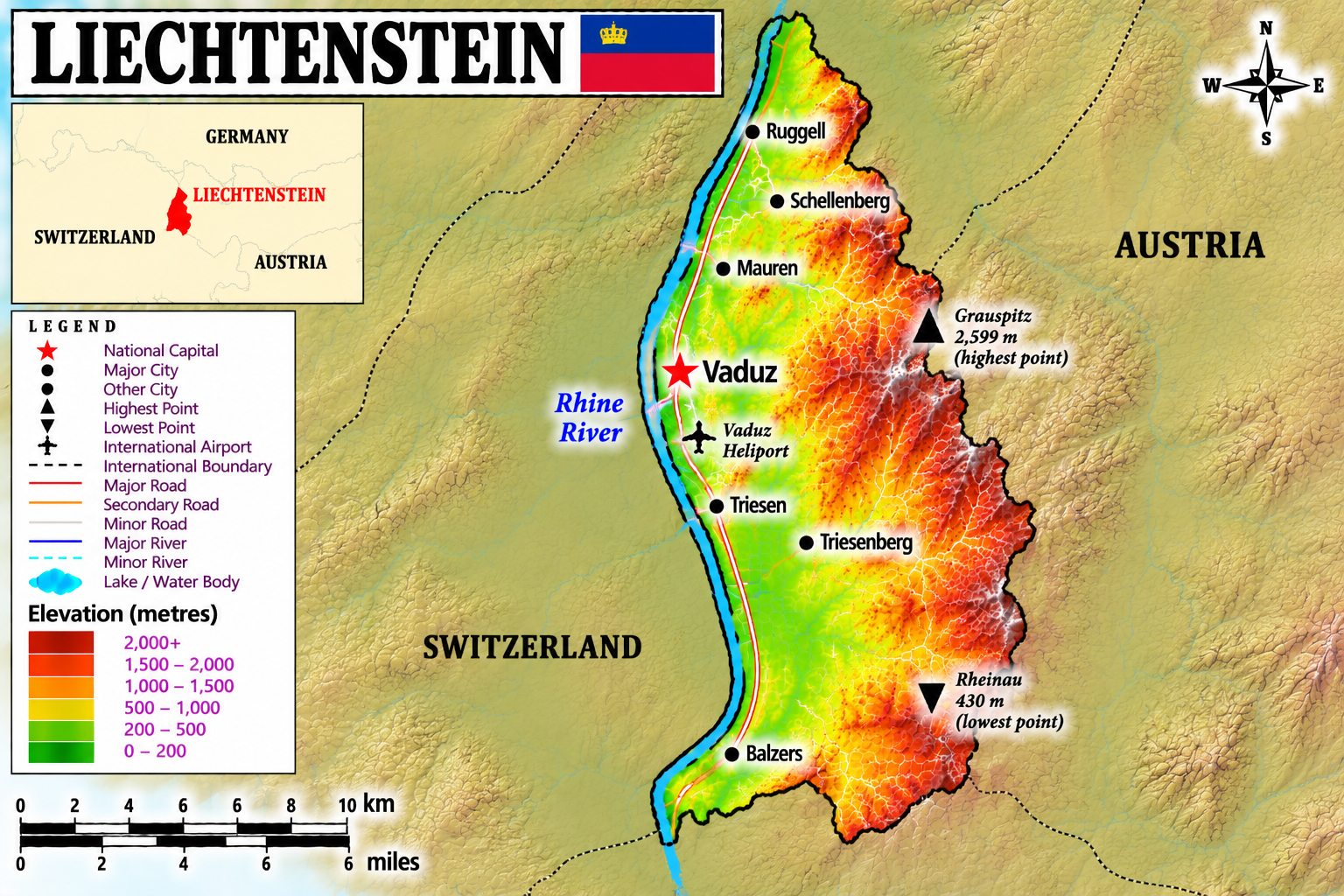
Liechtenstein — Detailed Physical Map
The Rhine Valley, Grauspitz, Eschnerberg, the eleven communes, major towns and the capital Vaduz
Tourist Attractions

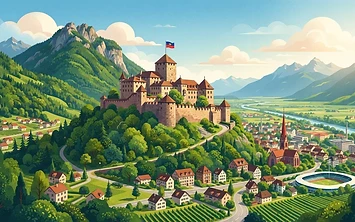
Perched 120 meters above the capital, this 12th-century fortress serves as the official residence of the Prince of Liechtenstein.
It is the most iconic symbol of the principality and offers stunning views over the Rhine Valley.

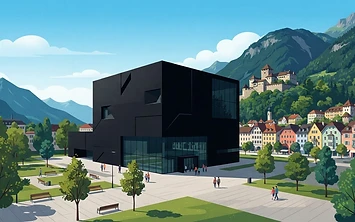
This striking, black-cube building houses a world-class collection of modern and contemporary art, including works from the Hilti Art Foundation.
The building itself is a masterpiece of minimalist architecture that stands out in the heart of the city.

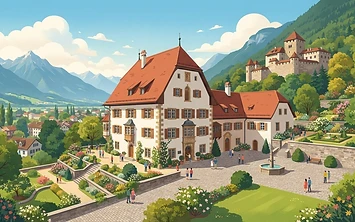
Housed in a historic building dating back to the 15th century, this museum showcases the country's rich history, archaeology, and natural heritage.
It features fascinating dioramas of local flora and fauna alongside royal artifacts.

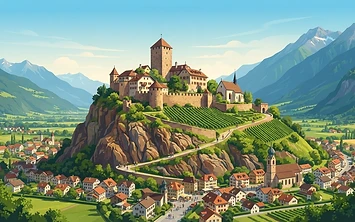
Situated on a 70-meter-high rocky hill, this well-preserved medieval castle overlooks the southern town of Balzers.
Visitors can explore the beautiful inner courtyard and enjoy panoramic views of the surrounding mountains.

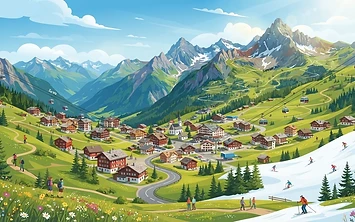
This idyllic mountain village is the country's premier destination for outdoor recreation, offering skiing in winter and extensive hiking trails in summer.
It is the perfect place to experience the pristine beauty of the Liechtenstein Alps.

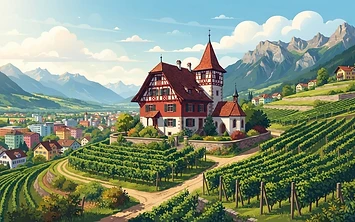
A distinctive 14th-century gabled house with a half-timbered tower, surrounded by one of the city's most prominent vineyards.
Its vibrant red facade and historic architecture make it one of the most photogenic spots in the country.
Geography
Nature
Grauspitz
2,599 m / 8,527 ft
41.9% of land
≈ 67 km² of forest
FAO / World Bank, forest area (% of land area)
Explore the Nature Atlas1,230 km764 mi
Forms the entire western border between Liechtenstein and Switzerland.
17 km11 mi
Flows through the Ruggeller Riet nature reserve before crossing into Austria.
0 km²0 sq mi · 6 m deep
Formed by massive floods of the Rhine river in 1927.
20 m66 ft
Located on the slopes of the Three Sisters mountain range.
River lengths are whole-river figures, including any section beyond Liechtenstein. Researched reference figures. Tap any name for where its name comes from and a Google Maps link.
Major Cities
- 1
Schaan
6,3622026
MapServes as the nation's primary industrial hub and hosts the most significant transportation infrastructure in the country.
- 2Capital
Vaduz
6,0872026
MapFunctions as the capital city and houses the official residence of the Prince of Liechtenstein.
- 3
Triesen
5,8342026
MapFeatures several well-preserved historical churches and traditional architecture reflecting the region's ancient settlement history.
- 4
Balzers
4,8512026
MapDominated by the majestic Gutenberg Castle, which stands prominently on a rocky hill overlooking the Rhine Valley.
- 5
Eschen
4,8002026
MapActs as the administrative and economic center for the northern region of the principality.
- 6
Mauren
4,6792026
MapKnown as a primary center for cultural events and residential life within the lowlands of the country.
- 7
Triesenberg
2,7392026
MapRenowned for its unique Walser dialect and elevated mountain setting overlooking the Rhine valley.
- 8
Ruggell
2,5982026
MapContains the Ruggeller Riet nature reserve, a protected wetland area of significant ecological importance.
- 9
Gamprin
1,8162026
MapIncludes the historic site of Nendeln, where remnants of ancient Roman villas have been discovered.
- 10
Schellenberg
1,1792026
MapHome to the historic ruins of the Upper and Lower castles dating back to the Middle Ages.
- 11
Planken
5072026
MapRepresents the smallest municipality in the country, known for its tranquil alpine surroundings and scenic views.
City populations are the latest official, UN or national-statistics estimates (2026–2026) compounded to 2026 at 0.5% a year (the nation's annual population growth rate); figures without a published update come from the open cities database (2020-era estimates) and are projected the same way.
Economy
Main exports
Liechtenstein's leading export commodities and products.
Tap any export to learn more. Spot prices in USD only for Live Data subscribers.
Main imports
Liechtenstein's leading import commodities and products.
Tap any import to learn more.
Military
Historical Timeline
3000 BCE
Neolithic Settlement of the Rhine Valley
The first permanent agricultural settlements appeared in the region, established by early Neolithic tribes who practiced farming and animal husbandry. These groups represent the earliest sedentary inhabitants of the land that now constitutes Liechtenstein.
15
Roman Annexation of Raetia
The Roman Empire conquered the region as part of the expansion into the Alpine province of Raetia. The area became strategically significant due to its position along the transit routes across the Alps.
1342
Formation of the County of Vaduz
The County of Vaduz was established as a sovereign political entity following the partition of the County of Werdenberg-Sargans. This event created the territorial nucleus of the modern state.
1699
Purchase of the Lordship of Schellenberg
Prince Johann Adam Andreas of Liechtenstein purchased the Lordship of Schellenberg from the Counts of Hohenems. This acquisition was a necessary step for the family to eventually gain a seat in the Imperial Diet.
1719
Establishment of the Principality of Liechtenstein
Holy Roman Emperor Charles VI officially elevated the combined territories of Vaduz and Schellenberg to the status of an Imperial Principality. This formal act created the sovereign entity of Liechtenstein under the rule of the House of Liechtenstein.
1806
Liechtenstein Gains Sovereignty
Liechtenstein joined the Confederation of the Rhine, effectively gaining full sovereignty and independence following the dissolution of the Holy Roman Empire. This marked the end of the nation's dependence on the Habsburg monarchy.
1862
Promulgation of the First Constitution
Prince Johann II granted the first constitution, which established a parliamentary body known as the Landtag. This transition introduced the beginnings of constitutional monarchy and representative governance.
1923
Customs Union with Switzerland
Liechtenstein signed a treaty establishing a customs and currency union with Switzerland, replacing its previous economic ties with Austria. This agreement solidified the nation's economic stability and neutrality throughout the 20th century.
1984
Women's Suffrage Referendum
Following a national referendum, the male electorate voted to grant women the right to vote in national elections. This was a pivotal moment for civil rights and gender equality in the principality.
2003
Constitutional Amendment Expanding Princely Powers
A controversial constitutional referendum significantly expanded the political powers of the Prince, including the right to veto legislation and dissolve parliament. This change reshaped the balance of power between the monarchy and the legislature.
2022
Daniel Risch Assumes Office as Prime Minister
Daniel Risch formally took office as the Head of Government of Liechtenstein after leading the Progressive Citizens' Party to a coalition victory. His administration has focused on digital transformation and economic resilience.
2025
Landtag Election Results
The 2025 parliamentary elections confirmed the continued stability of the coalition government. This democratic transition maintained the nation's political trajectory and parliamentary priorities.
National Anthem
Oben am jungen Rhein
Jakob Josef Jauch
Unknown
1920
Oben am jungen Rhein Lehnet sich Liechtenstein An Alpenhöh' Dies liebe Heimatland Das teure Vaterland Dem Gott die Treue bot Dem Gott die Treue bot Lebe du Fürstenhaus Lebe du Vaterland In deutscher Treu' Du liebes Liechtenstein Du liebes Liechtenstein In deutscher Treu'
The anthem was written by Jakob Josef Jauch in 1850. It was intended to honor the ruling Prince of Liechtenstein and the nation's alpine geography. For many years, the anthem was sung to the melody of the British national anthem, 'God Save the King'. It was officially adopted as the national anthem of the Principality of Liechtenstein in 1920. In 1963, the lyrics were modified to replace an original reference to the 'German' Rhine with a more neutral 'young' Rhine, reflecting post-WWII sensitivities. Today, the anthem remains a central symbol of national identity and sovereignty, performed at all official state functions and international sporting events.
National Holidays
This holiday marks the beginning of the new calendar year according to the Gregorian calendar.
A Christian feast day celebrating the revelation of God incarnate as Jesus Christ to the Gentiles.
An international day to celebrate and commemorate the social and economic achievements of workers.
A Christian holiday commemorating the bodily Ascension of Jesus into heaven, observed 40 days after Easter.
This date commemorates the Assumption of Mary and serves as the official national day of Liechtenstein, celebrating the country's sovereignty.
A major Christian holiday that commemorates the birth of Jesus Christ.
Good News Today
EU Committee Recommends Expanded RSV Prevention for Children
The European Medicines Agency's CHMP has issued a positive opinion to expand the use of the preventive treatment ENFLONSIA to children up to 24 months old. This recommendation, which includes Liechtenstein, aims to protect vulnerable infants from severe respiratory syncytial virus disease.
Fun Facts
The Picturesque Vaduz Castle
The Prince of Liechtenstein lives in Vaduz Castle, which overlooks the capital city from a high cliff. While the interior is private, the exterior is a major landmark.
Double Landlocked Alpine Nation
Liechtenstein is one of only two 'doubly landlocked' countries in the world, meaning it is surrounded entirely by other landlocked countries. It sits nestled between Switzerland and Austria.
World Leader in Dentures
The nation is a global powerhouse for the production of artificial teeth. The company Ivoclar Vivadent manufactures millions of dental products here for the global market.
Smallest Nation with Olympic Medals
Despite its small size, Liechtenstein has won more Olympic medals per capita than almost any other country. Most of these medals were earned in Alpine skiing events.
Monarchy with Political Power
Unlike many European constitutional monarchies, the Prince of Liechtenstein retains significant political power, including the right to veto legislation. It remains a rare example of a functional parliamentary monarchy.
High Density of Registered Companies
Due to favorable tax policies, there are more registered companies in Liechtenstein than there are citizens living in the country. It is a major international financial hub.
Prince's Private Vineyard Estate
The Prince of Liechtenstein owns a private vineyard in Vaduz called the Hofkellerei. They produce high-quality wines that are often served at state functions.
Cross-Country Hiking Trails
Liechtenstein features the Liechtenstein Trail, which covers the entire width and length of the country. Hikers can traverse the entire nation in just a few days.
Country Available for Rental
In a unique marketing move, the entire country was once available for private rental through a concierge service. This included branding rights and the use of the country's currency.
No Standing National Army
Liechtenstein has not had a standing army since 1868. The country relies on a small police force and maintains an open border policy with Switzerland.
Chuckies Trivia Quiz
Chuckies Trivia Quiz
Fifteen questions on Liechtenstein — five easy, five medium, five hard. How far can you get?
Sports & Live Events
Language
Counting to 10
1
1
= 10 (n = 0)
World Dictionary
Discover and translate any word into all supported languages.