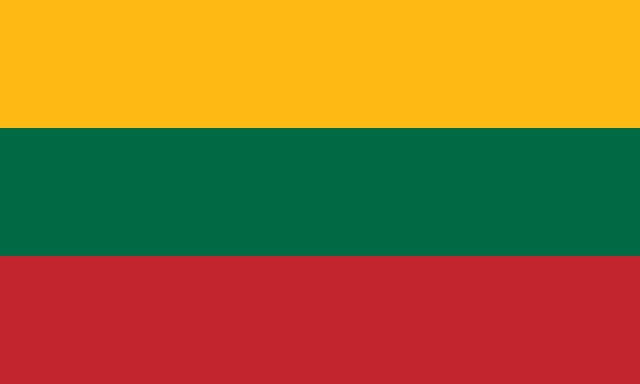
Lithuania
Europe

2,850,000
14:34 UTC+3
+370
Location
Geography
Economy
Main exports
Lithuania's leading export commodities and products.
Subscribe to Live Data for live spot prices
Live commodity prices on every nation's exports — $100 AUD/year.
Tap any export to learn more. Spot prices in USD only for Live Data subscribers.
Main imports
Lithuania's leading import commodities and products.
Tap any import to learn more.
Military
Historical Timeline
10000 BCE
Arrival of Kunda Culture Hunters
Following the retreat of the glaciers, the Kunda culture arrived as the first human inhabitants in the Baltic region. These nomadic hunter-gatherer groups established the earliest settlements along the riverbanks and coastlines.
1009
First Written Mention of Lithuania
The name of Lithuania was first recorded in the Quedlinburg Chronicle when Saint Bruno of Querfurt was killed on the border of Lithuania and Kievan Rus. This event marks the first historical entry of the nation into written records.
1253
Coronation of King Mindaugas
Mindaugas was crowned the first King of Lithuania, unifying the fragmented Baltic tribes into a single state. This event formally established the Kingdom of Lithuania as a Christian nation in Europe.
1410
Battle of Grunwald
A coalition led by the Grand Duchy of Lithuania and the Kingdom of Poland decisively defeated the Teutonic Order. This victory halted the German eastward expansion and established the Polish-Lithuanian alliance as a major European power.
1569
Union of Lublin
Lithuania and Poland formed a real union known as the Polish-Lithuanian Commonwealth. This dual state maintained a shared monarch and parliament while preserving distinct administrative structures for each partner.
1795
Third Partition of the Polish-Lithuanian Commonwealth
Following the final partition by the Russian Empire, Prussia, and Austria, the state of Lithuania was effectively liquidated. Its territories were mostly incorporated into the Russian Empire for the next century.
1918
Act of Independence of Lithuania
The Council of Lithuania signed the Act of Independence on February 16, declaring the restoration of a sovereign democratic Lithuanian state. This action ended centuries of foreign rule and established the modern republic.
1940
Soviet Occupation of Lithuania
As a result of the Molotov-Ribbentrop Pact, the Soviet Union occupied and subsequently annexed Lithuania. This marked the beginning of decades of totalitarian rule and mass deportations.
1990
Re-establishment of Independence
Lithuania became the first Soviet republic to formally declare its independence from the USSR on March 11. This bold move played a critical role in the eventual collapse of the Soviet Union.
2004
Accession to NATO and the European Union
Lithuania officially joined both NATO and the European Union in 2004. These memberships anchored the nation firmly within Western security and economic structures.
2015
Adoption of the Euro
Lithuania became the 19th member of the Eurozone on January 1, replacing the litas as its national currency. This completed the country's integration into the European financial system.
2024
Lithuanian Parliamentary Elections
Lithuania held parliamentary elections in October, leading to a transition of power toward a new governing coalition. These elections reflected the nation's ongoing democratic process and geopolitical concerns.
National Holidays
Commemorates the signing of the Act of Independence of Lithuania in 1918, which established the modern state of Lithuania.
Marks the adoption of the Act of the Re-Establishment of the State of Lithuania in 1990, declaring the restoration of Lithuania's independence from the Soviet Union.
Commemorates the coronation of Mindaugas as the first and only King of Lithuania in 1253.
Honors the people who died in 1991 during the defense of the Vilnius TV Tower against Soviet military forces.
Language
Counting to 10
1
1
= 10 (n = 0)
World Dictionary
Discover and translate any word into all supported languages.
The multilingual Dictionary is a Nations Pro feature.
Upgrade to Pro