
Luxembourg
Grand Duchy of Luxembourg
Europe
702,270
06:47 UTC+1
+352
.lu
Kneiff
560 m · 1,837 ft
Moselle River
133 m · 436 ft
138,907
Luxembourg City · 2026
138,907
Luxembourg City · 2026
Location
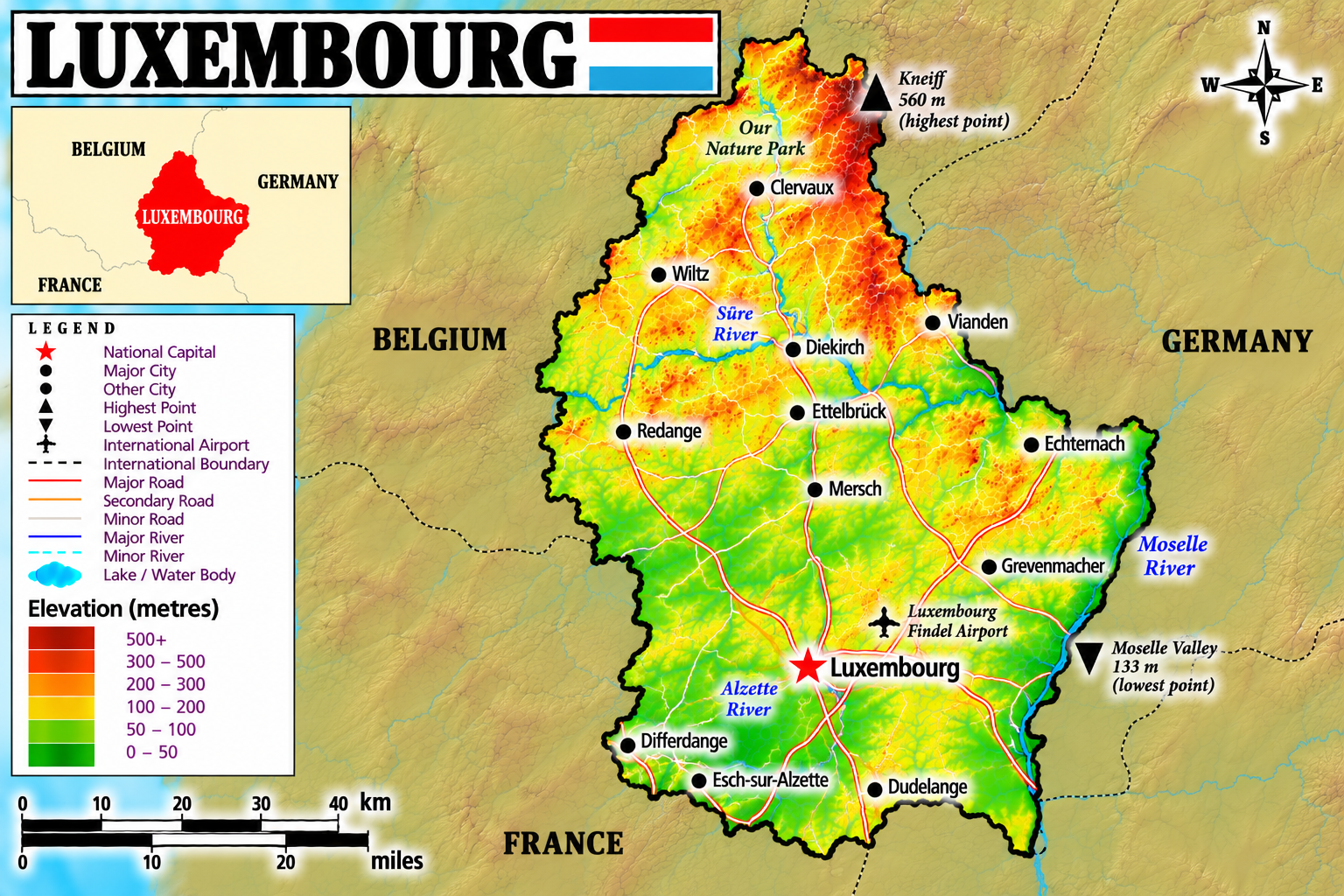
Luxembourg — Detailed Physical Map
Kneiff, the Our Nature Park, Sure and Moselle rivers, the Ardennes, major towns and Luxembourg City
Tourist Attractions

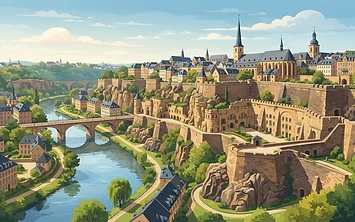
These extensive underground tunnels and fortifications were carved into the cliffs of the Bock promontory starting in the 17th century. They are a key part of the UNESCO-listed old town and fortress defenses.
Explore the fascinating labyrinth of tunnels that once protected the city from invaders.

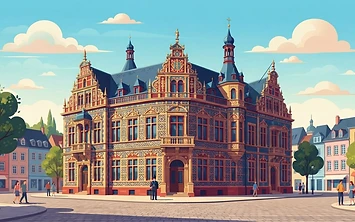
This 16th-century building serves as the official residence of the Grand Duke of Luxembourg and is a prime example of Flemish Renaissance architecture. It is the site where the head of state performs most of his official duties.
Admire the stunning architectural detail of this historic seat of power in the heart of the capital.

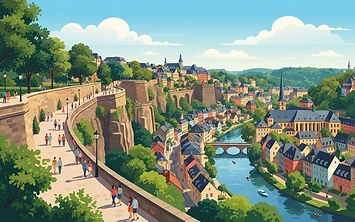
Often referred to as the most beautiful balcony in Europe, this scenic promenade follows the 17th-century ramparts. It offers breathtaking views over the Alzette River valley and the historic Grund district below.
Walk along the ramparts for the most iconic panoramic view of Luxembourg City.

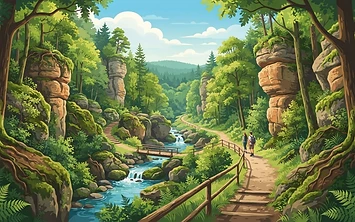
Known as Luxembourg's Little Switzerland, this region is famous for its unique sandstone rock formations, dense forests, and winding hiking trails. It is a premier destination for nature lovers and outdoor enthusiasts.
Discover the magical and mythical rock formations that define this picturesque landscape.

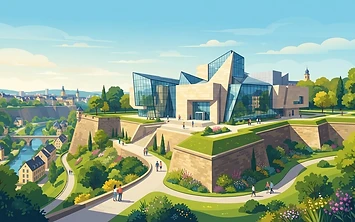
The Grand Duke Jean Museum of Modern Art is housed in a striking building designed by I.M. Pei. It showcases a diverse collection of contemporary art in a space that blends modern design with historic fortress walls.
Experience world-class contemporary art housed within a masterpiece of modern architecture.

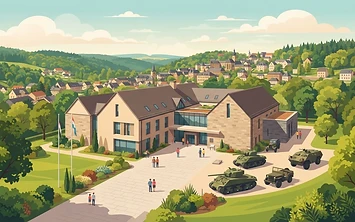
This museum provides a detailed look at the military history of Luxembourg, with a specific focus on the Battle of the Bulge during World War II. It features extensive collections of equipment, vehicles, and personal accounts from the conflict.
Gain a profound understanding of the region's pivotal role during the Second World War.
Geography
Nature
Kneiff
560 m / 1,837 ft
34.6% of land
≈ 895 km² of forest
FAO / World Bank, forest area (% of land area)
Explore the Nature Atlas544 km338 mi
Forms part of the natural border between Luxembourg and Germany.
172 km107 mi
The main tributary of the Moselle river flowing through the Oesling region.
73 km45 mi
Flows through the capital city and joins the Sure at Ettelbruck.
4 km²1 sq mi · 49 m deep
The largest reservoir in the country and a major source of drinking water.
0 km²0 sq mi
Formed by gravel extraction and popular as a recreational nature reserve area.
2 m7 ft
Located on the Black Ernz stream and famous for its picturesque stone bridge.
River lengths are whole-river figures, including any section beyond Luxembourg. Researched reference figures. Tap any name for where its name comes from and a Google Maps link.
Major Cities
- 1Capital
Luxembourg
139,7612026
MapServes as the capital city and a major global financial center housing several institutions of the European Union.
- 2
Esch-sur-Alzette
38,4912026
MapHistorically defined by its thriving steel industry, this southern town now focuses on education, innovation, and diverse cultural programs.
- 3
Esch-sur-Alzette
31,2512026
MapFunctions as a prominent hub for steel production and hosts a growing international campus for the University of Luxembourg.
- 4
Esch-sur-Alzette
22,5362026
MapRenowned for its industrial heritage as a former steel town, it now hosts the National Audiovisual Centre and art exhibitions.
- 5
Wiltz
7,9172026
MapKnown as the capital of the Luxembourg Ardennes, it hosts the annual open-air festival within its picturesque castle grounds.
- 6
Diekirch
7,3082026
MapFamous for its long-standing brewery and the National Museum of Military History documenting the Battle of the Bulge.
- 7
Capellen
6,5972026
MapActs as an important administrative and residential center situated on the strategic road connecting the capital to Belgium.
- 8
Echternach
5,9582026
MapCelebrated as the oldest city in the country, it is globally recognized for its historic abbey and traditional dancing procession.
- 9
Grevenmacher
5,3792026
MapSituated along the Moselle river, it serves as a central hub for the country’s flourishing wine and sparkling wine production.
- 10
Remich
4,0602026
MapFunctions as a popular tourist destination and river port, famously branded as the pearl of the Moselle river valley.
- 11
Clervaux
2,6392026
MapNestled in the northern mountains, it preserves the famous Family of Man photography exhibition within its landmark castle.
- 12
Vianden
2,2332026
MapFeatures a beautifully restored medieval castle that stands as one of the most significant feudal residences in Europe.
City populations are the latest official, UN or national-statistics estimates (2025–2025) compounded to 2026 at 1.5% a year (the nation's annual population growth rate); figures without a published update come from the open cities database (2020-era estimates) and are projected the same way.
Economy
Main exports
Luxembourg's leading export commodities and products.
Tap any export to learn more. Spot prices in USD only for Live Data subscribers.
Main imports
Luxembourg's leading import commodities and products.
Tap any import to learn more.
Military
Historical Timeline
500 BCE
Celtic Tribes Settlement
The Treveri, a Celtic tribe, established settlements in the region that encompasses modern-day Luxembourg. They built fortified hill forts known as oppida to defend their territory.
963
Founding of Luxembourg
Count Siegfried acquired the Lucilinburhuc castle, marking the foundation of the House of Luxembourg and the nation. This event is traditionally considered the birth of the state.
1354
Elevation to a Duchy
Emperor Charles IV elevated the County of Luxembourg to a Duchy. This enhanced the territory's status and political influence within the Holy Roman Empire.
1443
Burgundian Occupation
Philip the Good, Duke of Burgundy, conquered Luxembourg, ending the independence of the Luxembourg dynasty. The territory subsequently passed through Burgundian, Habsburg, and Spanish rule.
1815
Creation of the Grand Duchy
The Congress of Vienna established the Grand Duchy of Luxembourg as an independent state in personal union with the Netherlands. It was simultaneously made a member of the German Confederation.
1867
Treaty of London and Neutrality
The Treaty of London confirmed Luxembourg's independence and required it to remain permanently neutral. This allowed the fortress of Luxembourg to be dismantled.
1890
End of Personal Union
Upon the death of King William III of the Netherlands, the Luxembourg throne passed to the House of Nassau-Weilburg. This established a separate monarchy for Luxembourg.
1949
Accession to NATO
Luxembourg abandoned its policy of neutrality to become a founding member of the North Atlantic Treaty Organization. This decision aligned the nation with Western security interests.
1957
Founding of the European Economic Community
Luxembourg was one of the six original signatories of the Treaties of Rome, establishing the EEC. This move accelerated the country's economic integration into Europe.
2013
Xavier Bettel Becomes Prime Minister
Xavier Bettel assumed the office of Prime Minister, leading the first coalition government without the Christian Social Party in over three decades. He later became the first head of government in an EU country to enter a same-sex marriage while in office.
2023
Luc Frieden Takes Office
Following the general elections, Luc Frieden of the Christian Social Party was appointed Prime Minister of a new coalition government. This marked a shift back to a center-right administration.
2025
Grand Duke Henri's Succession Transition
Grand Duke Henri officially appointed his son, Hereditary Grand Duke Guillaume, as Lieutenant-Representative, signaling the beginning of a phased transition of power. This constitutional step prepared the monarchy for a change in leadership.
National Anthem
Ons Heemecht
Michel Lentz
Jean-Antoine Zinnen
1864
Wou d'Uelzecht duerch d'Wisen zielt, An d'Sauer därtech d'Fielsen leeft, De Rimmbierg klammt erop, den Hiwwel, Eist Heemechtsland, dat mir sou déif, An eisem Häerze spieren! O Du do uewen, deen d'Welt gelenkt, Dech hu mir gär, an d'Häerz geschenkt, O Du do uewen, deen d'Welt gelenkt, Dech hu mir gär, an d'Häerz geschenkt, Eist Heemechtsland, dat mir sou déif, An eisem Häerze spieren!
Ons Heemecht was written by poet Michel Lentz in 1859 and composed by Jean-Antoine Zinnen. It was first performed publicly on June 5, 1864, during an event in Ettelbruck. While Luxembourg also maintains a dynastic anthem for the Grand Ducal family called De Wilhelmus, Ons Heemecht is the official national anthem. The lyrics were written in the Luxembourgish language, reflecting the growing national identity of the country in the mid-19th century. Although it has never been formally adopted by a specific law, it has been recognized as the official anthem through long-standing tradition and use by the state. The anthem focuses on the natural landscapes of the country, specifically the Alzette and Sauer rivers. It serves as a symbol of national unity and sovereignty, frequently performed at state functions and formal occasions.
National Holidays
A public holiday marking the first day of the year in the Gregorian calendar.
Celebrated the day after Easter Sunday, this day is a public holiday in Luxembourg marking the resurrection of Jesus.
An annual holiday celebrating the achievements and contributions of the labor movement and workers.
This day commemorates the Schuman Declaration of 1950, which proposed the creation of the European Coal and Steel Community.
A public holiday commemorating the ascension of Jesus Christ into heaven.
A Christian holiday observed on the day after Pentecost, marking the descent of the Holy Spirit upon the Apostles.
This holiday officially celebrates the Grand Duke's birthday and serves as the country's main national celebration.
A religious public holiday celebrating the belief in the bodily ascension of the Virgin Mary into heaven.
A religious holiday dedicated to honoring all saints and martyrs of the Christian faith.
A public holiday commemorating the birth of Jesus Christ, widely observed as a major cultural and religious event.
Also known as the Second Day of Christmas, this is a public holiday honoring the first Christian martyr.
Good News Today
Luxembourg secures final €59 million payment under EU recovery plan
The European Commission has approved the final payment request for Luxembourg under the NextGenerationEU program. This milestone confirms the successful completion of all national reforms and investments in areas like renewable energy and healthcare.
Fun Facts
Free Public Transport System
Luxembourg is the first country in the world to make all public transportation, including trains and buses, completely free for everyone.
World's Highest Minimum Wage
The country consistently ranks among the highest in the world for gross domestic product per capita and minimum wage levels.
City Of Many Castles
The country is home to over 100 castles, including the spectacular Vianden Castle, which is considered one of the finest in Europe.
Grand Duchy Status Only
Luxembourg is currently the world's only remaining Grand Duchy, a unique form of monarchy governed by a Grand Duke.
Trilingual National Identity
Citizens officially use three languages: Luxembourgish for social interaction, French for administration, and German for newspapers and media.
Stunning Deep Space Views
The northern region of the country, known as the Oesling, has very low light pollution and is a destination for stargazing enthusiasts.
Moselle Valley Wine Region
The Moselle Valley region is world-renowned for its crisp white wines, specifically Riesling and sparkling crémant varieties.
European Union Administrative Hub
Luxembourg City serves as one of the three official capitals of the European Union, hosting several major judicial and financial institutions.
Hearty Traditional Meat Stew
Judd mat Gaardebounen, a dish made of smoked pork neck with broad beans, is the quintessential national comfort food.
High Percentage Protected Forest
Nearly one-third of the country's land area is covered by dense forests and nature reserves, reflecting a strong national commitment to ecology.
Chuckies Trivia Quiz
Chuckies Trivia Quiz
Fifteen questions on Luxembourg — five easy, five medium, five hard. How far can you get?
Sports & Live Events
Language
Counting to 10
1
1
= 10 (n = 0)
World Dictionary
Discover and translate any word into all supported languages.