
Monaco
Principality of Monaco
Europe
38,087
23:25 UTC+1
+377
.mc
Location
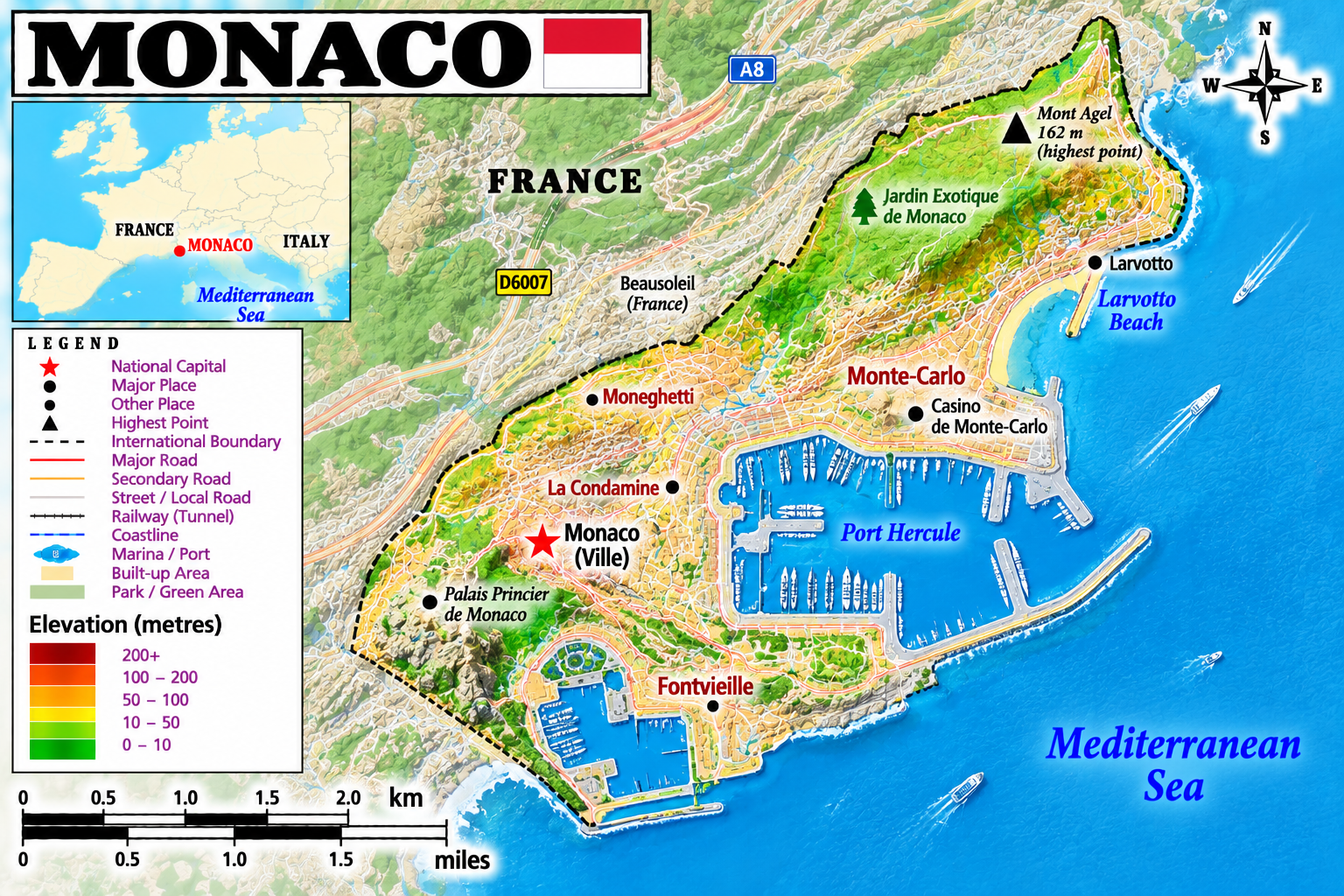
Monaco — Detailed Physical Map
Monte-Carlo, Port Hercules, the Casino, Larvotto Beach, Fontvieille, the Rocher, Mont Agel, the Palais Princier and the French border
Tourist Attractions
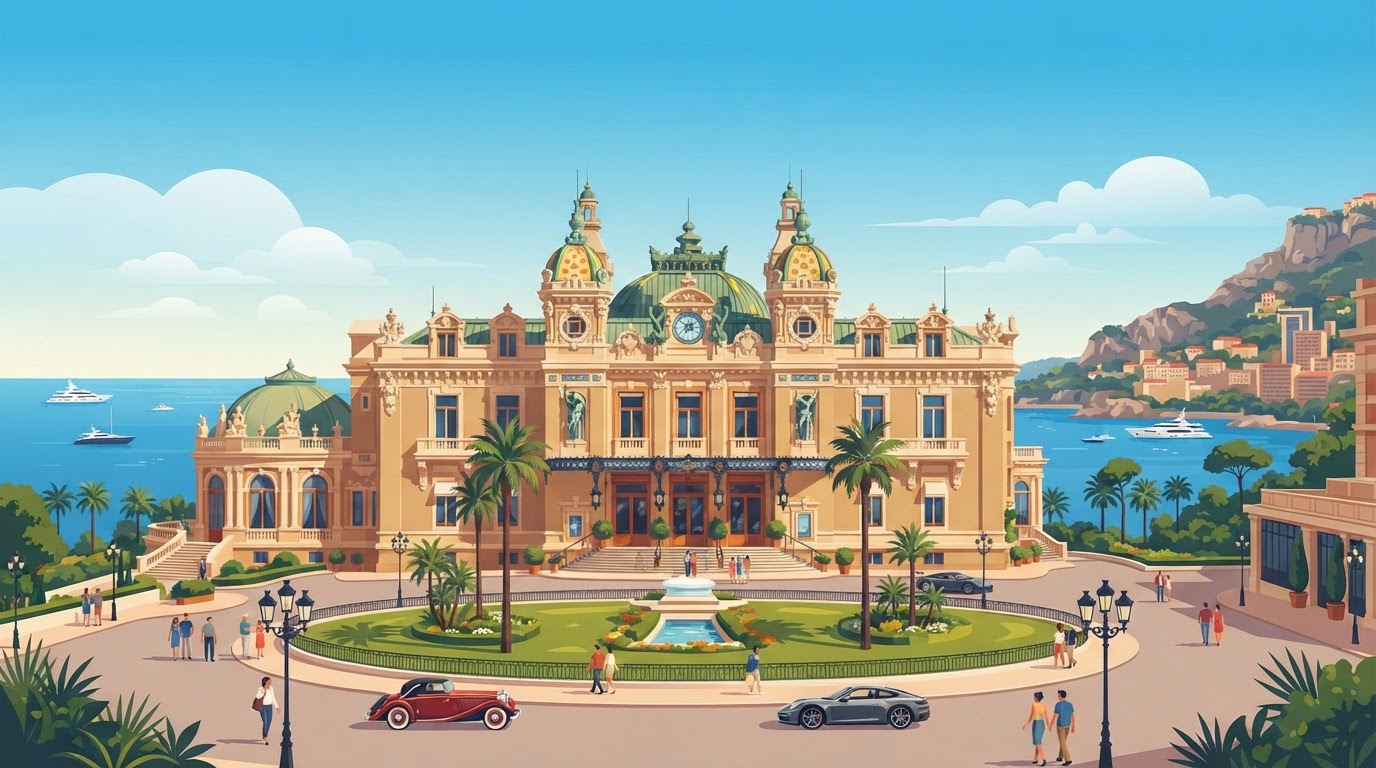
Designed by architect Charles Garnier and opened in 1863, this legendary Belle Époque building is the most iconic symbol of Monaco's glamour and high-stakes gaming history.
The building's opulent architecture and the parade of luxury supercars parked outside are world-famous sights.
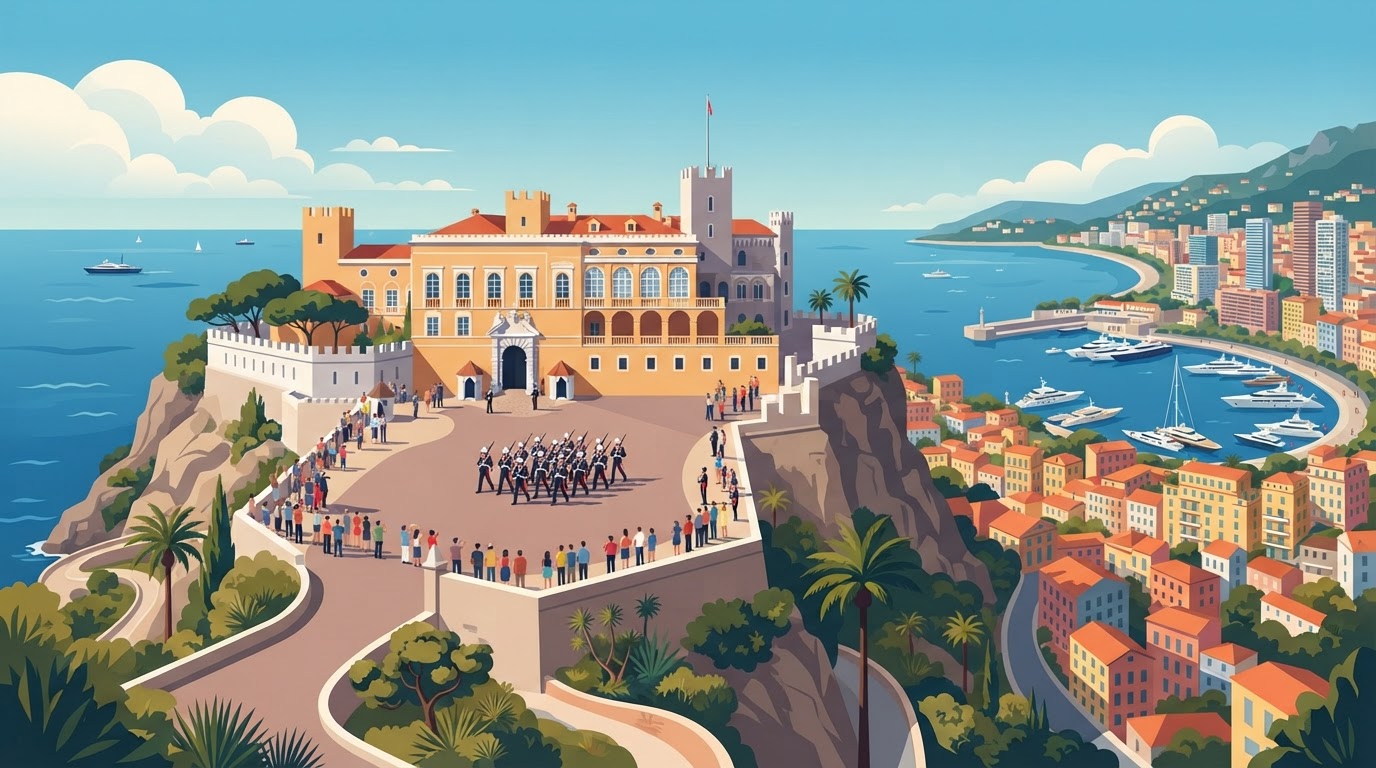
Perched on the Rock of Monaco, this royal residence has been the home of the Grimaldi family since 1297. Visitors can explore the historic State Apartments and witness the daily Changing of the Guard ceremony.
The palace square offers breathtaking panoramic views over the Mediterranean and the harbor.

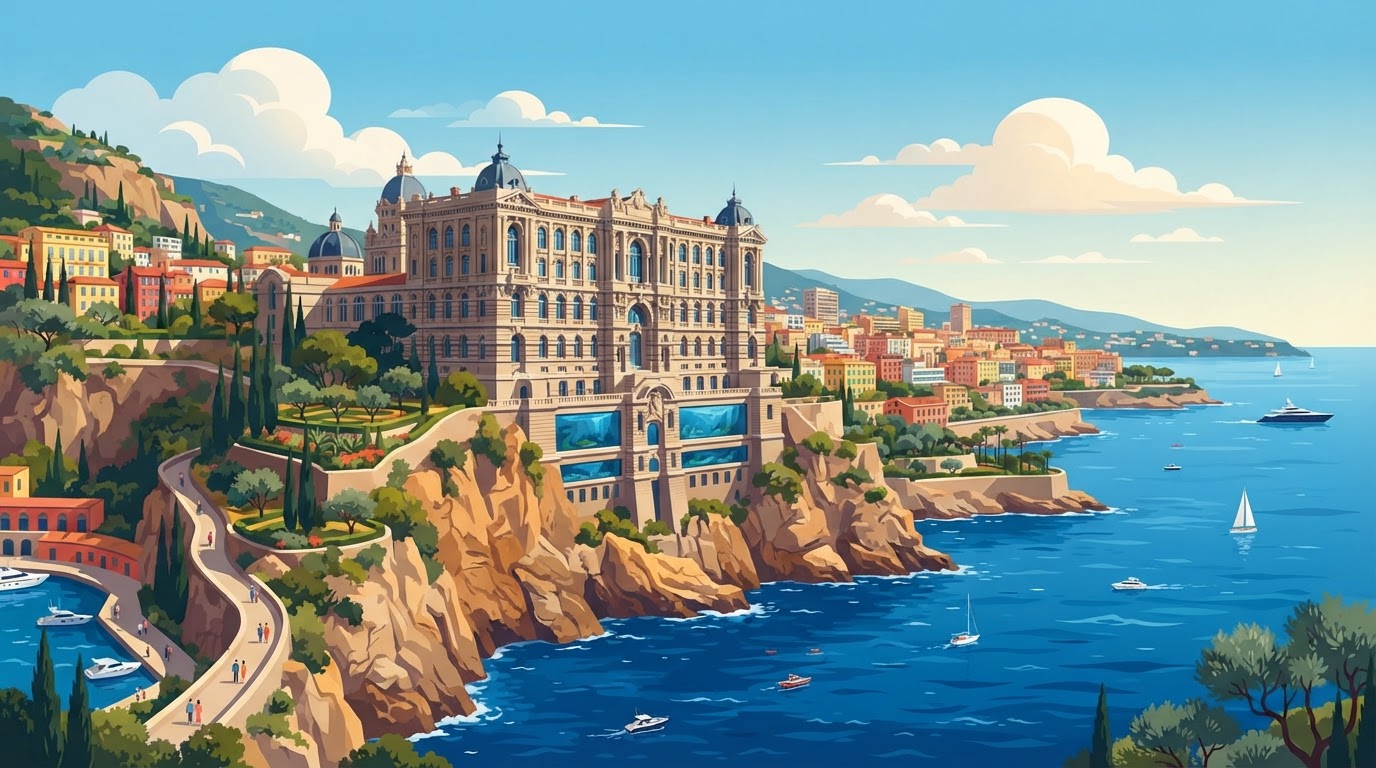
Founded by Prince Albert I and perched dramatically on a cliffside, this world-renowned institution is dedicated to marine science and conservation. It features an impressive aquarium and extensive collections of marine artifacts.
The rooftop terrace provides one of the most spectacular free views of the coastline in the entire principality.

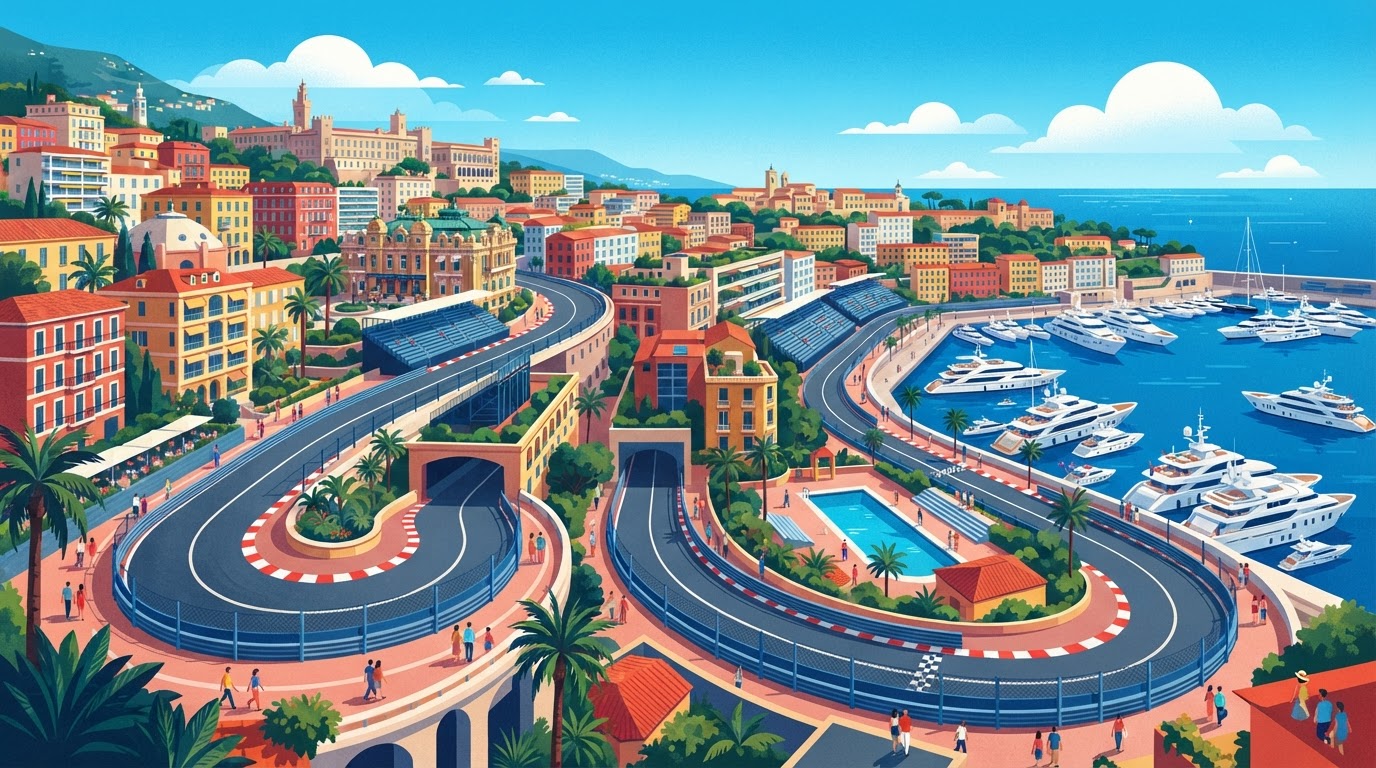
This world-famous Formula One street circuit winds through the public roads of Monaco, including the iconic Fairmont hairpin and the tunnel. It is walkable year-round, allowing visitors to trace the path of racing legends.
Walking the actual track allows you to experience the tight, challenging turns that define this prestigious race.

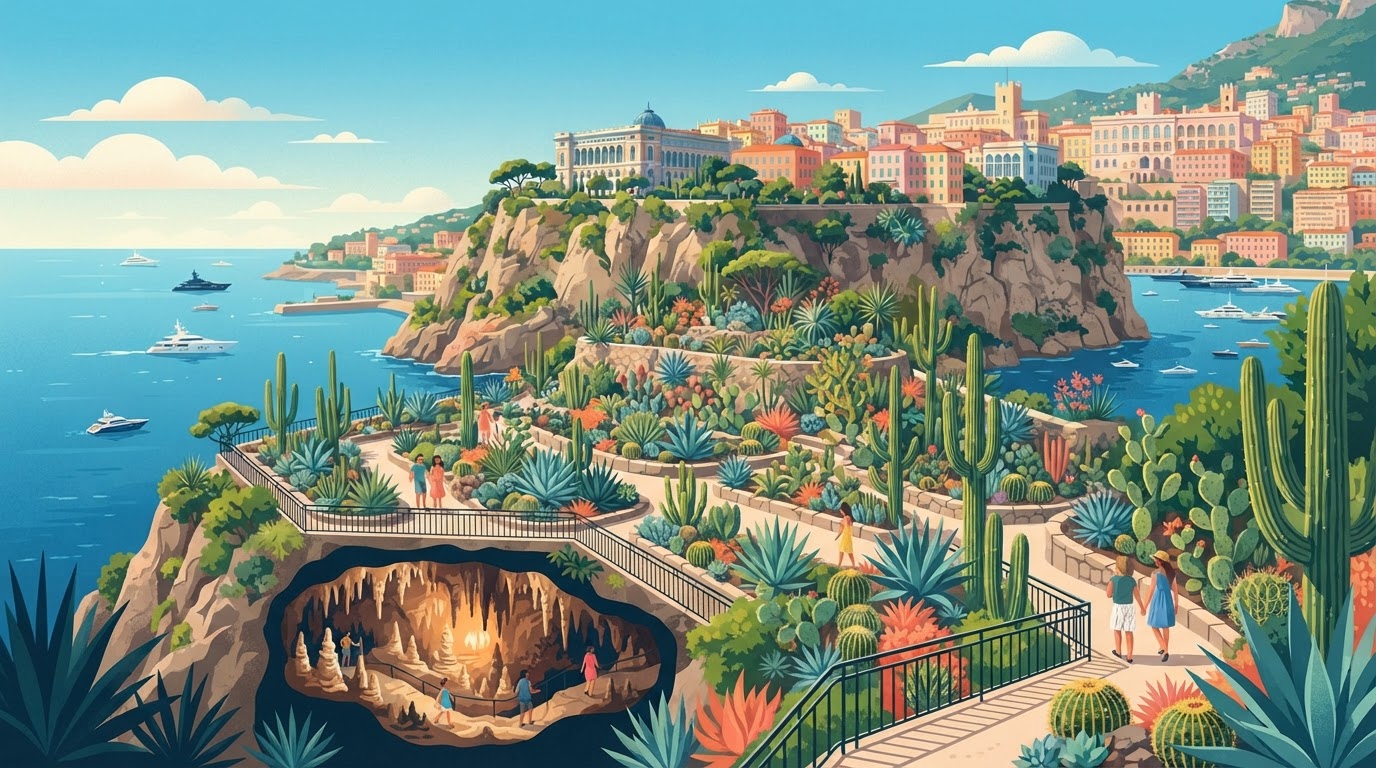
Opened in 1933, this cliffside garden showcases a vast collection of rare succulent plants and cacti from around the world. The site also includes an underground grotto with impressive stalactites and stalagmites.
The garden offers a unique combination of botanical wonders and sweeping vistas of the Mediterranean.

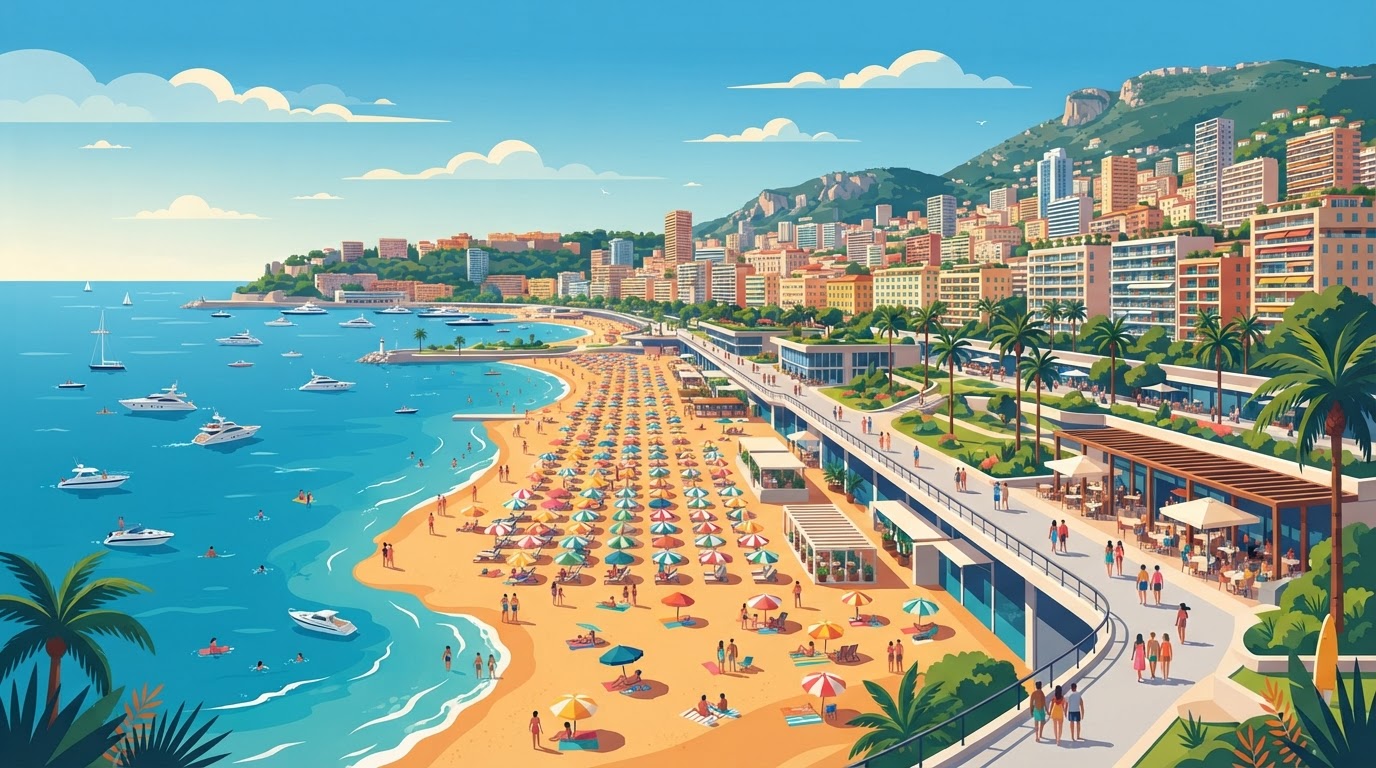
As Monaco's only public beach, this recently renovated stretch of coastline features a modern promenade, imported sand, and various seaside dining options. It serves as a popular spot for locals and tourists to relax by the water.
It is the perfect place to enjoy a refreshing swim and Mediterranean sunshine in the heart of the city.
Geography
Nature
Chemin des Revoires
161 m / 528 ft
0.0% of land
≈ 0 km² of forest
FAO / World Bank, forest area (% of land area)
Explore the Nature AtlasMajor Cities
- 1Capital
Houses the iconic Casino de Monte-Carlo and serves as the sovereign city-state's primary center for tourism and international finance.
38,6012026
Map
City populations are the latest official, UN or national-statistics estimates (2025–2025) compounded to 2026 at -0.66% a year (the nation's annual population growth rate); figures without a published update come from the open cities database (2020-era estimates) and are projected the same way.
Economy
Main exports
Monaco's leading export commodities and products.
Tap any export to learn more. Spot prices in USD only for Live Data subscribers.
Main imports
Monaco's leading import commodities and products.
Tap any import to learn more.
Military
Historical Timeline
600 BCE
Arrival of the Ligurian peoples
Ligurian tribes settled the area of present-day Monaco, taking advantage of the natural harbor. These early inhabitants laid the foundation for the region's long-standing maritime association.
1215
Foundation of the Genoese fortress
A detachment of Genoese Ghibellines founded a fortress on the Rock of Monaco to secure the territory. This event established the site as a strategic military outpost.
1297
The Grimaldi family seizes the Rock
Francesco Grimaldi, disguised as a monk, captured the fortress and began the long Grimaldi dynasty rule. This marks the historical origin of the principality's sovereign lineage.
1419
Establishment of formal sovereignty
The Grimaldi family purchased the land from the Crown of Aragon and secured full lordship over Monaco. This solidified their independent control over the territory.
1641
Treaty of Peronne with France
Monaco signed a treaty that ended its protectorate status under Spain and established a new alliance with France. This agreement guaranteed the protection and sovereignty of the prince.
1861
Franco-Monégasque Treaty of Independence
The principality ceded the cities of Menton and Roquebrune to France in exchange for official recognition of its sovereignty. This defined the current borders and political independence of Monaco.
1911
Promulgation of the first Constitution
Prince Albert I granted Monaco its first constitution, transforming the absolute monarchy into a constitutional one. This established a National Council to represent the population.
1962
Introduction of the revised Constitution
Prince Rainier III introduced a new constitution that abolished capital punishment and granted women the right to vote. It remains the foundational document for the modern principality.
1993
Monaco joins the United Nations
Monaco was admitted as the 183rd member state of the United Nations. This confirmed the principality's status and recognition in the international community.
2005
Accession of Prince Albert II
Following the death of his father, Prince Albert II ascended the throne of Monaco. He has focused his reign on environmental sustainability and modernization of the state.
2017
Monaco joins the European Investment Bank
The principality became a formal member of the European Investment Bank. This milestone strengthened Monaco's financial integration with European institutions.
2024
Monaco hosts major urban development projects
The principality completed significant phases of its Mareterra land reclamation project to expand urban space. This represents the latest major infrastructure milestone in the state's growth.
National Anthem
Louis Notari
Théophile Bellando de Castro
1867
Principauté Monaco, Ma patrie Oh combien je tiens à ton bonheur Principauté Monaco, Ma patrie Oh combien je tiens à ton bonheur Ôte-toi de là Laisse-nous vivre Dans la paix Et la joie Que Dieu protège La Principauté Et le Prince Et les Monégasques
The melody for the anthem was composed by Théophile Bellando de Castro in 1841. It was originally performed by the Carabiniers of the Prince, a military unit. The current lyrics were written by Louis Notari in 1931, replacing earlier versions that were less widely used. It was officially adopted as the national anthem of Monaco in 1867. The anthem is traditionally performed only in the Monegasque language, which is a dialect of Ligurian. It is played on official state occasions and is a symbol of the country's sovereignty and attachment to the Grimaldi dynasty. Public singing of the anthem usually only occurs during the national holiday on November 19.
National Holidays
Celebrates the beginning of the new calendar year.
A religious holiday marking the day after Easter Sunday, which commemorates the resurrection of Jesus Christ.
An international day to celebrate the achievements and contributions of workers.
A Christian holiday commemorating the bodily Ascension of Jesus into heaven, observed 40 days after Easter.
A religious holiday celebrated the day after Pentecost, which marks the descent of the Holy Spirit upon the Apostles.
A major religious feast celebrating the Virgin Mary's passage to heaven.
A day dedicated to the remembrance and honoring of all Christian saints.
The official national holiday of Monaco, historically celebrated on the name day of the reigning Prince's patron saint.
A religious feast celebrating the belief that the Virgin Mary was conceived without original sin.
An annual Christian festival commemorating the birth of Jesus Christ.
Good News Today
Monaco reports fifth consecutive year of economic growth in 2025
The Principality of Monaco achieved a positive economic dynamic in 2025, reaching a GDP of 10.6 billion euros. This represents a 1.7% annual growth rate when adjusted for inflation, demonstrating resilience despite the global economic context.
Fun Facts
Second Smallest Nation Globally
With a total area of only 2.02 square kilometers, Monaco is the second smallest independent state in the world, trailing only Vatican City.
Most Famous Street Circuit
The Monaco Grand Prix is held on narrow city streets that are notoriously difficult to navigate, making it one of the most prestigious races in Formula One history.
No Personal Income Tax
Since 1869, residents of Monaco have not been required to pay personal income tax, a policy that has helped the country become a hub for the global elite.
Extensive Land Reclamation Projects
Monaco continuously grows its landmass by reclaimed territory from the Mediterranean Sea, increasing its total surface area by about 20 percent since the 19th century.
Monaco Citizens Cannot Gamble
While the Casino de Monte-Carlo is iconic, Monaco citizens are actually legally prohibited from entering the gaming rooms of the country's casinos.
High Density Police Presence
Monaco maintains one of the highest numbers of police officers per capita and per square kilometer in the world, ensuring a very high level of security.
Home of the Grimaldi Dynasty
The House of Grimaldi has ruled over Monaco since 1297, making it one of the oldest reigning royal families in all of Europe.
The Exotic Garden Collection
The Jardin Exotique de Monaco features a spectacular collection of succulent plants perched on a cliffside, offering rare views of rare desert flora from around the world.
High Concentration of Millionaires
Statistically, Monaco has the highest density of millionaires and billionaires per capita of any country on the planet, with roughly one-third of the population being millionaires.
Traditional Stocafi Dish
A signature Monégasque dish is Stocafi, which consists of dried cod stewed in a rich tomato sauce with olives, garlic, and herbs, reflecting the region's Mediterranean culinary heritage.
Chuckies Trivia Quiz
Chuckies Trivia Quiz
Fifteen questions on Monaco — five easy, five medium, five hard. How far can you get?
Sports & Live Events
Language
Counting to 10
1
1
= 10 (n = 0)
World Dictionary
Discover and translate any word into all supported languages.