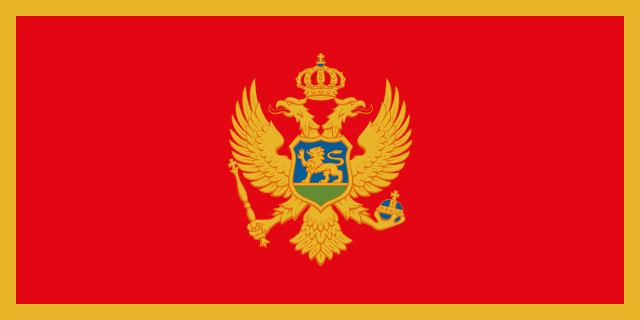

Montenegro
Europe
619,463
06:47 UTC+1
+382
.me
Zla Kolata
2,534 m · 8,314 ft
Adriatic Sea
0 m · 0 ft
151,800
Podgorica · 2026
151,800
Podgorica · 2026
Location
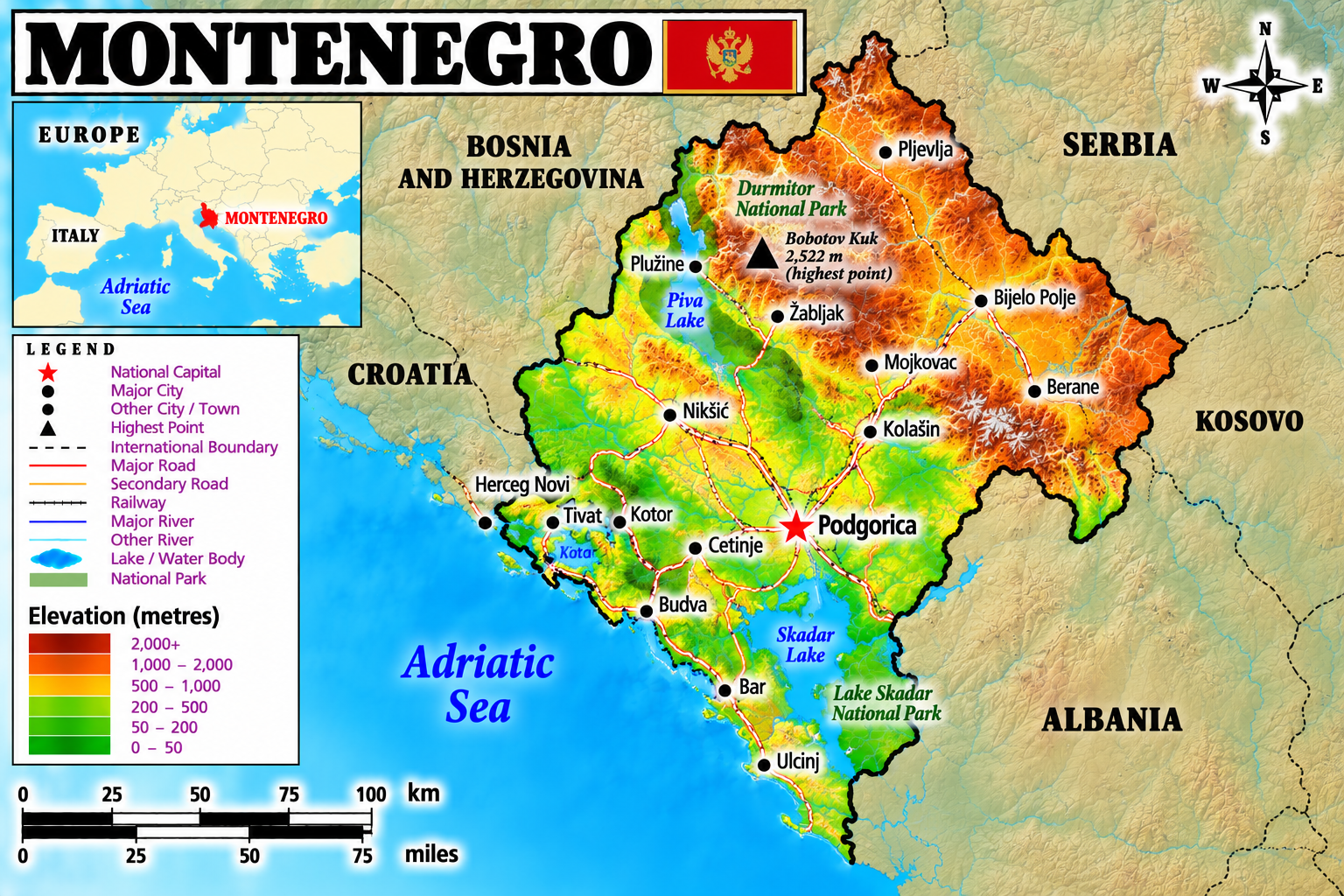
Montenegro — Detailed Physical Map
The Durmitor and Prokletije mountains, Bobotov Kuk, Lake Skadar, the Bay of Kotor, Skadar Lake and Lovćen national parks, major cities and the capital Podgorica
Tourist Attractions

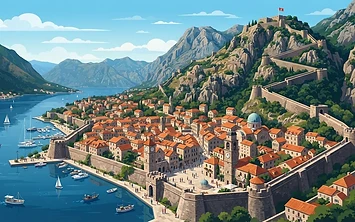
A UNESCO World Heritage site, this fortified medieval town is famous for its winding streets, historic squares, and well-preserved architecture set against dramatic mountains.
Climb the ancient city walls to the San Giovanni Fortress for a breathtaking panoramic view of the Bay of Kotor.

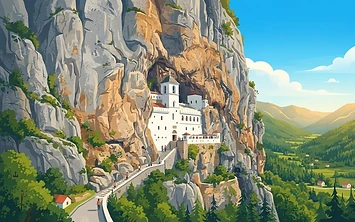
This 17th-century Serbian Orthodox monastery is carved directly into a sheer vertical cliffside, making it one of the most visually striking religious sites in the world.
It is the most important religious pilgrimage site in Montenegro, attracting visitors with its unique architecture and spiritual significance.

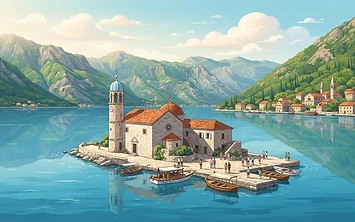
An iconic man-made islet in the Bay of Kotor featuring a beautiful 17th-century church and a museum filled with maritime artifacts.
The island offers a serene and picturesque experience, accessible by a short boat ride from the charming town of Perast.

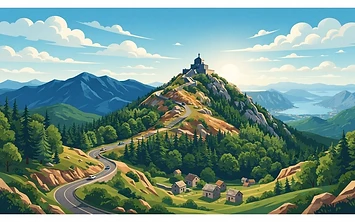
A majestic national park that serves as a national symbol, home to the Njegos Mausoleum which sits atop the mountain peak.
Ascend the steps to the mausoleum to enjoy spectacular 360-degree views of the Montenegrin landscape.

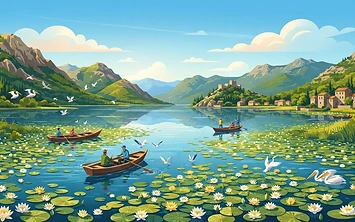
The largest lake in the Balkans, this national park is a haven for biodiversity, particularly known for its vast bird populations and floating water lilies.
Take a boat tour to explore the tranquil waters, hidden island monasteries, and traditional fishing villages.

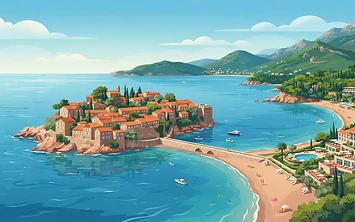
A former 15th-century fishing village turned luxury destination, famous for its iconic offshore island connected to the mainland by a narrow stone causeway.
The stunning contrast of the terracotta-roofed stone buildings against the turquoise Adriatic Sea makes it one of the most photographed spots in the country.
Geography
Nature
Zla Kolata
2,534 m / 8,314 ft
61.5% of land
≈ 8,494 km² of forest
FAO / World Bank, forest area (% of land area)
Explore the Nature Atlas144 km89 mi
Forms the deepest canyon in Europe along its course through the country.
113 km70 mi
Flows entirely through Montenegro before emptying into Lake Skadar.
220 km137 mi
Originates from Plavsko Lake and flows northward towards the Drina River.
370 km²143 sq mi · 44 m deep
Largest lake in Southern Europe shared between Montenegro and Albania.
1 km²0 sq mi · 49 m deep
Glacial lake located in Durmitor National Park beneath Meded Peak.
2 km²1 sq mi · 9 m deep
Largest glacial lake in Montenegro situated near the town of Plav.
30 m98 ft
Situated near the village of Ropojana in the Prokletije mountain range.
10 m33 ft
Located on the Cijevna River near the capital city of Podgorica.
River lengths are whole-river figures, including any section beyond Montenegro. Researched reference figures. Tap any name for where its name comes from and a Google Maps link.
Major Cities
- 1Capital
Podgorica
177,8782026
MapServes as the capital and primary administrative, economic, and cultural center of Montenegro.
- 2
Nikšić
27,7532026
MapFunctions as a significant industrial hub known for its major brewery and historical castle ruins.
- 3
Budva
22,3642026
MapRepresents the primary center of Montenegrin tourism, famous for its medieval old town and sandy beaches.
- 4
Pljevlja
15,4332026
MapCenters around a long-standing mining industry and the historic Hussein Pasha Mosque.
- 5
Bar
15,1732026
MapOperates as the country's most important maritime gateway and largest commercial port.
- 6
Cetinje
12,1742026
MapServed as the historical royal capital and remains the cultural and spiritual center of the nation.
- 7
Bijelo Polje
11,5072026
MapActs as the administrative and economic hub of the northern region located on the Lim River.
- 8
Kotor
11,4852026
MapPreserves a UNESCO-protected medieval old town nestled within a dramatic fjord-like bay.
- 9
Ulcinj
11,2552026
MapFeatures the extensive sandy Velika Plaza beach and rich oriental architectural influences.
- 10
Berane
9,1822026
MapDevelops as a regional center of the Lim valley with notable nearby Orthodox monasteries.
- 11
Plav
4,2292026
MapSurrounds a scenic glacial lake and serves as a gateway to the Prokletije mountain range.
- 12
Herceg Novi
3,7812026
MapHosts numerous botanical gardens and centuries-old fortresses along the entrance to Boka Bay.
City populations are the latest official, UN or national-statistics estimates (2026–2026) compounded to 2026 at -1.51% a year (the nation's annual population growth rate); figures without a published update come from the open cities database (2020-era estimates) and are projected the same way.
Economy
Main exports
Montenegro's leading export commodities and products.
Tap any export to learn more. Spot prices in USD only for Live Data subscribers.
Main imports
Montenegro's leading import commodities and products.
Tap any import to learn more.
Military
Historical Timeline
6000 BCE
Early Neolithic Settlement
The territory of modern Montenegro saw its first permanent agricultural settlements during the early Neolithic period. These early inhabitants established organized communities that laid the foundation for future civilizations in the region.
229 BCE
Illyrian Wars
The Roman Republic began a series of military campaigns against the Illyrian Kingdom, which encompassed parts of modern-day Montenegro. These conflicts eventually led to the incorporation of the region into the Roman province of Dalmatia.
1042
Battle of Bar
Stefan Vojislav defeated the Byzantine forces at the Battle of Bar, marking a pivotal moment in the establishment of the independent state of Duklja. This victory solidified the autonomy of the first South Slavic state on the Adriatic coast.
1482
Establishment of the Principality
Ivan Crnojević established the capital of the Principality of Zeta in Cetinje, moving the seat of government to the mountainous interior. This move was instrumental in preserving Montenegrin resistance against Ottoman expansion.
1516
Rule of the Prince-Bishops
Montenegro transitioned to a theocratic system of government under the rule of the Prince-Bishops, known as Vladikas. This system unified secular and religious authority to maintain independence against Ottoman encroachment.
1878
International Recognition of Independence
The Congress of Berlin formally recognized Montenegro as an independent sovereign state. This diplomatic breakthrough followed successful military campaigns against the Ottoman Empire.
1918
Unification with the Kingdom of Serbs, Croats and Slovenes
Following the conclusion of World War I, the Podgorica Assembly voted to unify Montenegro with the Kingdom of Serbia. This effectively ended the reign of the Petrović-Njegoš dynasty and Montenegro's status as an independent kingdom.
1945
Establishment of the Socialist Republic
Montenegro became one of the six constituent republics of the Socialist Federal Republic of Yugoslavia. This administrative change was established following the liberation of the region by partisan forces.
2006
Restoration of Independence
Montenegrin citizens voted in a national referendum to dissolve the state union with Serbia and Montenegro. The country subsequently declared its independence as a sovereign state on June 3, 2006.
2017
Accession to NATO
Montenegro officially joined the North Atlantic Treaty Organization as its 29th member state. This marked a significant shift in the nation's geopolitical alignment toward Western institutions.
2023
Election of Jakov Milatović
Jakov Milatović was elected President of Montenegro, marking the first time in decades that the country witnessed a peaceful transition of power from the long-ruling Democratic Party of Socialists. This election signaled a major change in the national political landscape.
2025
EU Accession Negotiations Advancement
Montenegro reached a significant milestone in its path toward European Union membership by receiving a positive report regarding the fulfillment of interim benchmarks. This development accelerated the integration process for the nation within the European framework.
National Anthem
Sekula Drljević
Traditional
2004
Oj, svijetla majska zoro, majko naša Crna Goro. Sinovi smo tvog stijenja i čuvari tvog poštenja. Volimo vas, brda tvrda, i jezera gorska bistra, vučemo se crnogorcima, a nećemo nikad nikom. Rijetka ljepota tvoja slobode sjaj je tvoj, koja vječno traje, nek ti vjerni sinovi ostaju. Dok lovćenska naša misao 给他 našu vjeru vječnu, crna goro, majko mila, tebi ćemo uvijek biti vjerni.
Oj, svijetla majska zoro is based on a traditional folk song that has existed in various forms in Montenegro since the 19th century. The modern lyrics were written by Sekula Drljević during the 1930s, though they remained controversial for many decades due to the author's political associations during World War II. Following the dissolution of the State Union of Serbia and Montenegro, the country sought a new national symbol. It was officially adopted as the national anthem of Montenegro in 2004 by the Parliament of Montenegro. The anthem replaced the former anthem Oj, Crna Goro, which was considered by some to be too closely linked to the Yugoslav era. Since its adoption, it has served as a central symbol of Montenegrin statehood and identity. The song is played at all official state functions, sporting events, and diplomatic ceremonies.
National Holidays
This date marks the beginning of the new calendar year and is celebrated as a public holiday.
This day commemorates the birth of Jesus Christ according to the Julian calendar, which is traditionally observed by the majority of the population.
This day commemorates the achievements of the labour movement and is observed as a public holiday throughout the country.
This holiday marks the anniversary of the 2006 referendum in which Montenegro voted to restore its independence as a sovereign state.
This date commemorates the Berlin Congress of 1878, which recognized Montenegro as an independent state, and the 1941 uprising against fascist occupation.
Good News Today
Montenegro Shines in UEFA Nations League – Securing Promotion to League B
The Montenegrin national football team successfully topped their group in the UEFA Nations League, securing promotion to League B. The team finished their campaign unbeaten with five wins and one draw, showcasing strong performance and team cohesion.
Fun Facts
Oldest Living Olive Tree
Located in Bar, the 'Stara Maslina' is over 2,000 years old, making it one of the oldest olive trees in the world.
Deepest Canyon in Europe
The Tara River Canyon is the deepest canyon in Europe and the second deepest in the world, trailing only the Grand Canyon.
Meaning Behind The Name
Montenegro translates to Black Mountain, referring to the dark, pine-covered appearance of Mount Lovćen.
Island Becomes Luxury Hotel
Sveti Stefan, a former 15th-century fortified fishing village, is now an exclusive island resort connected to the mainland by a narrow causeway.
Historic Constitution Of 1855
The Danilo Code of 1855 was a landmark legal document that helped modernize Montenegrin society by limiting the absolute power of the prince.
Unique Fjord-Like Bay
The Bay of Kotor is often called Europe's southernmost fjord, though it is actually a submerged river canyon formed by geological subsidence.
Man-Made Island Monastery
Our Lady of the Rocks is an island in the Bay of Kotor created artificially by local sailors dropping rocks into the water over centuries.
Famous Vranac Grape Variety
Montenegro is home to the Vranac grape, an ancient variety that produces a deep red wine renowned for its intense flavor profile.
Home To Endangered Pelicans
Lake Skadar is one of the last major habitats for the rare Dalmatian pelican, which is characterized by its distinct curly plumage.
Fun Lazy Olympics
The village of Brezna annually hosts a humorous 'Lazy Competition' where participants compete to see who can lie down and do the least for the longest time.
Chuckies Trivia Quiz
Chuckies Trivia Quiz
Fifteen questions on Montenegro — five easy, five medium, five hard. How far can you get?
Sports & Live Events
Language
Counting to 10
1
1
= 10 (n = 0)
World Dictionary
Discover and translate any word into all supported languages.