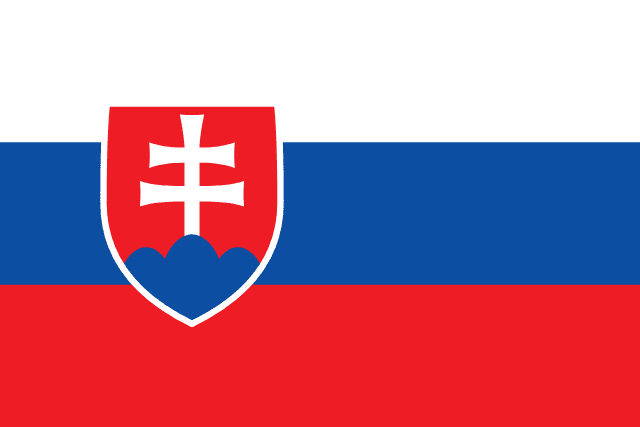

Slovakia
Slovak Republic
Europe
5,421,582
06:12 UTC+1
+421
.sk
Gerlachovsky stit
2,655 m · 8,711 ft
Streda nad Bodrogom
94 m · 308 ft
432,060
Bratislava · 2026
432,060
Bratislava · 2026
Location
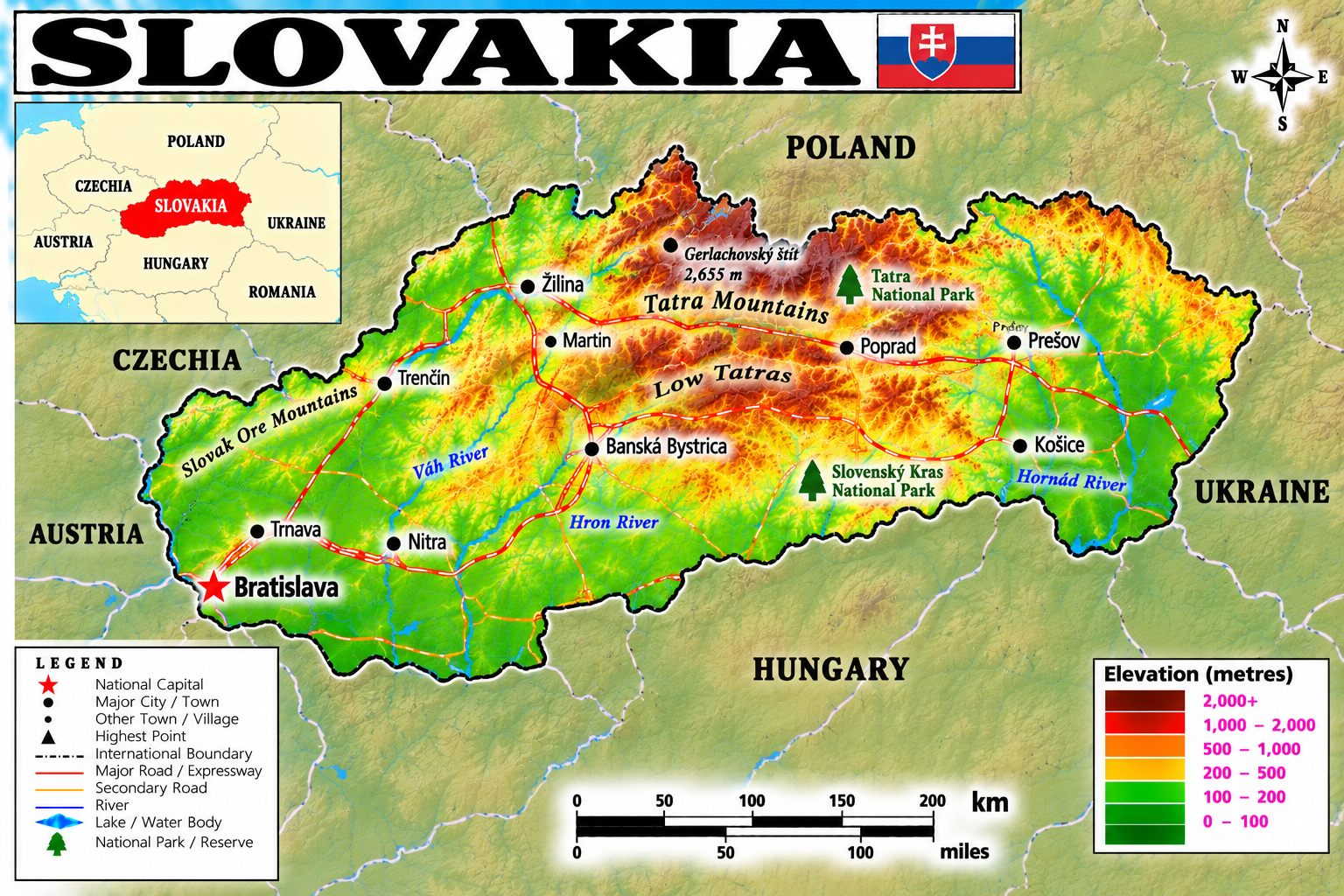
Slovakia — Detailed Physical Map
The High and Low Tatras, Gerlachovsky stit, Slovak Ore Mountains, Vah and Hron rivers, Tatra and Slovensky Kras parks, major cities and the capital Bratislava
Tourist Attractions

The High Tatras are Europe's smallest alpine mountain range, featuring jagged peaks, deep valleys, and glacial lakes. They serve as a premier destination for hiking, skiing, and mountaineering.
The breathtaking alpine scenery and the iconic peak of Kriváň make this a must-visit for outdoor enthusiasts.
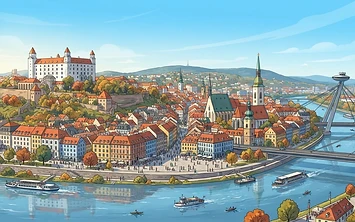
The historic heart of Slovakia's capital is a charming area filled with medieval architecture, narrow cobblestone streets, and vibrant squares. It is home to significant sites like St. Martin's Cathedral and the reconstructed Bratislava Castle overlooking the Danube.
Wandering through the preserved medieval streets and visiting the castle offers a perfect blend of history and city life.

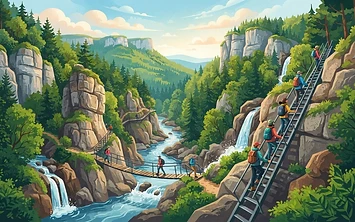
Known as an adventure playground, this national park is famous for its dramatic gorges, limestone plateaus, and numerous waterfalls accessible via ladders and bridges. It offers a unique, immersive experience in wild, protected nature.
The thrilling hike through the Hornád Breakthrough is an unforgettable experience for nature lovers.

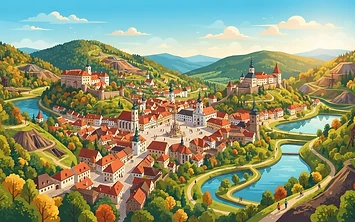
This UNESCO World Heritage town is nestled within the caldera of an ancient collapsed volcano and is renowned for its rich gold and silver mining history. Its well-preserved medieval center and unique technical water management system reflect its industrial past.
The town's stunning historic architecture and mining heritage make it one of the most picturesque places in the country.

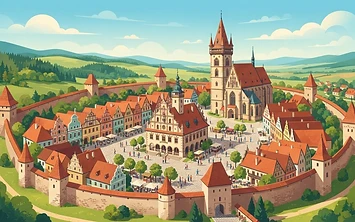
Bardejov is a royal town celebrated for its remarkably preserved Gothic and Renaissance town center, which is a UNESCO World Heritage site. It features a beautiful town hall square and the impressive Basilica of St. Egidius.
The original stone-paved Town Hall Square, lined with historic burgher houses, feels like stepping back in time.

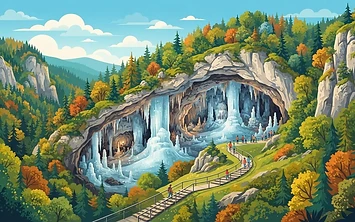
As one of the most significant ice caves in the world, this UNESCO-listed site contains massive ice formations that persist throughout the year. It provides a rare glimpse into a subterranean frozen kingdom.
The massive, ancient ice columns and frozen waterfalls create a truly otherworldly atmosphere.
Geography
Nature
Gerlachovsky stit
2,655 m / 8,711 ft
40.1% of land
≈ 19,664 km² of forest
FAO / World Bank, forest area (% of land area)
Explore the Nature Atlas2,850 km1,771 mi
Forms part of the border between Slovakia and Hungary near Bratislava.
403 km250 mi
Longest river flowing entirely within the territory of Slovakia.
298 km185 mi
Rises in the Low Tatras mountains and flows south into the Danube.
0 km²0 sq mi · 53 m deep
Largest and deepest glacial lake located on the Slovak side of the High Tatras.
0 km²0 sq mi · 20 m deep
Popular mountain lake and tourist resort situated in the High Tatras national park.
33 km²13 sq mi · 14 m deep
One of the largest water reservoirs in Slovakia used for recreation and fishing.
80 m262 ft
Tallest waterfall in the High Tatras mountains of Slovakia.
38 m125 ft
Located in the Fatra mountains and is a popular destination for hikers.
River lengths are whole-river figures, including any section beyond Slovakia. Researched reference figures. Tap any name for where its name comes from and a Google Maps link.
Major Cities
- 1Capital
Bratislava
485,9172026
MapServes as the political, cultural, and economic center of Slovakia and houses the iconic hilltop Bratislava Castle.
- 2
Košice
228,2492026
MapFeatures the magnificent Gothic St. Elisabeth Cathedral and acts as the primary industrial hub of eastern Slovakia.
- 3
Bratislava
113,4962026
MapComprises the largest high-density urban residential district in Central Europe, located on the right bank of the Danube.
- 4
Prešov
80,5422026
MapRenowned for its historical center and proximity to the famous salt mines located in nearby Solivar.
- 5
Žilina
80,0002026
MapFunctions as a crucial transportation crossroads and a major center for the automotive industry in northern Slovakia.
- 6
Nitra
75,6762026
MapStands as one of the oldest cities in the country and a significant historical center of early Christianity.
- 7
Banská Bystrica
72,7222026
MapPlayed a pivotal role during the Slovak National Uprising against Nazi forces during the Second World War.
- 8
Trnava
62,8362026
MapKnown as the Slovak Rome due to its high concentration of historical churches and religious architecture.
- 9
Trenčin
53,8862026
MapDominates the surrounding landscape with its medieval castle perched high upon a rocky cliff above the Vah river.
- 10
Žilina
49,6492026
MapServed as the primary center of Slovak national culture and literary life during the nineteenth century.
- 11
Prešov
47,8512026
MapActs as the main gateway to the High Tatra mountains and serves as a center for regional tourism.
- 12
Nitra
41,8042026
MapGained historical prominence primarily through coal mining activities in the Upper Nitra region.
City populations are the latest official, UN or national-statistics estimates (2026–2026) compounded to 2026 at -0.7% a year (the nation's annual population growth rate); figures without a published update come from the open cities database (2020-era estimates) and are projected the same way.
Economy
Main exports
Slovakia's leading export commodities and products.
Tap any export to learn more. Spot prices in USD only for Live Data subscribers.
Main imports
Slovakia's leading import commodities and products.
Tap any import to learn more.
Military
Historical Timeline
30000 BCE
Arrival of Early Paleolithic Settlers
Archaeological findings indicate human habitation in the territory of present-day Slovakia dating back to the Paleolithic era. These early settlers occupied cave systems such as Prepoštská jaskyňa in Bojnice.
833
Establishment of Great Moravia
Mojmír I unified the Slavic tribes to form the Great Moravian Empire. This state became a major political and cultural power in Central Europe.
1000
Incorporation into the Kingdom of Hungary
Following the collapse of Great Moravia, the territory was gradually integrated into the Kingdom of Hungary. It remained under Hungarian rule for nearly a millennium.
1843
Codification of the Slovak Language
Ľudovít Štúr and his associates codified the literary Slovak language based on Central Slovak dialects. This was a crucial milestone for the development of Slovak national identity.
1918
Founding of Czechoslovakia
Following the dissolution of the Austro-Hungarian Empire, Slovakia became a founding part of the new Czechoslovak Republic. This marked the first time Slovaks gained a distinct statehood within a democratic framework.
1939
Formation of the Slovak Republic
A German-backed Slovak state was established under Jozef Tiso following the partition of Czechoslovakia. The state functioned as a satellite of Nazi Germany during World War II.
1948
Communist Takeover of Czechoslovakia
The Communist Party of Czechoslovakia seized power in the February Coup. This led to decades of totalitarian rule and integration into the Eastern Bloc.
1989
The Velvet Revolution
Mass protests led to the peaceful collapse of the communist regime in Czechoslovakia. The movement restored democratic freedoms and the rule of law.
1993
Dissolution of Czechoslovakia
The Velvet Divorce resulted in the peaceful separation of Czechoslovakia into two independent sovereign states. The Slovak Republic was officially established on January 1, 1993.
2004
Accession to the European Union and NATO
Slovakia officially joined both the European Union and the North Atlantic Treaty Organization. These accessions firmly integrated the country into Western political and economic structures.
2019
Election of First Female President
Zuzana Čaputová was elected as the first female President of Slovakia. Her victory represented a significant shift in the nation's political landscape.
2025
Major Constitutional and Legislative Reforms
The Slovak government enacted significant judicial and administrative reforms to restructure state institutions. These changes aimed to streamline governance and address ongoing domestic political challenges.
National Anthem
Nad Tatrou sa blýska
Janko Matúška
Traditional
1993
Nad Tatrou sa blýska, hromy divo bijú. Zastavme ich, bratia, veď sa ony stratia, Slováci ožijú. To Slovensko naše posiaľ tvrdo spalo. Ale blesky hromu vzbudzujú ho k tomu, aby sa prebralo.
The lyrics were written by Janko Matúška in 1844 during a period of intense student protest in Pressburg, now Bratislava. The text was composed to the melody of the folk song 'Kopala studienku' to reflect the spirit of the Slovak national revival movement. It quickly became a popular patriotic song among the Slovak students and revolutionaries of 1848. The first stanza of the song served as the anthem of the state of Czechoslovakia alongside the Czech anthem until 1992. Upon the dissolution of Czechoslovakia in 1993, the first two stanzas were officially adopted as the national anthem of the newly independent Slovak Republic. The anthem serves as a primary symbol of Slovak identity and resilience, representing the nation's struggle for cultural and political autonomy.
National Holidays
Commemorates the peaceful dissolution of Czechoslovakia and the formation of an independent Slovak state in 1993.
Marks the start of the 1944 armed resistance by Slovak insurgents against Nazi German troops and the collaborationist government during World War II.
Celebrates the adoption of the Constitution of the Slovak Republic by the Slovak National Council in 1992.
Commemorates the student demonstrations in 1939 against Nazi occupation and the 1989 Velvet Revolution that led to the end of communist rule in Czechoslovakia.
Good News Today
International volunteers transform community centre for children in Dobšiná
Volunteers from eight countries collaborated with Habitat for Humanity to renovate the Domček Community Centre, which supports families affected by generational poverty. The project replaced a dangerous wall with a new fence and improved the facility's interior to create a safer, brighter space for local children.
Fun Facts
Highest castle density
Slovakia holds the world record for the highest number of castles and chateaux per capita, boasting over 180 castle ruins.
High Tatra mountains majesty
The High Tatras are the smallest alpine mountain range in the world but contain over 100 pristine mountain lakes called plesos.
Dobsina ice cave phenomenon
The Dobsina Ice Cave is one of the largest ice caves in the world and has been a UNESCO World Heritage site since 2000.
Tokaj wine region rarity
Slovakia shares the historic Tokaj wine region with Hungary, which is one of the oldest demarcated wine regions on the entire planet.
Bratislava's upside-down landmark
The UFO observation deck in Bratislava sits atop the Most SNP bridge and is designed to resemble a flying saucer suspended in mid-air.
Traditional wooden church architecture
Slovakia is famous for its unique wooden churches in the Carpathian region, which were built without a single iron nail.
Famous inventor of radio
Jozef Murgaš, a Slovak inventor, was a pioneer in wireless telegraphy and transmitted the first radio voice message in history.
Bryndzove halusky national favorite
The national dish, bryndzov'e halusky, consists of small potato dumplings covered in a creamy sheep cheese called bryndza and topped with bacon.
The vintage forest railway
The Cierny Hron Railway is a historic narrow-gauge steam train that transports passengers through deep forests as it once did for timber transport.
The heart of Europe
Geographically, the town of Kremnick'e Bane is considered by many to be the exact geographical center of Europe.
Chuckies Trivia Quiz
Chuckies Trivia Quiz
Fifteen questions on Slovakia — five easy, five medium, five hard. How far can you get?
Sports & Live Events
Language
Counting to 10
1
1
= 10 (n = 0)
World Dictionary
Discover and translate any word into all supported languages.