
Slovenia
Republic of Slovenia
Europe
2,114,124
05:25 UTC+1
+386
.si
Triglav
2,864 m · 9,396 ft
Adriatic Sea
0 m · 0 ft
292,085
Ljubljana · 2026
292,085
Ljubljana · 2026
Location
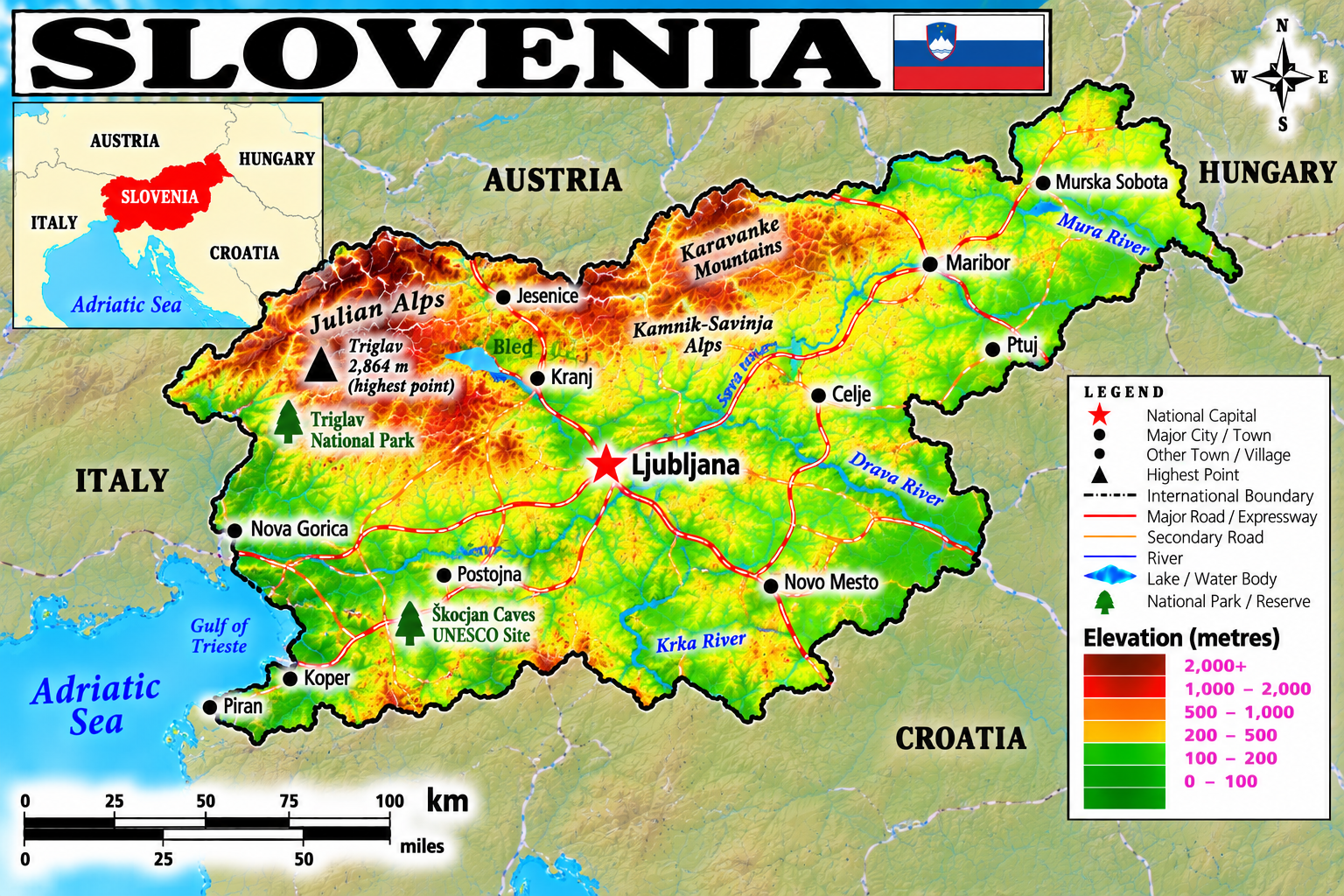
Slovenia — Detailed Physical Map
The Julian Alps and Triglav, Karavanke and Kamnik-Savinja Alps, Sava, Drava and Krka rivers, Triglav park, Skocjan Caves, the Adriatic coast, major cities and the capital Ljubljana
Tourist Attractions

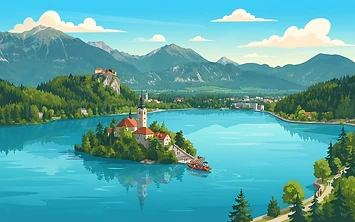
A stunning glacial lake featuring a tiny island with a baroque church and a medieval castle perched on a steep cliff above the water.
The iconic view of the island church set against the backdrop of the Julian Alps is Slovenia's most famous postcard image.

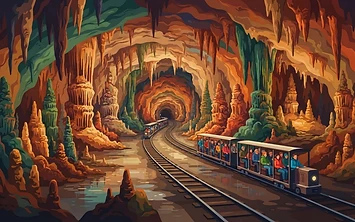
One of the world's largest and most visited cave systems, featuring a unique double-track underground railway that takes visitors through massive halls and stalactite formations.
Experience a thrilling train ride deep into the subterranean world to see the cave's extraordinary stone sculptures.

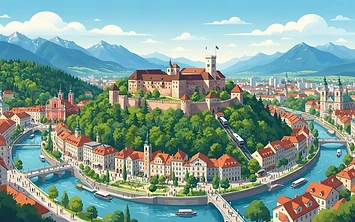
A medieval fortress overlooking the capital city, offering a blend of historic architecture, museums, and panoramic views of the surrounding mountains.
Take the funicular to the top for a sweeping view of the city's red-roofed buildings and the distant Alps.

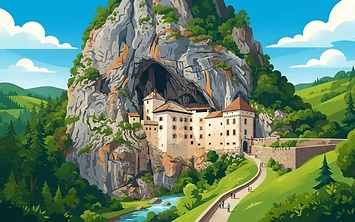
A remarkable Renaissance castle built directly into the mouth of a towering cave, known for its dramatic cliffside position and secret tunnel network.
It is the world's largest cave castle, offering a fascinating look at medieval engineering and defensive architecture.

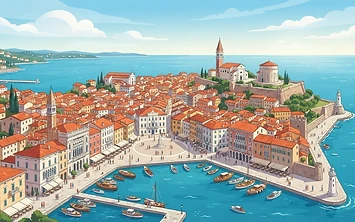
A picturesque coastal town on the Adriatic Sea, famous for its well-preserved Venetian Gothic architecture and narrow, winding streets.
Stroll through the beautiful Tartini Square and enjoy the Mediterranean atmosphere of this historic seaside gem.

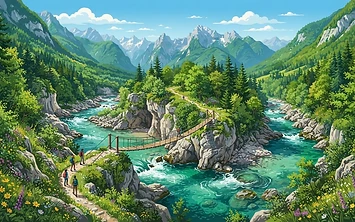
A breathtaking valley carved by the emerald-green Soča River, known for its dramatic gorges, suspension bridges, and pristine alpine scenery.
The river's unique turquoise color makes it one of the most beautiful natural wonders in Europe for hiking and water sports.
Geography
Nature
Triglav
2,864 m / 9,396 ft
61.8% of land
≈ 12,529 km² of forest
FAO / World Bank, forest area (% of land area)
Explore the Nature Atlas990 km615 mi
Forms from the confluence of the Sava Dolinka and Sava Bohinjka near Radovljica.
710 km441 mi
Originates in the Italian Alps and flows through the northern part of Slovenia.
138 km86 mi
Renowned for its distinctive emerald green water color.
3 km²1 sq mi · 45 m deep
Largest permanent natural lake situated within the borders of Slovenia.
1 km²1 sq mi · 30 m deep
Features a small island with a church in the middle of the water.
38 km²15 sq mi · 10 m deep
Largest intermittent lake in the country during the wet season.
144 m472 ft
Features one of the highest volumes of water among Slovenian waterfalls.
78 m256 ft
Serves as the primary source of the Sava Bohinjka river.
River lengths are whole-river figures, including any section beyond Slovenia. Researched reference figures. Tap any name for where its name comes from and a Google Maps link.
Major Cities
- 1Capital
Ljubljana
291,8252026
MapServes as the political, cultural, and scientific heart of Slovenia, renowned for its central river and medieval castle.
- 2
Maribor
97,7122026
MapHouses the world's oldest grapevine and acts as the economic and cultural center of the Styria region.
- 3
Celje
38,1172026
MapFeatures a prominent medieval castle that served as the ancestral seat of the powerful Counts of Celje.
- 4
Kranj
37,9602026
MapFunctions as the capital of the Gorenjska region, known for its deep canyon and historical connection to France Prešeren.
- 5
Koper
26,5322026
MapOperates as Slovenia's only major international seaport and a vital gateway for maritime trade in the Adriatic.
- 6
Velenje
25,6392026
MapOriginated from a planned industrial expansion focused on coal mining and features a unique model town design.
- 7
Novo Mesto
24,8322026
MapHosts a significant pharmaceutical industry and is famous for its rich archaeological heritage involving Hallstatt culture finds.
- 8
Ptuj
18,3652026
MapHolds the title of the oldest town in Slovenia, famously recognized for its traditional Kurenti carnival costumes.
- 9
Jesenice
13,8792026
MapRepresents the historical center of the Slovenian steel industry, shaped heavily by ironworks production.
- 10
Kamnik
13,7282026
MapLies nestled at the foot of the Kamnik-Savinja Alps, historically serving as a medieval trading post.
- 11
Trbovlje
13,7112026
MapMaintains a long history centered on coal mining and boasts the tallest chimney in Europe.
- 12
Domžale
13,4182026
MapMaintained a strong historical reputation for its straw hat production and remains a key suburban hub.
City populations are the latest official, UN or national-statistics estimates (2026–2026) compounded to 2026 at -0.1% a year (the nation's annual population growth rate); figures without a published update come from the open cities database (2020-era estimates) and are projected the same way.
Economy
Main exports
Slovenia's leading export commodities and products.
Tap any export to learn more. Spot prices in USD only for Live Data subscribers.
Main imports
Slovenia's leading import commodities and products.
Tap any import to learn more.
Military
Historical Timeline
30000 BCE
Early human presence in Divje Babe
Archaeological evidence confirms that Neanderthals inhabited the Divje Babe cave during the Paleolithic era. This site provided the famous Divje Babe flute, considered one of the oldest musical instruments in the world.
623
Establishment of Carantania
The Slavic tribes formed the principality of Carantania, which is considered the first independent Slavic state. It established a unique system of government involving the enthronement of dukes on the Prince's Stone.
1278
Habsburg acquisition of the territory
Rudolf I of Habsburg defeated Ottokar II of Bohemia, marking the start of centuries of Habsburg influence over the Slovenian lands. This event integrated the region into the broader Austrian dynastic territories.
1550
First books in the Slovenian language
Primož Trubar published the first books written in Slovenian, the Catechismus and Abecedarium. This milestone was crucial for the development of Slovenian literacy and national identity during the Reformation.
1918
Formation of the State of SHS
Following the collapse of the Austro-Hungarian Empire, the State of Slovenes, Croats and Serbs was declared. This entity soon merged with the Kingdom of Serbia to form the Kingdom of Serbs, Croats and Slovenes.
1945
Formation of the Socialist Republic of Slovenia
Following the Allied victory in World War II, Slovenia became a constituent republic within the Socialist Federal Republic of Yugoslavia. A socialist government was established under the leadership of the Communist Party.
1991
Declaration of Slovenian independence
After a successful plebiscite, Slovenia formally declared independence from Yugoslavia on June 25, 1991. A ten-day war followed before the country secured its sovereignty.
2004
Accession to the European Union and NATO
Slovenia officially joined both the European Union and NATO in 2004. These moves solidified the country's integration into Western political, economic, and security structures.
2007
Adoption of the Euro currency
Slovenia became the first country among the new member states to join the Eurozone. This transition marked a major milestone in the nation's economic integration with the rest of Europe.
2022
Election of the first female president
Nataša Pirc Musar was elected as the first female President of Slovenia in the country's history. Her victory marked a significant shift in the nation's political representation.
2023
Record-breaking catastrophic flooding
In August 2023, Slovenia experienced the worst natural disaster in its independent history due to widespread, devastating floods. The event led to extensive national recovery efforts and international aid mobilization.
2025
Slovenia's tenure on the UN Security Council
Slovenia began its two-year term as a non-permanent member of the United Nations Security Council for 2024-2025. During this period, the nation actively participated in international diplomacy regarding global conflicts.
National Anthem
Zdravljica
France Prešeren
Stanko Premrl
1990
Žive naj vsi narodi, ki hrepene dočakat' dan, da koder sonce hodi, prepir iz sveta bo pregnan, da rojak prost bo vsak, ne vrag, le sosed bo mejak!
The lyrics for the anthem were written by the renowned Slovenian poet France Prešeren in 1844 as a drinking song titled Zdravljica. The music was composed by Stanko Premrl in 1905 to accompany the poem. After Slovenia gained independence from Yugoslavia, the seventh stanza of the poem was officially adopted as the national anthem in 1990. Unlike many national anthems that focus on battle or nationalistic pride, this anthem is celebrated for its humanist message of peace and friendship among nations. It replaced the previous anthem, Naprej zastava slave, which had served as the anthem of the Socialist Republic of Slovenia. The anthem is unique because its lyrics emphasize equality and cooperation rather than military strength. It remains a symbol of Slovenian identity and the country's commitment to international diplomacy.
National Holidays
This day commemorates the death of France Prešeren, Slovenia's national poet, and serves as the country's cultural holiday.
This is a religious holiday observed on the day following Easter Sunday, celebrating the resurrection of Jesus Christ.
This day commemorates the 1991 declaration of independence from the Socialist Federal Republic of Yugoslavia.
This day marks the 1990 plebiscite in which an overwhelming majority of Slovenians voted for the country's independence.
Good News Today
Slovenia, Cyprus, and Slovakia join ASEAN peace treaty
Slovenia officially signed the Treaty of Amity and Cooperation in Southeast Asia to strengthen its engagement with the bloc and promote global peace. The agreement emphasizes cooperation and the peaceful settlement of disputes.
Fun Facts
Land Of The Beekeeper
Slovenia has the highest number of beekeepers per capita in the world and even declared World Bee Day to be May 20th in honor of Anton Janša.
Among The Greenest Countries
Over 60 percent of Slovenia is covered by forests, making it one of the most forested countries in all of Europe.
Capital City Of Dragons
The symbol of Ljubljana is the dragon, which adorns the famous Dragon Bridge and represents the legend of Jason and the Argonauts defeating a monster.
World's Oldest Producing Vine
The city of Maribor is home to the Old Vine, which at over 400 years old, is officially recognized as the oldest noble vine still producing grapes.
Lake Bled's Church Island
Lake Bled features the only natural island in Slovenia, which houses a 17th-century church that visitors reach by traditional flat-bottom wooden boats called pletnas.
Extensive Underground Cave Systems
Slovenia is famous for its karst landscape, containing over 10,000 registered caves including the spectacular Postojna Cave system.
Home Of The Human Fish
The olm, or 'human fish,' is a blind, cave-dwelling amphibian found in Slovenian karst caves that can live for over 100 years.
National Symbol Mount Triglav
Mount Triglav, the highest peak in the Julian Alps, is a source of national pride and is featured on the country's coat of arms and flag.
Traditional Medieval Salt Harvesting
The Sečovlje Salina Nature Park still produces salt using traditional methods that have remained largely unchanged since the 14th century.
Unique Nut Roll Pastry
Potica is the traditional Slovenian festive cake, a rolled yeast dough pastry filled with walnuts or other ingredients, served at almost every holiday.
Chuckies Trivia Quiz
Chuckies Trivia Quiz
Fifteen questions on Slovenia — five easy, five medium, five hard. How far can you get?
Sports & Live Events
Language
Counting to 10
1
1
= 10 (n = 0)
World Dictionary
Discover and translate any word into all supported languages.