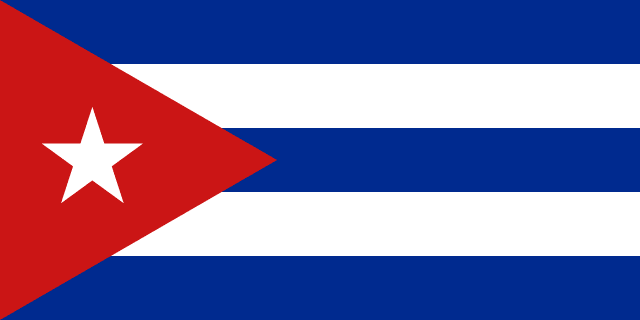
Cuba
North America

11,000,000
09:07 UTC-4
+53
Location
Geography
Economy
Main exports
Cuba's leading export commodities and products.
Subscribe to Live Data for live spot prices
Live commodity prices on every nation's exports — $100 AUD/year.
Tap any export to learn more. Spot prices in USD only for Live Data subscribers.
Main imports
Cuba's leading import commodities and products.
Tap any import to learn more.
Military
Historical Timeline
4000 BCE
Taíno Peoples Arrive
The Taíno people, the earliest known Indigenous inhabitants of Cuba, migrated from South America. They developed a complex society with agriculture and distinct cultural practices.
1492
Christopher Columbus Arrives
Italian explorer Christopher Columbus, sailing for Spain, landed in Cuba. This marked the beginning of Spanish colonization and profound changes for the Indigenous population.
1511
Spanish Conquest Begins
Spanish conquistador Diego Velázquez de Cuéllar began the conquest of Cuba. The Indigenous Taíno population was decimated by disease and forced labor.
1868
Ten Years' War for Independence
Cuban rebels launched the Ten Years' War against Spanish rule, seeking independence and the abolition of slavery. The conflict was ultimately unsuccessful but ignited the independence movement.
1895
Cuban War of Independence
José Martí led the final phase of the struggle for Cuban independence. The war concluded with U.S. intervention and Spanish defeat.
1898
U.S. Intervention and Spanish-American War
The United States intervened in the Cuban War of Independence, leading to the Spanish-American War. Spain ceded Cuba to the U.S.
1902
Republic of Cuba Established
Cuba gained formal independence from the United States, although the U.S. maintained significant influence through the Platt Amendment. Tomás Estrada Palma became the first president.
1959
Cuban Revolution Triumphs
Fidel Castro's revolutionary forces overthrew the authoritarian regime of Fulgencio Batista. This led to a socialist state and profound social and economic reforms.
1961
Bay of Pigs Invasion
A U.S.-backed invasion by Cuban exiles at the Bay of Pigs failed. This event solidified Castro's power and intensified U.S.-Cuba tensions.
1962
Cuban Missile Crisis
The Soviet Union placed nuclear missiles in Cuba, leading to a tense standoff with the United States. The crisis brought the world to the brink of nuclear war.
1991
Collapse of the Soviet Union
The dissolution of the Soviet Union severely impacted Cuba's economy, which had relied heavily on Soviet aid. This period is often referred to as the "Special Period."
2008
Fidel Castro Steps Down
Fidel Castro officially resigned as President of Cuba, handing power to his brother, Raúl Castro. This marked a significant transition in Cuban leadership after nearly 50 years.
National Holidays
Commemorates the triumph of the Cuban Revolution in 1959 when Fulgencio Batista fled the country.
Celebrates the achievements of the workers' movement and is marked by large parades throughout the country.
Commemorates the 1953 attack on the Moncada Barracks, which is considered the beginning of the Cuban Revolution.
Marks the beginning of the Ten Years' War in 1868, when Carlos Manuel de Céspedes declared independence from Spain.
A Christian holiday celebrating the birth of Jesus Christ, officially reinstated as a public holiday in Cuba in 1998.
Language
Counting to 10
1
1
= 10 (n = 0)
World Dictionary
Discover and translate any word into all supported languages.
The multilingual Dictionary is a Nations Pro feature.
Upgrade to Pro