

Grenada
North America
117,957
23:11 UTC-4
+1473
.gd
Mount Saint Catherine
840 m · 2,756 ft
Caribbean Sea
0 m · 0 ft
3,508
St. George's · 2026
3,508
St. George's · 2026
Location
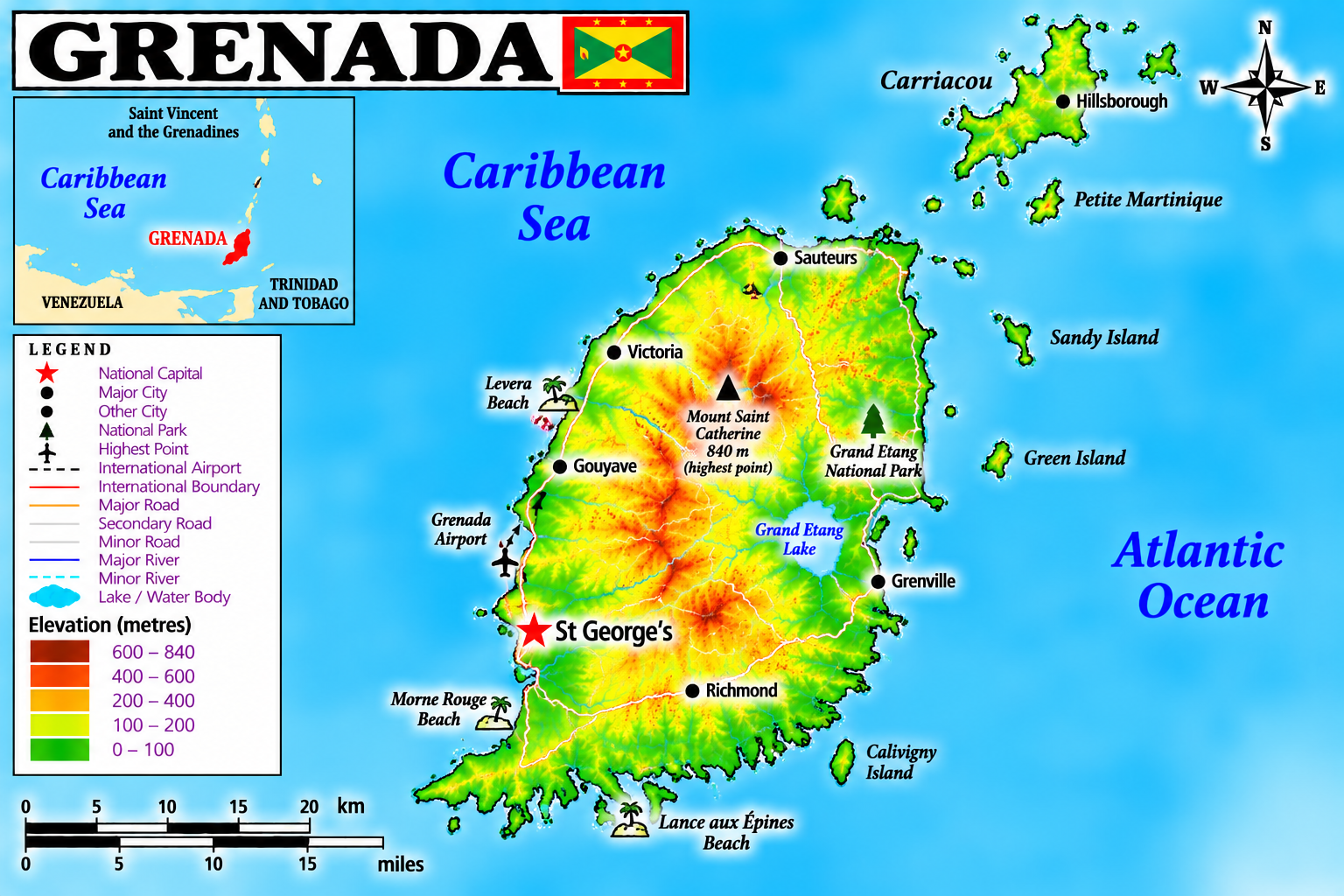
Grenada — Detailed Physical Map
Mount Saint Catherine, Grand Etang National Park, the Grenadines of Carriacou and Petite Martinique, beaches and the capital St George's
Tourist Attractions

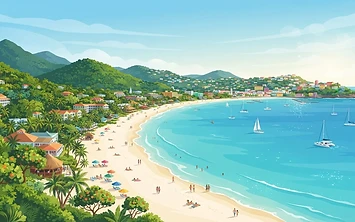
A world-renowned two-mile stretch of pristine white sand and calm, turquoise waters. It is widely considered the most iconic beach in Grenada.
The perfect spot for swimming and relaxing with a view of the Caribbean Sea.

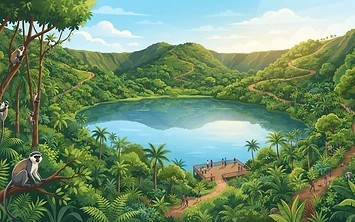
A lush rainforest reserve set within the crater of an extinct volcano, featuring a scenic lake and diverse wildlife like Mona monkeys. It offers numerous hiking trails through the island's central highlands.
Experience the unique beauty of the volcanic crater lake surrounded by tropical flora.

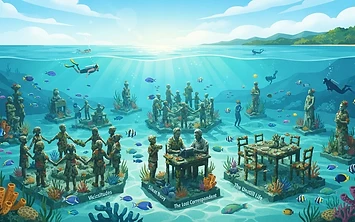
A unique underwater art installation created by Jason deCaires Taylor, featuring over 60 life-sized sculptures submerged on the seabed. It serves as an artificial reef that attracts diverse marine life.
A surreal and unforgettable experience for snorkelers and scuba divers.

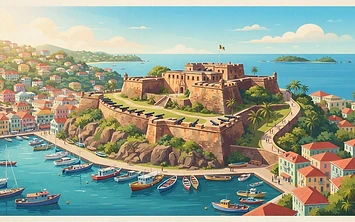
Built by the French in the early 18th century, this historic fort stands as a sentinel over the capital's harbour. It features weathered stone walls and original cannons from the colonial era.
Provides the most commanding panoramic views of St. George’s and the harbour.

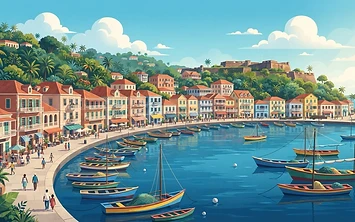
The picturesque, horseshoe-shaped waterfront promenade of the capital city. It is lined with colourful colonial-style buildings, fishing boats, and local businesses.
The ideal place for a scenic stroll to soak in the vibrant atmosphere of the capital.

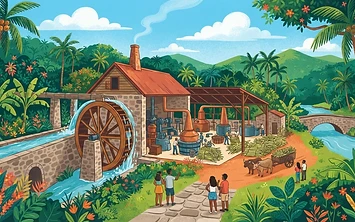
The oldest functioning water-propelled distillery in the Caribbean, using traditional methods to produce rum. It offers visitors a glimpse into the island's long-standing history of sugar and rum production.
Witness the fascinating, centuries-old process of rum production using a water wheel.
Geography
Nature
Mount Saint Catherine
840 m / 2,756 ft
52.0% of land
≈ 179 km² of forest
FAO / World Bank, forest area (% of land area)
Explore the Nature Atlas—
Flows through the capital city of St. George's into the harbor.
0 km²0 sq mi · 6 m deep
Occupies the crater of an extinct volcano within a national park.
0 km²0 sq mi
Part of a coastal wildlife sanctuary known for nesting sea turtles.
15 m49 ft
Located on the edge of the rainforest in the parish of St. John.
9 m30 ft
Surrounded by lush gardens and tropical foliage in a mountain setting.
River lengths are whole-river figures, including any section beyond Grenada. Researched reference figures. Tap any name for where its name comes from and a Google Maps link.
Major Cities
- 1Capital
Saint George
47,4182026
MapServes as the capital city and main port, characterized by colorful colonial buildings and the historic Fort George.
- 2
Saint David
15,1002026
MapFeatures the scenic La Sagesse Nature Center which includes a protected beach, mangrove estuary, and salt pond.
City populations are the latest official, UN or national-statistics estimates (2026–2026) compounded to 2026 at 0.4% a year (the nation's annual population growth rate); figures without a published update come from the open cities database (2020-era estimates) and are projected the same way.
Economy
Main exports
Grenada's leading export commodities and products.
Tap any export to learn more. Spot prices in USD only for Live Data subscribers.
Main imports
Grenada's leading import commodities and products.
Tap any import to learn more.
Military
Historical Timeline
1
Arrival of the Island Caribs
Indigenous Kalinago, or Island Caribs, settled on the island after migrating from the South American mainland. They established a vibrant culture that thrived on the island for centuries prior to European contact.
1498
Christopher Columbus sights Grenada
Christopher Columbus became the first European to sight the island during his third voyage to the Americas. He named the island Concepcion, though the name did not persist.
1650
French Colonization Begins
The French established a permanent settlement after purchasing the island from the local Indigenous population. This initiated a period of French colonial rule and the development of sugar plantations.
1763
Treaty of Paris
Under the terms of the Treaty of Paris, France officially ceded Grenada to Great Britain following the Seven Years' War. This shifted the island into the British colonial sphere.
1795
Fedon's Rebellion
Julien Fedon led a major armed insurrection against British rule inspired by the French Revolution. The rebellion was ultimately crushed by British forces in 1796.
1974
Independence from Britain
Grenada achieved full independence from the United Kingdom, with Eric Gairy serving as the nation's first Prime Minister. The country became a constitutional monarchy within the Commonwealth.
1979
New Jewel Movement Revolution
Maurice Bishop led a bloodless coup d'état, establishing the People's Revolutionary Government. This marked a significant shift toward socialist policies and alignment with the Eastern Bloc.
1983
United States-led Invasion
Following political instability and the execution of Maurice Bishop, a U.S.-led military force invaded the island to restore order. The intervention led to the end of the revolutionary government.
2013
Keith Mitchell returns to power
The New National Party, led by Keith Mitchell, secured a historic clean sweep in the general elections. This marked a return to governance for the party after a period of opposition.
2021
Establishment of the Climate Smart Agriculture Initiative
Grenada launched a major national program to modernize its agricultural sector and address the impacts of climate change on food security. This initiative reflects the nation's vulnerability and commitment to environmental sustainability.
2022
Election of Dickon Mitchell
Dickon Mitchell and the National Democratic Congress won the general election, marking a significant political transition. This victory represented the first time a new generation of leadership assumed control in over a decade.
2025
National Constitutional Reform Commission
The government initiated a comprehensive review of the national constitution to address modern governance challenges and potential republican status. This process represents a significant step in the ongoing evolution of Grenadian statehood.
National Anthem
Irva Merle Baptiste
Louis Arnold Masanto
1974
Hail! Grenada, land of ours, We pledge ourselves to thee, Heads, hearts and hands in unity To reach our destiny. Ever conscious of God, Being proud of our heritage, May we with faith and courage Aspire, build, advance as one, People, people, people!
Hail Grenada was selected as the national anthem to coincide with Grenada's independence from the United Kingdom in 1974. The song was the result of a national competition held to choose an anthem that would embody the spirit of the newly sovereign nation. Irva Merle Baptiste authored the lyrics, while the music was composed by Louis Arnold Masanto. It officially replaced the British anthem 'God Save the Queen' upon the attainment of independence on February 7, 1974. The anthem emphasizes the values of unity, faith, and progress, which are central to the Grenadian national identity. Since its adoption, it has remained the unchanged, official musical symbol of the state during formal state ceremonies and international events. It serves as a source of patriotic pride for Grenadians both at home and within the diaspora.
National Holidays
This holiday marks the beginning of the new year according to the Gregorian calendar.
This date commemorates Grenada's attainment of independence from the United Kingdom in 1974.
A Christian holiday observing the crucifixion of Jesus Christ and his death at Calvary.
An international day to celebrate the social and economic achievements of the labour movement and workers.
This holiday marks the anniversary of the 1834 abolition of slavery throughout the British Empire.
This day commemorates the 1983 United States-led intervention in Grenada, which ended a period of political instability.
Good News Today
Grenada earns multiple honours at Taste of the Caribbean 2026
Grenada's culinary team achieved significant success at the 2026 Taste of the Caribbean competition. Junior Chef Rashid Cromwell secured a gold medal, contributing to the nation's overall impressive performance.
Fun Facts
Global Spice Island Reputation
Grenada is famously known as the Spice Island because it is one of the world's leading exporters of nutmeg and mace.
Underwater Sculpture Park Gallery
The Molinere Underwater Sculpture Park was the world's first of its kind, featuring life-size statues that serve as an artificial reef.
Organic Cocoa Estate Production
The island is home to unique, small-batch chocolate factories that process high-quality, organic cacao directly from the source.
Kick Em Jenny Volcano
Just off the coast lies Kick 'em Jenny, the only known active submarine volcano in the Eastern Caribbean.
Traditional Oil Down Dish
The national dish, Oil Down, is a hearty one-pot stew made with salted meat, breadfruit, callaloo, and coconut milk.
Grand Etang Lake Crater
Located high in the mountains, Grand Etang Lake is a serene body of water sitting inside an extinct volcanic crater.
Leatherback Turtle Nesting Site
Levera Beach is a major protected nesting site for leatherback turtles, the largest of all living sea turtles.
Mona Monkeys Introduction
Mona monkeys, native to West Africa, were brought to the island in the 18th century and now thrive in the lush rainforests.
National Stadium Multi-Purpose Use
The National Stadium in Grenada is unique for its capability to host both international cricket matches and world-class athletic events.
Nutmeg Tree National Symbol
The nutmeg tree is so important to the national identity that it is prominently featured on the Grenadian national flag.
Chuckies Trivia Quiz
Chuckies Trivia Quiz
Fifteen questions on Grenada — five easy, five medium, five hard. How far can you get?
Sports & Live Events
Language
Counting to 10
1
1
= 10 (n = 0)
World Dictionary
Discover and translate any word into all supported languages.