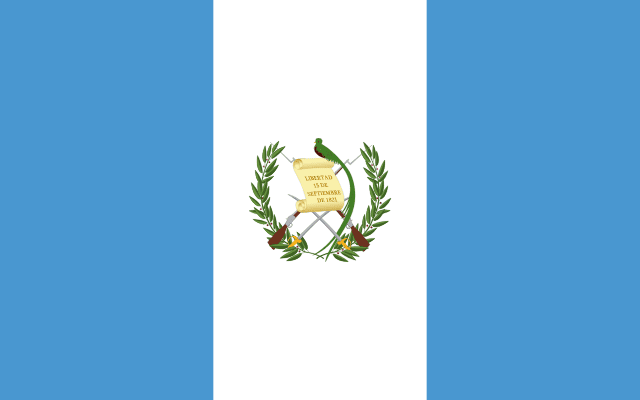
Guatemala
North America

18,406,359
12:35 UTC-6
+502
Location
Geography
Economy
Main exports
Guatemala's leading export commodities and products.
Subscribe to Live Data for live spot prices
Live commodity prices on every nation's exports — $100 AUD/year.
Tap any export to learn more. Spot prices in USD only for Live Data subscribers.
Main imports
Guatemala's leading import commodities and products.
Tap any import to learn more.
Military
Historical Timeline
11000 BCE
Arrival of Paleo-Indian hunters
The earliest evidence of human presence in the territory of present-day Guatemala dates back to approximately 11,000 BCE. These early nomadic groups established the foundational presence of Indigenous peoples in the region.
250 BCE
Rise of the Classic Maya Civilization
During the Classic Period, the Maya civilization in the Petén Basin developed sophisticated mathematics, astronomy, and architectural styles. Major city-states like Tikal emerged as powerful political and cultural centers.
1524
Spanish Conquest of Guatemala
Pedro de Alvarado arrived in Guatemala and defeated the Kʼicheʼ kingdom, beginning the era of Spanish colonial rule. This conquest drastically altered the political and social structure of the region.
1821
Independence from Spain
Guatemala declared its independence from the Spanish Empire on September 15, 1821. It initially joined the Mexican Empire before becoming part of the Federal Republic of Central America.
1847
Founding of the Republic of Guatemala
Rafael Carrera officially declared Guatemala an independent republic, separating it from the failed Central American Federation. This event solidified the state's national sovereignty.
1901
Establishment of United Fruit Company
The United Fruit Company began operations in Guatemala, exerting significant influence over the nation's economy and politics for decades. This period marked the dominance of banana exports in the Guatemalan economy.
1944
The Guatemalan October Revolution
A popular uprising overthrew the dictatorship of Jorge Ubico, leading to a decade of democratic reforms. This era introduced labor laws, social security, and agrarian reform initiatives.
1954
Coup d'état against Jacobo Árbenz
A CIA-backed military coup ousted President Jacobo Árbenz following his efforts to implement land reform. The intervention marked the beginning of a long period of political instability.
1960
Beginning of the Guatemalan Civil War
A long-standing internal conflict began between the state and various guerrilla groups. The war lasted for 36 years and resulted in significant human rights abuses and loss of life.
1996
Signing of the Peace Accords
The government and the Guatemalan National Revolutionary Unity signed a series of agreements to end the civil war. These accords aimed to address the root causes of the conflict and integrate former insurgents into political life.
2015
Anti-Corruption Protests and Resignation
Massive public protests against high-level corruption led to the resignation and arrest of President Otto Pérez Molina. The movement highlighted significant public demand for transparency and justice.
2024
Inauguration of Bernardo Arévalo
Bernardo Arévalo assumed the presidency following a tumultuous election process marked by legal challenges. His administration faces the task of addressing institutional corruption and social inequality.
National Holidays
This day marks the beginning of the civil calendar year.
This day honors the contributions and rights of workers across the country.
This holiday commemorates the Liberal Revolution of 1871 and recognizes the role of the Guatemalan Armed Forces.
This day celebrates the anniversary of Guatemala's declaration of independence from Spain in 1821.
This holiday commemorates the 1944 October Revolution, which ended the dictatorship of Jorge Ubico and initiated a period of democratic reforms.
This is a religious and cultural holiday celebrating the birth of Jesus Christ.
Language
Counting to 10
1
1
= 10 (n = 0)
World Dictionary
Discover and translate any word into all supported languages.
The multilingual Dictionary is a Nations Pro feature.
Upgrade to Pro