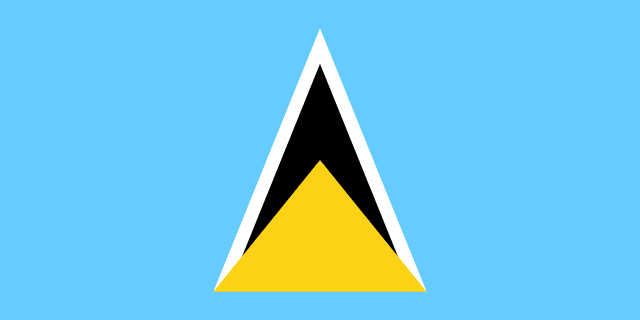

Saint Lucia
North America
180,645
08:08 UTC-4
+1758
.lc
Mount Gimie
950 m · 3,117 ft
Caribbean Sea
0 m · 0 ft
65,309
Castries · 2026
65,309
Castries · 2026
Location
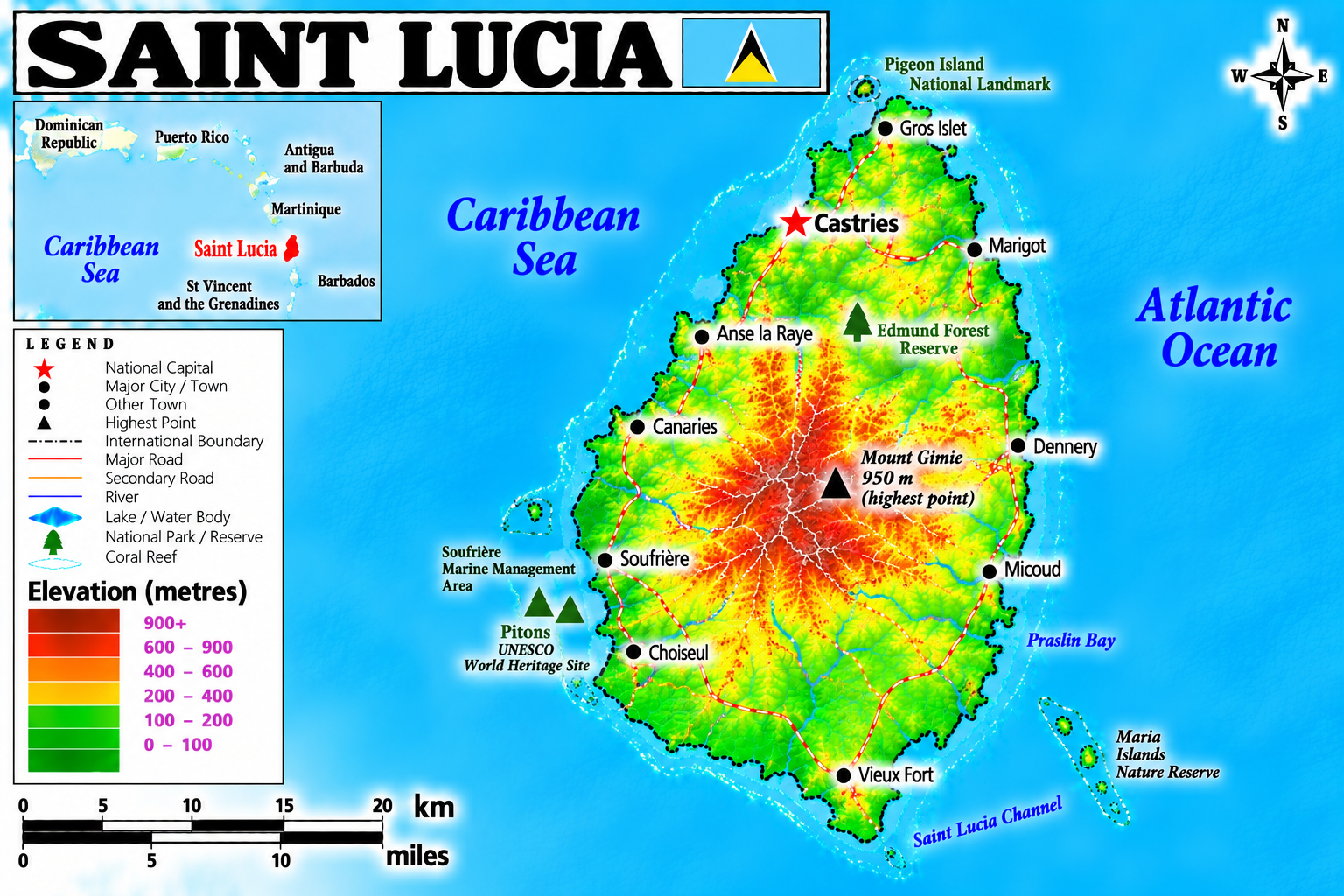
Saint Lucia — Detailed Physical Map
Mount Gimie, the Pitons UNESCO site, Soufrière and the marine management area, Edmund Forest Reserve, Pigeon Island and the capital Castries
Tourist Attractions

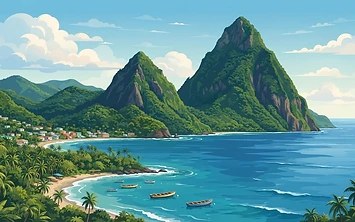
These two iconic, forest-clad volcanic spires, Gros Piton and Petit Piton, rise dramatically beside the Caribbean Sea. They are a UNESCO World Heritage Site recognized for their unique volcanic geology and natural beauty.
The breathtaking panoramic views of the island and sea from the peaks are unmatched.

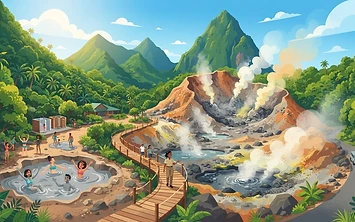
Known as the world's only drive-in volcano, this geothermal site features bubbling mud pools and hot springs. Visitors can take guided tours of the volcanic vents or enjoy a therapeutic mineral mud bath.
Experience the unique opportunity to bathe in mineral-rich volcanic mud.

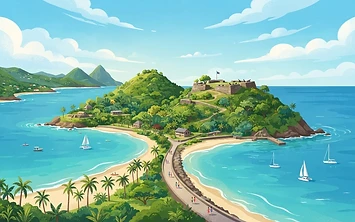
This historic park connects to the mainland by a causeway and features 18th-century military ruins, including Fort Rodney. It serves as both a protected nature reserve and a site of significant colonial history.
Hike to Signal Peak for stunning views of the coastline and neighboring Martinique.


Located on the historic Soufrière Estate, these gardens showcase a vibrant collection of tropical flora and the colorful Diamond Waterfall. The site also features historic mineral baths originally built for French troops.
The mineral-rich waterfall creates a stunning, multi-colored display against the volcanic rock.


The island's largest open-air market is a bustling hub for local commerce, offering everything from fresh tropical fruits and spices to handmade crafts. It provides an authentic look at daily life and local culinary traditions.
It is the best place to sample authentic local spices and traditional Saint Lucian snacks.

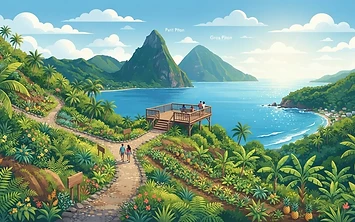
This relatively accessible hiking trail offers a guided walk through lush landscapes and organic farms. It provides some of the most spectacular, unobstructed views of the Pitons and the southern coastline.
The 'Stairway to Heaven' section offers a perfect photo opportunity with the Pitons in the background.
Geography
Nature
Mount Gimie
950 m / 3,117 ft
34.0% of land
≈ 210 km² of forest
FAO / World Bank, forest area (% of land area)
Explore the Nature Atlas11 km7 mi
Largest river basin on the island and a major source of agricultural irrigation.
9 km6 mi
Flows through the southern region before emptying into the Atlantic Ocean.
15 m49 ft
Water is rich in minerals and changes color due to volcanic deposits.
15 m49 ft
Situated in a tropical garden near the town of Soufriere.
River lengths are whole-river figures, including any section beyond Saint Lucia. Researched reference figures. Tap any name for where its name comes from and a Google Maps link.
Major Cities
- 1Capital
Castries
70,8442026
Map - 2
Gros-Islet
21,9212026
Map - 3
Micoud
16,8202026
Map - 4
Vieux-Fort
15,9402026
Map - 5
Castries
13,1372026
Map
City populations are the latest official, UN or national-statistics estimates compounded to 2026 at 0.2% a year (the nation's annual population growth rate); figures without a published update come from the open cities database (2020-era estimates) and are projected the same way.
Economy
Main exports
Saint Lucia's leading export commodities and products.
Tap any export to learn more. Spot prices in USD only for Live Data subscribers.
Main imports
Saint Lucia's leading import commodities and products.
Tap any import to learn more.
Military
Historical Timeline
Creating artwork for each milestone…
200
Arawak Settlement
The Arawak people, also known as the Igneri, were the earliest known inhabitants to establish permanent settlements on Saint Lucia. They brought agriculture and ceramic traditions to the island.
800
Arrival of the Kalinago
The Kalinago people migrated to Saint Lucia, gradually displacing or integrating with the existing Arawak population. They maintained a strong maritime culture and resisted early European encroachment.
1660
Treaty with the Kalinago
The French signed a treaty with the native Kalinago people, formally establishing French influence over the island. This marked the beginning of a long period of colonial competition between France and Britain.
1814
British Sovereignty Confirmed
Following the Treaty of Paris, Saint Lucia was officially ceded to Great Britain after centuries of conflict between the French and the British. It remained a British colony for over 160 years.
1834
Abolition of Slavery
The British Parliament passed the Slavery Abolition Act, ending the system of enslaved labor on the island. This significantly altered the demographic and economic structure of Saint Lucian society.
1967
Associated Statehood
Saint Lucia was granted associated statehood by the United Kingdom, which gave the island full control over its internal affairs. This was a critical step toward complete sovereignty.
1979
Independence from Britain
Saint Lucia gained full independence from the United Kingdom on February 22, 1979. Sir John Compton became the country's first Prime Minister following this transition.
1992
Derek Walcott Nobel Prize
Saint Lucian poet and playwright Derek Walcott was awarded the Nobel Prize in Literature. This event brought significant international cultural recognition to the nation.
2016
Election of Prime Minister Allen Chastanet
Allen Chastanet of the United Workers Party led his party to a decisive victory in the general election. This marked a major transition in the national political landscape.
2021
Philip J. Pierre Assumes Office
Following a landslide victory for the Saint Lucia Labour Party, Philip J. Pierre was sworn in as Prime Minister. This election demonstrated a significant shift in legislative control.
2024
Expansion of Digital Economic Initiatives
The government ramped up efforts to digitize public services and diversify the economy through the 'Digital Saint Lucia' project. This aimed to modernize infrastructure and improve administrative efficiency.
2025
National Sustainable Development Strategy
Saint Lucia unveiled an updated national climate resilience plan to mitigate risks from natural disasters and rising sea levels. This milestone reflects the country's commitment to long-term environmental and economic stability.
National Anthem
Charles Jesse
Leton Felix Thomas
1967
Sons and daughters of Saint Lucia, Love the land that gave us birth, Land of sunshine, land of plenty, Land of beauty, land of worth. May the good Lord bless our island, Guard her sons from grief and strife, May we be a united people, And progress through endless life. Saint Lucia! Mother island, Thy children greet thee with prayer, To seek thy glory and welfare, To love and cherish thee ever.
The national anthem of Saint Lucia was written by Reverend Father Charles Jesse and composed by Leton Felix Thomas. It was selected following a competition held in 1967 to commemorate the island's transition to the status of an Associated State of the United Kingdom. Upon the country gaining full independence in 1979, the anthem was retained as the official national symbol. The song emphasizes themes of national unity, appreciation for the island's natural beauty, and a collective commitment to progress. It serves as a central element of official state functions, schools, and national celebrations. Since its adoption, the lyrics have remained unchanged, maintaining their original intent to foster patriotism among the populace. The anthem represents the spirit and identity of the Saint Lucian people as they look toward a future of continued growth.
National Holidays
Celebrates the start of the new calendar year according to the Gregorian calendar.
Commemorates Saint Lucia's attainment of independence from the United Kingdom in 1979.
A Christian holiday marking the crucifixion of Jesus Christ and his death at Calvary.
Honors the contributions and rights of workers in Saint Lucian society.
Marks the anniversary of the abolition of slavery in the British West Indies.
Celebrates the feast day of Saint Lucy of Syracuse and highlights the nation's cultural heritage.
Good News Today
Saint Lucia's Piton Boyz Secure Gold Cup Qualification Spot
The Saint Lucia national football team, known as the Piton Boyz, has secured a spot in the Gold Cup qualification after achieving five consecutive wins. This victory solidifies their top position in the Nations League Group Stage.
Fun Facts
Iconic twin volcanic spires
The Pitons are two dramatic volcanic plugs that rise straight out of the Caribbean Sea, serving as the country's national symbol.
World's only drive-in volcano
Sulphur Springs is renowned for being the world's only drive-in volcano, allowing visitors to view bubbling springs from their cars.
Historic cocoa production legacy
The island has a rich history of chocolate production, with estates dating back to the 1700s still crafting organic bars today.
Rare national bird species
The Saint Lucia Parrot, or Amazona versicolor, is a vibrant bird found nowhere else in the world except within these rainforests.
Two Nobel Prize winners
Saint Lucia holds the world record for the highest number of Nobel Prize laureates per capita, with two winners in literature and economics.
La Rose and La Marguerite
The country celebrates two unique flower festivals each year, rooted in historical rivalries between two ancient secret societies.
One of the world's oldest ports
Castries harbor is one of the deepest and most naturally protected ports in the Caribbean, serving sailors for centuries.
World's only dry forest reserve
The Maria Islands Nature Reserve protects a unique ecosystem that is home to the world's rarest snake, the Saint Lucia racer.
Purest organic honey production
Due to the lack of large-scale industrial pollution, Saint Lucian beekeepers produce some of the purest, most floral organic honey available.
Historic cricket ground status
The Beausejour Cricket Ground was the first stadium in the Caribbean to host a day-night cricket match under floodlights.
Chuckies Trivia Quiz
Chuckies Trivia Quiz
Fifteen questions on Saint Lucia — five easy, five medium, five hard. How far can you get?
Sports & Live Events
Language
Counting to 10
1
1
= 10 (n = 0)
World Dictionary
Discover and translate any word into all supported languages.