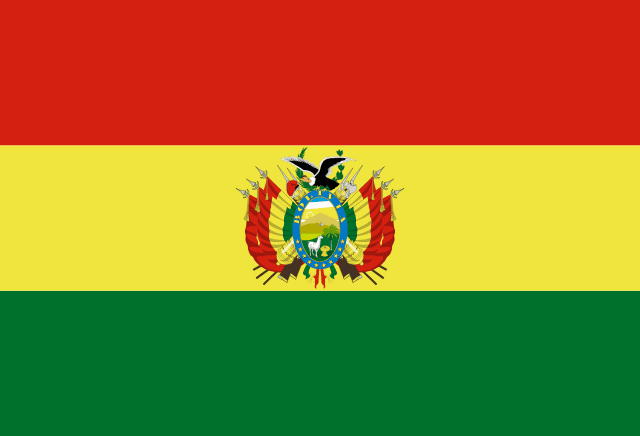

Bolivia
Plurinational State of Bolivia
South America
12,827,827
16:47 UTC-4
+591
.bo
Nevado Sajama
6,542 m · 21,463 ft
Paraguay River
70 m · 230 ft
984,442
Sucre · 2026
2,922,069
Santa Cruz de la Sierra · 2026
Location
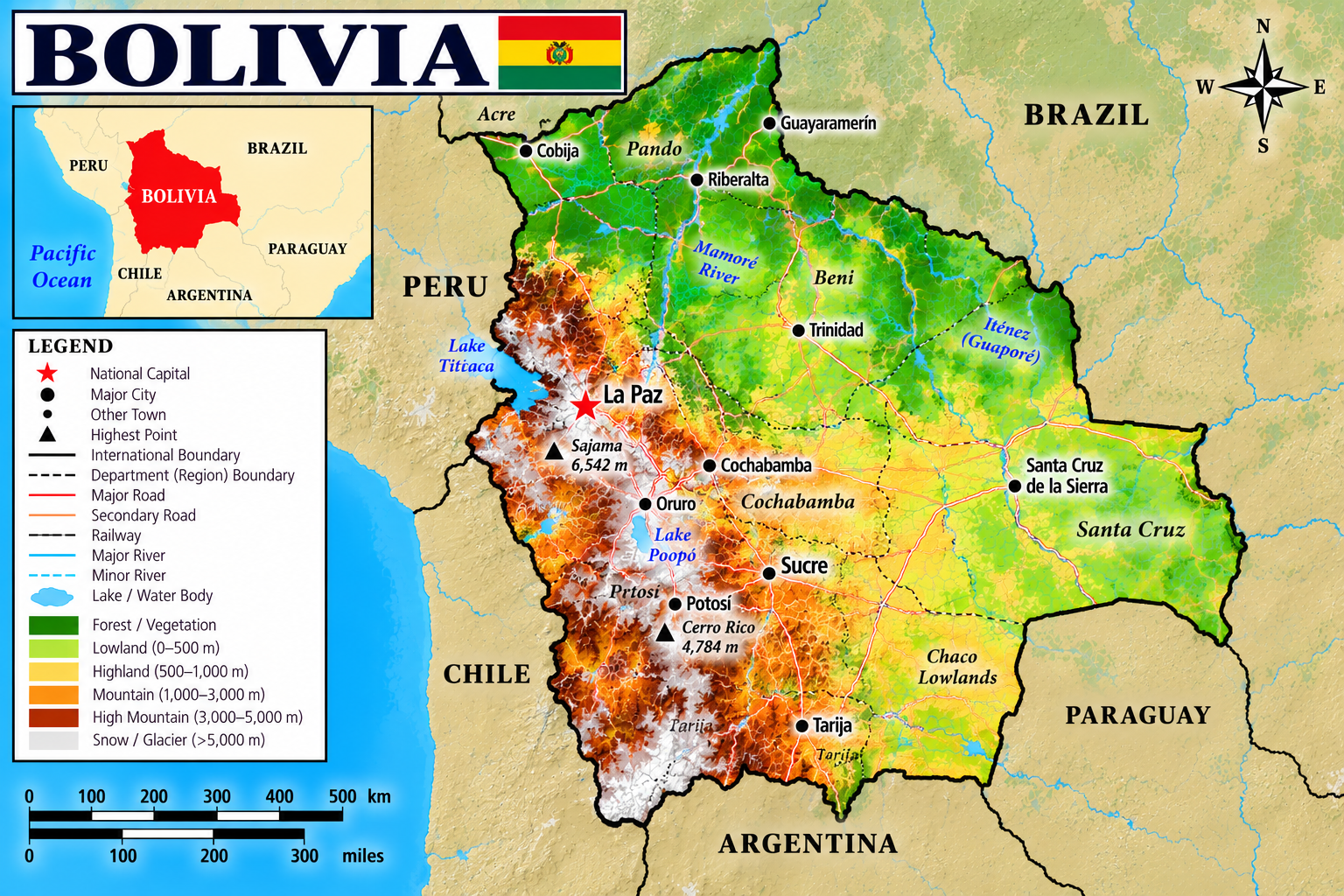
Bolivia — Detailed Physical Map
Andean terrain, Sajama and Cerro Rico, departments, rivers, cities and the seat of government La Paz
Tourist Attractions

The world's largest salt flat, this vast, blindingly white expanse was formed by the evaporation of prehistoric lakes. During the rainy season, a thin layer of water transforms the surface into a giant, perfect mirror reflecting the sky.
Witnessing the surreal, mirror-like reflection during the rainy season is an unforgettable experience.
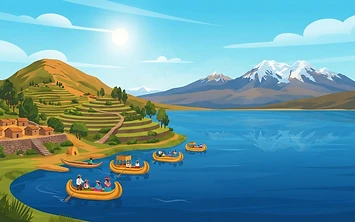
Straddling the border of Bolivia and Peru, this is the world's highest navigable lake at over 3,800 meters. It is considered the birthplace of Inca culture and is home to the sacred Isla del Sol.
Explore the ancient ruins and serene landscapes of the Isla del Sol, the legendary cradle of the Inca civilization.

This UNESCO World Heritage site is one of the most important pre-Columbian archaeological complexes in South America. It served as the spiritual and political center of a powerful civilization that predates the Inca Empire.
Marvel at the monumental stone architecture, including the iconic Gate of the Sun.
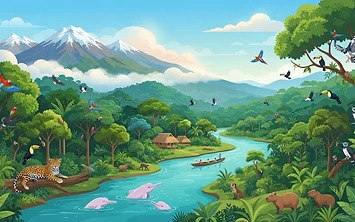
Stretching from the high Andes to the tropical Amazon, this park is one of the most biodiverse protected areas on Earth. It is home to thousands of species of plants, birds, and mammals, including jaguars and pink dolphins.
Experience unparalleled wildlife spotting in one of the world's most pristine rainforest environments.

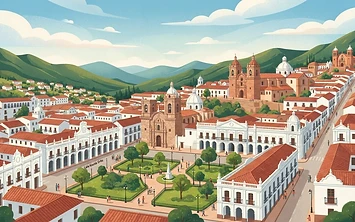
Known as the 'White City,' Bolivia's constitutional capital is celebrated for its exceptionally well-preserved colonial architecture and peaceful, historic atmosphere. The city center is a UNESCO World Heritage site filled with republican-era buildings and churches.
Stroll through the beautifully maintained historic center to admire the classic white-washed colonial buildings.

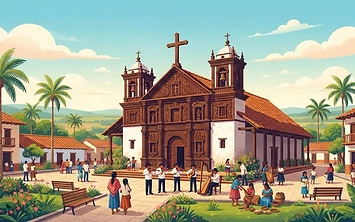
This collection of six historic towns features unique churches that blend Catholic religious architecture with indigenous craftsmanship. These settlements remain active cultural centers that preserve a distinct artistic and musical heritage.
Admire the intricate wood carvings and unique architectural fusion found in these centuries-old mission churches.
Geography
Nature
Nevado Sajama
6,542 m / 21,463 ft
47.0% of land
≈ 516,334 km² of forest
FAO / World Bank, forest area (% of land area)
Explore the Nature Atlas1,930 km1,199 mi
Forms the border between Bolivia and Brazil for a significant stretch.
1,178 km732 mi
Flows through the rainforest and serves as a major waterway for remote communities.
1,438 km894 mi
Flows entirely within the borders of Bolivia before joining the Mamore.
8,372 km²3,232 sq mi · 281 m deep
Highest navigable lake in the world located in the Andes mountains.
1,000 km²386 sq mi · 3 m deep
Shallow saline lake that has suffered from periodic drying events.
155 km²60 sq mi
Located in the Beni Department and surrounded by tropical wetlands.
—
Hidden within the Amboro National Park surrounded by dense cloud forest.
—
Situated near the border areas and often accessed during regional tours.
River lengths are whole-river figures, including any section beyond Bolivia. Researched reference figures. Tap any name for where its name comes from and a Google Maps link.
Major Cities
- 1
Santa Cruz
1,647,3302026
MapEconomic engine of Bolivia, acting as the primary hub for agricultural production and regional commerce in the eastern lowlands.
- 2
La Paz
894,8332026
MapVibrant metropolis situated on the Altiplano, serving as the primary gateway to the nation through its international airport.
- 3Capital
La Paz
757,4312026
MapAdministrative capital of Bolivia, famous for its dramatic high-altitude geography and extensive public cable car transportation network.
- 4
Cochabamba
674,1282026
MapRecognized as the culinary capital of Bolivia, known for its mild climate and significant agricultural contributions to the country.
- 5
Oruro
305,7242026
MapRenowned for hosting the spectacular Carnival of Oruro, a UNESCO Masterpiece of the Oral and Intangible Heritage of Humanity.
- 6
Oruro
305,7242026
MapRenowned for hosting the spectacular Carnival of Oruro, a UNESCO Masterpiece of the Oral and Intangible Heritage of Humanity.
- 7Capital
Chuquisaca
305,0122026
MapConstitutional capital of Bolivia, celebrated for its well-preserved colonial architecture and status as a UNESCO World Heritage site.
- 8
Tarija
246,3612026
MapPrimary wine-producing region of Bolivia, famous for its high-altitude vineyards and unique Mediterranean-like climate.
- 9
Cochabamba
228,9312026
MapMajor urban center near Cochabamba known for its significant agricultural production and expanding role in the departmental economy.
- 10
Potosí
224,5922026
MapHistorically significant center of global silver production during the Spanish colonial era, once among the world's richest cities.
- 11
Santa Cruz
163,7182026
MapRapidly growing industrial hub located in the Santa Cruz department, serving as a key logistical center for regional manufacturing.
- 12
Santa Cruz
130,7432026
MapCentral hub for the sugar cane industry, playing a vital role in the agro-industrial development of Santa Cruz.
City populations are the latest official, UN or national-statistics estimates (2026–2026) compounded to 2026 at 1.4% a year (the nation's annual population growth rate); figures without a published update come from the open cities database (2020-era estimates) and are projected the same way.
Economy
Main exports
Bolivia's leading export commodities and products.
Tap any export to learn more. Spot prices in USD only for Live Data subscribers.
Main imports
Bolivia's leading import commodities and products.
Tap any import to learn more.
Military
Historical Timeline
10000 BCE
Arrival of Indigenous Inhabitants
Evidence suggests that the first Paleo-Indian hunters and gatherers began settling in the Andean highlands around 10,000 BCE. These early populations established the foundations for the complex societies that later dominated the region.
500
Rise of the Tiwanaku Empire
The Tiwanaku culture emerged near Lake Titicaca as a major pre-Columbian civilization. It became a powerful political and religious center that influenced vast areas of the Andean region for centuries.
1545
Discovery of Silver in Potosi
Spanish colonizers discovered massive silver deposits in the Cerro Rico mountain of Potosi. This discovery led to the establishment of one of the world's largest cities at the time and fueled the economy of the Spanish Empire.
1825
Independence of Bolivia
After a long struggle for independence led by Simon Bolivar and Antonio Jose de Sucre, the Republic of Bolivia was officially founded. The nation was named in honor of the Venezuelan military leader who liberated the territory.
1879
Outbreak of the War of the Pacific
Bolivia entered a conflict against Chile over territory in the Atacama Desert. The defeat resulted in the loss of Bolivia's coastal territory and its status as a landlocked nation.
1932
Chaco War against Paraguay
Bolivia engaged in a brutal war with Paraguay over the control of the oil-rich Chaco region. The conflict caused significant loss of life and ended with a diplomatic settlement that favored Paraguayan claims.
1952
The Bolivian National Revolution
A popular uprising led by the Nationalist Revolutionary Movement brought sweeping reforms, including universal suffrage and the nationalization of tin mines. It fundamentally restructured the nation's political and social landscape.
2006
Election of Evo Morales
Evo Morales was elected as the first Indigenous president in Bolivian history. His administration implemented significant social welfare programs and nationalized key sectors of the economy.
2019
Political Crisis and Resignation of Morales
Following contested election results and widespread civil unrest, Evo Morales resigned from the presidency. A transitional government was established to oversee new national elections.
2020
Election of Luis Arce
Luis Arce won the general election, marking the return of the Movement for Socialism party to power. His government focused on economic recovery following the political instability of the previous year.
2024
Failed Military Coup Attempt
In June 2024, military forces led by General Juan Jose Zuniga attempted to storm the presidential palace in La Paz. The government successfully suppressed the uprising, leading to the arrest of the responsible commanders.
2025
National Census and Political Tensions
Bolivia conducted a national census to update population data for political representation and economic resource allocation. The process highlighted deep regional and political divisions throughout the country.
National Anthem
Himno Nacional de Bolivia
José Ignacio de Sanjinés
Leopoldo Benedetto Vincenti
1852
Bolivianos, el hado propicio coronó nuestros votos y anhelo; es ya libre, ya libre este suelo, ya cesó su servil condición. Al estruendo marcial que ayer fuera y al clamor de la guerra horroroso, sigue en calma este día radioso una firme y feliz unión. ¡Loor eterno a los bravos guerreros, cuyo heroico valor y firmeza han conquistado las glorias intactas que Bolivia feliz hoy disfruta!
The National Anthem of Bolivia was composed by the Italian musician Leopoldo Benedetto Vincenti and written by the lawyer and statesman José Ignacio de Sanjinés. It was first performed on November 18, 1845, in the city of La Paz to commemorate the fourth anniversary of the Battle of Ingavi. The anthem was officially adopted as the national symbol during the presidency of Manuel Isidoro Belzu in 1852. Its lyrics reflect the nation's spirit of liberation and independence from Spanish colonial rule following the Bolivian War of Independence. While originally composed as a longer piece with multiple verses, modern performances typically focus on the first verse and the chorus. It remains a central element of national identity, played during all formal state ceremonies and patriotic observances throughout the country.
National Holidays
Commemorates the founding of the Plurinational State of Bolivia in 2009 following the implementation of the new constitution. It marks the shift toward recognizing the country's diverse indigenous cultures and political structure.
A major Christian holiday observed to mark the crucifixion of Jesus Christ. It is a time of reflection and religious observance throughout the nation.
Celebrated to honor the contributions of workers to society and the economy. It is a public holiday that often features parades and union demonstrations.
A Catholic feast day celebrating the Real Presence of Jesus Christ in the Holy Eucharist. It is observed with religious processions and traditional culinary customs in various regions of Bolivia.
The most important national holiday in Bolivia, commemorating the declaration of independence from Spanish colonial rule in 1825. Celebrations include military parades, civic events, and patriotic displays across the country.
The annual celebration of the birth of Jesus Christ. It is a major public holiday centered on family gatherings and religious traditions.
Good News Today
Bolivia Secures $277M German Climate Deal at COP31 for Forest and Water Conservation
President Rodrigo Paz announced a historic €250 million commitment from Germany's KfW development bank to support forest conservation and clean energy. This agreement marks the country's largest environmental financing deal in over two decades.
Fun Facts
Largest Mirror On Earth
The Salar de Uyuni is the world's largest salt flat, which creates a stunning mirror effect when covered with a thin layer of water.
Country With Two Capitals
Bolivia maintains two official capital cities, Sucre as the constitutional capital and La Paz as the administrative center.
World's Highest Urban Cable System
La Paz features the Mi Teleférico network, which is the highest and longest aerial cable car system globally, serving as primary public transit.
Cholita Wrestlers Are Iconic
Bolivia is famous for 'Cholita wrestling,' where indigenous women perform professional wrestling matches while wearing traditional skirts and bowler hats.
Ancient Potato Preservation Techniques
Bolivia is home to thousands of potato varieties, and indigenous people have used freeze-drying methods for centuries to preserve them as chuno.
Ancient Reed Boat Traditions
On Lake Titicaca, the Uru people build floating islands and boats made entirely from layers of native totora reeds.
Graveyard Of Abandoned Trains
Near the town of Uyuni lies a massive train cemetery containing rusted 19th-century steam locomotives left behind after the collapse of the mining industry.
Cactus Island In Salt Flats
Incahuasi Island, located in the middle of the salt flats, is covered in giant cacti that can grow over 30 feet tall.
Extremely High Biodiversity Zone
Bolivia ranks among the top countries for plant and animal species diversity, encompassing everything from Amazon rainforests to arid Andean plateaus.
Salteñas Are Sweet And Savory
The national snack, the salteña, is a baked empanada that is uniquely juicy due to a gelatinous broth filling that thickens as it cools.
Chuckies Trivia Quiz
Chuckies Trivia Quiz
Fifteen questions on Bolivia — five easy, five medium, five hard. How far can you get?
Sports & Live Events
Language
Counting to 10
1
1
= 10 (n = 0)
World Dictionary
Discover and translate any word into all supported languages.