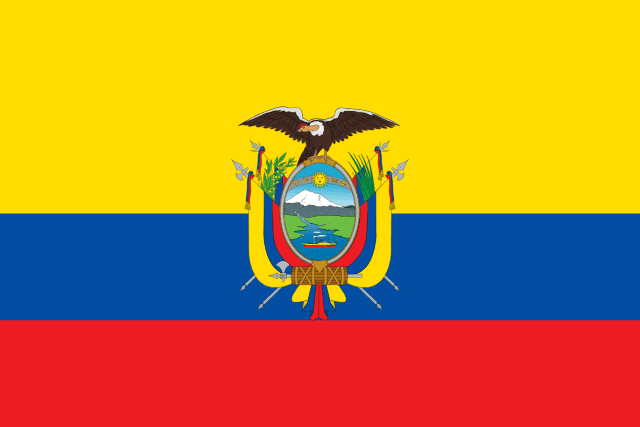

Ecuador
Republic of Ecuador
South America
18,493,988
21:14 UTC-5
+593
.ec
Chimborazo
6,263 m · 20,548 ft
Pacific Ocean
0 m · 0 ft
1,881,237
Quito · 2026
3,212,390
Guayaquil · 2026
Location
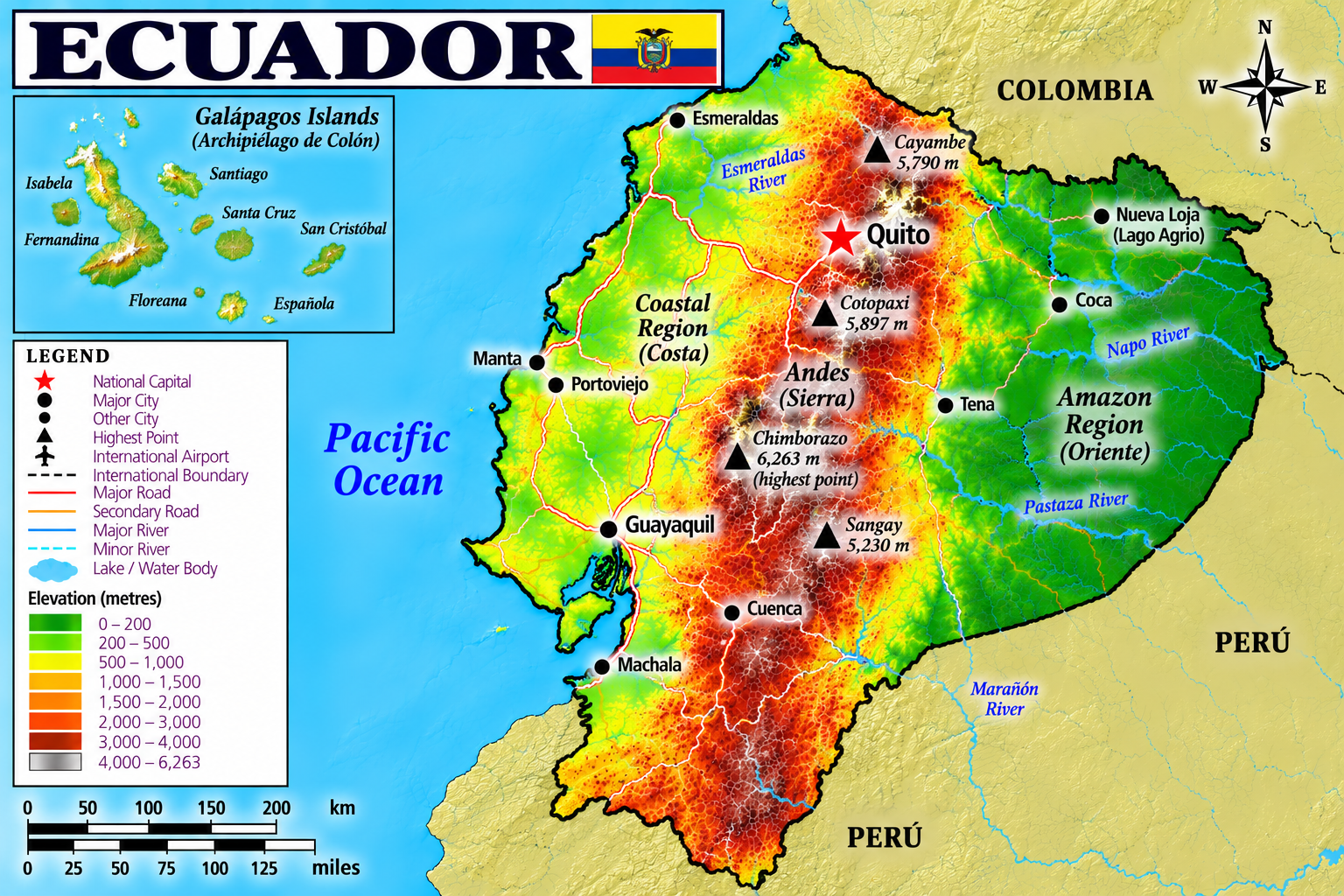
Ecuador — Detailed Physical Map
Andes, Cotopaxi and Chimborazo, the Galápagos Islands, Amazon rainforest, major cities and the capital Quito
Tourist Attractions

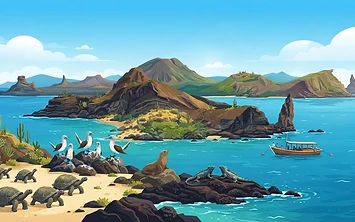
An isolated volcanic archipelago famous for its unique wildlife, including giant tortoises and blue-footed boobies, which inspired Charles Darwin's theory of evolution.
It is one of the world's premier destinations for observing rare wildlife in their natural, fearless habitat.

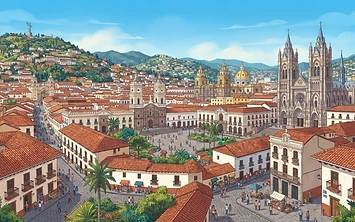
The historical heart of Ecuador's capital is a UNESCO World Heritage site featuring exceptionally well-preserved colonial architecture, grand plazas, and ornate churches.
Walking through the narrow, cobblestone streets offers an immersive experience into the colonial history of the Andes.

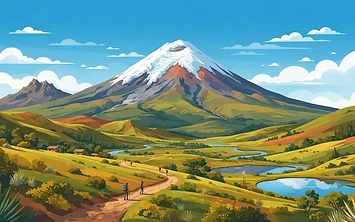
Home to one of the world's highest active volcanoes, this park features a dramatic, snow-capped, cone-shaped peak rising above the Andean highlands.
The park provides breathtaking panoramic views and world-class hiking opportunities at the base of an iconic volcano.

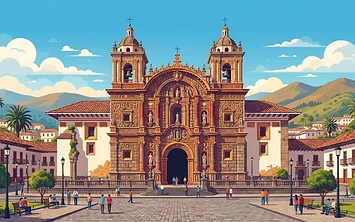
Often cited as the most beautiful church in Ecuador, this Jesuit temple is renowned for its stunning interior covered in intricate gold leaf carvings.
The sheer opulence of the gold-covered walls and ceilings makes it a masterpiece of Baroque architecture.

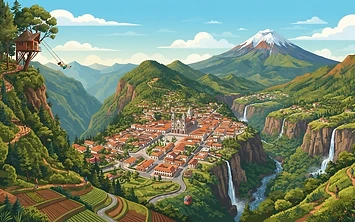
Nestled in the Andes, this town is famous for its natural hot springs, dramatic waterfalls, and the famous 'Swing at the End of the World' at Casa del Árbol.
It serves as the adventure capital of Ecuador, offering a perfect mix of relaxation and adrenaline-fueled activities.

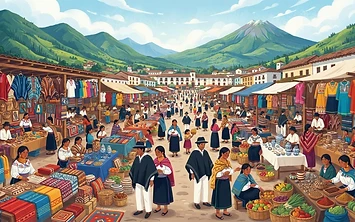
One of the largest and most vibrant artisan markets in South America, where local Kichwa people sell traditional textiles, ponchos, and handmade crafts.
It is the best place to experience authentic indigenous culture and purchase high-quality, traditional Ecuadorian handicrafts.
Geography
Nature
Chimborazo
6,263 m / 20,548 ft
49.9% of land
≈ 141,497 km² of forest
FAO / World Bank, forest area (% of land area)
Explore the Nature Atlas1,610 km1,000 mi
Forms a significant portion of the border between Ecuador and Colombia.
1,400 km870 mi
Major tributary of the Amazon River that originates in the Ecuadorian Andes.
390 km242 mi
Largest drainage basin on the South American Pacific coast.
4 km²2 sq mi · 200 m deep
Caldera lake formed by a massive volcanic eruption thousands of years ago.
7 km²3 sq mi · 35 m deep
Located at the base of the Imbabura volcano in the northern highlands.
2 km²1 sq mi
Cluster of three lakes situated in a high-altitude paramo ecosystem.
150 m492 ft
Previously the tallest waterfall in the country before the riverbed collapsed.
80 m262 ft
Renowned for its intense power and proximity to the city of Banos.
River lengths are whole-river figures, including any section beyond Ecuador. Researched reference figures. Tap any name for where its name comes from and a Google Maps link.
Major Cities
- 1
Guayas
2,900,3752026
MapServes as the primary port and commercial center of Ecuador, driving much of the nation's international maritime trade.
- 2Capital
Pichincha
1,865,6322026
MapStands as the high-altitude capital city, famous for its exceptionally well-preserved historic center and colonial architecture.
- 3
Azuay
378,6232026
MapRenowned for its colonial heritage, beautiful rivers, and production of world-famous Panama hats.
- 4
Santo Domingo de los Tsáchilas
361,8602026
MapActs as a vital transportation hub linking the Andean highlands to the coastal lowlands of the country.
- 5
El Oro
307,6822026
MapRecognized as the banana capital of the world due to its massive exports of the fruit.
- 6
Manabí
281,4772026
MapOperates as a major hub for the nation's tuna fishing industry and international maritime transit.
- 7
Manabí
264,1082026
MapFunctions as a significant agricultural and administrative center situated in the fertile valleys of Manabi province.
- 8
Guayas
242,1432026
MapHonors the legacy of the revolutionary leader who modernized the country through railway infrastructure and secular reforms.
- 9
Loja
212,2662026
MapCelebrated as the music and cultural capital of Ecuador, featuring a prominent annual religious pilgrimage.
- 10
Morona-Santiago
190,1972026
MapPromoted as a gateway to the Amazon rainforest, known for its rich cultural ties to Shuar communities.
- 11
Tungurahua
183,0692026
MapHosts the famous Fruit and Flower Festival, celebrating the resilience of the local economy after historic volcanic eruptions.
- 12
Esmeraldas
172,9732026
MapServes as a crucial northern coastal port, known for its vibrant Afro-Ecuadorian culture and rich tropical biodiversity.
City populations are the latest official, UN or national-statistics estimates (2026–2026) compounded to 2026 at 0.8% a year (the nation's annual population growth rate); figures without a published update come from the open cities database (2020-era estimates) and are projected the same way.
Economy
Main exports
Ecuador's leading export commodities and products.
Tap any export to learn more. Spot prices in USD only for Live Data subscribers.
Main imports
Ecuador's leading import commodities and products.
Tap any import to learn more.
Military
Historical Timeline
11000 BCE
Arrival of the Paleo-Indian settlers
The first human inhabitants arrived in the Andean highlands, establishing early settlements such as El Inga. These groups were the ancestors of the diverse Indigenous cultures that developed across the region.
1460
Inca Conquest of the Northern Andes
Inca forces led by Tupac Yupanqui expanded their empire into modern-day Ecuador, integrating local cultures into the Tahuantinsuyo. This period saw the development of major infrastructure and administrative centers like Tomebamba.
1534
Foundation of San Francisco de Quito
Spanish conquistador Sebastián de Benalcázar founded the city of Quito on the ruins of an Inca settlement. This marked the formal beginning of Spanish colonial rule in the region.
1822
Battle of Pichincha and Independence
Forces led by Antonio José de Sucre defeated the Spanish royalists on the slopes of the Pichincha volcano. This victory secured the independence of the territory, which joined the Republic of Gran Colombia.
1830
Formation of the Republic of Ecuador
Ecuador officially separated from Gran Colombia to become an independent sovereign state. Juan José Flores was inaugurated as the nation's first president.
1895
The Liberal Revolution
Led by Eloy Alfaro, this political movement overthrew the conservative government to establish a secular state. It introduced major reforms, including the separation of church and state and the promotion of public education.
1941
Ecuadorian-Peruvian War
A border conflict broke out between Ecuador and Peru, leading to the Rio Protocol in 1942. This conflict defined much of the geopolitical tension between the two nations throughout the 20th century.
1972
Commencement of Oil Exports
The extraction of petroleum in the Amazon region began, fundamentally transforming the national economy. Oil exports became the primary source of state revenue, fueling significant modernization and urban growth.
2000
Adoption of the US Dollar
In response to a severe financial crisis and hyperinflation, the Ecuadorian government replaced the national currency, the sucre, with the US dollar. This move helped stabilize the economy despite the loss of monetary policy autonomy.
2008
Ratification of the Montecristi Constitution
A new national constitution was approved by referendum, introducing significant changes to state structure and rights. It explicitly recognized the rights of nature, making Ecuador the first country to do so in its supreme law.
2023
Election of Daniel Noboa
Daniel Noboa was elected president in a snap election, becoming the youngest president in Ecuadorian history. He took office amidst a challenging internal security crisis and significant economic instability.
2025
General Presidential Election
Ecuador held a presidential election to determine the leadership for the upcoming term. The results reflected the ongoing national debate regarding economic policy and the management of the public security crisis.
National Anthem
Salve, oh patria
Juan León Mera
Antonio Neumane
1866
Salve, oh patria, mil veces! oh patria, gloria a ti! ya tu pecho rebosa, gozo y paz ya tu pecho rebosa, gozo y paz. Ya tu pecho rebosa, gozo y paz ya tu pecho rebosa, gozo y paz, y tu frente radiosa, más que el sol contemplamos lucir, y tu frente radiosa, más que el sol contemplamos lucir.
The National Anthem of Ecuador was composed in 1866 by the French-born musician Antonio Neumane. The lyrics were penned by the Ecuadorian writer and politician Juan León Mera at the request of the Senate. It was officially adopted by Congress on September 29, 1866, to replace a previous anthem that had fallen out of favor. The anthem reflects the country's struggle for independence and celebrates the natural beauty and spirit of the Ecuadorian people. Over the decades, the complete original version was often criticized for its length, leading to a decree in 1948 that solidified the current version consisting of the second stanza and the chorus. It remains a powerful symbol of Ecuadorian national identity, played daily in schools and on all major state occasions.
National Holidays
Celebrates the start of the Gregorian calendar year with traditional family gatherings and the burning of effigies.
Commemorates the achievements of workers and the international labor movement.
Marks the anniversary of the 1822 battle that secured the independence of the territory of present-day Ecuador from Spanish colonial rule.
Commemorates the proclamation of independence from Spain in 1809, marking the first call for independence in South America.
Celebrates the start of the city of Guayaquil's war of independence in 1820.
Marks the anniversary of the city of Cuenca declaring its independence from Spain in 1820.
A religious holiday celebrating the birth of Jesus Christ, widely observed as a national holiday.
Good News Today
Fundación Kara Solar wins international recognition for Amazonian solar boat project
Fundación Kara Solar was honored at the 2026 Premios Verdes for its innovative solar-powered electric boat initiative that connects Indigenous communities in the Amazon. The project annually transports over 10,000 passengers and has significantly reduced reliance on fossil fuels across 53 communities.
Fun Facts
Center of the Earth Country
The country is named after the equator, which passes through it, allowing you to stand with one foot in each hemisphere.
Highest Point from Earth's Center
Mount Chimborazo is the closest point on Earth to the stars because the planet bulges at the equator.
Birthplace of Evolutionary Theory
The Galapagos Islands, belonging to Ecuador, inspired Charles Darwin's groundbreaking theory of evolution by natural selection.
World's Leading Banana Exporter
Ecuador is the largest exporter of bananas globally, providing a massive portion of the world's supply.
Birthplace of Ancient Chocolate
Archaeologists found evidence of cacao use dating back over 5,000 years, making Ecuador the true cradle of chocolate.
World's Highest Biodiversity Density
Ecuador hosts more species per square kilometer than any other country, especially within its Amazonian regions.
The Devil's Nose Railway
The Nariz del Diablo is a feat of engineering that zigzags up a near-vertical mountain cliff.
Panama Hats are Ecuadorian
Despite the misleading name, the famous hand-woven Panama hat originated and is still crafted in Ecuador.
Home to Bioluminescent Fungi
The cloud forests contain rare species of mushrooms that glow in the dark, lighting up the forest floor.
First UNESCO World Heritage City
Quito was one of the first two sites ever named a UNESCO World Heritage site for its preserved historic center.
Chuckies Trivia Quiz
Chuckies Trivia Quiz
Fifteen questions on Ecuador — five easy, five medium, five hard. How far can you get?
Sports & Live Events
Language
Counting to 10
1
1
= 10 (n = 0)
World Dictionary
Discover and translate any word into all supported languages.