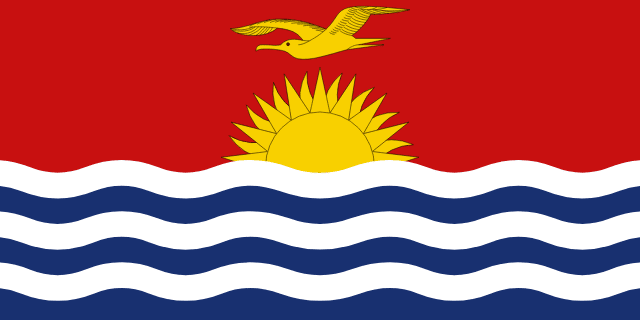
Kiribati
Oceania

100,000
01:31 UTC+12
+686
Location
Geography
Economy
Main exports
Kiribati's leading export commodities and products.
Subscribe to Live Data for live spot prices
Live commodity prices on every nation's exports — $100 AUD/year.
Tap any export to learn more. Spot prices in USD only for Live Data subscribers.
Main imports
Kiribati's leading import commodities and products.
Tap any import to learn more.
Military
Historical Timeline
200 BCE
Austronesian Settlement of the Gilbert Islands
Austronesian-speaking peoples arrived and established the first permanent settlements in the islands. These settlers formed the ancestral basis for the modern I-Kiribati population.
1606
First European Contact by Spanish Navigators
Pedro Fernandes de Queirós became the first European to sight the islands of the archipelago. This marked the beginning of intermittent contact between the inhabitants and European explorers.
1788
Naming of the Gilbert Islands
Captain Thomas Gilbert sighted several islands in the group, leading to the archipelago being named the Gilbert Islands in his honor. This name remained in use throughout the colonial era.
1892
Establishment of British Protectorate
The Gilbert Islands were formally declared a British protectorate by Captain E.H.M. Davis. This established the foundation for formal colonial administration.
1916
Formation of the Gilbert and Ellice Islands Colony
The British government officially incorporated the Gilbert and Ellice Islands into a single Crown Colony. This administrative unit unified the diverse island groups under one governance structure.
1943
Battle of Tarawa During World War II
United States forces launched a major offensive against Japanese troops occupying the Tarawa atoll. The battle resulted in significant casualties and served as a critical turning point in the Pacific theater.
1975
Separation of the Ellice Islands
The Ellice Islands were formally separated from the Gilbert Islands based on ethnic differences. The Ellice Islands subsequently moved toward independence as Tuvalu.
1979
Independence of the Republic of Kiribati
The Gilbert Islands gained full independence from the United Kingdom and officially adopted the name Kiribati. Ieremia Tabai became the nation's first president.
1999
Admission to the United Nations
Kiribati was formally admitted as the 186th member of the United Nations. This increased the nation's participation in international diplomacy and global climate discussions.
2014
Purchase of Land in Fiji
The government purchased approximately 6,000 acres of land on Vanua Levu, Fiji. This move was intended to ensure long-term food security and potential migration options due to rising sea levels.
2019
Switch of Diplomatic Recognition to China
Kiribati formally severed diplomatic ties with Taiwan to establish official relations with the People's Republic of China. This decision significantly altered the nation's foreign policy and regional strategic alignment.
2024
Ongoing Climate Advocacy and Adaptation Efforts
Kiribati continues to lead international advocacy for small island states regarding the existential threats posed by climate change. The government focuses on critical infrastructure resilience and international resource mobilization.
National Holidays
Celebrates the start of the Gregorian calendar year.
Commemorates Kiribati's attainment of independence from the United Kingdom in 1979.
A day dedicated to recognizing and celebrating the contributions and potential of the nation's youth.
Honors the elders and traditional wisdom of the Unimwane, who play a crucial role in Kiribati society.
The annual Christian holiday celebrating the birth of Jesus Christ.
Language
Counting to 10
1
1
= 10 (n = 0)
World Dictionary
Discover and translate any word into all supported languages.
The multilingual Dictionary is a Nations Pro feature.
Upgrade to Pro