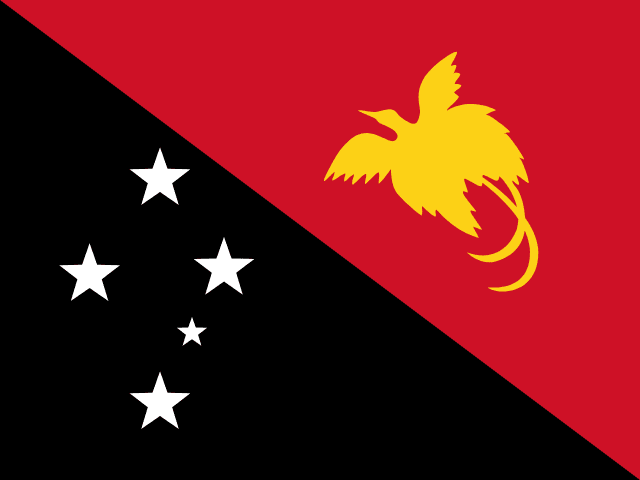
Papua New Guinea
Oceania

10,947,848
21:34 UTC+10
+675
Location
Geography
Economy
Main exports
Papua New Guinea's leading export commodities and products.
Subscribe to Live Data for live spot prices
Live commodity prices on every nation's exports — $100 AUD/year.
Tap any export to learn more. Spot prices in USD only for Live Data subscribers.
Main imports
Papua New Guinea's leading import commodities and products.
Tap any import to learn more.
Military
Historical Timeline
50000 BCE
Arrival of Papuan Ancestors
The first human inhabitants arrived on the island of New Guinea, crossing from Southeast Asia during the Pleistocene epoch. These early settlers established diverse hunter-gatherer societies across the rugged landscape.
7000 BCE
Early Agricultural Development
Indigenous inhabitants of the Highlands developed sophisticated forms of horticulture, including the cultivation of taro and bananas. This transition to agriculture supported increased population density and permanent settlements in the region.
1526
European Contact Begins
Portuguese explorer Jorge de Menezes reached the island and is credited with naming it 'Ilhas dos Papuas'. This marked the beginning of intermittent contact between the inhabitants and European maritime powers.
1884
Colonial Partition of New Guinea
Germany claimed the northeastern part of the island while Britain established a protectorate over the southeast. This effectively divided the territory under rival colonial administrations.
1914
Australian Occupation of German New Guinea
Following the outbreak of World War I, Australian forces seized the German-controlled northern territory. The area was later placed under an Australian mandate by the League of Nations.
1942
New Guinea Campaign of World War II
The island became a major theater of war between Allied and Japanese forces, resulting in widespread destruction and significant loss of life. The brutal conflict reshaped the political and social landscape of the territory.
1975
Independence from Australia
Papua New Guinea achieved full sovereignty from Australian administration on September 16, 1975. Michael Somare became the nation's first Prime Minister, leading the country into a new era of self-governance.
1988
Bougainville Civil War
An armed conflict erupted on the island of Bougainville over resource management and environmental concerns related to the Panguna mine. The decade-long insurgency caused massive displacement and a severe humanitarian crisis.
2001
Bougainville Peace Agreement
A formal peace agreement was signed between the national government and the Bougainville Revolutionary Army, ending the armed conflict. The treaty established a framework for an autonomous government and a future referendum on independence.
2011
PNG Constitutional Crisis
A major political impasse occurred when the Supreme Court ruled that the appointment of Peter O'Neill as Prime Minister was unconstitutional. This period highlighted tensions between the judiciary, the executive branch, and the legislature.
2019
Bougainville Independence Referendum
The people of Bougainville voted overwhelmingly in favor of independence from Papua New Guinea in a non-binding referendum. This marked a critical milestone in the peace process initiated decades earlier.
2022
2022 National General Election
Papua New Guinea conducted its tenth national general election since independence, resulting in the re-election of James Marape as Prime Minister. The election process was marked by significant logistical challenges and efforts to ensure regional stability.
National Holidays
A Christian holiday commemorating the crucifixion of Jesus Christ. It is a time of solemn religious observance and public reflection.
The day following Easter Sunday, which marks the resurrection of Jesus Christ. It serves as a public holiday for rest and religious celebration.
A public holiday celebrated to mark the official birthday of the reigning monarch of Papua New Guinea. It is observed with official ceremonies and community events.
Commemorates the service and sacrifice of Papua New Guineans who served in the armed forces, particularly during the Kokoda Track campaign in World War II.
Marks the anniversary of Papua New Guinea's independence from Australian administration in 1975. It is the nation's most significant patriotic celebration.
A Christian holiday celebrating the birth of Jesus Christ. It is widely observed as a day of family gathering and religious significance.
Language
Counting to 10
1
1
= 10 (n = 0)
World Dictionary
Discover and translate any word into all supported languages.
The multilingual Dictionary is a Nations Pro feature.
Upgrade to Pro