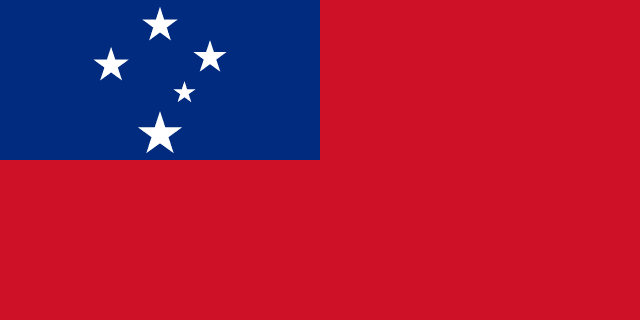

Samoa
Independent State of Samoa
Oceania
220,835
16:48 UTC+13
+685
.ws
Mount Silisili
1,858 m · 6,096 ft
Pacific Ocean
0 m · 0 ft
37,444
Apia · 2026
37,444
Apia · 2026
Location
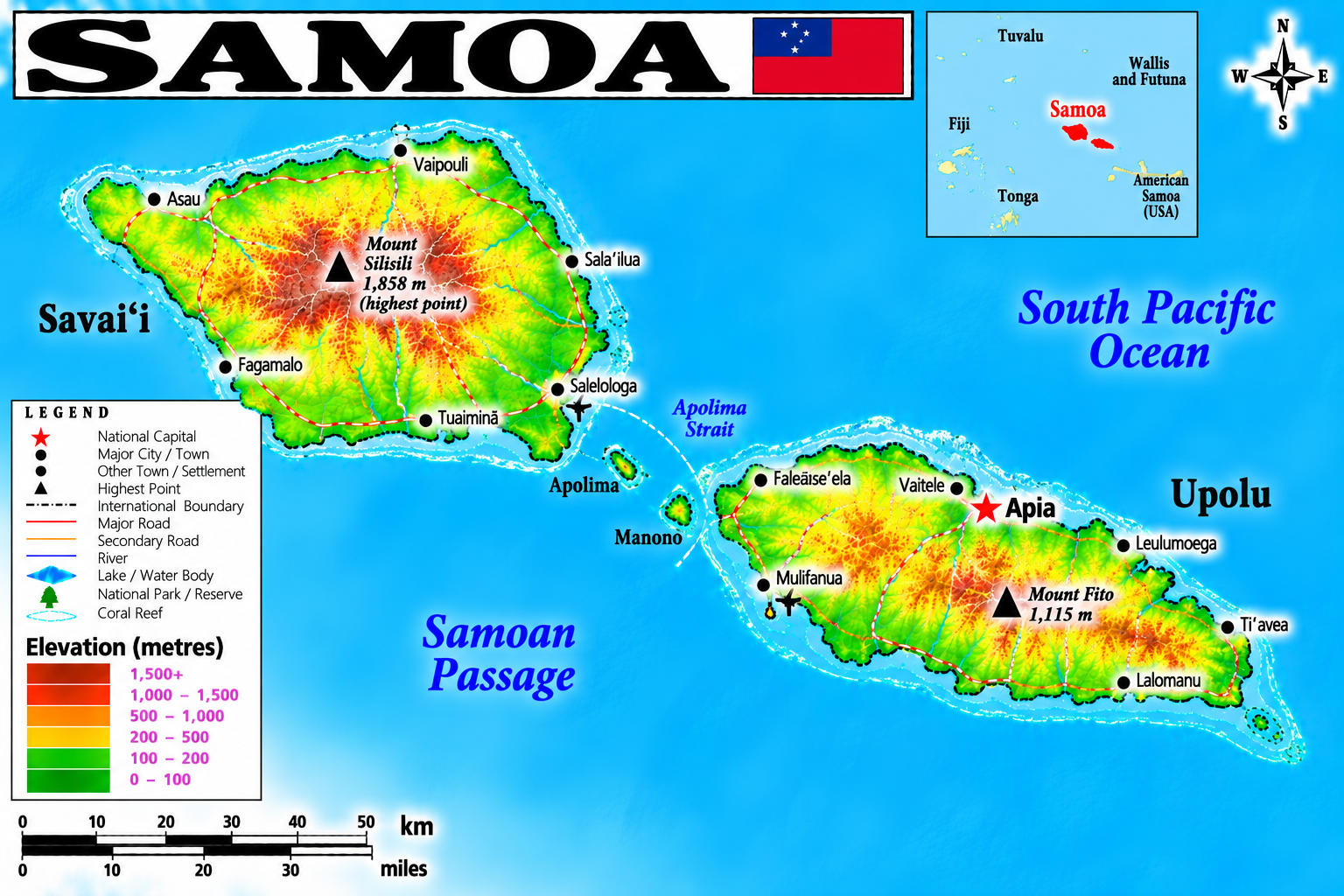
Samoa — Detailed Physical Map
Savai'i and Upolu, Mount Silisili and Mount Fito, the Apolima Strait, Apia and the Samoan Passage
Tourist Attractions

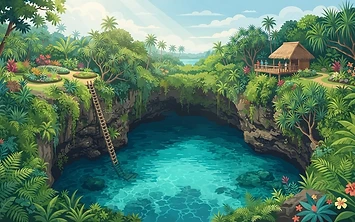
A stunning natural swimming hole formed by a collapsed lava tube, featuring crystal-clear turquoise water surrounded by lush tropical gardens.
The iconic ladder descent into the deep, emerald-colored pool is a world-famous photo opportunity.

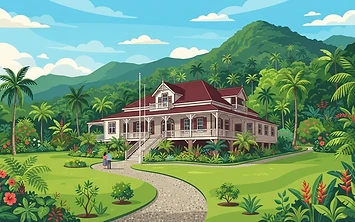
The beautifully restored former home of the famous Scottish author who spent his final years in Samoa, now serving as a museum dedicated to his life and legacy.
Visitors can tour the preserved rooms and learn about the deep connection between the author and the Samoan people.

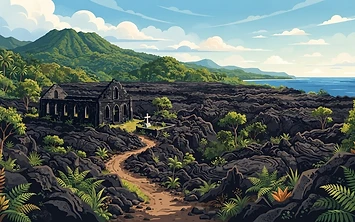
A vast, haunting landscape created by the eruption of Mt. Matavanu between 1905 and 1911, which buried several villages in volcanic rock.
You can walk among the ruins of a church and other structures that were partially swallowed by the slow-moving lava flows.

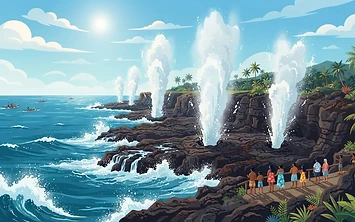
Powerful volcanic vents along the coastline that shoot seawater hundreds of feet into the air with thunderous force.
Watching the ocean spray blast skyward through the ancient lava tubes is a spectacular display of nature's raw power.

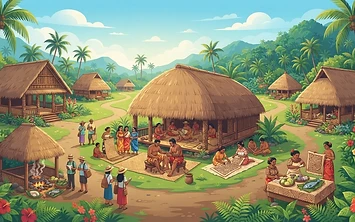
An immersive cultural center where visitors can experience the 'Fa'a Samoa' way of life through traditional crafts, tattooing, and culinary demonstrations.
It offers an authentic, hands-on introduction to the customs and daily traditions that define Samoan society.

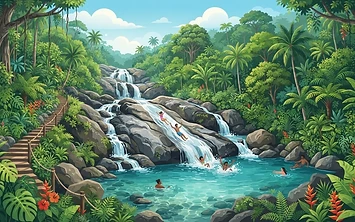
A series of natural rock slides smoothed by centuries of flowing water, nestled within a lush rainforest setting.
It serves as a natural waterpark where visitors can slide down the rocks into refreshing, cool pools below.
Geography
Nature
Mount Silisili
1,858 m / 6,096 ft
52.0% of land
≈ 1,478 km² of forest
FAO / World Bank, forest area (% of land area)
Explore the Nature Atlas—
Flows through the capital city Apia before emptying into the Pacific Ocean.
0 km²0 sq mi
A volcanic crater lake famous for its population of goldfish.
—
A scenic waterfall located in the south of Savaii island.
54 m177 ft
Located within a lush tropical garden on Upolu island.
River lengths are whole-river figures, including any section beyond Samoa. Researched reference figures. Tap any name for where its name comes from and a Google Maps link.
Major Cities
- 1Capital
Tuamasaga
36,8822026
MapServes as the capital of Samoa and acts as the primary hub for government, commerce, and international transport.
- 2
Satupa‘itea
5,5492026
MapFunctions as a prominent administrative and cultural district center on the southern coast of Savai'i island.
- 3
Tuamasaga
2,0592026
MapFunctions as a significant historical village that once served as the traditional seat of power for the Tui Atua.
- 4
Gagaifomauga
1,3092026
MapFeatures the historic Congregational Christian Church as a prominent landmark on the northern coast of Savai'i.
- 5
A‘ana
1,2202026
MapMaintains a vital cultural role as the traditional center of the A'ana district and residence of high chiefs.
- 6
Vaisigano
1,1672026
MapHosts a deep-water harbor that historically supported the island's timber industry and provides crucial maritime access.
- 7
Atua
9782026
MapStands as the historic seat of the Tui Atua and a site of immense political importance in Samoan tradition.
- 8
Palauli
8082026
MapContains the significant ancient Pulemelei Mound, the largest and most mysterious prehistoric structure in Polynesia.
- 9
Gaga‘emauga
6182026
MapPreserves the remnants of the Virgin's Grave and buried churches left behind by the 1905 Mount Matavanu volcanic eruption.
- 10
Va‘a-o-Fonoti
462026
MapProvides a scenic coastal setting in the Va'a-o-Fonoti district known for its traditional village lifestyle.
- 11
Aiga-i-le-Tai
—2026
MapOperates the primary ferry terminal connecting the islands of Upolu and Savai'i through regular inter-island service.
- 12
Fa‘asaleleaga
—2026
MapServed as a key political center for the Fa'asaleleaga district and is noted for its role in local leadership.
City populations are the latest official, UN or national-statistics estimates (2021–2026) compounded to 2026 at 0.5% a year (the nation's annual population growth rate); figures without a published update come from the open cities database (2020-era estimates) and are projected the same way.
Economy
Main exports
Samoa's leading export commodities and products.
Tap any export to learn more. Spot prices in USD only for Live Data subscribers.
Main imports
Samoa's leading import commodities and products.
Tap any import to learn more.
Military
Historical Timeline
1000 BCE
Arrival of the Lapita People
Austronesian-speaking ancestors of the Samoan people, known as the Lapita, arrived in the islands around 1000 BCE. This settlement marked the beginning of the distinctive Polynesian culture that developed across the archipelago.
1722
First European Contact
Dutch explorer Jacob Roggeveen became the first European to sight the islands of Samoa. This initial encounter initiated sporadic contact between Samoans and Western explorers and traders.
1830
Arrival of John Williams
The London Missionary Society arrived in Samoa, leading to the rapid conversion of the population to Christianity. This event fundamentally altered Samoan social structures and introduced literacy to the islands.
1889
The Berlin Act
Following the Second Samoan Civil War, the Berlin Act was signed by Germany, the United States, and the United Kingdom. This treaty established a tri-partite protectorate over the islands.
1899
Tripartite Convention
The Samoa Tripartite Convention partitioned the islands between Germany and the United States. Germany took control of the western islands, while the United States claimed the eastern portion.
1914
New Zealand Occupation
At the outbreak of World War I, New Zealand forces captured Western Samoa from Germany. This occupation transitioned the administration of the islands to New Zealand control.
1962
Independence of Western Samoa
Western Samoa became the first Pacific nation to regain its independence from colonial rule. The country adopted a constitutional monarchy based on traditional Samoan systems.
1997
Change of Country Name
The nation officially changed its name from Western Samoa to the Independent State of Samoa. This move signified a desire to reflect the unity and sovereignty of all Samoan islands.
2009
Switching to Driving on the Left
Samoa officially changed its traffic side from the right to the left to align with regional neighbors like Australia and New Zealand. The transition was a major infrastructure and cultural adjustment for the nation.
2021
Election of First Female Prime Minister
Fiame Naomi Mataʻafa became the first woman to be elected Prime Minister of Samoa. Her victory marked a historic milestone for gender representation in Pacific island politics.
2024
Hosting the Commonwealth Heads of Government Meeting
Samoa hosted the 2024 Commonwealth Heads of Government Meeting, the first time a Small Island Developing State in the Pacific held the summit. The event focused on climate change and sustainable development.
2025
National Climate Resiliency Initiative Expansion
The government launched an expanded national infrastructure plan to address rising sea levels and coastal erosion. This initiative represents a critical state effort to mitigate the ongoing impacts of global climate change.
National Anthem
O S V o le Sa'olotoga o Samoa
Sauni Iiga Kuresa
Sauni Iiga Kuresa
1962
Samoa tula'i ma sisi ia lau fu'a, le fu'a o le sa'olotoga. Ia e sapaia lou pale, Samoa, la'u penina o le Pasefika. Samoa tula'i ma sisi ia lau fu'a, le fu'a o le sa'olotoga.
The national anthem of Samoa was written and composed by Sauni Iiga Kuresa, a prominent Samoan musician and educator. It was officially adopted in 1962, coinciding with Samoa's independence from New Zealand. The anthem is designed to instill a sense of national identity and pride among the Samoan people following their transition to a sovereign state. Its lyrics invoke imagery of the country as the 'pearl of the Pacific' and encourage citizens to uphold the nation's honor. The composition remains the primary symbol of national unity and is performed at all major state and public functions. It replaced the previous anthem used during the period of administration by New Zealand. The anthem has not undergone any official changes to its lyrics since its adoption.
National Holidays
This holiday marks the beginning of the new calendar year according to the Gregorian calendar.
This day commemorates the crucifixion of Jesus Christ and his death at Calvary.
Observed the day after Easter Sunday, this holiday commemorates the resurrection of Jesus Christ.
This holiday commemorates Samoa's independence from New Zealand, which was formally achieved in 1962.
This is a major religious holiday celebrating the birth of Jesus Christ.
Traditionally a day for charitable giving, it is observed as a public holiday following Christmas.
Good News Today
Samoa Victim Support Group honoured with prestigious UNESCO award
The Samoa Victim Support Group has been recognized with a prestigious award from UNESCO for its dedicated work in the community. This honor highlights the organization's significant contributions to supporting vulnerable individuals and families across the nation.
Fun Facts
Skipped a Full Calendar Day
In 2011, Samoa shifted from the east to the west side of the International Date Line, meaning they completely bypassed December 30th.
Home of Robert Louis Stevenson
The famous author of Treasure Island spent his final years in Samoa, where locals affectionately nicknamed him 'Tusitala' or teller of tales.
Traditional Open Air Fale Architecture
Traditional Samoan houses called fales are built without walls, emphasizing community transparency and natural ventilation.
To Sua Ocean Trench
This spectacular natural swimming pool is a 30-meter deep lava sinkhole surrounded by lush gardens and connected to the ocean.
Fa'a Samoa Cultural Integrity
Fa'a Samoa, or the 'Samoan Way,' is an ancient social code that dictates daily life and preserves traditional hierarchy and values.
Global Rugby Talent Factory
Despite a small population, Samoa produces an incredibly high number of world-class professional rugby and American football players.
Traditional Tatau Ink Artistry
The term tattoo actually originates from the Samoan word 'tatau,' and the intricate patterns hold significant genealogical and cultural meaning.
National Dish Oka I'a
The national dish, Oka I'a, is a refreshing blend of raw fish marinated in citrus juice and creamy coconut milk.
First to See the Sun
Since the 2011 date line change, Samoa is now one of the first countries in the world to welcome each new day.
Legendary Physical Strength Traditions
Samoan culture places immense value on physical strength and resilience, which is deeply celebrated in local sporting and dance rituals.
Chuckies Trivia Quiz
Chuckies Trivia Quiz
Fifteen questions on Samoa — five easy, five medium, five hard. How far can you get?
Sports & Live Events
Language
Counting to 10
1
1
= 10 (n = 0)
World Dictionary
Discover and translate any word into all supported languages.