

Tonga
Kingdom of Tonga
Oceania
103,291
00:28 UTC+13
+676
.to
Location
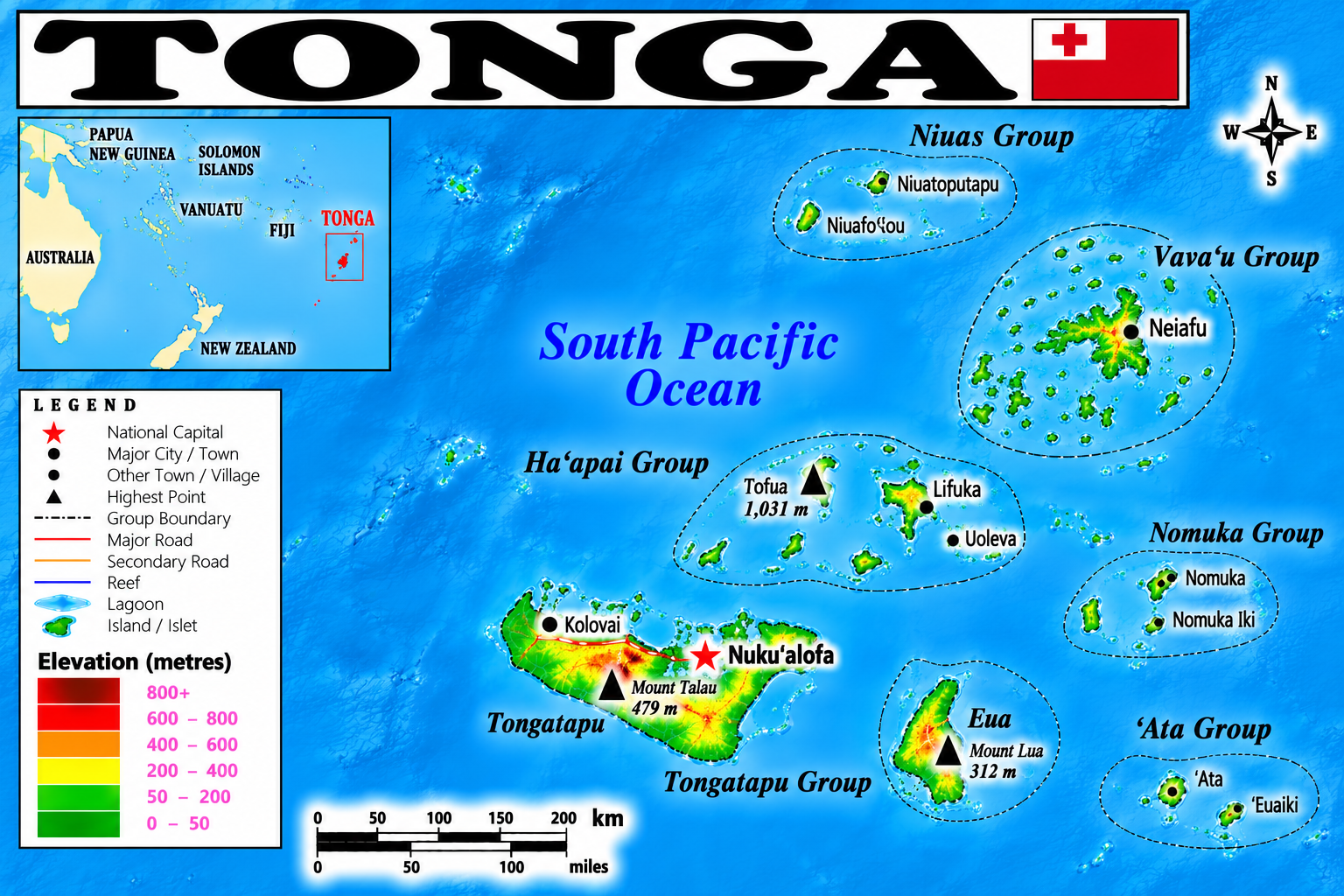
Tonga — Detailed Physical Map
Tongatapu and 'Eua, the Ha'apai and Vava'u groups, Tofua volcano, Niuatoputapa, reef outlines and the capital Nuku'alofa
Tourist Attractions


Built in 1865–67, this iconic white wooden palace serves as the official residence of the Tongan royal family. It is a prominent feature on the Nuku'alofa seafront.
It is the most recognizable symbol of the South Pacific's only remaining monarchy.

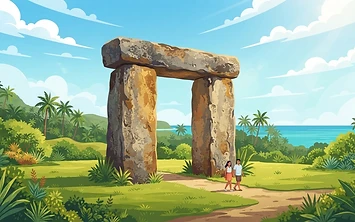
This monumental 13th-century trilithon consists of three massive coral limestone stones. It is often referred to as the Stonehenge of the Pacific.
It is a remarkable feat of ancient engineering and a significant archaeological site.


These natural blowholes stretch along the coastline where ocean swells are forced through rock shelves. They can send water spraying up to 18 meters into the air.
The raw power of the ocean creating a whistling roar is a spectacular natural display.


A stunning sea cave carved into the depths of Kapa Island, accessible only by boat or kayak. It is a popular spot for snorkelling and scuba diving in clear waters.
The interior of the cave offers a breathtaking experience with light filtering through the entrance.

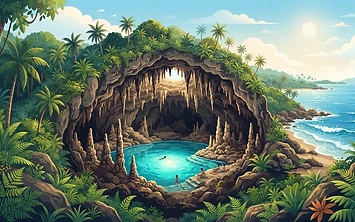
An impressive limestone cave system featuring stalactites and stalagmites. It contains a unique, natural freshwater swimming pool inside the cavern.
Swimming in the cool, clear underground pool is a unique and refreshing experience.

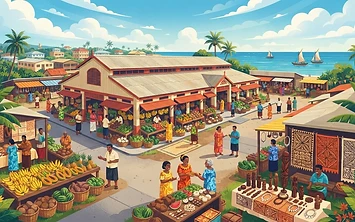
The central hub for local commerce, this market offers a vibrant look at Tongan life. Visitors can find fresh produce, traditional handicrafts, and local snacks.
It is the best place to experience authentic local culture and purchase handmade Tongan souvenirs.
Geography
Nature
Unnamed point on Kao
1,033 m / 3,389 ft
12.0% of land
≈ 90 km² of forest
FAO / World Bank, forest area (% of land area)
Explore the Nature Atlas19 km²7 sq mi
Located within the volcanic crater on the island of Niuafoou.
River lengths are whole-river figures, including any section beyond Tonga. Researched reference figures. Tap any name for where its name comes from and a Google Maps link.
Major Cities
- 1Capital
Tongatapu
Serves as the constitutional monarchy's capital and largest city, housing the historic Royal Palace near the waterfront.
33,1312026
Map - 2
Vava‘u
Functions as the administrative center of the Vava`u island group and a popular destination for yachting and whale watching.
5,4412026
Map
City populations are the latest official, UN or national-statistics estimates (2026–2026) compounded to 2026 at -0.43% a year (the nation's annual population growth rate); figures without a published update come from the open cities database (2020-era estimates) and are projected the same way.
Economy
Main exports
Tonga's leading export commodities and products.
Tap any export to learn more. Spot prices in USD only for Live Data subscribers.
Main imports
Tonga's leading import commodities and products.
Tap any import to learn more.
Military
Historical Timeline
900 BCE
Lapita Settlement of Tonga
Austronesian-speaking settlers associated with the Lapita culture arrived in the Tongan archipelago. This marked the beginning of human habitation in the islands.
950
Establishment of the Tu'i Tonga Empire
The Tu'i Tonga dynasty was founded by 'Aho'eitu, establishing a centralized monarchy that eventually expanded its influence across much of Western Polynesia. This empire dominated maritime trade and political power in the region for centuries.
1616
First European Contact
Dutch explorers Willem Schouten and Jacob Le Maire became the first Europeans to sight the Tongan islands, specifically Niuatoputapu. Their arrival initiated contact with the outside world.
1773
Captain James Cook Visits Tonga
British explorer James Cook made his first of three visits to the archipelago, famously naming them the Friendly Islands. His documentation provided Europe with its first detailed accounts of Tongan society.
1845
Unification of Tonga
Taufa'ahau Tupou I unified the Tongan islands under his rule following a period of civil war. He subsequently established the modern constitutional monarchy.
1875
Adoption of the Constitution
King George Tupou I promulgated a formal constitution that defined the structure of the government and granted rights to the Tongan people. This document ensured Tonga maintained its sovereignty during the colonial era.
1900
Establishment of British Protectorate
Tonga signed a Treaty of Friendship with Great Britain, becoming a protected state. While the UK managed foreign affairs, Tonga retained its internal autonomy.
1970
Restoration of Full Independence
Tonga officially regained full control over its foreign policy and exited the British protectorate status. The nation subsequently joined the Commonwealth of Nations.
1999
Admission to the United Nations
Tonga formally joined the United Nations, signaling its active participation in the global diplomatic community. This move strengthened its international recognition and sovereignty.
2010
First Democratic General Election
Tonga held its first democratic election under reforms that shifted power from the monarchy to a parliament elected by the people. This transformation marked a historic move toward a more representative government.
2022
Hunga Tonga-Hunga Ha'apai Eruption
A massive volcanic eruption and subsequent tsunami caused widespread destruction across the archipelago. The event triggered a significant international humanitarian response and long-term recovery efforts.
2024
Hosting the Pacific Islands Forum
Tonga hosted the 53rd Pacific Islands Forum, focusing on regional climate security and economic resilience. The event highlighted Tonga's leadership in addressing challenges facing Pacific nations.
2025
Appointment of 19th Prime Minister
On January 22, 2025, His Majesty King Tupou VI appointed Dr. ‘Aisake Valu Eke as the 19th Prime Minister of the Kingdom of Tonga.
2025
Tonga holds fifth general election
The people of Tonga participated in the country's fifth general election on November 20, 2025.
2026
Accession to nuclear disarmament treaties
On July 7, 2026, Tonga formalized its accession to the Treaty on the Prohibition of Nuclear Weapons and ratified the Comprehensive Nuclear-Test-Ban Treaty.
National Anthem
Ko e fasi 'o e tu'i 'o e 'Otu Tonga
Prince Uelingatoni Ngū Tupoumalohi
Karl Gustavus Schmitt
1874
'E 'Otua mafimafi Ko homau 'Eiki koe Ko koe ko e falala'anga Mo e 'ofa ki Tonga 'Afio hifo 'emau lotu 'A ia 'oku mau faí ni Oi 'Otua ke ke tali 'Emau hūhū kiate koe
The national anthem of Tonga was written by Prince Uelingatoni Ngū Tupoumalohi, the son of King George Tupou I. It was composed by Karl Gustavus Schmitt, a German-born musician who served as the bandmaster for the Tongan Royal Band. The anthem was officially adopted in 1874, coinciding with the establishment of the modern Tongan constitution. The lyrics reflect strong Christian values, which are deeply embedded in Tongan national identity and culture. Unlike many anthems that focus on national military glory, this composition functions as a solemn prayer for divine protection and guidance. The song remains a central part of Tongan national ceremonies and is performed with great reverence at official state functions.
National Holidays
A public holiday marking the first day of the Gregorian calendar year.
A national day of remembrance for those who served and died in all wars, conflicts, and peacekeeping operations.
Commemorates the abolition of serfdom in Tonga by King George Tupou I in 1862.
A public holiday celebrated to honor the official birthday of the reigning monarch of Tonga.
Commemorates the signing of the Tongan Constitution in 1875 by King George Tupou I.
A public holiday celebrating the birth of Jesus Christ, widely observed throughout the Christian nation of Tonga.
Good News Today
Tonga advocates for climate-resilient education at COP31
Tonga is pushing for global climate finance to prioritize the construction of climate-resilient schools and the integration of climate literacy into education systems. This initiative aims to protect children's wellbeing and ensure educational continuity in the face of climate-related hazards.
Fun Facts
Kingdom of the Pacific
Tonga is the only Pacific island nation that never fully lost its indigenous governance and remains the last monarchy in the region.
First to See Sunrise
Due to its location just west of the International Date Line, the Tongan island of Niue is among the first places on Earth to welcome the new day.
Pigs Are Sacred Property
In Tongan culture, pigs are considered a symbol of wealth and are often given as significant gifts during weddings and funerals.
Mapu 'a Vaea Blowholes
These spectacular natural rock formations shoot plumes of seawater up to 30 meters high along the southern coastline of Tongatapu.
Humpback Whale Breeding Ground
Tonga is one of the few places in the world where you can legally swim with humpback whales in their natural mating waters.
Tongan Nose Flute
The fangufangu is a traditional nose-blown flute once used by nobility to produce soft, melodic sounds during quiet social gatherings.
National Beverage Kava
Kava is a traditional peppery drink made from the roots of the kava plant, served during formal ceremonies to build community ties.
Lakaanga Traditional Dance
The Lakaanga is a graceful, slow-moving traditional dance involving coordinated hand gestures that tell complex stories of Tongan heritage.
'Ata Island History
The remote island of 'Ata is famous for the 1965 Tongan castaway story, where six students survived for over a year using ingenuity.
Rugby Union National Passion
Rugby is more than a sport in Tonga; it is a national obsession, with the national team known as the Ikale Tahi.
Chuckies Trivia Quiz
Chuckies Trivia Quiz
Fifteen questions on Tonga — five easy, five medium, five hard. How far can you get?
Sports & Live Events
Language
Counting to 10
1
1
= 10 (n = 0)
World Dictionary
Discover and translate any word into all supported languages.