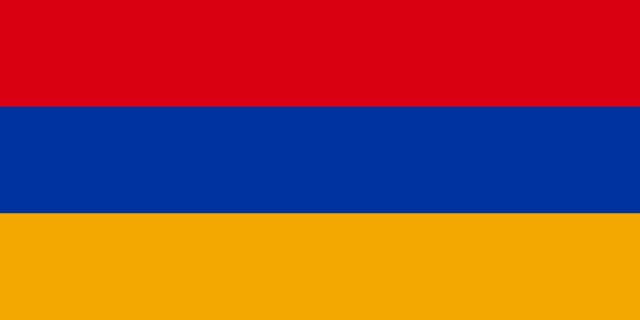
Armenia
Asia

3,090,000
15:34 UTC+4
+374
Location
Geography
Economy
Main exports
Armenia's leading export commodities and products.
Subscribe to Live Data for live spot prices
Live commodity prices on every nation's exports — $100 AUD/year.
Tap any export to learn more. Spot prices in USD only for Live Data subscribers.
Main imports
Armenia's leading import commodities and products.
Tap any import to learn more.
Military
Historical Timeline
8000 BCE
Early Neolithic Armenian Highlands Settlement
Archaeological evidence confirms that the Armenian Highlands were inhabited by early Neolithic groups who transitioned to agriculture and animal husbandry. These indigenous populations established some of the earliest sedentary communities in the region.
782 BCE
Founding of Erebuni-Yerevan
King Argishti I of Urartu founded the fortress of Erebuni, which served as a major administrative and military center. This site forms the foundational historical basis for the modern capital city of Yerevan.
190 BCE
Establishment of the Artaxiad Dynasty
Artashes I declared the independence of the Kingdom of Armenia from the Seleucid Empire. This period marked the consolidation of the Armenian state and the expansion of its territory under Tigranes the Great.
301
Adoption of Christianity as State Religion
Under the influence of Gregory the Illuminator, King Tiridates III proclaimed Christianity the official religion of Armenia. This made Armenia the first nation in the world to adopt Christianity as its state faith.
405
Creation of the Armenian Alphabet
Mesrop Mashtots invented the Armenian alphabet to facilitate the translation of the Bible and promote literacy. This development was crucial for the preservation of Armenian cultural and religious identity.
885
Establishment of the Bagratid Kingdom
Ashot I was recognized as the King of Armenia by the Abbasid Caliphate and the Byzantine Empire, restoring Armenian sovereign statehood. This era saw a significant cultural and architectural revival known as the Armenian Golden Age.
1080
Formation of the Armenian Kingdom of Cilicia
Following the fall of the Bagratid Kingdom, Armenians established a new state in the region of Cilicia near the Mediterranean coast. This kingdom played a significant role in Mediterranean politics and trade during the Crusades.
1915
The Armenian Genocide
During World War I, the Ottoman government systematically orchestrated the mass deportation and killing of the Armenian population within its territory. The event resulted in the loss of an estimated 1.5 million lives and remains a foundational trauma in national history.
1918
Declaration of the First Republic
Following the collapse of the Russian Empire, the Republic of Armenia declared its independence on May 28. This marked the re-emergence of an independent Armenian state after centuries of foreign rule.
1991
Restoration of Independence from the Soviet Union
Armenia held a national referendum and officially declared its independence from the disintegrating Soviet Union. This transition marked the beginning of a modern parliamentary democracy.
2018
The Velvet Revolution
A series of peaceful anti-government protests led by Nikol Pashinyan resulted in the resignation of Prime Minister Serzh Sargsyan. The movement was characterized by its non-violent approach and demands for democratic reform.
2023
Exodus of Artsakh Armenians
Following a large-scale military offensive by Azerbaijan in Nagorno-Karabakh, almost the entire Armenian population of the region fled to Armenia. This event significantly altered the demographics and political landscape of the South Caucasus.
National Holidays
This period marks the transition to the new calendar year and the celebration of the Armenian Apostolic Christmas.
This day commemorates the establishment of the Armenian Armed Forces in 1992 following the country's independence.
This is a national day of mourning that commemorates the victims of the Armenian Genocide of 1915.
This holiday marks the victory of the Allied forces in World War II and the liberation of Shushi during the First Nagorno-Karabakh War.
This day celebrates the 1991 national referendum where Armenia officially voted to secede from the Soviet Union.
Language
Counting to 10
1
1
= 10 (n = 0)
World Dictionary
Discover and translate any word into all supported languages.
The multilingual Dictionary is a Nations Pro feature.
Upgrade to Pro