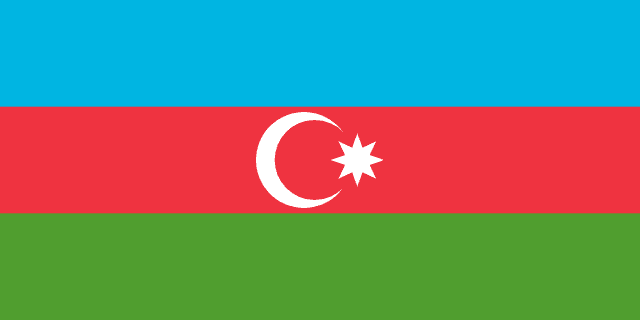

Azerbaijan
Republic of Azerbaijan
Asia
10,272,363
02:29 UTC+4
+994
.az
Bazarduzu Dagi
4,466 m · 14,652 ft
Caspian Sea
-28 m · -92 ft
2,366,030
Baku · 2026
2,366,030
Baku · 2026
Location
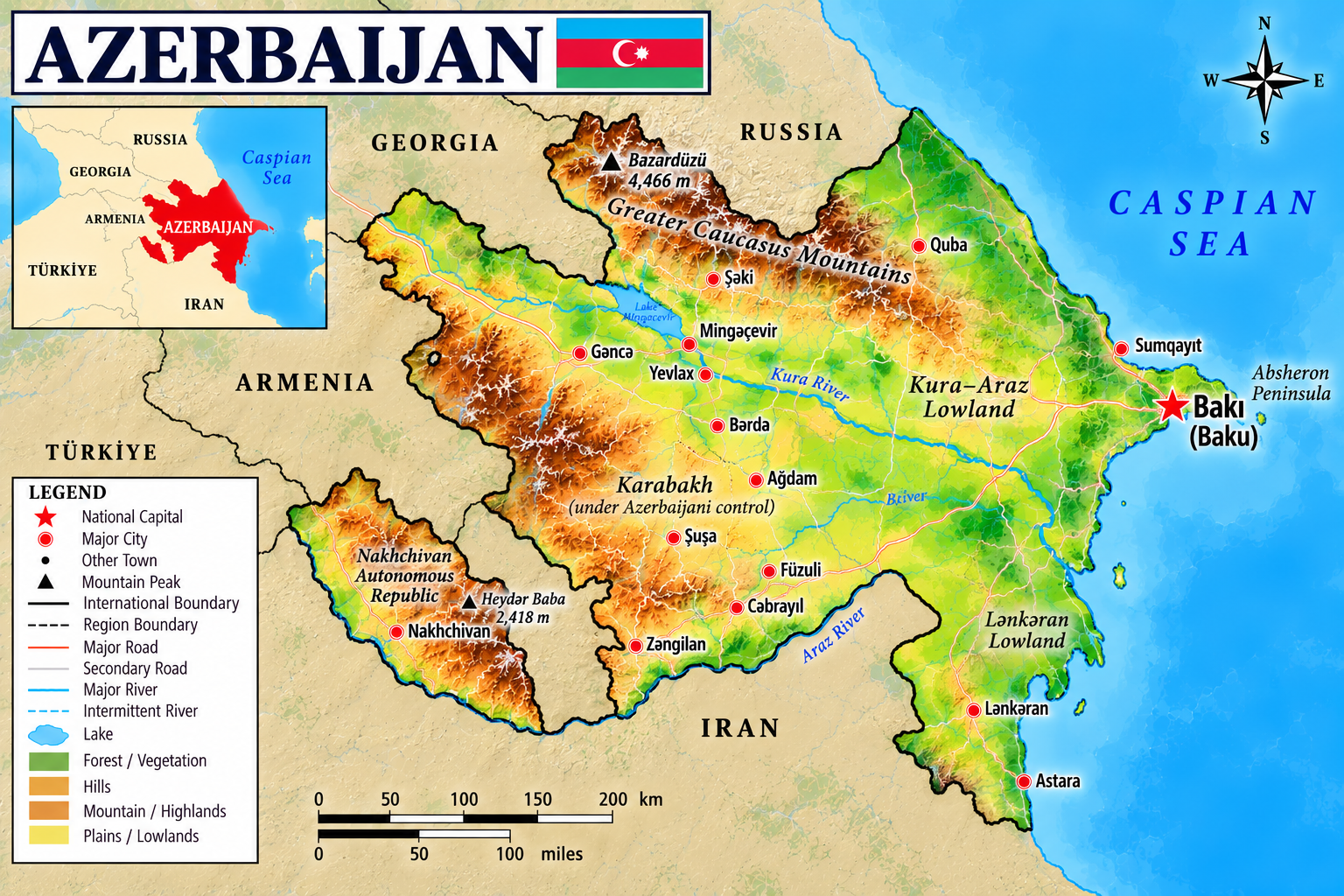
Azerbaijan — Detailed Physical Map
Caucasus terrain, Caspian coast, rivers, district boundaries, capitals and major towns
Tourist Attractions
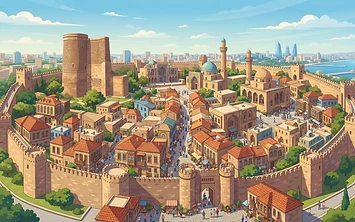
A UNESCO World Heritage site, this ancient walled core of the capital features a maze of narrow cobblestone streets, historic mosques, and traditional architecture.
It offers an immersive journey through centuries of history within the heart of a modern metropolis.
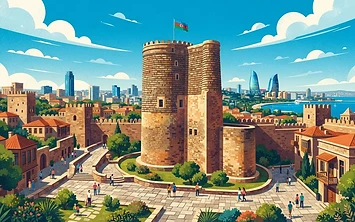
This iconic, mysterious stone tower is one of Azerbaijan's most recognizable symbols, dating back to the medieval period.
Climb to the top for a panoramic view of the Old City rooftops and the Caspian Sea.

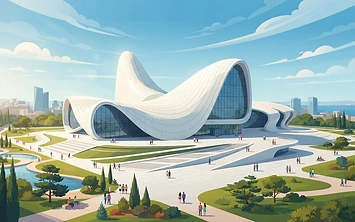
Designed by renowned architect Zaha Hadid, this building is famous for its distinctive, flowing, curved architecture that defies traditional geometric forms.
It is a masterpiece of modern architecture that serves as a premier cultural hub.

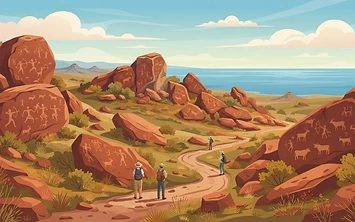
This UNESCO-listed site preserves thousands of ancient petroglyphs that depict prehistoric life, hunting scenes, and ritual dances.
It provides a rare and fascinating glimpse into human history dating back thousands of years.

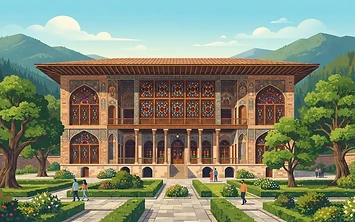
An 18th-century royal residence known for its exquisite craftsmanship, particularly its intricate stained-glass windows known as shebeke.
The stunning, colorful light patterns created by the stained glass are a visual marvel.

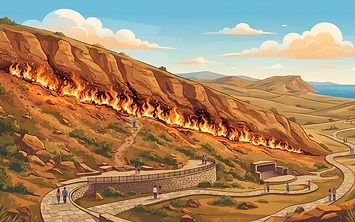
Known as the 'Burning Mountain,' this natural wonder features a hillside that has been continuously ablaze for years due to underground natural gas leaks.
Witnessing the eternal flames dancing on the hillside is a unique and surreal natural phenomenon.
Geography
Nature
Bazarduzu Dagi
4,466 m / 14,652 ft
14.2% of land
≈ 12,297 km² of forest
FAO / World Bank, forest area (% of land area)
Explore the Nature Atlas1,515 km941 mi
Rises in Turkey and flows into the Caspian Sea.
1,072 km666 mi
Forms a significant portion of the border between Azerbaijan and Iran.
216 km134 mi
Serves as part of the natural border between Azerbaijan and Russia.
371,000 km²143,244 sq mi · 1,025 m deep
World's largest inland body of water by surface area.
1 km²0 sq mi · 96 m deep
Formed as a result of a massive earthquake in the twelfth century.
66 km²25 sq mi · 6 m deep
Covers the largest surface area among freshwater lakes in the country.
75 m246 ft
Located on the Velvely River in the Quba District.
53 m174 ft
Comprised of seven different tiers of cascading water near Qabala.
River lengths are whole-river figures, including any section beyond Azerbaijan. Researched reference figures. Tap any name for where its name comes from and a Google Maps link.
Major Cities
- 1Capital
Bakı
2,389,2272026
MapServes as the capital and largest city of Azerbaijan, famous for its historic Old City and modern Flame Towers.
- 2
Sumqayıt
447,4312026
MapFunctions as a major industrial center located on the Caspian Sea coast, known primarily for its petrochemical production.
- 3
Gəncə
330,7352026
MapStands as the second-largest city in the country, renowned for its rich history and the mausoleum of Nizami Ganjavi.
- 4
Abşeron
196,2002026
MapActs as an important residential suburb located just northwest of the capital city of Baku.
- 5
Şəki
186,0512026
MapFeatures the historic Palace of the Shaki Khans and stands as a renowned center for traditional silk production.
- 6
Naxçıvan
162,2102026
MapServes as the capital of the Naxcivan Autonomous Republic, noted for its significant salt mines and ancient monuments.
- 7
Ağcabədi
138,4092026
MapOperates as a significant agricultural hub within the country, historically celebrated for its traditional Karabakh horse breeding.
- 8
Mingəçevir
136,3482026
MapContains the nation's largest hydroelectric power station and is frequently referred to as the city of lights.
- 9
Şirvan
101,5292026
MapMaintains a regional economy centered on the oil and gas industry along the Kura River.
- 10
Bakı
86,8322026
MapFunctions as a densely populated municipality situated within the administrative boundaries of the Suraxani district.
- 11
Bakı
85,9222026
MapHosts a major wastewater treatment facility and serves as an important coastal residential settlement near the capital.
- 12
Bakı
72,3772026
MapComprises a large urban settlement serving as a key residential and industrial suburb within the Sabuncu district.
City populations are the latest official, UN or national-statistics estimates (2025–2026) compounded to 2026 at 0.18% a year (the nation's annual population growth rate); figures without a published update come from the open cities database (2020-era estimates) and are projected the same way.
Economy
Main exports
Azerbaijan's leading export commodities and products.
Tap any export to learn more. Spot prices in USD only for Live Data subscribers.
Main imports
Azerbaijan's leading import commodities and products.
Tap any import to learn more.
Military
Historical Timeline
15000 BCE
Early Paleolithic habitation of Azykh Cave
The discovery of Azykh Cave in the Fuzuli district provides evidence of one of the earliest human settlements in the region. Archaeological findings date back to the Paleolithic era, marking the arrival of early prehistoric populations.
600 BCE
Formation of the Kingdom of Mannae
The Kingdom of Mannae emerged as a significant regional power, fostering a distinct civilization in the southern part of modern Azerbaijan. It played a crucial role in the political landscape of the ancient Near East.
323 BCE
Establishment of Caucasian Albania
Following the collapse of the Achaemenid Empire, the Kingdom of Caucasian Albania was established in the region. It served as an influential state that maintained its own culture and script for several centuries.
642
Arrival of Islam in Azerbaijan
The Arab conquest introduced Islam to the region, fundamentally transforming the local religious, cultural, and social structures. This shift laid the foundation for the eventual formation of a predominantly Muslim society.
1501
Founding of the Safavid Empire
Shah Ismail I founded the Safavid Empire, establishing a centralized state that promoted Azerbaijani language and culture. This period is regarded as a zenith in the historical development of the region.
1828
Treaty of Turkmenchay
The treaty concluded the Russo-Persian War and divided the Azerbaijani territories between the Russian and Persian empires. This event initiated a long period of Russian influence and subsequent colonial administration.
1918
Proclamation of the Azerbaijan Democratic Republic
The Azerbaijan Democratic Republic was declared as the first secular, democratic parliamentary republic in the Muslim world. It secured brief but significant independence before being incorporated into the Soviet Union.
1920
Establishment of the Azerbaijan Soviet Socialist Republic
The Red Army entered Baku in 1920, leading to the incorporation of Azerbaijan into the Soviet Union. For the next seven decades, the republic functioned as a constituent entity of the USSR.
1991
Restoration of Independence
Azerbaijan declared its independence from the collapsing Soviet Union following the adoption of the Constitutional Act. This marked the beginning of a new era of statehood and international sovereignty.
1994
Contract of the Century
The Azerbaijani government signed a massive production-sharing agreement with international oil companies to develop Caspian Sea reserves. This deal became the cornerstone of the nation's modern economic transformation and energy policy.
2020
The Second Nagorno-Karabakh War
A 44-day armed conflict between Azerbaijan and Armenia resulted in the restoration of control over large parts of the disputed Nagorno-Karabakh region. The war significantly reshaped the geopolitical landscape of the South Caucasus.
2023
Restoration of Sovereignty over Nagorno-Karabakh
Following a one-day military operation in September, Azerbaijan fully restored its administrative and legal control over the Nagorno-Karabakh region. This event marked the end of the long-standing separatist administration in the area.
2024
Azerbaijan holds snap presidential election
On February 7, 2024, Azerbaijan held a snap presidential election in which incumbent Ilham Aliyev secured a fifth term. For the first time in the country's post-Soviet history, voting took place across the entire internationally recognized territory, including the Karabakh region.
2024
Azerbaijan holds snap parliamentary elections
On September 1, 2024, Azerbaijan conducted early parliamentary elections, resulting in the New Azerbaijan Party retaining its majority in the National Assembly. The election was moved forward from its original November date to avoid coinciding with the COP29 summit.
2024
Azerbaijan hosts COP29 climate summit
From November 11 to 22, 2024, Azerbaijan hosted the 29th United Nations Climate Change Conference (COP29) in Baku. The event marked a milestone for the country as it implemented sustainable management practices, achieving ISO 20121:2024 certification.
2025
Approval of National Artificial Intelligence Strategy
President Ilham Aliyev signed a decree approving the Artificial Intelligence Strategy of the Republic of Azerbaijan for 2025-2028 to accelerate technological development. The strategy aims to enhance research, infrastructure, and the pool of qualified personnel in the field of AI.
2025
Opening of Azerbaijan Pavilion at Osaka Expo
Azerbaijan officially opened its national pavilion at the Expo 2025 Osaka in Japan. The pavilion, organized by the Heydar Aliyev Center, showcased the nation's cultural heritage and commitment to sustainable development.
2026
Inauguration of Gobustan Solar Power Plant
President Ilham Aliyev inaugurated the 100-megawatt Gobustan solar power plant on September 16, 2026. This project represents a significant expansion of Azerbaijan's renewable energy sector and its national energy strategy.
National Anthem
Azərbaycan marşı
Ahmed Javad
Uzeyir Hajibeyov
1992
Azərbaycan! Azərbaycan! Ey qəhrəman övladın şanlı Vətəni! Sənçün hər kəs fəda olmağa hazırdır, Sənçün hər kəs qanını tökməyə qadirdir! Minlərlə can qurban olmuş, Sinən hərbə meydan olmuş! Hüququndan keçən əsgər, Hərə bir qəhrəman olmuş! Sən olasan gülüstan, Sənə hər an can qurban! Sənə min bir məhəbbət sinəmdə tutmuşam mən! Azərbaycan! Azərbaycan!
The March of Azerbaijan was composed by Uzeyir Hajibeyov in 1919 during the short-lived Azerbaijan Democratic Republic. The lyrics were penned by the poet Ahmed Javad to inspire national pride and independence. After the Soviet Union occupied Azerbaijan, the song was banned and replaced by the anthem of the Azerbaijan SSR. Following the restoration of independence in 1991, the Azerbaijani parliament officially reinstated the original composition as the national anthem on May 27, 1992. It remains a central symbol of Azerbaijani sovereignty and national identity. The anthem is played at all major state, diplomatic, and sporting events involving the country.
National Holidays
These days mark the beginning of the new calendar year and are celebrated nationwide with public events and family gatherings.
This ancient festival marks the arrival of spring and the vernal equinox, celebrating nature's awakening and renewal.
This day commemorates the victory of the Azerbaijani Armed Forces in the 2020 Nagorno-Karabakh war and the restoration of the country's territorial integrity.
This holiday marks the beginning of the national democratic movement in 1988, which eventually led to Azerbaijan's independence from the Soviet Union.
This day is dedicated to fostering unity among Azerbaijanis living both within the country and in the global diaspora.
Good News Today
Azerbaijan to increase social benefits in 2027
The Azerbaijani government has allocated 281 million AZN for 2027 to finance increased social benefits for citizens. This funding will support payments for temporary incapacity for work, maternity, and childcare.
Fun Facts
Land of Eternal Fires
The Yanar Dag fire burns continuously on a hillside because of natural gas seeping from the earth, fueling ancient fire-worshiping traditions.
World’s Highest Mud Volcano Count
Azerbaijan is home to nearly half of all the world's mud volcanoes, which produce cold, bubbling volcanic mud rather than molten lava.
Traditional Tea Hospitality Rituals
In Azerbaijani culture, it is customary to serve tea in armudu glasses, shaped like a pear, before any food is served to guests.
First Industrial Oil Extraction
The world's first oil well was drilled mechanically in the Absheron Peninsula in 1846, long before the global oil industry took off.
Mastery of Intricate Carpet Weaving
Azerbaijani carpet weaving is a centuries-old art form where each region possesses unique patterns and traditional symbols recognized by UNESCO.
Tandir Oven Bread Traditions
Bread is considered sacred in Azerbaijan; it is traditionally baked in a cylindrical clay oven called a tandir, giving it a smoky flavor.
Maiden Tower’s Mysterious History
The Maiden Tower in Baku is an ancient stone fortress whose exact original purpose remains a mystery to historians and archaeologists.
Unique Petroleum Health Spa
In the city of Naftalan, visitors can soak in therapeutic crude oil baths that are said to help treat various skin and joint conditions.
Global Chess Powerhouse Nation
Azerbaijan is widely regarded as a world-class chess nation, consistently producing grandmasters and prioritizing chess education in schools.
Gobustan Ancient Rock Art
The Gobustan National Park contains over 6,000 prehistoric rock carvings, some dating back as far as 40,000 years into the Stone Age.
Chuckies Trivia Quiz
Chuckies Trivia Quiz
Fifteen questions on Azerbaijan — five easy, five medium, five hard. How far can you get?
Sports & Live Events
Language
Counting to 10
1
1
= 10 (n = 0)
World Dictionary
Discover and translate any word into all supported languages.