

Bhutan
Kingdom of Bhutan
Asia
808,671
12:10 UTC+6
+975
.bt
Gangkhar Puensum
7,570 m · 24,836 ft
Drangme Chhu
97 m · 318 ft
127,301
Thimphu · 2026
127,301
Thimphu · 2026
Location
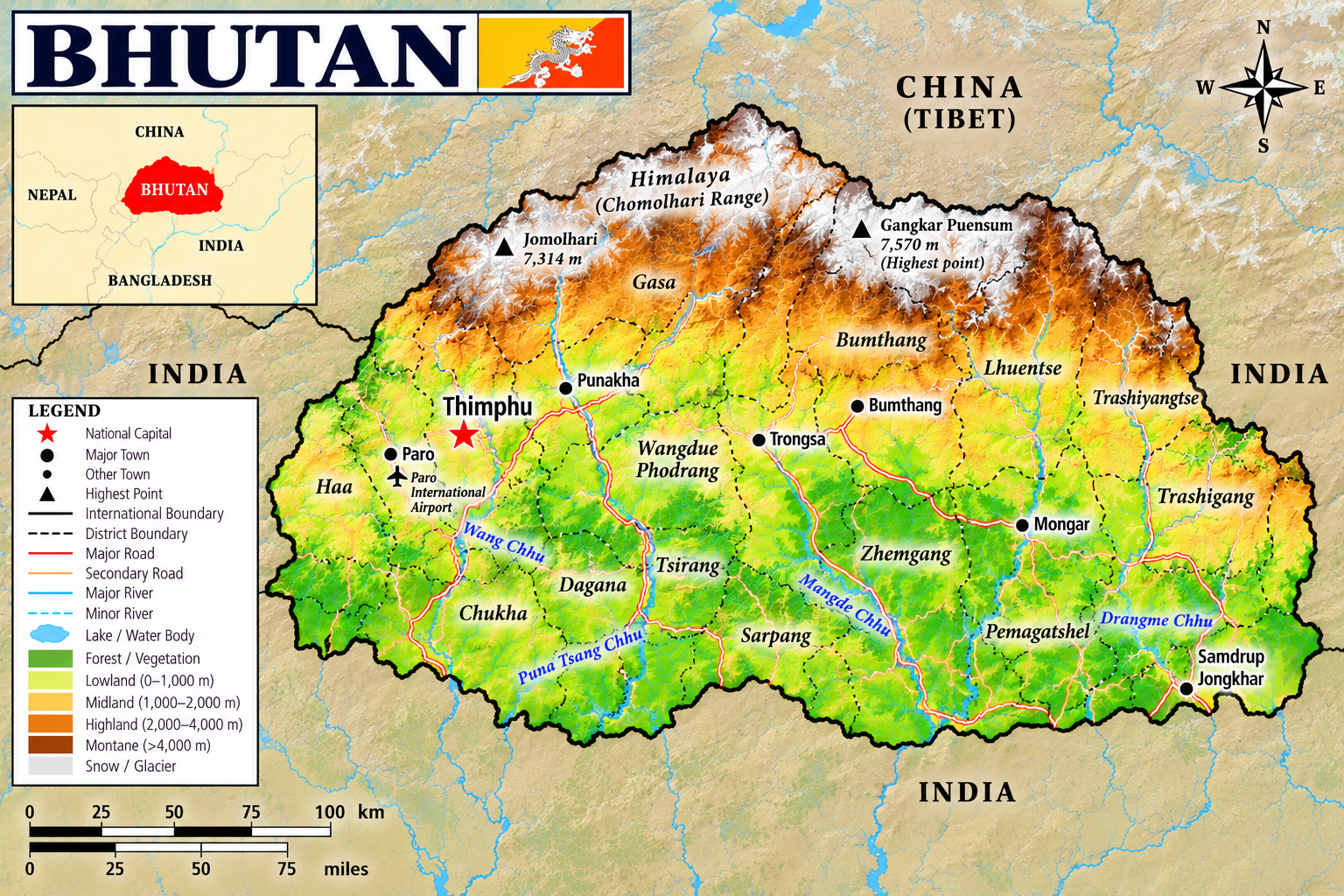
Bhutan — Detailed Physical Map
Himalayan terrain, Gangkar Puensum, districts, rivers, major towns and the capital Thimphu
Tourist Attractions
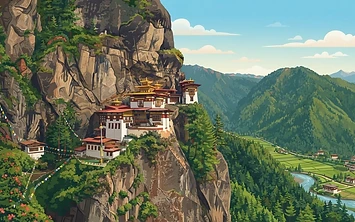
This iconic sacred monastery is perched precariously on a cliffside 900 meters above the Paro Valley. It is widely considered the most famous and breathtaking site in all of Bhutan.
The challenging hike to this cliff-clinging temple offers unparalleled spiritual and scenic rewards.

Known as the 'Palace of Great Happiness,' this magnificent fortress sits at the confluence of the Pho Chhu and Mo Chhu rivers. It is celebrated for its stunning architecture and historical role as the seat of Bhutan's rulers.
The sight of the dzong surrounded by blooming jacaranda trees in spring is one of the most picturesque scenes in the country.

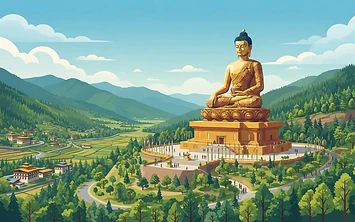
Standing 169 feet tall, this massive golden statue of Buddha overlooks the Thimphu Valley from a hilltop. The interior of the statue houses 125,000 smaller Buddha statues.
The statue provides a panoramic view of the capital city and is particularly striking during sunrise or sunset.

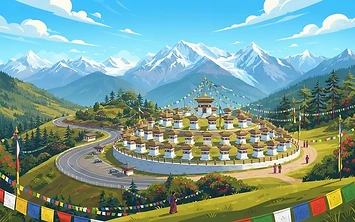
This high mountain pass features 108 memorial chortens built to honor Bhutanese soldiers. It serves as a popular vantage point for viewing the snow-capped peaks of the Himalayas.
On a clear day, the pass offers one of the most spectacular panoramic views of the Himalayan mountain range.

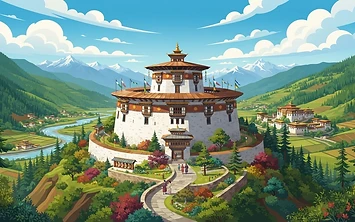
Housed in a historic 17th-century watchtower, this museum preserves over 1,500 years of Bhutanese cultural heritage. Its collection includes ancient thangkas, festival masks, and traditional weapons.
The museum provides a deep, comprehensive insight into the country's rich history and artistic traditions.

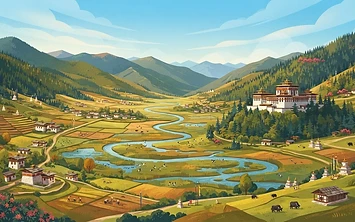
This beautiful, U-shaped glacial valley is a vital conservation area and the winter home of the rare, endangered black-necked cranes. It is a serene destination known for its pristine landscapes and traditional rural life.
It is the premier location in Bhutan for birdwatching and experiencing the tranquility of the high-altitude wilderness.
Geography
Nature
Gangkhar Puensum
7,570 m / 24,836 ft
71.6% of land
≈ 27,490 km² of forest
FAO / World Bank, forest area (% of land area)
Explore the Nature Atlas376 km234 mi
The largest river system in Bhutan flows into the Brahmaputra River in India.
320 km199 mi
Formed by the confluence of the Pho Chhu and Mo Chhu rivers.
370 km230 mi
Flows through the capital city of Thimphu.
0 km²0 sq mi
A sacred glacial lake located in the Haa District.
0 km²0 sq mi
A high altitude lake located near the border with Tibet.
—
A seasonal waterfall located in the southern part of the country.
River lengths are whole-river figures, including any section beyond Bhutan. Researched reference figures. Tap any name for where its name comes from and a Google Maps link.
Major Cities
- 1Capital
Thimphu
141,0762026
MapServes as the capital city and center of government, housing the majestic Tashichho Dzong along the Wang Chhu River.
- 2
Chhukha
32,9992026
MapFunctions as the primary gateway and trading hub connecting Bhutan to the Indian state of West Bengal.
- 3
Paro
17,8352026
MapHosts the country's only international airport and the iconic Tiger's Nest Monastery perched on a cliffside.
- 4
Samdrup Jongkhar
11,8552026
MapProvides a vital trade and transport corridor linking the southeastern region of Bhutan with neighboring Indian plains.
- 5
Wangdue Phodrang
10,6342026
MapFamous for its historic dzong site overlooking the confluence of the Punakha Chu and Tang Chu rivers.
- 6
Sarpang
10,3522026
MapActs as an emerging economic hub in southern Bhutan known for its transit role and proximity to India.
- 7
Punakha
9,2402026
MapHouses the grand Punakha Dzong, formerly the administrative seat and capital of Bhutan until the mid-twentieth century.
- 8
Bumthang
7,7732026
MapKnown as the cultural heart of the Bumthang Valley and a major center for religious history and tourism.
- 9
Samtse
5,7072026
MapContributes significantly to Bhutan's agricultural and industrial output due to its fertile plains and border location.
- 10
Mongar
5,1642026
MapServes as an essential administrative hub for eastern Bhutan, known for its scenic mountains and traditional weaving.
- 11
Trashigang
3,5282026
MapStands as the largest district in Bhutan and a key education center centered around its ancient hillside dzong.
- 12
Trashi Yangtse
3,5262026
MapCelebrated for its exquisite traditional wood carving and the unique Chorten Kora stupa modeled after Boudhanath.
City populations are the latest official, UN or national-statistics estimates (2026–2026) compounded to 2026 at 0.9% a year (the nation's annual population growth rate); figures without a published update come from the open cities database (2020-era estimates) and are projected the same way.
Economy
Main exports
Bhutan's leading export commodities and products.
Tap any export to learn more. Spot prices in USD only for Live Data subscribers.
Main imports
Bhutan's leading import commodities and products.
Tap any import to learn more.
Military
Historical Timeline
2000 BCE
Early settlement by Monpa and Lhop peoples
Archaeological evidence suggests that the earliest inhabitants of Bhutan, the ancestors of the Monpa and Lhop peoples, settled in the region around 2000 BCE.
747
Arrival of Guru Rinpoche
Guru Rinpoche visited Bhutan and is credited with introducing Buddhism to the region, significantly shaping its cultural and religious landscape.
1616
Unification under Zhabdrung Ngawang Namgyal
Zhabdrung Ngawang Namgyal arrived in Bhutan and unified the warring valleys into a single nation-state, establishing the dual system of government.
1774
First contact with the British East India Company
Bhutan signed a peace treaty with the British East India Company following a conflict in Cooch Behar, marking the first formal diplomatic contact with Britain.
1865
Treaty of Sinchula
Following the Duar War, Bhutan ceded border territories to British India in exchange for an annual subsidy, altering the nation's southern borders.
1907
Establishment of the hereditary monarchy
Ugyen Wangchuck was elected as the first hereditary Druk Gyalpo of Bhutan, consolidating national leadership under the Wangchuck dynasty.
1971
Admission to the United Nations
Bhutan became the 128th member of the United Nations, formalizing its status as a sovereign and independent state on the global stage.
2008
Transition to a constitutional monarchy
Bhutan held its first democratic general elections, transitioning from an absolute monarchy to a parliamentary democracy under a new constitution.
2018
Election of the DNT government
The Druk Nyamrup Tshogpa party won the third general election, leading to the formation of a government headed by Prime Minister Lotay Tshering.
2021
Completion of nationwide COVID-19 vaccination campaign
Bhutan gained international recognition for completing one of the world's fastest national COVID-19 vaccination drives, covering over 90 percent of the adult population in two weeks.
2024
Fourth general elections and new government
The People's Democratic Party won the 2024 general elections, resulting in Tshering Tobgay being appointed as the Prime Minister for a second term.
2025
Inauguration of the Gelephu Mindfulness City project
The Bhutanese government accelerated development of the Gelephu Mindfulness City, a special administrative zone designed to foster economic growth through sustainable, mindful urban planning.
National Anthem
འབྲུག་ཙན་དན་
Dasho Gyaldun Thinley
Aku Tongmi
1953
འབྲུག་ཙན་དན་བཀོད་པའི་རྒྱལ་ཁབ་ནང་། དཔལ་ལྡན་འབྲུག་པ་ཕྱོགས་ལས་རྣམ་རྒྱལ། འབྲུག་ཙན་དན་བཀོད་པའི་རྒྱལ་ཁབ་ནང་། དཔལ་ལྡན་འབྲུག་པ་ཕྱོགས་ལས་རྣམ་རྒྱལ། དགའ་སྐྱིད་དཔལ་འཛོམས་ཉི་མ་འཆར་བཞིན་པ། ཟླ་མེད་གངས་རིའི་ཅོད་པཎ་བཏူབའི་སྐུ། འབྲུག་ཙན་དན་བཀོད་པའི་རྒྱལ་ཁབ་ནང་། དཔལ་ལྡན་འབྲུག་པ་ཕྱོགས་ལས་རྣམ་རྒྱལ།
Druk Tsendhen was composed in 1953 to coincide with the coronation of the third King of Bhutan, Jigme Dorji Wangchuck. The lyrics were written by Dasho Gyaldun Thinley, and the melody was composed by Aku Tongmi, a Bhutanese musician who had been trained in India. The music was inspired by the traditional folk song 'Thri Nampa Sepai Pema'. Before this anthem, Bhutan did not have a standardized national song for official ceremonies. It was officially adopted in 1953 and continues to be played during state functions and official arrivals. The anthem emphasizes the beauty of the Bhutanese landscape and the strength of its spiritual and political identity.
National Holidays
Celebrated on the first day of the 12th month of the lunar calendar, it marks the day Zhabdrung Ngawang Namgyal arrived in Bhutan and is observed with prayers and offerings.
This is the Bhutanese New Year, celebrated according to the lunar calendar with traditional rituals, feasts, and archery competitions.
This holiday celebrates the birth of the reigning monarch of Bhutan and is observed with various cultural programs across the nation.
This day honors the birth of Jigme Dorji Wangchuck, the third king of Bhutan who is known as the father of modern Bhutan.
This day commemorates the coronation of Ugyen Wangchuck as the first King of Bhutan in 1907, marking the beginning of the monarchy.
Good News Today
Bhutan wins Earthshot Prize for nature protection and restoration
Bhutan was recognized as a winner of the 2026 Earthshot Prize for its commitment to keeping over 60% of its land under forest cover and its philosophy of Gross National Happiness. The country is currently implementing the Restore Bhutan programme to rehabilitate 50,000 hectares of degraded landscapes by 2030.
Fun Facts
Gross National Happiness Index
Bhutan is the only country in the world that prioritizes Gross National Happiness over Gross Domestic Product in its development philosophy.
Highest Unclimbed Mountain
Bhutan is home to Gangkhar Puensum, which is widely considered the highest unclimbed mountain in the world due to local spiritual beliefs.
Archery is National Sport
Archery was declared the national sport in 1971, and matches are social festivals featuring traditional dancing, singing, and elaborate banquets.
Chili is a Vegetable
In Bhutan, chilis are not used just as a spice but as a primary vegetable, with the national dish Ema Datshi consisting entirely of chilis and cheese.
Tobacco Sales Ban
Bhutan was the first country in the world to implement a total ban on the sale of tobacco products, reflecting its commitment to public health.
Majestic Dzong Architecture
The country is famous for its massive fortress-monasteries called Dzongs, which are built without the use of any architectural blueprints or iron nails.
The Land of Thunder Dragon
The country is locally known as Druk Yul, which translates to 'Land of the Thunder Dragon,' a reference to the frequent storms rolling in from the Himalayas.
Constitutional Forest Coverage
The Bhutanese constitution mandates that at least 60 percent of the nation's land must remain under forest cover for all time.
No Traffic Lights
The capital city, Thimphu, is famously one of the only world capitals that operates without a single traffic light, using hand signals instead.
Tiger's Nest Monastery
Paro Taktsang, or the Tiger's Nest, is a spectacular monastery perched on a cliffside 3,000 feet above the Paro Valley floor.
Chuckies Trivia Quiz
Chuckies Trivia Quiz
Fifteen questions on Bhutan — five easy, five medium, five hard. How far can you get?
Sports & Live Events
Language
Counting to 10
1
1
= 10 (n = 0)
World Dictionary
Discover and translate any word into all supported languages.