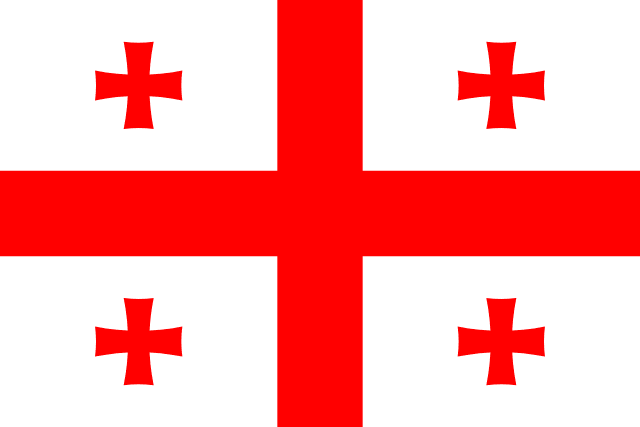

Georgia
Asia
3,682,324
08:22 UTC+4
+995
.ge
Shkhara
5,206 m · 17,080 ft
Black Sea
0 m · 0 ft
1,223,091
Tbilisi · 2026
1,223,091
Tbilisi · 2026
Location
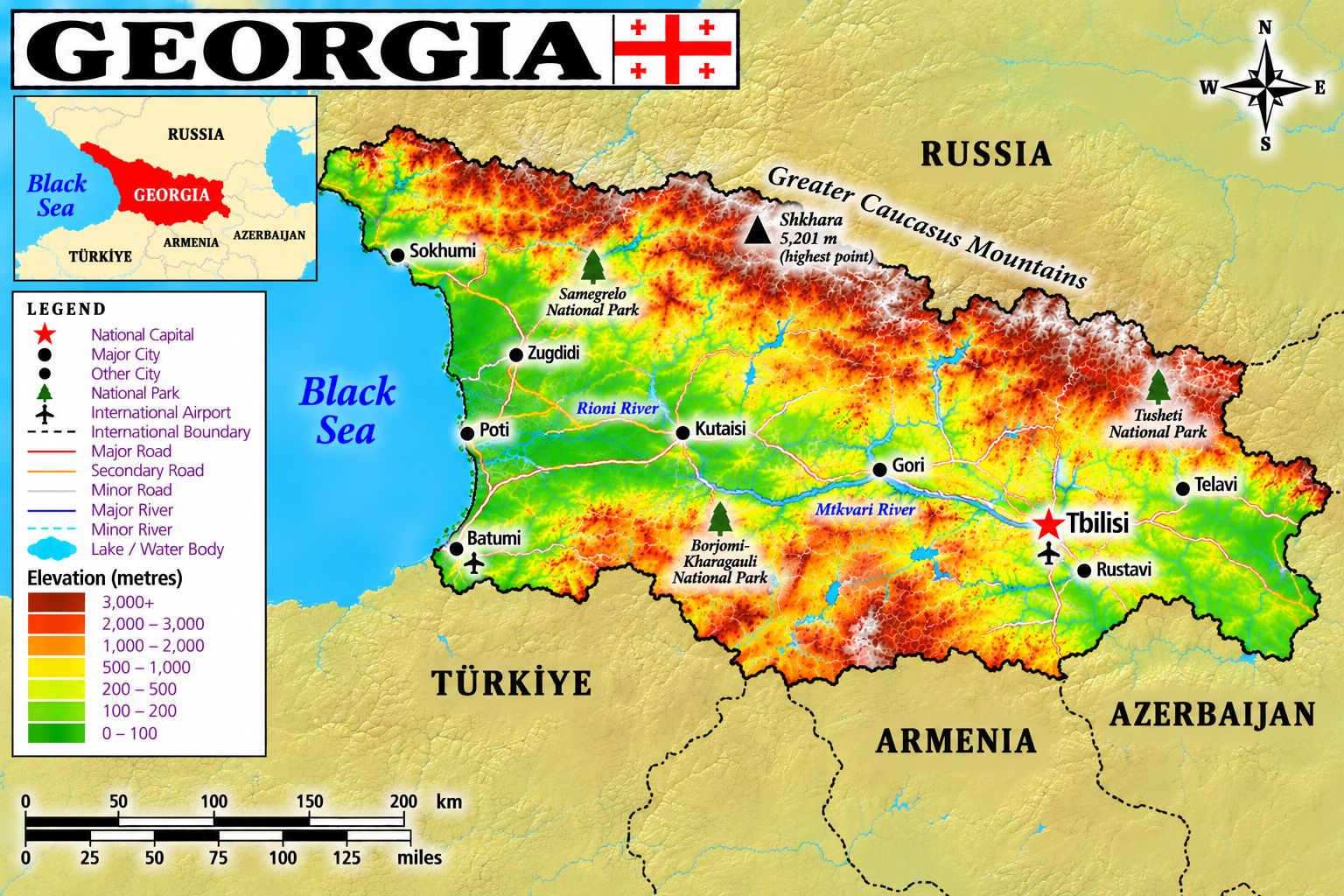
Georgia — Detailed Physical Map
The Greater Caucasus and Shkhara, Rioni and Mtkvari rivers, Borjomi-Kharagauli and Tusheti parks, major cities and the capital Tbilisi
Tourist Attractions

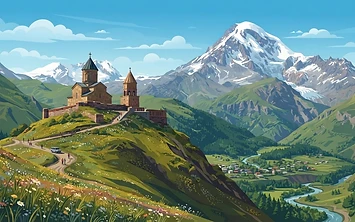
Perched high on a mountain slope against the backdrop of Mount Kazbek, this 14th-century church is a quintessential symbol of Georgia's landscape and faith.
The panoramic view of the church set against the dramatic Caucasus Mountains is one of the most iconic sights in the country.

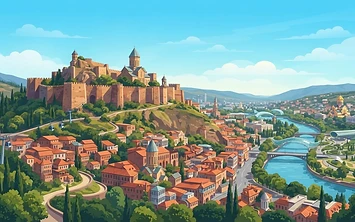
This ancient fortress overlooks the capital city, offering a glimpse into the defensive history of Tbilisi with walls that date back to the 4th century.
It provides the best vantage point to view the sprawling Old Town and the Kura River below.

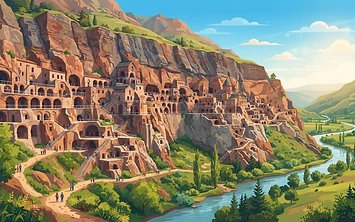
Vardzia is an expansive cave monastery complex carved into the side of the Erusheti Mountain during the 12th century.
Exploring the labyrinth of tunnels, chapels, and living quarters carved directly into the rock face is a unique historical experience.

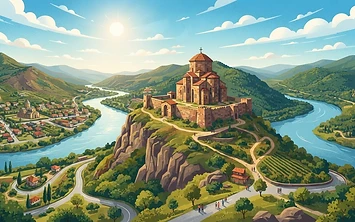
A UNESCO World Heritage site, this 6th-century Orthodox monastery stands on a hilltop overlooking the confluence of the Mtkvari and Aragvi rivers.
The site offers a stunning view of Mtskheta, the ancient capital of Georgia, and the meeting point of two major rivers.

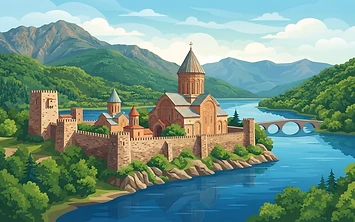
Located along the Aragvi River, this 16th-century castle complex features well-preserved towers and churches with intricate stone carvings.
The fortress is beautifully situated overlooking the turquoise waters of the Zhinvali Reservoir.

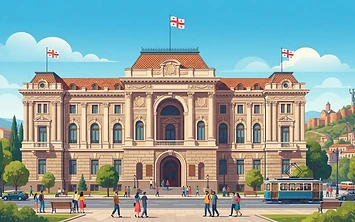
This premier institution houses a vast collection of artifacts ranging from prehistoric archaeological finds to medieval art and Soviet-era history.
The Archaeological Treasury exhibit features exquisite gold jewelry and artifacts that showcase the ancient craftsmanship of the region.
Geography
Nature
Shkhara
5,206 m / 17,080 ft
40.6% of land
≈ 28,298 km² of forest
FAO / World Bank, forest area (% of land area)
Explore the Nature Atlas1,515 km941 mi
Rises in Turkey and flows through Tbilisi before reaching the Caspian Sea.
327 km203 mi
Primary river of Western Georgia originating in the Greater Caucasus mountains.
213 km132 mi
Forms the border between Samegrelo and the breakaway region of Abkhazia.
38 km²14 sq mi · 3 m deep
Largest lake by surface area located in the Javakheti Plateau.
14 km²5 sq mi · 40 m deep
Volcanic lake surrounded by the Trialeti Range in the Samtskhe-Javakheti region.
1 km²1 sq mi · 63 m deep
Alpine lake situated within the volcanic Keli Highland at high elevation.
—
Feature of the Ktsia-Tabatskuri Managed Reserve known for its unique weeping wall style.
—
Waterfall located near the colorful alpine lakes in the Khevsureti region.
River lengths are whole-river figures, including any section beyond Georgia. Researched reference figures. Tap any name for where its name comes from and a Google Maps link.
Major Cities
- 1Capital
Tbilisi
1,326,1642026
MapServes as the vibrant capital city and cultural center of Georgia, known for its historic Old Town and diverse architecture.
- 2
Ajaria
234,7262026
MapActs as the primary Black Sea resort city and major port, famous for its modern skyscrapers and seaside botanical garden.
- 3
Imereti
163,9132026
MapFunctions as a major historical hub and home to the UNESCO-listed Gelati Monastery and the iconic Bagrati Cathedral.
- 4
Kvemo Kartli
133,1392026
MapEstablished as a prominent industrial city during the Soviet era, particularly noted for its large-scale metallurgical production facilities.
- 5
Abkhazia
67,6642026
MapStands as the historic seaside capital of Abkhazia, renowned for its coastal beauty and unique subtropical climate.
- 6
Samegrelo-Zemo Svaneti
61,0002026
MapServes as the administrative center of Samegrelo, notable for the impressive Dadiani Palace complex and its historic royal artifacts.
- 7
Shida Kartli
53,1312026
MapRecognized as the birthplace of Joseph Stalin and site of a dedicated museum reflecting the leader's complex historical legacy.
- 8
Samegrelo-Zemo Svaneti
38,2672026
MapHosts a vital deep-water seaport on the Black Sea coast that facilitates a significant portion of Georgia's international maritime trade.
- 9
Shida Kartli
30,0692026
MapLocated in the central foothills, this urban center serves as the administrative hub within the Tskhinvali region.
- 10
Shida Kartli
25,0132026
MapFunctions as a critical railway junction and transport hub located in the Shida Kartli region of central Georgia.
- 11
Imereti
21,0962026
MapActs as a major transportation intersection, connecting western and eastern railway lines throughout the Georgian landscape.
- 12
Ajaria
16,1312026
MapOffers an expansive stretch of pebble beaches and serves as a popular summer holiday destination along the Adjarian coastline.
City populations are the latest official, UN or national-statistics estimates (2024–2026) compounded to 2026 at -0.2% a year (the nation's annual population growth rate); figures without a published update come from the open cities database (2020-era estimates) and are projected the same way.
Economy
Main exports
Georgia's leading export commodities and products.
Tap any export to learn more. Spot prices in USD only for Live Data subscribers.
Main imports
Georgia's leading import commodities and products.
Tap any import to learn more.
Military
Historical Timeline
1800000 BCE
Early Human Occupation in Dmanisi
Archaeological findings in Dmanisi provide evidence of the earliest hominid occupation outside of Africa, dating back approximately 1.8 million years.
300 BCE
Unification of the Kingdom of Iberia
King Parnavaz I unified the Georgian tribes and established the Kingdom of Iberia, adopting a unique Georgian script and administrative system.
337
Adoption of Christianity
King Mirian III declared Christianity the official state religion of Iberia, significantly influencing the cultural and political trajectory of the nation.
1184
Reign of Queen Tamar
The Golden Age of Georgia reached its zenith under Queen Tamar, who expanded the kingdom's borders and fostered an era of cultural, architectural, and literary growth.
1801
Annexation by the Russian Empire
Following the Treaty of Georgievsk, the Russian Empire abolished the Georgian monarchy and annexed the country, beginning over a century of tsarist rule.
1918
Declaration of Independence
In the wake of the Russian Revolution, Georgia declared independence and established the Democratic Republic of Georgia, which lasted until the Soviet invasion in 1921.
1991
Restoration of Independence
Following the collapse of the Soviet Union, Georgia officially regained its independence, with Zviad Gamsakhurdia serving as the country's first president.
2003
The Rose Revolution
A series of peaceful mass protests led by Mikheil Saakashvili ousted the government of Eduard Shevardnadze, ushering in significant democratic and economic reforms.
2008
Russo-Georgian War
A brief but devastating military conflict between Georgia and Russia occurred over the breakaway regions of South Ossetia and Abkhazia, resulting in a Russian military presence in these territories.
2018
Election of Salome Zourabichvili
Salome Zourabichvili became the first woman elected to the presidency of Georgia, marking a significant milestone in the country's political history.
2023
Granting of EU Candidate Status
The European Council officially granted Georgia candidate status for European Union membership, reflecting a major shift in the country's geopolitical orientation.
2025
Parliamentary Tensions and Political Shifts
Georgia experienced significant political turbulence and increased public protests following the 2024 parliamentary elections, leading to ongoing debates regarding the country's democratic standards and path toward EU integration in 2025.
National Anthem
Tavisupleba
David Magradze
Zakaria Paliashvili
2004
Chemi khatia samshoblo, Sakhatos samtavro gulsa, Natsilebi da natsilebi Sharavandedi tsamtsamsa. Am dgeshi chven-da tsinaparebs, Kmarat gvyavs gmerti erTaderi, gatsevda gza da gza da gza, Tavisupleba samaradis. Didheba Tavisuplebas, Didheba Tavisuplebas!
The current national anthem of Georgia, known as 'Tavisupleba', was officially adopted on April 23, 2004, following the Rose Revolution. The lyrics were written by poet David Magradze, who adapted lines from the works of several classic Georgian poets including Akaki Tsereteli, Grigol Orbeliani, and Galaktion Tabidze. The music is derived from two operas by the renowned Georgian composer Zakaria Paliashvili, specifically 'Daisi' and 'Abesalom da Eteri'. This composition replaced the previous anthem, 'Dideba', which had served as the national anthem since 1990. The selection of the new anthem was aimed at reflecting a post-revolutionary sense of national unity and democratic aspiration. It remains a deeply significant symbol of Georgian national identity and is performed at all major state occasions and formal international events.
National Holidays
This holiday marks the beginning of the new calendar year and is celebrated with traditional feasts and family gatherings.
This day commemorates the birth of Jesus Christ according to the Julian calendar, which is observed by the Georgian Orthodox Church.
This day is dedicated to celebrating the social, economic, cultural, and political achievements of women and is a widely observed public holiday.
This date commemorates the adoption of the Act of Independence in 1918, which established the First Republic of Georgia.
This day honors the memory of those who died during the 1989 anti-Soviet protests in Tbilisi, which was a pivotal event in the struggle for Georgian independence.
Good News Today
Georgia ranked among top countries with lowest levels of hunger
The 2026 Global Hunger Index identifies Georgia as one of the 24 countries worldwide where hunger is not considered a significant problem. The report highlights the country's substantial progress in food security since 2012.
Fun Facts
Birthplace Of Wine Making
Archaeological evidence suggests that Georgia has been producing wine for 8,000 years, utilizing unique clay vessels buried underground called Qvevri.
Highest Settlements In Europe
Georgia's mountain village of Ushguli is widely considered one of the highest continuously inhabited settlements on the entire European continent.
Unique Ancient Writing System
Georgian is one of only 14 unique scripts in the world, featuring a beautiful and flowing alphabet that dates back to the 3rd century BC.
The Iconic Khachapuri Bread
Khachapuri, a boat-shaped bread filled with melted cheese, egg, and butter, is so beloved it has its own inflation index used by local economists.
Land Of Polyphonic Singing
Georgian polyphonic singing is a complex and ancient musical tradition that is recognized by UNESCO as a masterpiece of intangible cultural heritage.
Second Oldest Christian Nation
Georgia adopted Christianity as its state religion in the early 4th century, becoming the second country in the world to do so.
Cradle Of Primitive Humans
The Dmanisi site in Georgia contains the oldest hominid fossils discovered outside of Africa, dating back approximately 1.8 million years.
City Of Sulfur Baths
Tbilisi, the capital, derives its name from the Old Georgian word 'tbili', meaning warm, referring to the natural hot sulfur springs in the city center.
Chidaoba Wrestling Tradition
Chidaoba is a traditional Georgian form of wrestling that combines music, dance, and combat techniques dating back to the medieval era.
Protective Fortress Architecture
The Svaneti region is famous for its defensive stone towers, which were built centuries ago by families to protect themselves against invaders and avalanches.
Chuckies Trivia Quiz
Chuckies Trivia Quiz
Fifteen questions on Georgia — five easy, five medium, five hard. How far can you get?
Sports & Live Events
Language
Counting to 10
1
1
= 10 (n = 0)
World Dictionary
Discover and translate any word into all supported languages.