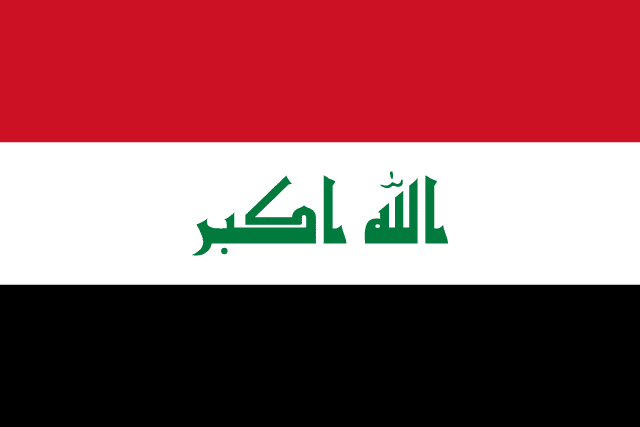

Iraq
Republic of Iraq
Asia
48,571,340
07:22 UTC+3
+964
.iq
Cheekha Dar
3,611 m · 11,847 ft
Persian Gulf
0 m · 0 ft
7,956,324
Baghdad · 2026
7,956,324
Baghdad · 2026
Location
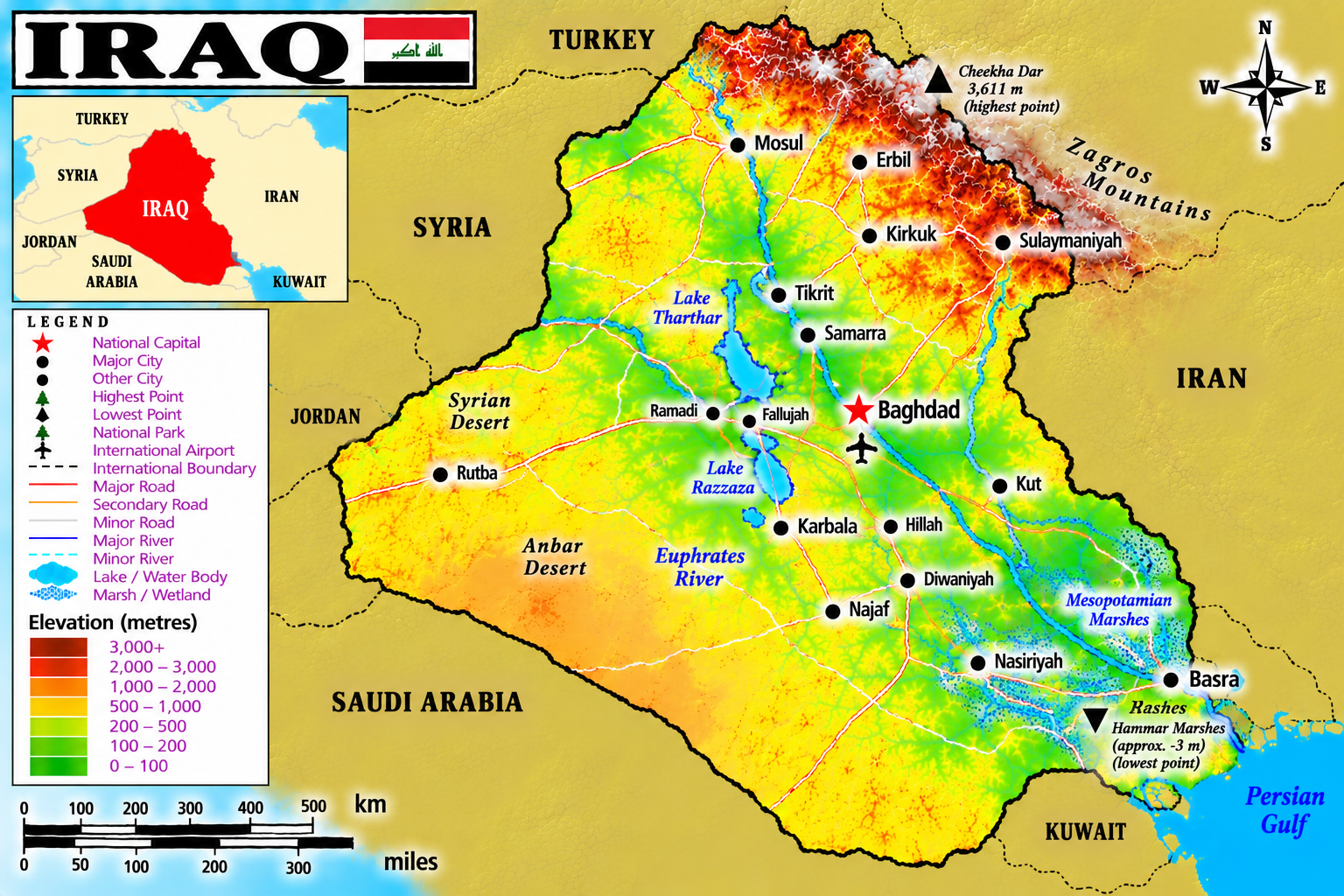
Iraq — Detailed Physical Map
The Tigris and Euphrates rivers, Zagros Mountains, Mesopotamian Marshes, western deserts, major cities and the capital Baghdad
Tourist Attractions

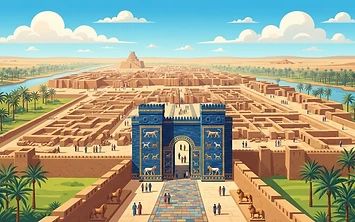
Once the capital of the Neo-Babylonian Empire, this ancient city is one of the most famous archaeological sites in the world. Visitors can explore the ruins of Nebuchadnezzar's palace and the reconstructed Ishtar Gate.
Walk along the ancient Processional Way of one of the earliest cradles of civilization.

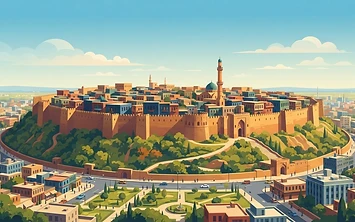
Situated on a massive tell overlooking the city, this UNESCO World Heritage site is a prime example of Ottoman-era urban planning with foundations dating back to the Assyrian period. It remains one of the oldest continuously inhabited places on earth.
Experience the stunning panoramic views of Erbil from the top of the ancient mound.

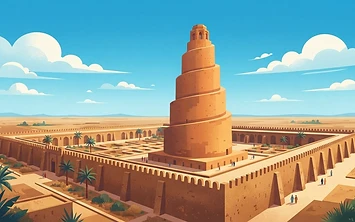
This iconic 9th-century site features a unique, massive spiral minaret that stands as a masterpiece of Islamic architecture. It was once part of the largest mosque in the world during the Abbasid Caliphate.
Climb the distinctive spiral ramp of the Malwiya Minaret for a unique architectural experience.

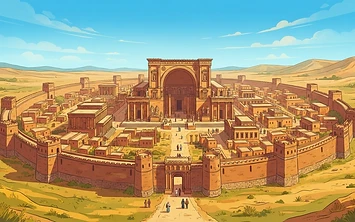
A remarkably well-preserved fortified city that served as a major trading center and capital of the first Arab Kingdom. The site is famous for its unique fusion of Greek, Roman, and Mesopotamian architectural styles.
Marvel at the intricate stone carvings and massive defensive walls that withstood ancient Roman invasions.

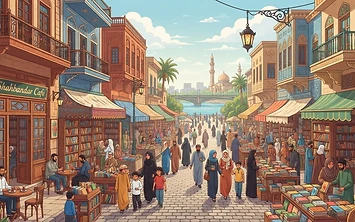
Named after the renowned 10th-century poet, this historic street is the vibrant intellectual heart of Baghdad. It is lined with traditional bookstores, outdoor stalls, and historic cafes where scholars and artists have gathered for generations.
Soak in the intellectual atmosphere and browse the vast collection of books in this legendary cultural hub.

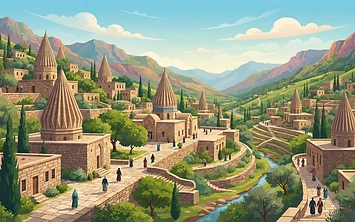
Nestled in a peaceful mountain valley, this is the holiest site for the Yazidi people. The village is characterized by its conical stone temples and a deeply spiritual atmosphere that requires visitors to walk barefoot.
Experience the profound serenity and unique traditions of this sacred, ancient mountain sanctuary.
Geography
Nature
Cheekha Dar
3,611 m / 11,847 ft
1.9% of land
≈ 8,328 km² of forest
FAO / World Bank, forest area (% of land area)
Explore the Nature Atlas2,800 km1,740 mi
Rises in the Armenian Highlands and flows through Syria before entering Iraq.
1,900 km1,181 mi
Originates in the Taurus Mountains of Turkey and joins the Euphrates in southern Iraq.
200 km124 mi
Formed by the confluence of the Tigris and Euphrates rivers near Al-Qurnah.
2,710 km²1,046 sq mi
Largest lake in Iraq situated between the Tigris and Euphrates rivers.
140 km²54 sq mi
Functions as a major reservoir for flood control on the Euphrates River.
1,560 km²602 sq mi
Also known as Lake Milh, it serves as a significant drainage basin.
12 m39 ft
Situated between the Korek and Bradost mountains in the Kurdistan region.
25 m82 ft
Features a series of cascades located in the Halabja Governorate.
River lengths are whole-river figures, including any section beyond Iraq. Researched reference figures. Tap any name for where its name comes from and a Google Maps link.
Major Cities
- 1Capital
Baghdād
8,001,2232026
MapServes as the capital of Iraq and stands as a major cultural and intellectual hub of the Arab world.
- 2
Al Başrah
1,609,7152026
MapFunctions as Iraq's primary port city and serves as the center of the country's oil production industry.
- 3
Nīnawá
1,598,7302026
MapFeatures the historic Great Mosque of al-Nuri and acts as a vital trade center in northern Iraq.
- 4
Karkūk
1,179,7482026
MapHosts some of the world's oldest and most significant oil fields within the northern region of Iraq.
- 5
Arbīl
1,042,8502026
MapContains a continuously inhabited ancient citadel that is recognized as a UNESCO World Heritage site.
- 6
An Najaf
885,8052026
MapHouses the Imam Ali Shrine, making it one of the holiest cities for followers of Shia Islam.
- 7
Karbalā’
842,6002026
MapAttracts millions of pilgrims annually to the shrines of Imam Hussain and Abbas ibn Ali.
- 8
As Sulaymānīyah
800,6362026
MapActs as a cultural and artistic capital known for its mountainous landscape and vibrant educational institutions.
- 9
Dhī Qār
669,0432026
MapLocated near the ancient ruins of Ur, it serves as the gateway to significant Sumerian archaeological sites.
- 10
Maysān
634,0832026
MapLies along the Tigris River and functions as a prominent agricultural and commercial center in southern Iraq.
- 11
Bābil
544,4952026
MapStands near the ruins of the ancient city of Babylon, famous for the Hanging Gardens and Ishtar Gate.
- 12
Al Anbār
269,2952026
MapSituated on the banks of the Euphrates River, it serves as a key administrative hub in Anbar Province.
City populations are the latest official, UN or national-statistics estimates (2026–2026) compounded to 2026 at 2.3% a year (the nation's annual population growth rate); figures without a published update come from the open cities database (2020-era estimates) and are projected the same way.
Economy
Main exports
Iraq's leading export commodities and products.
Tap any export to learn more. Spot prices in USD only for Live Data subscribers.
Main imports
Iraq's leading import commodities and products.
Tap any import to learn more.
Military
Historical Timeline
8000 BCE
Early Neolithic Settlements in Mesopotamia
The transition to sedentary farming communities began in Northern Mesopotamia, marking the rise of the world's earliest agricultural societies.
3500 BCE
Rise of the Sumerian Civilization
The Sumerians developed the world's first writing system, cuneiform, and established complex city-states in southern Mesopotamia.
1792 BCE
Reign of Hammurabi
Hammurabi unified much of Mesopotamia under the Babylonian Empire and promulgated one of the earliest known legal codes.
762
Founding of Baghdad
The Abbasid Caliphate established Baghdad as its capital, transforming it into a global center of science, culture, and trade during the Islamic Golden Age.
1258
Siege of Baghdad by the Mongols
The Mongol Empire captured and largely destroyed Baghdad, effectively ending the Abbasid Caliphate and the Islamic Golden Age.
1921
Establishment of the Kingdom of Iraq
Following the dissolution of the Ottoman Empire and a period of British mandate, Faisal I was crowned the first King of Iraq.
1958
The 14 July Revolution
A military coup led by Abd al-Karim Qasim overthrew the monarchy, leading to the declaration of the Republic of Iraq.
1979
Saddam Hussein Assumes Presidency
Saddam Hussein officially took control of the Iraqi presidency, initiating decades of authoritarian rule and involvement in major regional wars.
2003
Invasion of Iraq
A United States-led coalition invaded Iraq, resulting in the removal of Saddam Hussein's government and a total transformation of the national political structure.
2005
First Multi-Party Parliamentary Elections
Iraqi citizens participated in the nation's first democratic elections following the 2003 invasion to draft a new constitution.
2017
Territorial Defeat of ISIS
Iraqi security forces, supported by an international coalition, declared victory over the Islamic State in Iraq after a multi-year conflict.
2025
Completion of Grand Faw Port Project
Iraq initiated significant operational phases of the Grand Faw Port, aiming to establish the country as a major regional logistics and transit hub.
National Anthem
موطني
Ibrahim Tuqan
Mohammed Flayfel
2004
موطني موطني الجلال والجمال والسناء والبهاء في رباك في رباك والحياة والنجاة والهناء والرجاء في هواك في هواك هل أراك هل أراك سالما منعما وغانما مكرما هل أراك في علاك تبلغ السما تبلغ السما موطني موطني
Mawtini was written by Palestinian poet Ibrahim Tuqan in 1934 and composed by the Lebanese musician Mohammed Flayfel. It gained significant popularity across the Arab world as a patriotic anthem during various independence movements. Following the 2003 invasion of Iraq and the subsequent political transition, the Iraqi Governing Council officially adopted it as the national anthem in 2004. It replaced the previous anthem, 'Ard al-Furatayn', which had been associated with the Ba'athist regime. Unlike the previous anthem, which focused on pan-Arabism and specific political themes, Mawtini emphasizes a more universal sense of national pride and longing. It is widely recognized and cherished by the Iraqi populace for its lyrical depth and emotional resonance. The song remains a potent symbol of Iraqi unity and sovereignty in the post-2004 era.
National Holidays
This day commemorates the establishment of the Iraqi Army in 1921. It serves as a national day to honor the country's military forces and their history.
Also known as the Kurdish New Year, this day marks the vernal equinox and the arrival of spring. It is a major cultural holiday, particularly in the Kurdistan Region of Iraq.
An internationally recognized day to celebrate the achievements and contributions of workers. It is observed as a public holiday throughout Iraq.
This day marks the 2017 liberation of Iraq from the Islamic State. It is observed as a national holiday to celebrate national sovereignty and the defeat of the insurgency.
Good News Today
Iraq reopens Shib border crossing with Iran after 3-week closure
Iraqi authorities successfully reopened the Shib border crossing to passengers and commercial traffic following the completion of necessary technical procedures. The reopening restores a key transit route, facilitating the movement of people and goods between the two nations.
Fun Facts
Cradle of Human Writing
The ancient Sumerians of Mesopotamia, located in modern-day Iraq, are credited with developing cuneiform, the first known system of writing.
Invention of the Calendar
Ancient Babylonian astronomers in Iraq were the first to divide an hour into 60 minutes and a minute into 60 seconds.
Birthplace of Early Agriculture
The Fertile Crescent, covering much of Iraq, was the site where humans first transitioned from hunting to systematic farming and animal domestication.
Introduction of the Base-60 System
The sexagesimal system of counting in 60s, still used today for timekeeping and geometry, was developed by ancient Mesopotamian mathematicians.
Date Palm Legacy
Iraq was once famously known as the 'Land of Date Palms,' with the country historically home to tens of millions of these ancient trees.
Code of Hammurabi Origin
One of the world's earliest and most complete written legal codes was created by King Hammurabi in ancient Babylon.
Ziggurat of Ur Architecture
The Great Ziggurat of Ur is a massive, well-preserved step pyramid that showcases the advanced engineering skills of the Neo-Sumerian era.
Oldest Known Written Music
The Hurrian Hymn, the world’s oldest known piece of written music, was discovered inscribed on clay tablets in the ancient city of Ugarit.
Marsh Arab Mudhif Homes
The Marsh Arabs of southern Iraq build traditional arched guest houses, called Mudhif, entirely out of reeds harvested from the marshes.
Astronomy Pioneers in Babylon
Babylonian astronomers were the first to track planetary movements and predict solar eclipses using sophisticated mathematical models.
Chuckies Trivia Quiz
Chuckies Trivia Quiz
Fifteen questions on Iraq — five easy, five medium, five hard. How far can you get?
Sports & Live Events
Language
Counting to 10
1
1
= 10 (n = 0)
World Dictionary
Discover and translate any word into all supported languages.