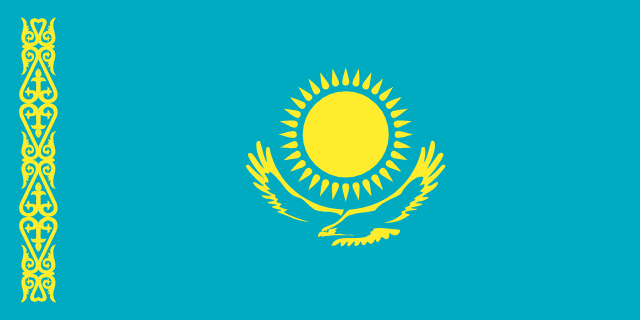

Kazakhstan
Republic of Kazakhstan
Asia
20,627,550
09:26 UTC+5
+7
.kz
Khan Tengri
6,995 m · 22,949 ft
Karagiye Depression
-132 m · -433 ft
1,537,699
Astana · 2026
2,333,855
Almaty · 2026
Location
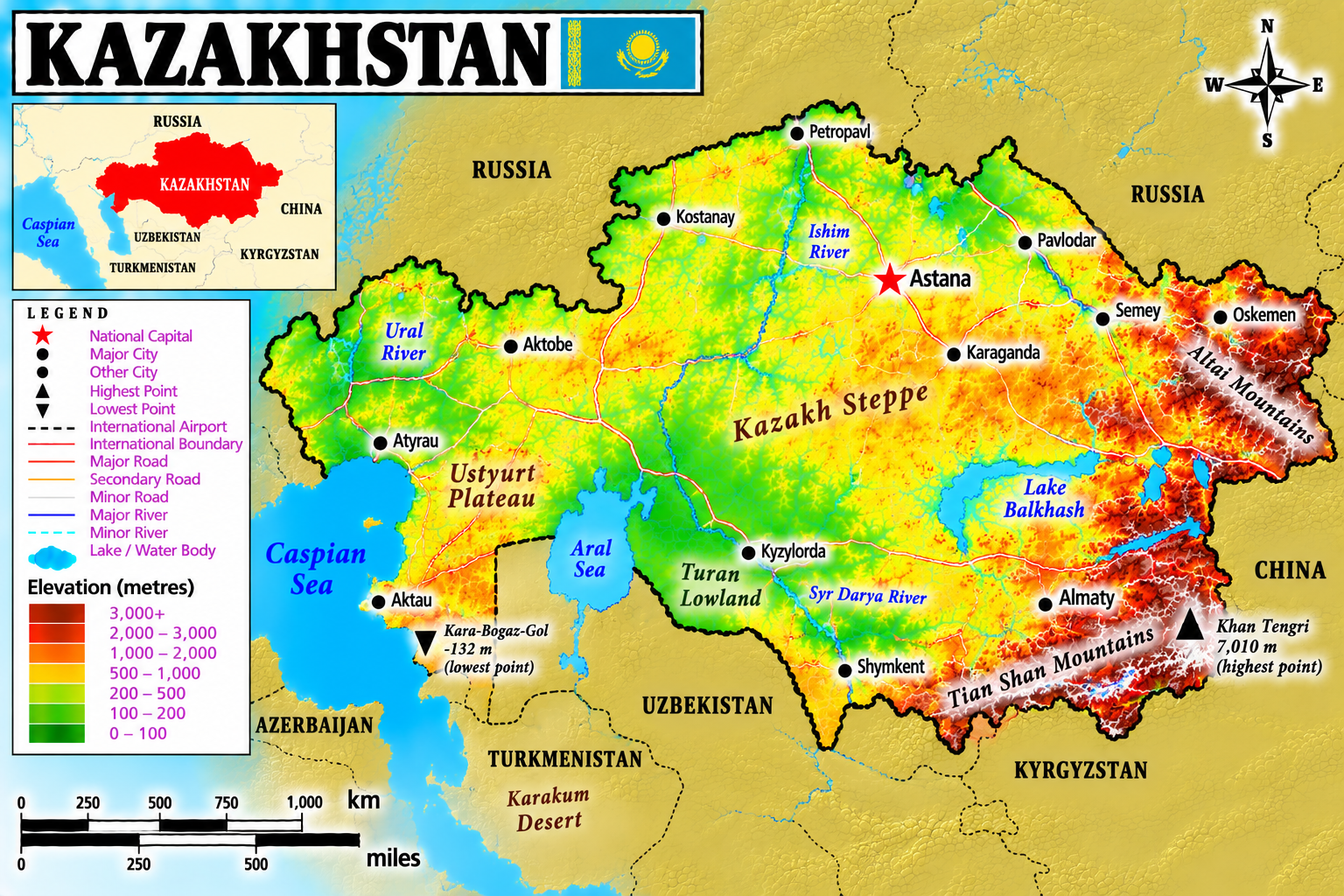
Kazakhstan — Detailed Physical Map
The Kazakh Steppe, Caspian and Aral seas, Lake Balkhash, Tian Shan and Altai mountains, major cities and the capital Astana
Tourist Attractions

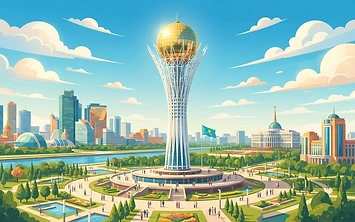
This 97-meter tall monument is the iconic symbol of Kazakhstan's independence and modern identity, featuring a golden egg atop a tree-like structure.
The observation deck provides a stunning panoramic view of the entire capital city.

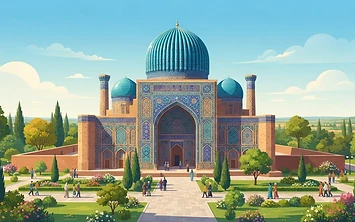
A UNESCO World Heritage site, this magnificent 14th-century structure is one of the most significant architectural achievements of the Timurid era.
It is a masterpiece of medieval Islamic architecture and a deeply sacred pilgrimage site.

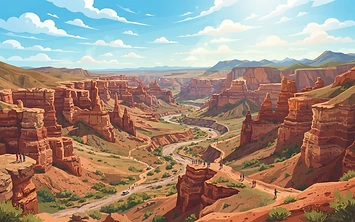
Often called the 'Little Grand Canyon,' this geological wonder stretches over 150 kilometers and features dramatic, reddish-brown rock formations.
The 'Valley of Castles' section offers breathtaking, towering rock sculptures that look like ancient fortresses.

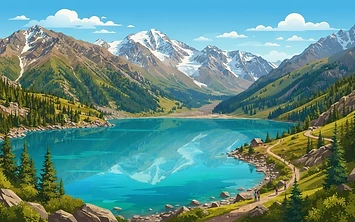
Nestled high in the Tian Shan mountains, this alpine lake is famous for its vibrant, shifting turquoise waters that change color with the seasons.
The stunning contrast of the bright blue water against the surrounding snow-capped mountain peaks is a photographer's dream.

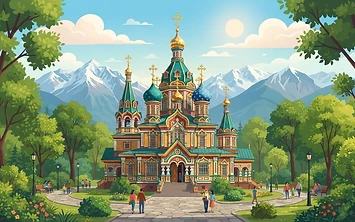
Also known as the Zenkov Cathedral, this colorful Orthodox church is constructed entirely of wood without the use of metal nails.
It stands as one of the tallest wooden buildings in the world and survived the massive 1911 earthquake.

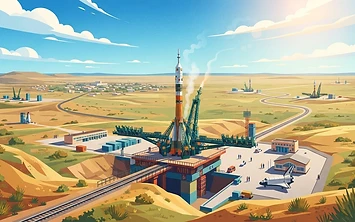
As the world's first and largest space launch facility, this site is where the first artificial satellite and the first human were launched into space.
It is a historic site of global importance that offers a unique look into the legacy of human space exploration.
Geography
Nature
Khan Tengri
6,995 m / 22,949 ft
1.3% of land
≈ 35,424 km² of forest
FAO / World Bank, forest area (% of land area)
Explore the Nature Atlas4,248 km2,640 mi
Rises in the Altai Mountains and flows through China, Kazakhstan, and Russia.
2,450 km1,522 mi
A major left tributary of the Irtysh River flowing through Kazakhstan and Russia.
2,212 km1,374 mi
Originates in the Tian Shan mountains and flows into the Aral Sea.
371,000 km²143,244 sq mi · 1,025 m deep
The largest inland body of water in the world by surface area.
16,400 km²6,332 sq mi · 26 m deep
The eastern part of the lake is saline while the western part is freshwater.
1,810 km²699 sq mi · 10 m deep
Situated in a hollow between the Altai and Tarbagatai mountain ranges.
168 m551 ft
Considered the highest waterfall in the Central Asian region.
80 m262 ft
Located in the remote Altai Mountains near the border with China.
River lengths are whole-river figures, including any section beyond Kazakhstan. Researched reference figures. Tap any name for where its name comes from and a Google Maps link.
Major Cities
- 1
2,387,8962026
MapServed as the nation's capital until 1997 and remains the largest commercial and cultural hub of Kazakhstan.
- 2Capital
1,700,3852026
MapFunctioning as the modern capital city, it is home to iconic futuristic architecture like the Bayterek observation tower.
- 3
1,316,8882026
MapActs as a major industrial center and a significant crossroads along the historical Silk Road trade routes.
- 4
590,4002026
MapFunctions as a key industrial and administrative center in western Kazakhstan, supported by a thriving oil and gas sector.
- 5
526,0002026
MapDeveloped originally as a major coal mining hub and remains a center for heavy industry in the country.
- 6
441,2002026
MapRanked among the oldest cities in the country, it preserves significant historical sites from the medieval Silk Road era.
- 7
335,5002026
MapOperates as a vital industrial center along the Irtysh River, housing major aluminum and oil refining facilities.
- 8
332,0002026
MapKnown as the country's oil capital, it is located at the mouth of the Ural River near the Caspian Sea.
- 9
315,7002026
MapRecognized for its historical association with the former Soviet nuclear testing site located in the surrounding steppe region.
- 10
253,8142026
MapLocated near the Baikonur Cosmodrome, it serves as an essential administrative and transport center in the southern region.
- 11
253,6272026
MapHosts massive non-ferrous metallurgical plants and serves as a primary hub for the regional mining industry.
- 12
189,9202026
MapSituated at the confluence of the Ural and Chogan rivers, it functions as a historic gateway between Europe and Asia.
City populations are the latest official, UN or national-statistics estimates (2025–2026) compounded to 2026 at 1.3% a year (the nation's annual population growth rate); figures without a published update come from the open cities database (2020-era estimates) and are projected the same way.
Economy
Main exports
Kazakhstan's leading export commodities and products.
Tap any export to learn more. Spot prices in USD only for Live Data subscribers.
Main imports
Kazakhstan's leading import commodities and products.
Tap any import to learn more.
Military
Historical Timeline
3000 BCE
Botai Culture Settlement
The Botai culture represents one of the earliest known settlements in the region, notable for the domestication of horses. These ancient inhabitants laid the foundational nomadic traditions of the Eurasian Steppe.
1219
Mongol Conquest of Central Asia
Genghis Khan led the Mongol Empire in a sweeping conquest that brought the territory of modern-day Kazakhstan under Mongol rule. This period significantly influenced the ethnic and political structure of the region.
1465
Foundation of the Kazakh Khanate
Kerey and Zhanibek Khan established the Kazakh Khanate, marking the beginning of a distinct Kazakh statehood. This event united various Turkic tribes under a centralized political entity.
1731
Russian Protectorate Agreement
Abul Khair Khan of the Junior Juz sought an alliance with the Russian Empire to protect the Kazakhs from Dzungar attacks. This agreement began the gradual integration of Kazakh lands into the Russian sphere of influence.
1920
Formation of the Kazakh ASSR
The Soviet government established the Kirghiz Autonomous Socialist Soviet Republic, which was later renamed the Kazakh ASSR. This created the administrative foundation for the modern Kazakh borders within the Soviet Union.
1932
The Great Famine
Collectivization policies led by the Soviet leadership resulted in a catastrophic famine that caused a massive loss of life among the Kazakh nomadic population. The demographic impact of this period remains a significant historical trauma.
1991
Independence from the Soviet Union
Following the dissolution of the Soviet Union, Kazakhstan declared its formal independence on December 16. Nursultan Nazarbayev became the first president of the sovereign nation.
1997
Relocation of the Capital
The government officially moved the capital from Almaty to Astana, then known as Akmola. This strategic move aimed to shift the center of political gravity toward the northern region of the country.
2019
Resignation of Nursultan Nazarbayev
After nearly three decades in power, the founding president Nursultan Nazarbayev resigned from office. Kassym-Jomart Tokayev succeeded him, marking a major transition in the nation's leadership.
2022
January Protests and Political Reform
Mass protests across the country led to a significant shift in the political landscape and the initiation of constitutional reforms. These events accelerated the movement away from the political dominance of the previous administration.
2024
Economic Diversification Initiatives
The government ramped up efforts to diversify the economy away from heavy reliance on natural resource exports. This includes significant investments in infrastructure, technology, and the development of the Trans-Caspian International Transport Route.
2025
National Referendum on Nuclear Energy
Kazakhstan held a nationwide referendum to decide on the construction of the country's first nuclear power plant to meet rising energy demands. The public approval of the project represents a major milestone in national energy strategy.
National Anthem
Менің Қазақстаным
Zhumeken Nazhimedenov and Nursultan Nazarbayev
Shamshi Kaldayakov
2006
Алтын күн аспаны, Алтын дән даласы, Ерліктің дастаны – Еліме қарашы! Ежелден ер деген, Даңқымыз шықты ғой, Намысын бермеген, Қазағым мықты ғой! Қайырмасы: Менің елім, менің елім, Гүлің болып егілемін, Жырың болып төгілемін, елім! Туған жерім менің — Қазақстаным! Ұрпаққа жол ашқан, Кең байтақ жерім бар. Бірлігі жарасқан, Тәуелсіз елім бар. Қарсы алған уақытты, Мәңгілік досындай. Біздің ел бақытты, Біздің ел осындай!
The melody for the current national anthem, 'My Kazakhstan', was originally composed in 1956 by Shamshi Kaldayakov with lyrics written by Zhumeken Nazhimedenov. It gained significant popularity as a patriotic song during the Soviet era. Following independence, Kazakhstan initially retained the music of the anthem of the Kazakh SSR but sought a new identity. In 2006, the parliament adopted the present song as the official state anthem. President Nursultan Nazarbayev contributed to the refinement of the lyrics to align with the country's national vision. It officially replaced the previous anthem on January 11, 2006, symbolizing a shift toward a modern national narrative. The anthem holds immense cultural significance, serving as a symbol of sovereignty, unity, and the vast, golden steppes of the nation.
National Holidays
These days celebrate the beginning of the new calendar year according to the Gregorian calendar.
A day commemorating the cultural, political, and socioeconomic achievements of women, traditionally involving the presentation of flowers and gifts.
This ancient spring equinox festival marks the arrival of the new year and celebrates renewal, fertility, and friendship.
Established to celebrate the multi-ethnic composition of Kazakhstan and promote harmony and peace among the various peoples living in the country.
Commemorates the formation of the national armed forces and serves as a day to honor military personnel and veterans.
Marks the anniversary of the adoption of the Declaration of State Sovereignty of the Kazakh SSR in 1990, serving as the country's national holiday.
Good News Today
Kazakhstan Releases Second Tiger Into Wild as Reintroduction Program Advances
Kazakhstan successfully released a second Amur tiger into the Ile-Balkhash State Nature Reserve on October 31. This milestone is part of an ambitious long-term program to restore the species to its historical habitat after more than 70 years of absence.
Fun Facts
Birthplace of Space Exploration
The Baikonur Cosmodrome is the world's first and largest space launch facility, where the first satellite Sputnik and the first human Yuri Gagarin were launched.
The Original Home of Apples
Genetic research confirms that the wild forests of the Almaty region are the ancestral home of the domestic apple, Malus sieversii.
Ancient Nomadic Horse Culture
Historians believe the Botai culture in Kazakhstan was the first civilization to domesticate the horse over 5,000 years ago.
Highest Ice Skating Rink
The Medeu high-mountain sports complex sits 1,691 meters above sea level and has hosted hundreds of world records in speed skating.
Traditional Horse Meat Cuisine
Beshbarmak, the national dish, literally translates to 'five fingers' because it is traditionally eaten with one's hands.
Vast Steppe Landscape
Kazakhstan is the largest landlocked country in the world, stretching across two continents with its western part in Eastern Europe.
Eagle Hunting Heritage
The tradition of 'berkutchi', or hunting with golden eagles, remains a highly respected and preserved cultural practice among nomadic descendants.
Futuristic Capital Architecture
Astana features the Bayterek Tower, a monument designed to represent a mythical tree of life holding a golden egg laid by a magic bird.
Unique Musical Instruments
The Dombra is a two-stringed long-necked lute that is central to Kazakh culture and can play incredibly complex melodic structures.
The Golden Man Discovery
Archaeologists discovered the 'Golden Man' in an Issyk burial mound, a warrior wearing over 4,000 gold plates depicting mythological creatures.
Chuckies Trivia Quiz
Chuckies Trivia Quiz
Fifteen questions on Kazakhstan — five easy, five medium, five hard. How far can you get?
Sports & Live Events
Language
Counting to 10
1
1
= 10 (n = 0)
World Dictionary
Discover and translate any word into all supported languages.