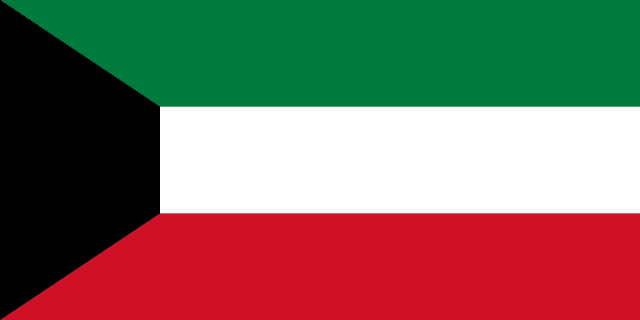

Kuwait
State of Kuwait
Asia
5,077,649
07:03 UTC+3
+965
.kw
Mutla Ridge
306 m · 1,004 ft
Persian Gulf
0 m · 0 ft
614,452
Kuwait City · 2026
3,108,765
Kuwait City · 2026
Location
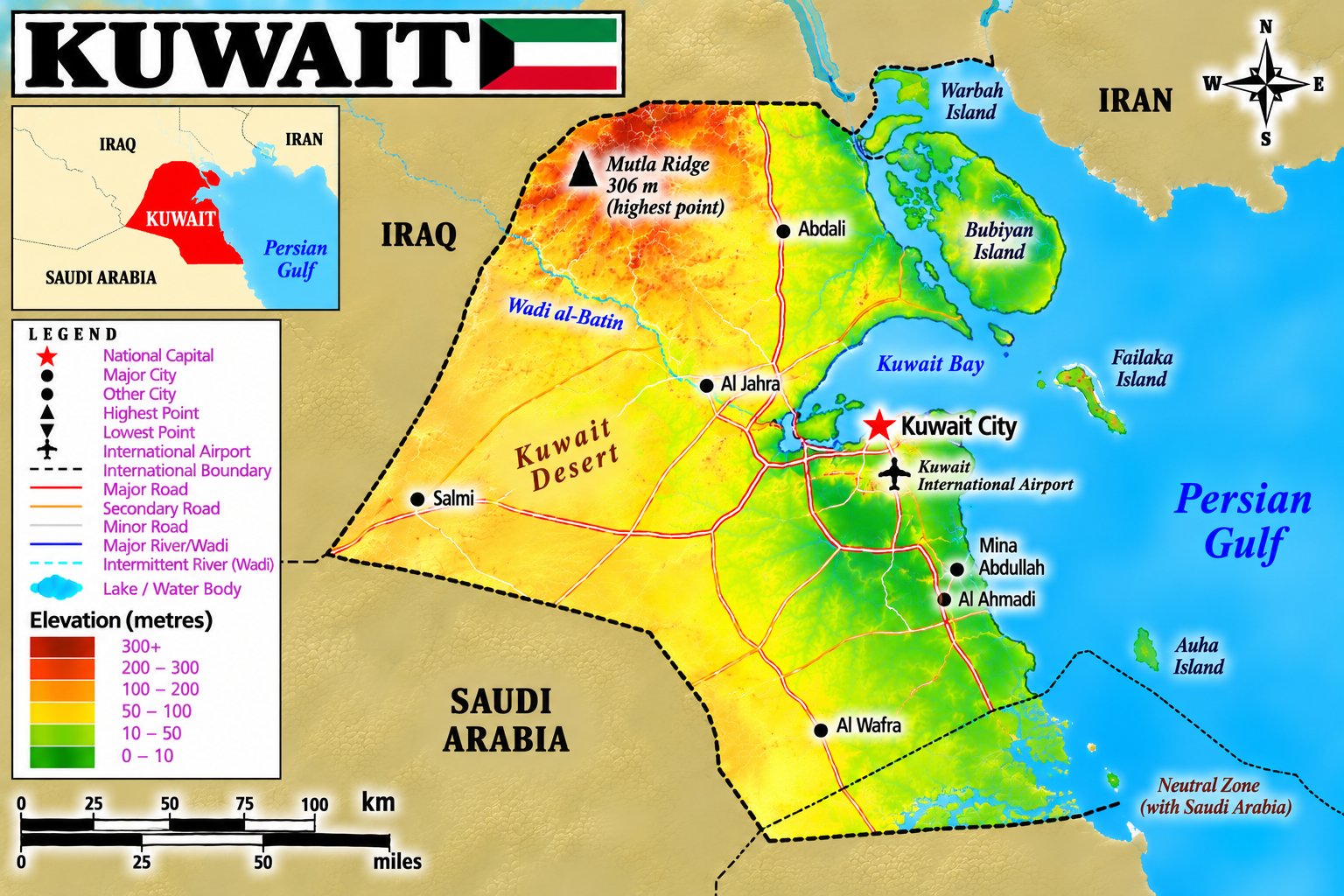
Kuwait — Detailed Physical Map
Kuwait Bay and the Persian Gulf, Bubiyan and Failaka islands, Mutla Ridge, the Kuwait Desert, major cities and the capital Kuwait City
Tourist Attractions
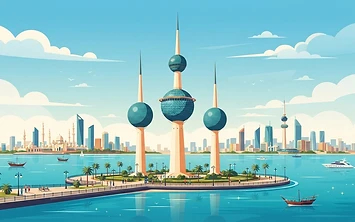
These three iconic towers are the most prominent symbol of Kuwait, featuring a unique spherical design that overlooks the Arabian Gulf. They serve as both a water storage facility and a popular destination for panoramic city views.
The observation sphere offers a stunning rotating view of the city skyline and the sea.
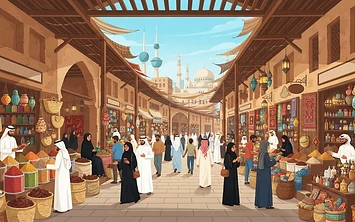
This historic traditional market is the heart of old Kuwait, filled with narrow lanes selling spices, dates, perfumes, and traditional handicrafts. It provides an authentic glimpse into the country's commercial heritage and local lifestyle.
It is the perfect place to experience a traditional atmosphere and enjoy authentic Kuwaiti cuisine.

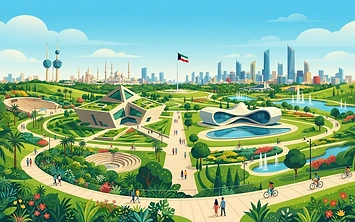
As the largest urban park in the country, this beautifully landscaped space features lush gardens, walking tracks, and modern architectural structures. It also houses the Remembrance Museum and the Habitat Museum, which offer interactive insights into Kuwait's history and environment.
The park's outdoor amphitheater frequently hosts musical shows against a backdrop of the city skyline.

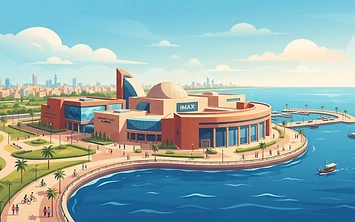
This massive complex is a premier family destination featuring one of the largest aquariums in the Middle East, an IMAX cinema, and the Discovery Place. It is designed to educate visitors about the marine life and natural history of the region.
The aquarium showcases a diverse range of Gulf marine life, including reef sharks and giant groupers.

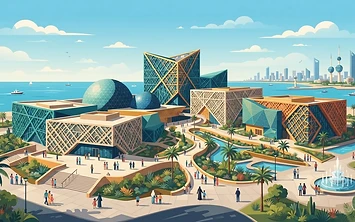
This world-class cultural complex houses 22 galleries across several museums, including those dedicated to space, science, technology, and Islamic history. It is an architectural marvel that provides a comprehensive look at global and regional scientific achievements.
The center features over 1,100 interactive exhibits that cater to all ages.

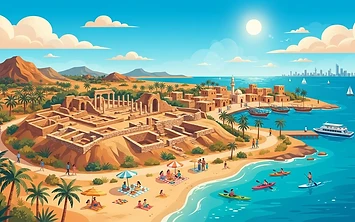
Located 20 kilometers off the coast, this island is rich in history with archaeological sites dating back over 3,000 years. It offers a unique escape where visitors can explore ancient ruins alongside modern recreational activities like kayaking and picnicking.
It is a rare site where visitors can explore over 45 distinct archaeological locations spanning multiple civilizations.
Geography
Nature
Mutla Ridge
306 m / 1,004 ft
0.4% of land
≈ 71 km² of forest
FAO / World Bank, forest area (% of land area)
Explore the Nature AtlasMajor Cities
- 1
Al Jahrā’
561,0062026
MapRetains significant historical importance as the site of the 1920 Battle of Al Jahra near the Red Palace.
- 2Capital
Al ‘Āşimah
70,8262026
MapServes as the political, cultural, and economic capital featuring the iconic Kuwait Towers along the Arabian Gulf coastline.
- 3
Al Aḩmadī
53,6422026
MapOperates as a major residential suburban area within the Al Ahmadi Governorate housing a large portion of the population.
- 4
Al Aḩmadī
33,0302026
MapOriginates as the administrative headquarters for the national oil industry due to its strategic location near major oil fields.
- 5
Al Aḩmadī
18,7272026
MapFunctions as a prominent coastal residential area known for its proximity to large public parks and the seaside.
City populations are the latest official, UN or national-statistics estimates (2024–2026) compounded to 2026 at 1.5% a year (the nation's annual population growth rate); figures without a published update come from the open cities database (2020-era estimates) and are projected the same way.
Economy
Main exports
Kuwait's leading export commodities and products.
Tap any export to learn more. Spot prices in USD only for Live Data subscribers.
Main imports
Kuwait's leading import commodities and products.
Tap any import to learn more.
Military
Historical Timeline
3000 BCE
Early Mesopotamian and Dilmun Civilization Settlement
The island of Failaka and the Kuwaiti mainland were part of the Dilmun civilization, serving as a significant trading hub between Mesopotamia and the Indus Valley.
1613
Founding of Kuwait Town
The Bani Utbah tribes settled in the region, establishing the town of Kuwait and initiating a transition toward a structured maritime trade center.
1756
Establishment of the Al-Sabah Dynasty
Sabah bin Jaber was chosen as the first ruler of Kuwait, beginning a hereditary leadership that continues to govern the state today.
1899
Anglo-Kuwaiti Agreement
Sheikh Mubarak Al-Sabah signed an agreement with the British Empire, granting Britain control over foreign affairs in exchange for military protection.
1938
Discovery of Oil
The Burgan oil field was discovered, marking a pivotal transition from a pearl-diving and maritime trade economy to an oil-based economy.
1961
Independence from Great Britain
Kuwait gained full independence on June 19, 1961, ending the British protectorate status and establishing the modern State of Kuwait.
1962
Adoption of the Constitution
Kuwait adopted its constitution, establishing the Emirate as a constitutional monarchy with a parliament, the National Assembly.
1990
Iraqi Invasion and Gulf War
Iraq invaded and occupied Kuwait in August 1990, triggering an international response that culminated in the Gulf War and the liberation of Kuwait in 1991.
2005
Women's Political Rights Granted
The National Assembly passed a law granting women the right to vote and run for office in national elections.
2020
Accession of Emir Nawaf Al-Ahmad
Following the passing of Emir Sabah Al-Ahmad, Sheikh Nawaf Al-Ahmad Al-Jaber Al-Sabah ascended to the throne as the 16th Emir of Kuwait.
2023
General Elections and Political Reform
Kuwait held major parliamentary elections following a period of political deadlock, signaling a continued effort to stabilize the legislative process.
2024
Accession of Emir Mishal Al-Ahmad
Sheikh Mishal Al-Ahmad Al-Jaber Al-Sabah officially took the oath of office as the 17th Emir of Kuwait following the death of his predecessor, Emir Nawaf.
National Anthem
النشيد الوطني الكويتي
Ahmad Meshari Al-Adwani
Ibrahim Al-Soula
1978
وطني الكويت سلمت للمجد وعلى جبينك طالع السعد وطني الكويت وطني الكويت وطني الكويت سلمت للمجد يا مهد آباء الأولي كتبوا سفر الخلود فنادت الشهب الله أكبر إن الفجر قصصنا فيه وبشرى لنا وطني الكويت سلمت للمجد وعلى جبينك طالع السعد
The current national anthem of Kuwait was officially adopted on February 25, 1978, during the reign of Sheikh Jaber Al-Ahmad Al-Sabah. Prior to its adoption, the country used a royal salute composed by Yousuf Al-Adsani. The anthem was commissioned as part of a national competition to reflect the state's modern identity and progress. It was written by the prominent Kuwaiti poet Ahmad Meshari Al-Adwani, who played a significant role in modern Kuwaiti literature. The music was composed by Ibrahim Al-Soula and orchestrated by Ahmad Ali to create a solemn yet patriotic sound. It replaced the previous royal salute to emphasize national unity rather than focusing solely on the ruling monarchy. The anthem is now played daily on radio and television and is performed at all official government and educational ceremonies.
National Holidays
This holiday marks the beginning of the Gregorian calendar year and is observed as a public holiday in Kuwait.
This date commemorates the day in 1950 when Sheikh Abdullah Al-Salim Al-Sabah ascended to the throne, marking Kuwait's path toward independence.
This holiday marks the anniversary of the liberation of Kuwait from the Iraqi occupation in 1991 during the Gulf War.
This festival marks the end of the holy month of Ramadan, a period of fasting, prayer, and reflection for Muslims worldwide.
Also known as the Festival of Sacrifice, this holiday honors the willingness of Ibrahim to sacrifice his son as an act of obedience to God's command.
Good News Today
Kuwait’s humanitarian mission brings hope to communities
Kuwaiti charities have successfully delivered food aid, medical care, and housing to vulnerable populations in Kyrgyzstan, Benin, and Tanzania. These initiatives aim to provide both immediate relief and long-term sustainable development for those in need.
Fun Facts
World's Largest Oil Reserves
Kuwait holds approximately 8% of the world's total crude oil reserves in the Burgan Field, which is the largest sandstone oil field on Earth.
Ancient Dilmun Civilization Site
The island of Failaka features ruins dating back to the Dilmun civilization, which served as a major trade hub in the Bronze Age.
Iconic Water Tower Architecture
The Kuwait Towers are a set of three distinct mushroom-shaped towers designed by Swedish architect Sune Lindström to symbolize the country's modernization.
National Falconry Traditions
Falconry is a deep-rooted cultural passion in Kuwait, where highly trained birds of prey are considered status symbols and family companions.
Traditional Dhow Boat Building
Kuwait was historically famous for building sturdy Dhow ships, which played a crucial role in the pearl diving industry of the Arabian Gulf.
Home To Al Hamra Tower
The Al Hamra Tower in Kuwait City is the tallest carved sculpture-shaped skyscraper in the world, specifically designed to withstand extreme desert winds.
The Famous Machboos Dish
Machboos is the national dish, a flavorful combination of spiced basmati rice topped with tender lamb, chicken, or fish, often served during large family gatherings.
Unique Weekend Structure
Kuwait transitioned its weekend to Friday and Saturday in 2007 to better align its financial and business sectors with international markets.
Bubiyan Island Biodiversity
Bubiyan, Kuwait's largest island, is largely uninhabited and serves as a vital sanctuary for migratory birds and diverse marine ecosystems.
The Dishdasha Tailoring Heritage
The Dishdasha is the traditional white garment worn by Kuwaiti men, specifically tailored to handle the intense heat while maintaining a formal aesthetic.
Chuckies Trivia Quiz
Chuckies Trivia Quiz
Fifteen questions on Kuwait — five easy, five medium, five hard. How far can you get?
Sports & Live Events
Language
Counting to 10
1
1
= 10 (n = 0)
World Dictionary
Discover and translate any word into all supported languages.